
Hospital Helipad Design in India
An Architect's Working Reference — AAI & DGCA Approval · ICAO Annex 14 Vol II · FATO & TLOF Sizing · Light / Medium / Heavy Helicopter Classification · Rooftop vs Ground-Level · Structural Loading · Approach Paths · Lighting & Marking · Time-Critical Patient Transfer to ED
A hospital helipad is the architectural device that connects a hospital to the air-evacuation network. Where roads are insufficient — distances of more than 50 km, urban traffic, mountain terrain, mass-casualty events, or simple time-critical neuro/cardiac transfers — the helicopter is the only realistic patient-transport modality, and the hospital that has a working helipad is the hospital that can receive these patients. In India, until the mid-2010s, helipads at hospitals were rare; today they are standard at tertiary corporate hospitals (Apollo, Fortis, Manipal, Max), at most AIIMS campuses, at major cancer centres (Tata Memorial, RGCI, HCG), and increasingly at state-government tertiary referral hospitals. The architectural problem is specific — neither a building problem nor a hospital-equipment problem, but an aerodrome problem with hospital-integration requirements — and demands working knowledge of helicopter performance, aviation regulation, and structural engineering that is not part of routine architectural practice.
This guide is a facility-type deep-dive in the Studio Matrx healthcare architecture series. It assumes the reader has read the pillar regulatory reference, the hospital design roadmap, and the disaster-resilient lifeline hospital guide (because helipad is part of the lifeline architecture for mass casualty response). Here we focus on what is specific to helipad — the AAI-DGCA-ICAO regulatory stack, the helicopter classification that drives all sizing, the FATO and TLOF dimensioning, the rooftop vs ground-level decision, the approach paths and obstacle-clearance cones, the day-marking and night-lighting standards, the structural loading specifications, the time-critical patient transfer route, the failure modes that recur across Indian projects, and the pre-design audit framework.
The position this guide takes is specific: a hospital helipad is a serious aerodrome with hospital-integration requirements; it is not an architectural ornament. The architect who treats it as a token rooftop addition produces a pad that AAI will not approve, that pilots will not use, and that the hospital will eventually demolish. The architect who internalises the brief — engaging with AAI from concept stage, sizing for the largest helicopter that may use the pad, ensuring obstacle-free approach cones in two directions, providing 100% backup-power lighting, dimensioning the stretcher lift correctly, and connecting the helipad to ED in under 5 minutes — produces a pad that integrates the hospital into the country's air-evacuation network and saves lives that ground transport cannot.
"In trauma, the hour after injury is the golden hour. Air evacuation buys us minutes that ground transport cannot. The hospital with a working helipad is the hospital that exists during those minutes; the hospital without is the hospital that arrives too late." — Dr. Mahim Mittal (b. 1965), trauma surgeon, paraphrased
"Helipad design is the architectural problem most architects do least well, because the brief borrows from aviation engineering rather than from hospital architecture. The architect who learns the aerodrome side of the problem produces a hospital that is operationally complete; the architect who delegates it produces a hospital that is operationally incomplete." — Ar. Sundeep Kataria (b. 1962), Mumbai healthcare architect, paraphrased
1. Why Helipad is its Own Typology
Six characteristics make helipad distinct from general healthcare architecture:
- It is an aerodrome, not a building. Helipad design is governed by aviation regulation, not building regulation. The reference standards are DGCA CAR Section 4 Series E and ICAO Annex 14 Volume II, not NBC or state CEA.
- It is sized to the helicopter, not the hospital. A 30-bed hospital and a 500-bed hospital have the same helipad if both serve the same helicopter. The hospital scale does not drive the pad dimensions; the helicopter does.
- The approach path matters as much as the pad. The pad is useless if the approach path is obstacle-blocked. Two clear approach paths separated by 90° are mandatory; both must have an 8° obstacle-clearance cone for at least 100 m from the pad.
- Day-night-weather operability differs by hospital tier. A daytime VFR-only helipad is sufficient for a regional hospital. A 24×7 IFR-capable helipad is required for a tertiary referral centre that receives at all hours and in adverse weather. The lighting and marking specifications differ accordingly.
- Patient transfer time is part of the architectural brief. The pad-to-ED time is the most consequential operational metric. Helicopter-borne trauma patients have a 5-minute target from touchdown to resus bed. The architecture either supports or obstructs this.
- The structural loading is dynamic. A helicopter touchdown imposes a dynamic load of approximately 1.5× MTOW for a few seconds. A 7-tonne helicopter generates a transient 10.5-tonne load on the pad. The structure must be designed for this dynamic case, not just the static weight.
The composite effect is that helipad architecture is a hybrid of aviation engineering, structural engineering, and hospital operational planning. No single architectural discipline dominates; the architect coordinates a small team of specialists.
2. The Regulatory Stack
A hospital helipad in India sits in a five-layer regulatory stack.
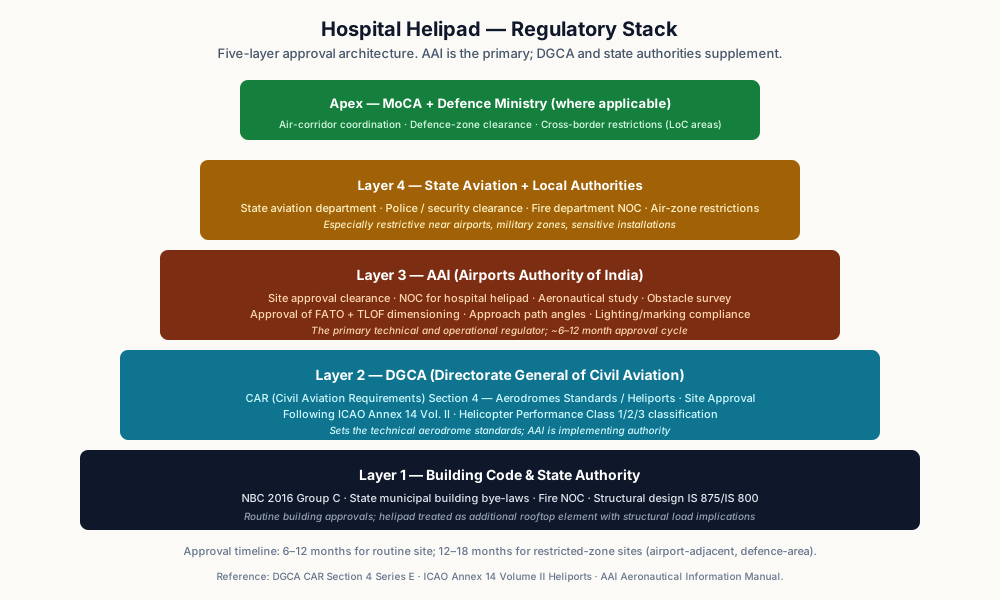
Layer 1 — Building Code & State Authority. NBC 2016 Group C, state municipal building bye-laws, fire NOC, structural design per IS 875 (wind) and IS 800 (steel). Routine building approvals; helipad treated as additional rooftop element with structural load implications.
Layer 2 — DGCA (Directorate General of Civil Aviation). CAR (Civil Aviation Requirements) Section 4 Series E covers heliports. India's DGCA standards are aligned with ICAO Annex 14 Volume II. Helicopter performance classification (Class 1 / 2 / 3) determines minimum FATO sizing.
Layer 3 — AAI (Airports Authority of India). The primary technical and operational regulator for helipads in India. AAI issues site approval, conducts aeronautical study and obstacle survey, approves FATO + TLOF dimensioning, approves approach path angles, and verifies lighting/marking compliance. The AAI approval cycle is typically 6–12 months for routine sites; 12–18 months for restricted-zone sites (airport-adjacent, defence-area).
Layer 4 — State Aviation + Local Authorities. State aviation department, police/security clearance, local fire NOC, air-zone restrictions. Especially restrictive near airports, military zones, and sensitive installations.
Apex — MoCA + Defence Ministry. Air-corridor coordination, defence-zone clearance, cross-border restrictions in LoC areas.
The architect's first deliverable for any helipad project: the aviation compliance map. A document identifying (a) the proposed helipad location with site coordinates, (b) the surrounding airspace classification, (c) the proximity to airports / military zones, (d) the helicopter classes intended to use the pad, (e) the AAI/DGCA approval pathway, and (f) the timeline for clearances. Without this map, the architectural design is premature.
Approval timeline reality. A helipad project approved on day 1 of hospital design will receive AAI clearance around month 8–10; the pad is ready for commissioning around month 18–22 (after construction). A helipad initiated mid-construction faces a 6–9 month delay to obtain clearances. The earliest-possible engagement with AAI is the single most consequential operational decision the architect can make.
3. Helicopter Classification & FATO/TLOF Sizing
All helipad sizing derives from the largest helicopter that may use the pad. Three classes dominate Indian medical-helicopter operation.
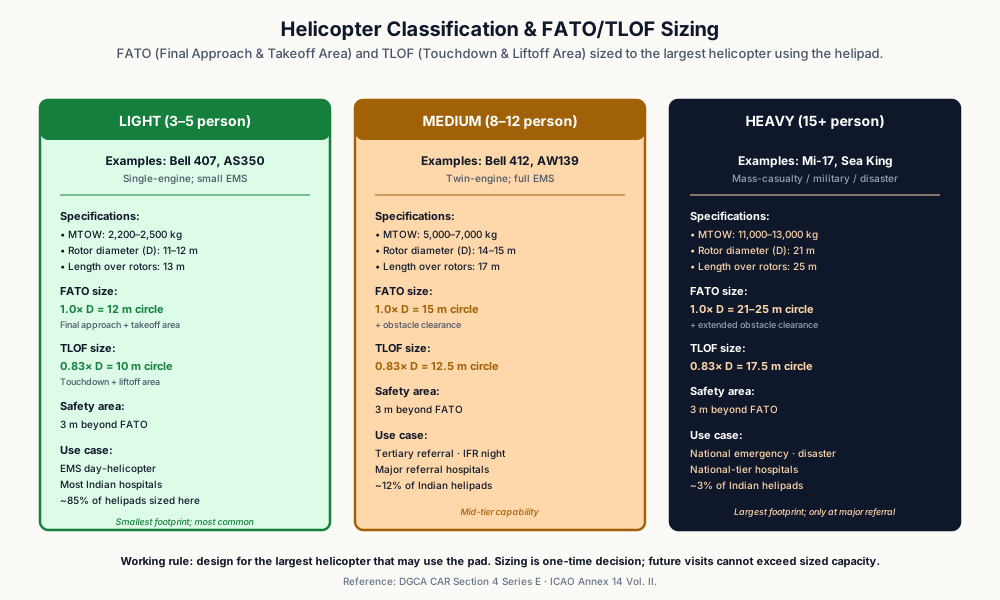
Light helicopters (3–5 person, single-engine). Examples: Bell 407, Eurocopter AS350. MTOW: 2,200–2,500 kg. Rotor diameter (D): 11–12 m. Used for: EMS day-helicopter, most Indian helipads (~85%). FATO size: 1.0× D = 12 m diameter circle. TLOF size: 0.83× D = 10 m. Smallest footprint; most common.
Medium helicopters (8–12 person, twin-engine). Examples: Bell 412, Leonardo AW139. MTOW: 5,000–7,000 kg. Rotor diameter: 14–15 m. Used for: tertiary referral with IFR night capability, major referral hospitals (~12% of Indian helipads). FATO size: 15 m diameter. TLOF size: 12.5 m. Mid-tier; required for serious EMS programmes.
Heavy helicopters (15+ person; military/disaster). Examples: Mi-17, Sea King. MTOW: 11,000–13,000 kg. Rotor diameter: 21 m. Used for: mass-casualty / disaster / national emergency, national-tier hospitals (~3% of Indian helipads). FATO: 21–25 m diameter. TLOF: 17.5 m. Largest footprint; only at major referral.
Working sizing rule: size for the largest helicopter that may use the pad. Helipad sizing is a one-time decision; future visits cannot exceed the sized capacity. A medium-tier hospital should ideally size for medium helicopters (AW139) to retain flexibility for future air-evacuation network growth.
FATO vs TLOF.
- FATO (Final Approach & Takeoff Area): The area over which the helicopter completes its final approach phase or initiates its takeoff phase. Sized 1.0× rotor diameter D minimum. Includes obstacle-free conditions in both approach paths.
- TLOF (Touchdown & Liftoff Area): The load-bearing area where the helicopter actually touches down. Centred within the FATO. Sized 0.83× D minimum. Must be structurally sized for dynamic load.
Safety area: A peripheral 3 m beyond the FATO that must be obstacle-free. Sometimes called the "safety net" or "runoff area". Drainage and surface treatment included.
4. Rooftop vs Ground-Level Decision
The single most consequential architectural decision: rooftop helipad on the hospital building, or ground-level helipad on a separate site near the ED?
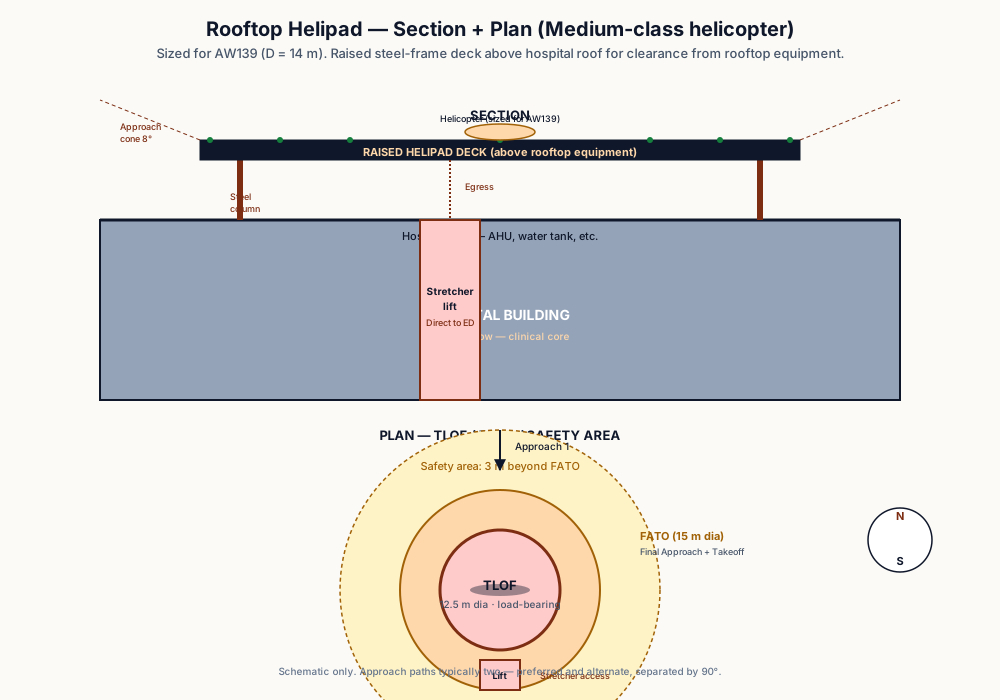
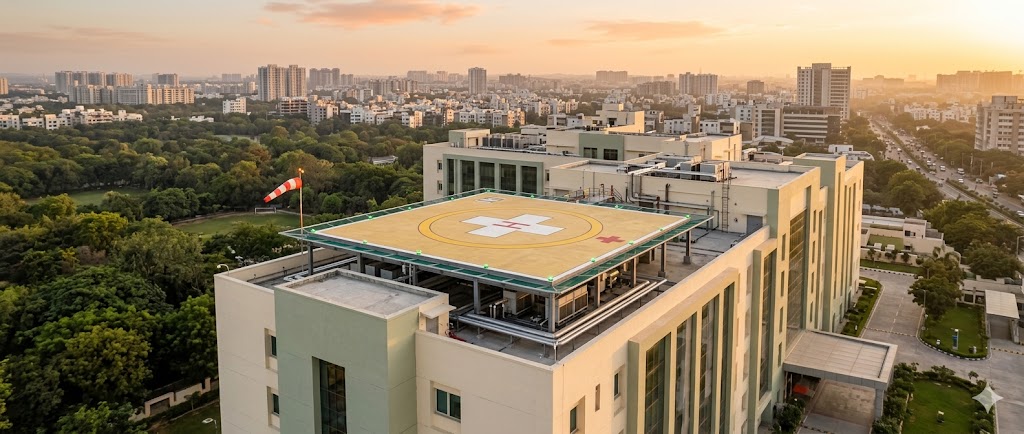
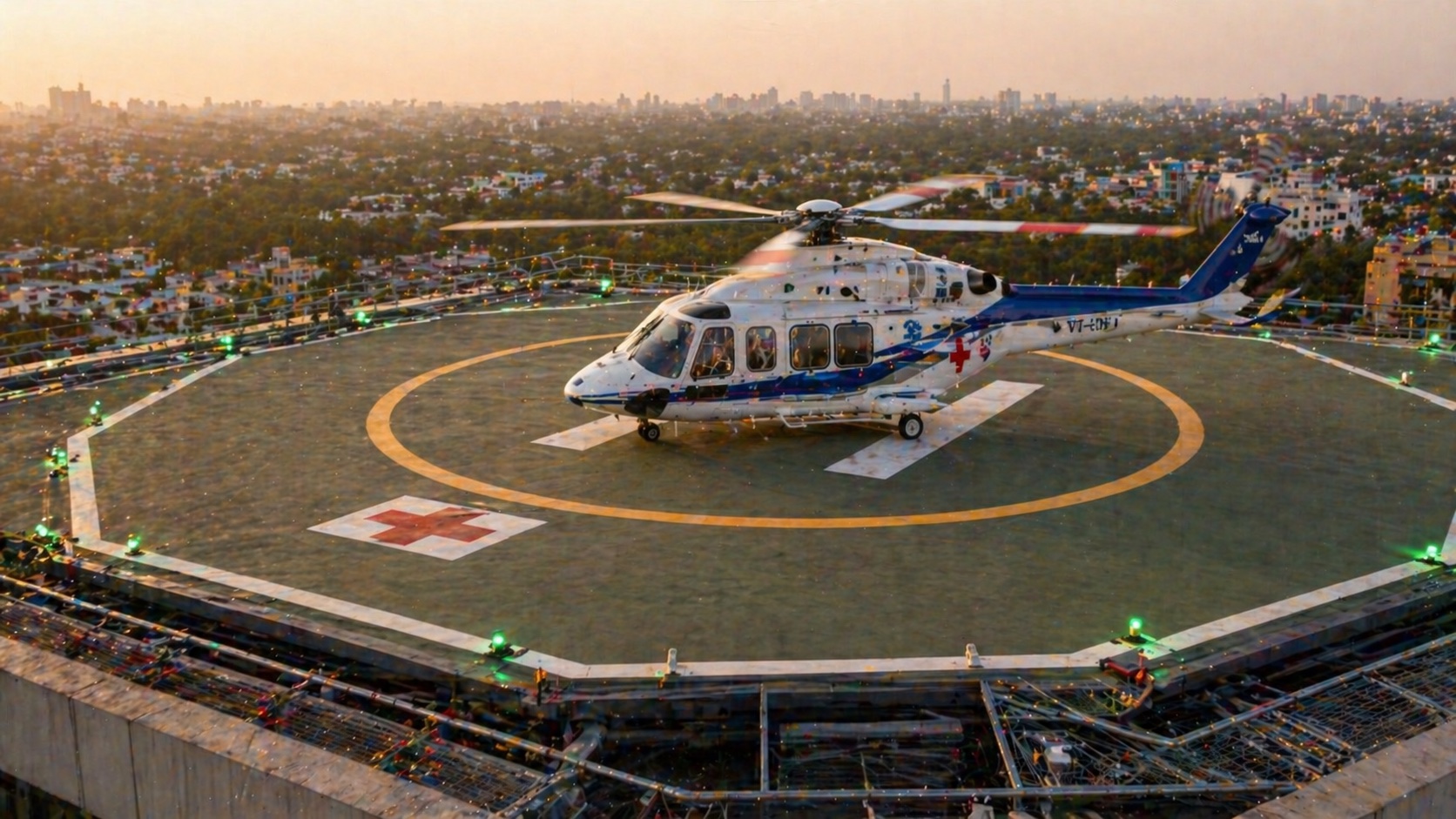
Rooftop helipad. Built on the hospital building's roof, typically on a raised steel frame above rooftop equipment (AHUs, water tanks, plant rooms). Pros: shortest vertical patient transfer (one stretcher-lift ride from helipad to ED); no separate site required; iconic. Cons: significant structural cost; obstacle-clearance challenges in dense urban context; specialist construction.
Use cases for rooftop: dense urban tertiary hospitals (Apollo Chennai, Fortis Mumbai, AIIMS Delhi); space-constrained sites; high-volume EMS programmes that justify the structural premium.

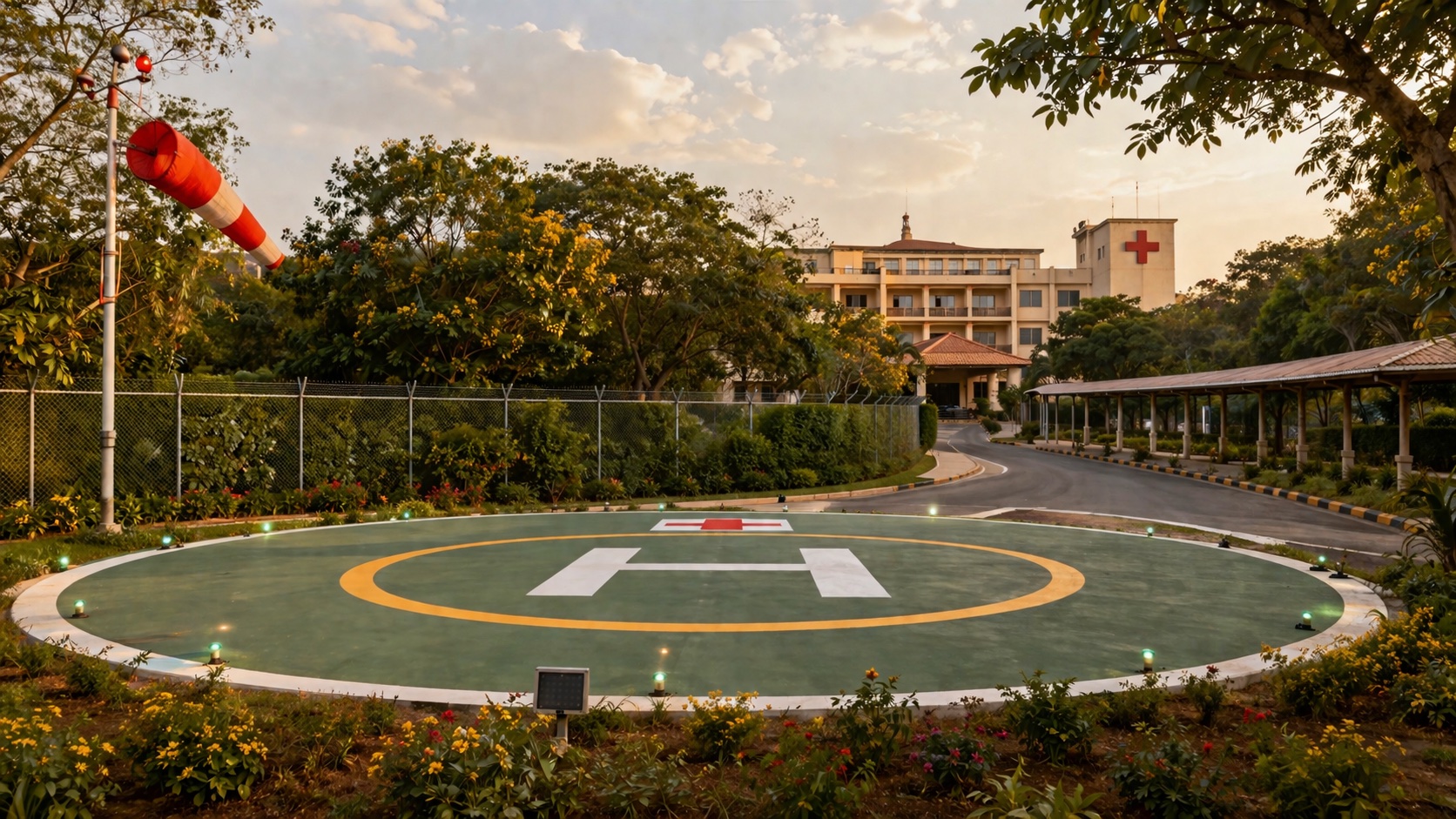
Ground-level helipad. A separate paved surface at ground level, typically 100–200 m from the hospital ED, connected by an ambulance road. Pros: lower cost; simpler structural; faster construction; flexible if hospital expands. Cons: requires significant site area (50 × 50 m minimum for medium-class FATO + safety + obstacle clearance); patient transfer involves a 1–3 minute ambulance ride.
Use cases for ground-level: suburban or rural tertiary hospitals (most state government tertiary, AIIMS satellite campuses); sites with adequate land; medium-volume EMS programmes; cost-constrained projects.
Decision matrix:
| Parameter | Rooftop | Ground-Level |
|---|---|---|
| Construction cost | High (1.5–2.0× ground-level) | Baseline |
| Site requirement | Hospital roof footprint | 50 × 50 m additional plot |
| Patient transfer time | Fastest (single stretcher-lift) | Slightly slower (ambulance ride 1–3 min) |
| Obstacle clearance | Often constrained urban | Easier in suburban/rural |
| Future expansion | Constrained | Flexible |
| Construction lead time | Longer (specialist structural) | Shorter |
Indian deployment 2026: rooftop ~30%, ground-level ~70%. Rooftop dominant in tier-1 cities; ground-level dominant elsewhere.
5. Approach Paths & Obstacle Clearance
The most consequential operational requirement for any helipad. A pad without clear approach paths is an architectural decoration, not a functioning helipad.
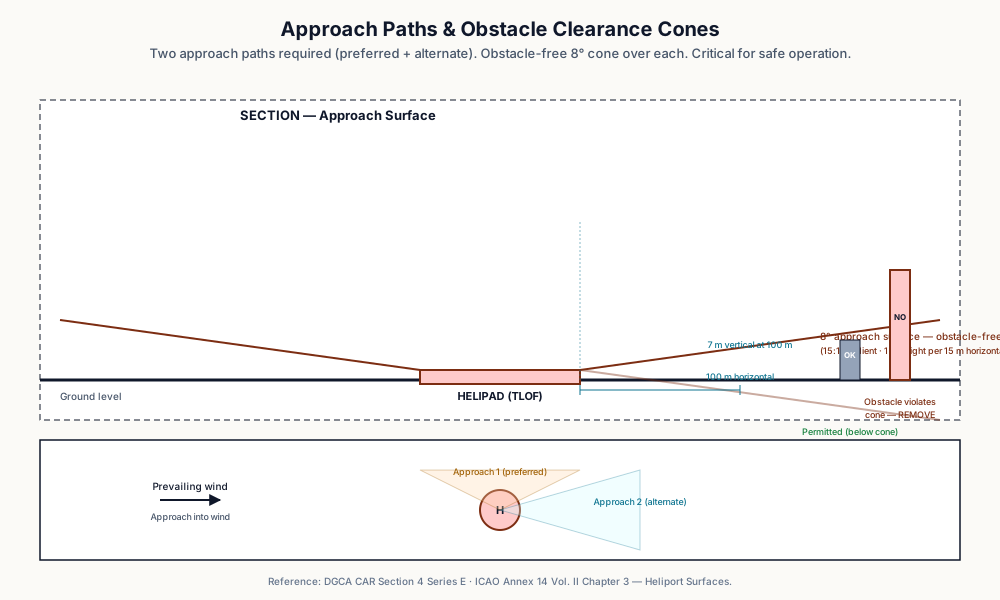
Two approach paths required. A "preferred" approach (typically into the prevailing wind) and an "alternate" (typically 90° offset). Both must be obstacle-free for safe operation in any wind direction.
Obstacle-clearance cone. Each approach path requires an 8° obstacle-clearance surface — for every 15 m of horizontal distance from the pad, the obstacle ceiling rises by 1 m. At 100 m horizontal, the obstacle ceiling is 7 m above the pad. At 500 m, it is 35 m. The cone extends to where the helicopter has cleared all obstacles for routine flight.
Obstacle survey. Before AAI approval, the hospital must commission an aeronautical obstacle survey. Surrounding buildings, mobile-phone towers, electrical pylons, trees, and other tall structures within ~500 m must be measured. Any structure penetrating the 8° cone must either be removed, lowered, or marked with obstruction lighting.
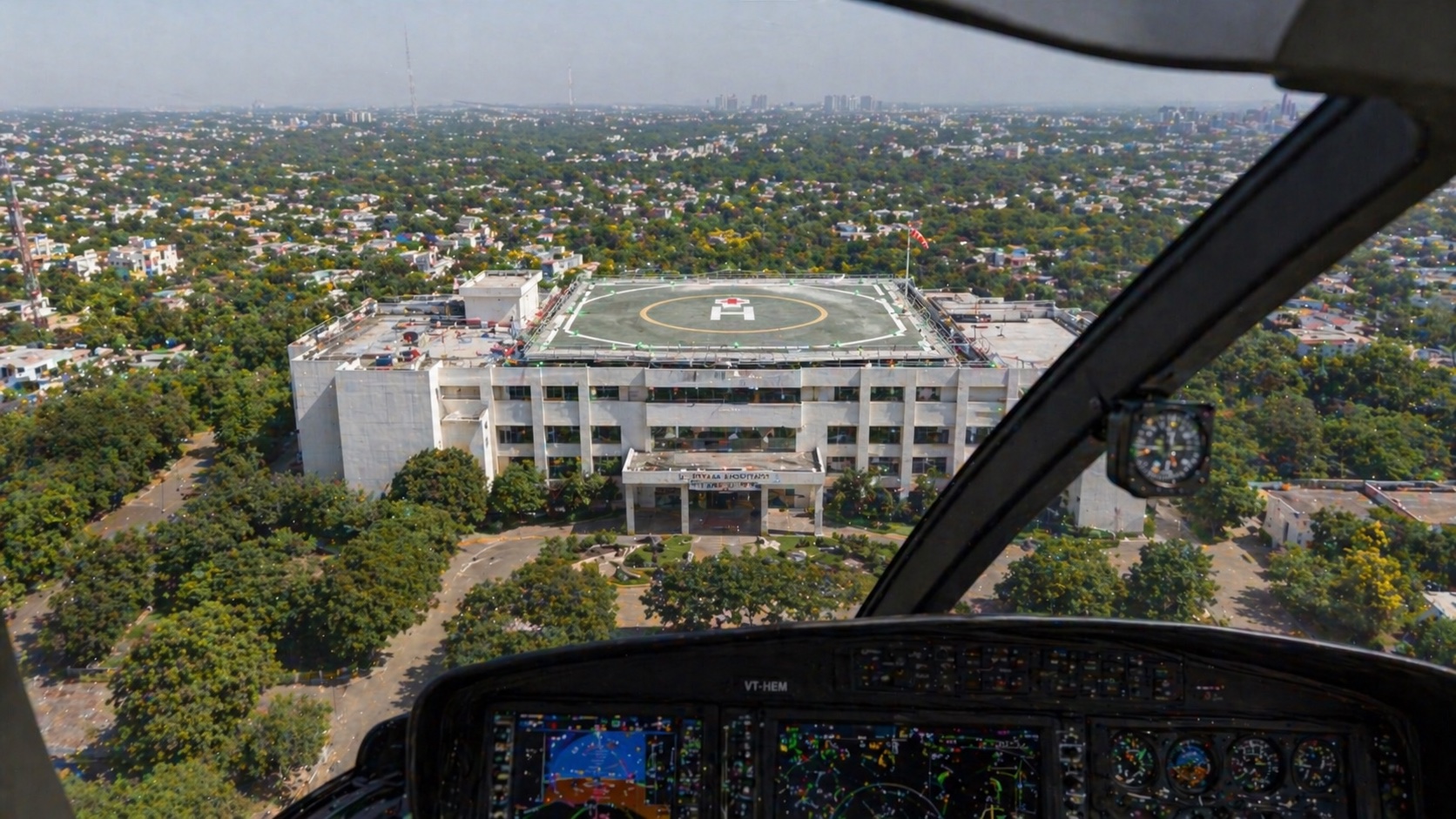
The compromise scenario. In dense urban Indian sites (Mumbai, Delhi, Bengaluru), achieving two fully clear 8° cones is sometimes impossible. The compromise: a single approach path with restricted operations, or a higher rooftop pad to clear surrounding obstacles. This compromise reduces all-weather operability and limits helicopter classes.
Wind-direction considerations. Helicopters typically take off and land into the wind for performance. The preferred approach should align with the prevailing wind direction at the site (typically west-southwest in most Indian regions, but site-specific). The alternate approach offers operability when winds shift.
6. Lighting & Marking
Marking ensures pilot identification by day; lighting ensures identification by night and adverse weather.
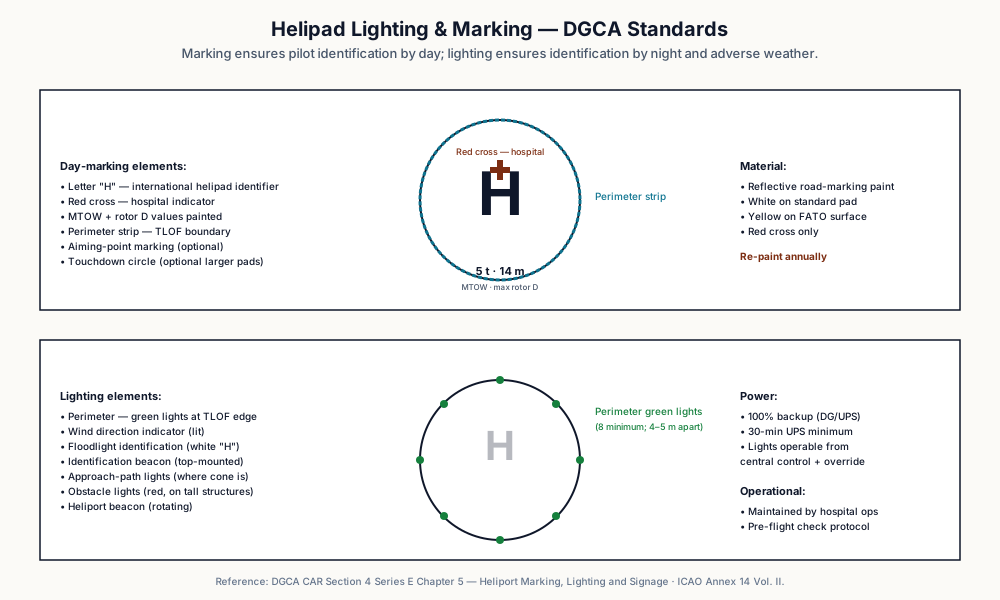
Day-marking elements:
- Letter "H" — international helipad identifier; painted in white on the TLOF surface; size 3–4 m for medium-class pad
- Red cross — hospital indicator (the H is supplemented with a red cross to identify a hospital helipad)
- MTOW + rotor D markings — painted values for pilot reference (e.g., "5 t · 14 m")
- Perimeter strip — TLOF boundary marking
- Aiming-point marking — optional; a target circle for the pilot to aim at
- Touchdown circle — optional on larger pads
Material: Reflective road-marking paint. White on standard pad surface; yellow on FATO if differentiated; red for the cross only. Re-paint annually — Indian sun and monsoon degrade markings.
Night and adverse-weather lighting:
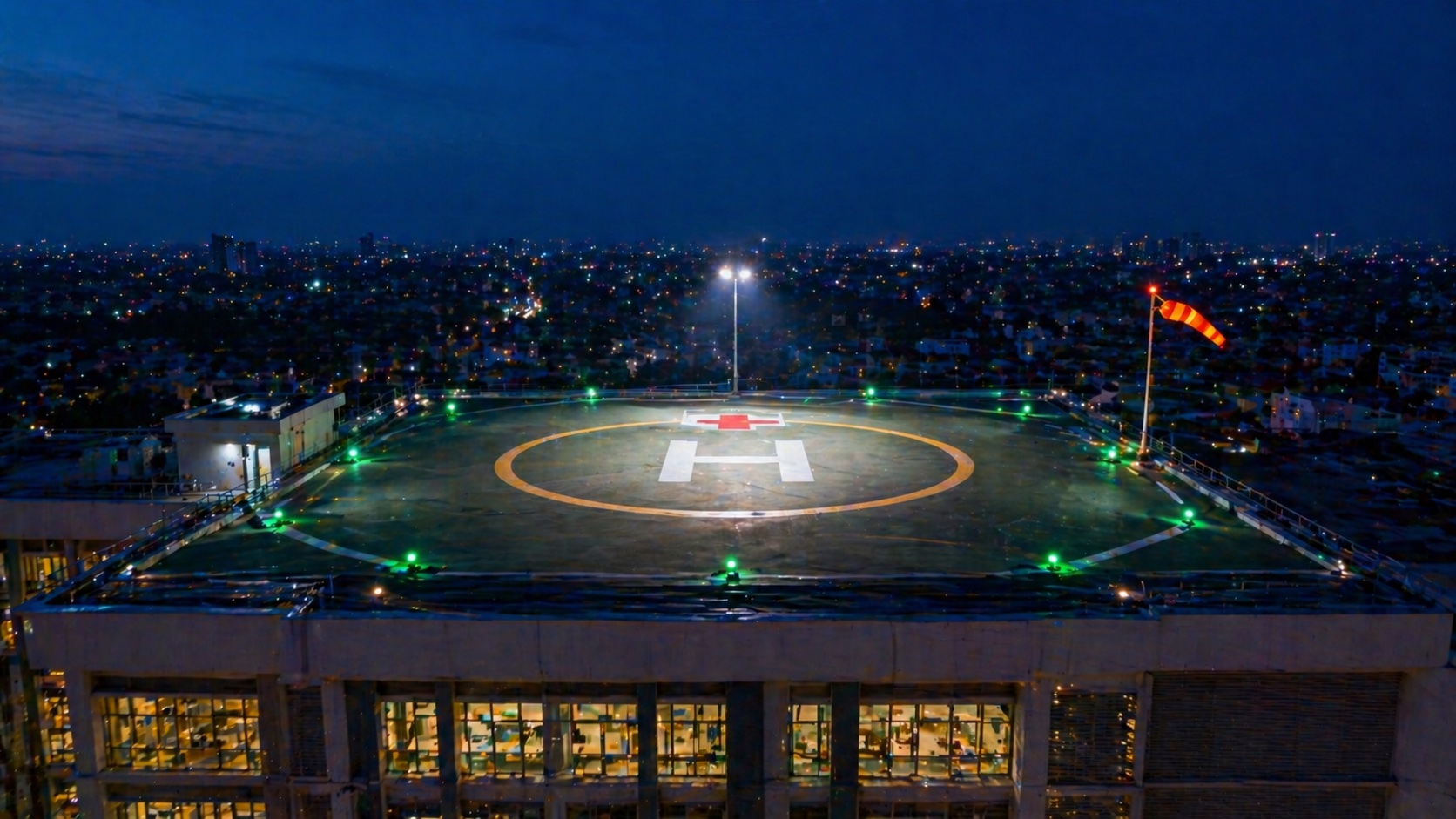
- Perimeter green lights — at TLOF edge; minimum 8 lights, spaced 4–5 m apart
- Wind direction indicator (lit) — illuminated wind sock visible from approach
- Floodlight identification — white floodlight illuminating the "H" letter
- Identification beacon — top-mounted; flashing
- Approach-path lights — where the cone is, for IFR-capable pads
- Obstacle lights (red) — on tall structures within the cone
- Heliport beacon (rotating) — visible from longer distance
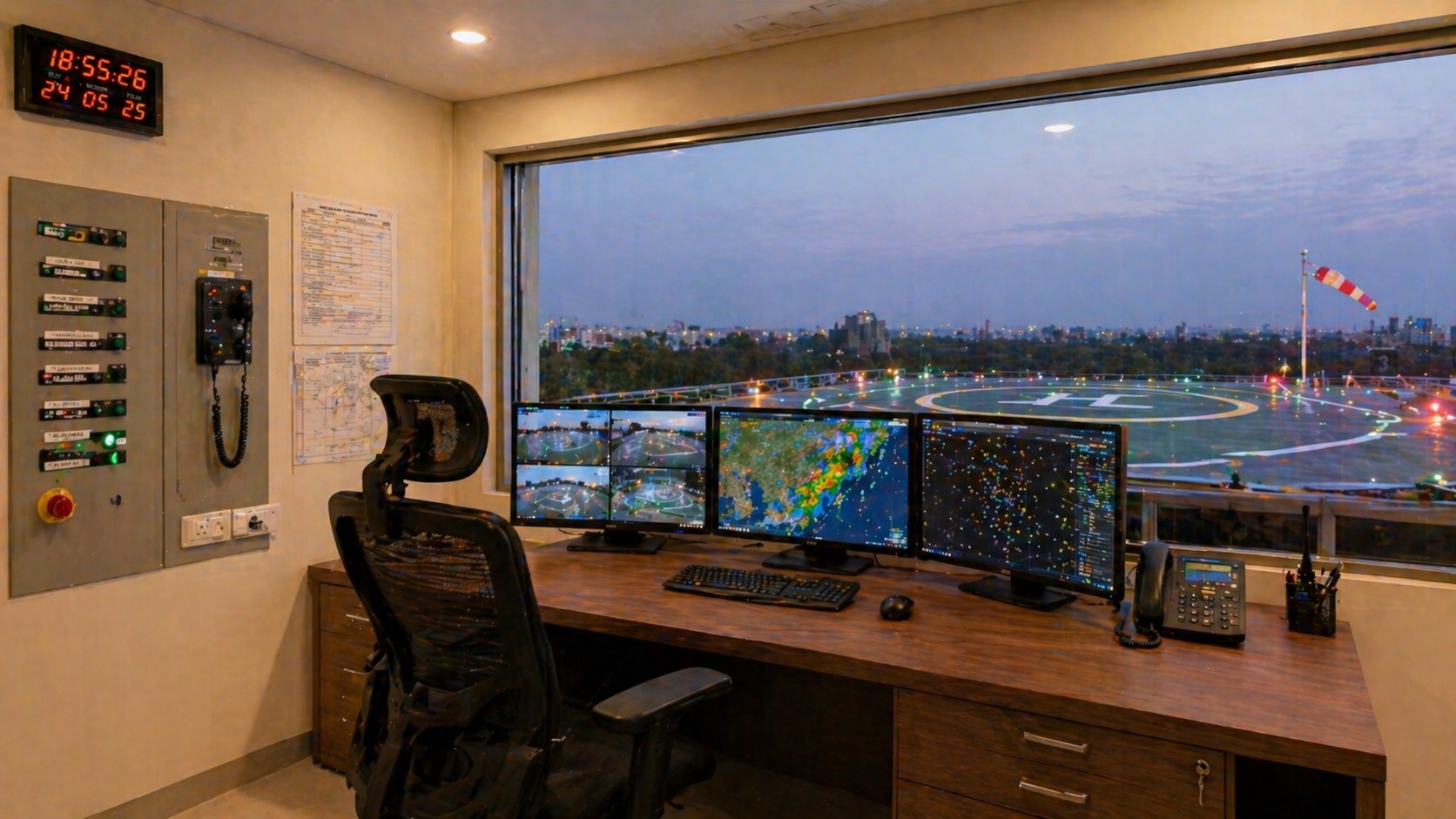
Power: 100% backup (DG/UPS) for all lighting; 30-minute UPS minimum. Lights operable from central control with manual override at the helipad for emergency.
Operational: Maintained by hospital operations; pre-flight check protocol verifies lights before each flight.
Pad classification by lighting:
- Day-only VFR (Visual Flight Rules): marking only; minimal lighting; daytime use; most regional hospitals
- Night VFR: full marking + perimeter green + wind sock + identification beacon; tertiary hospitals
- Night IFR (Instrument Flight Rules): full IFR lighting suite; major tertiary; expensive but enables all-weather operation
7. Structural Design Considerations
A helicopter touchdown imposes a dynamic load of approximately 1.5× MTOW for a few seconds. Structural design must address this dynamic case, not just the static weight.
Working structural specifications:
| Parameter | Specification |
|---|---|
| Static load | 1.0× MTOW of design helicopter (5,000 kg for AW139, etc.) |
| Dynamic load | 1.5× MTOW (transient touchdown impact) |
| Wind load | Per IS 875 Part 3, basic wind speed for region; helipad on rooftop sees full wind exposure |
| Surface treatment | Anti-skid surface; granular epoxy or similar; replaces every 10–12 years |
| Drainage | 1% slope to perimeter; channel drains; fuel-resistant |
| Fire resistance | Steel deck with 2-hour fire rating below; concrete deck inherently rated |
| Edge protection | Net or barrier system at edge; prevents debris from falling |
Structural systems for rooftop helipads:
- Steel frame with concrete deck — most common; lightweight; spans rooftop equipment; 800–1,200 kg/m² dead load
- Prefabricated aluminium deck — lighter; faster construction; specialised supplier (e.g., Bayards, FEC)
- Cast-in-place concrete — heavier; used when structural slab is part of the building roof itself
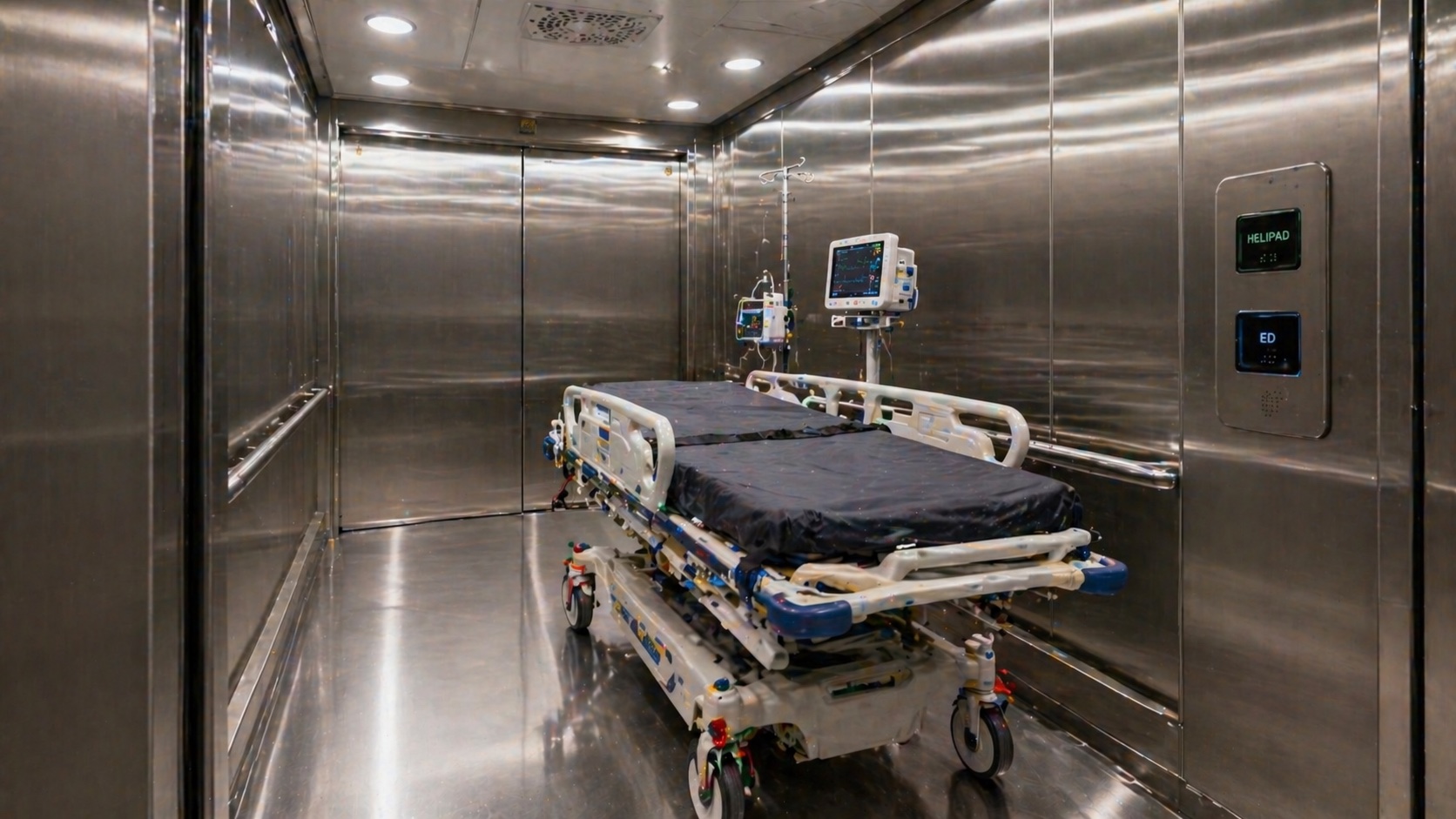
Patient transfer route from rooftop: A dedicated stretcher lift directly from the helipad deck to the ED is the architectural requirement. The lift cabin must accommodate a stretcher (1500 × 2400 mm minimum), accompanying staff (2–3 persons), and emergency equipment. Lift speed 1.5–2 m/s; capacity 1,500 kg; 100% backup power; no intermediate stops (helipad → ED only).
8. Patient Transfer Route — The Time-Critical Architecture
The pad-to-ED transfer time is the most consequential operational metric of any hospital helipad. The architecture either supports or obstructs the goal of helicopter-touchdown to resus-bed in 5 minutes.
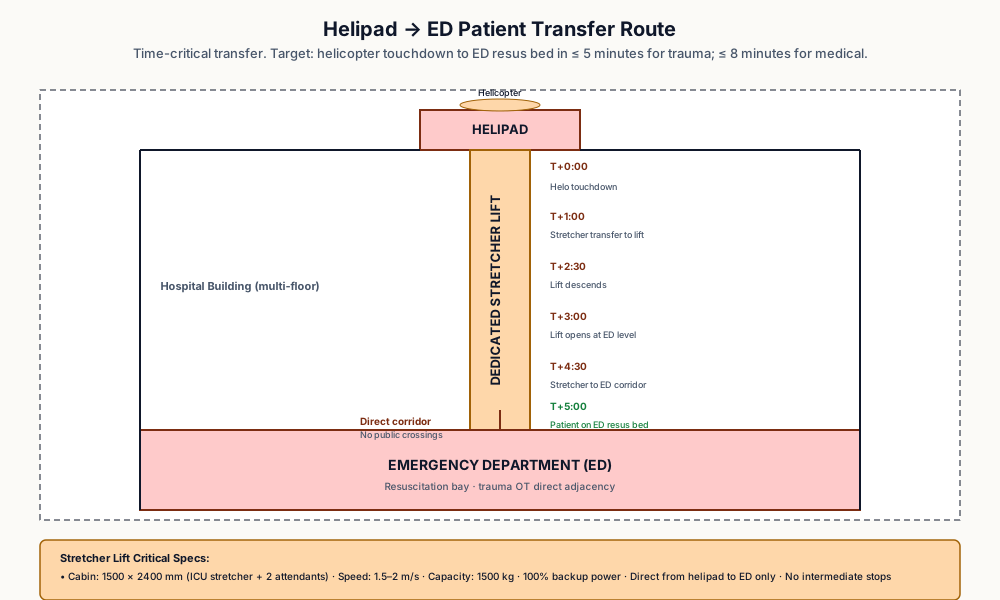
Working time targets:
- Helicopter touchdown — T+0:00
- Stretcher transfer to lift — T+1:00 (stretcher offloaded from helo, wheeled to lift)
- Lift descent — T+2:30 (lift door closes, descends to ED level)
- Lift opens at ED level — T+3:00
- Stretcher to ED corridor — T+4:30 (lift to ED entry)
- Patient on ED resus bed — T+5:00 (stretcher to bed transfer in ED)
Architectural enablers:
- Dedicated stretcher lift — direct helipad to ED only; no intermediate stops; cabin sized for ICU stretcher
- Direct corridor from lift to ED — no public crossings; no other clinical departments en route
- ED resus bay adjacent to lift exit — minimum walk distance; clear sight line
- 100% backup power for lift — must operate during power outage when helicopter is on pad
Failure modes to avoid:
- Lift shared with patient/visitor lifts: causes wait for cabin during emergency
- Lift not directly to ED: detour through other floors adds 1–3 minutes
- Lift cabin too small for ICU stretcher: stretcher won't fit; patient transferred between stretchers
- Lift speed < 1.5 m/s: descent time too long
- No backup power: lift unusable during outage when needed most
9. Common Failure Modes — Helipad Specific
A pattern audit of stalled or non-operational Indian hospital helipads reveals recurring failures:
| # | Failure Mode | Root Cause | Consequence | Prevention |
|---|---|---|---|---|
| 1 | Approach paths obstructed by existing buildings | Site selection error | AAI refuses approval | Aeronautical obstacle survey at concept |
| 2 | FATO undersized for helicopter that visits | Generic small-pad design | Helicopter cannot land safely | Size for largest helicopter at concept |
| 3 | Single approach path only | Constrained site | Restricted operations; not all-weather | Two paths from concept; site selection criterion |
| 4 | No wind-direction analysis | Generic orientation | Approach into crosswind unsafe | Wind data + orientation per AAI |
| 5 | Lighting power not backed up | Generic electrical | Lights fail during emergency landing | 100% backup power |
| 6 | Stretcher lift shared with visitor lift | Cost-driven | Wait for cabin during transfer | Dedicated stretcher lift |
| 7 | Pad-to-ED transfer > 8 minutes | Routing through multiple floors | Patient deteriorates en route | Direct lift to ED |
| 8 | No fire fighting infrastructure on pad | Brief overlooked | Helicopter fire = catastrophe | Foam hydrant + firefighting at pad |
| 9 | Surface anti-skid degraded | Maintenance overlooked | Helicopter slip on landing | Annual surface inspection; renewal at 10–12 yr |
| 10 | Marking faded (rain/sun) | Maintenance overlooked | Pilot identification difficult | Annual repaint |
| 11 | AAI approval not obtained | Sequencing error | Helipad illegal to operate | AAI engagement at concept |
| 12 | Wind sock missing or non-functional | Operational oversight | No real-time wind data for pilot | Lit wind sock; pre-flight check |
| 13 | Boundary fencing inadequate | Cost-driven | Public access hazard | 1.8 m chain-link minimum (ground-level) |
| 14 | Structural dynamic load not designed | Structural under-spec | Pad fails on hard touchdown | 1.5× MTOW dynamic case in structural |
| 15 | Helipad above unoccupied building | Underutilised | Helipad never used post-construction | Match helipad to genuine EMS programme |
| 16 | Heavy helicopter pad on site that gets only light | Over-designed | Construction cost wasted | Right-size to actual helicopter mix |
10. Pre-Design Audit Framework for Helipad Briefs
A 12-question audit at concept stage. Three or more "no" answers indicate the brief is not helipad-ready.
| # | Audit Question | Why It Matters | Required Output |
|---|---|---|---|
| 1 | Is the helicopter class fixed (light / medium / heavy)? | Drives FATO/TLOF sizing | Class declaration |
| 2 | Is the rooftop vs ground-level decision made? | Drives structural cost | Site decision |
| 3 | Has aeronautical obstacle survey been commissioned? | AAI requirement | Survey report |
| 4 | Are two approach paths obstacle-clear at 8°? | Operational requirement | Cone analysis |
| 5 | Is wind data analysed for orientation? | Safety | Wind rose |
| 6 | Is AAI engagement initiated at concept stage? | Approval timeline | AAI letter |
| 7 | Is structural design for 1.5× MTOW dynamic? | Safety | Structural calc |
| 8 | Is the stretcher lift dedicated and 1500 × 2400 mm? | Patient transfer | Lift schedule |
| 9 | Is direct lift-to-ED routing designed? | Time-critical | Floor plan |
| 10 | Is 100% backup power for pad lighting and lift? | Operational | Electrical plan |
| 11 | Is fire-fighting infrastructure on pad designed? | Safety | FFS plan |
| 12 | Is pad-to-ED transfer time ≤ 5 minutes verified? | Operational | Time analysis |
11. The Architect's Helipad-Specific Compliance Deliverables
Beyond general healthcare deliverables (see pillar reference), the helipad-specific deliverables are:
| # | Deliverable | Recipient | Stage |
|---|---|---|---|
| 1 | Aviation compliance map (AAI/DGCA/local) | Client / AAI | Concept |
| 2 | Helicopter class declaration with FATO/TLOF | AAI | Concept |
| 3 | Aeronautical obstacle survey | AAI | Preliminary |
| 4 | Two approach paths with 8° cone analysis | AAI | Preliminary |
| 5 | Wind orientation analysis | AAI | Preliminary |
| 6 | Structural design for dynamic load | Structural | Detailed |
| 7 | Day-marking plan | AAI | Detailed |
| 8 | Night-lighting plan | AAI | Detailed |
| 9 | Stretcher lift specification | Lift consultant | Detailed |
| 10 | Patient transfer route drawing (helipad → ED) | Client | Detailed |
| 11 | Fire-fighting infrastructure on pad | FFS consultant | Detailed |
| 12 | Boundary fencing + security perimeter (ground-level) | Client | Detailed |
| 13 | Operational procedure manual | Client | Pre-handover |
"The helipad is the architectural element that connects a hospital to the air-evacuation network and, through it, to the country's emergency-response system. Get it right, and the hospital saves lives that ground transport cannot. Get it wrong, and the hospital has an expensive ornament on its roof." — Group Captain (Retd.) Ajay Lele (b. 1958), aviation safety consultant, paraphrased
References
- AAI (2017) Aeronautical Information Manual. New Delhi: Airports Authority of India.
- Bureau of Indian Standards (2007) IS 800: General Construction in Steel — Code of Practice. New Delhi: BIS.
- Bureau of Indian Standards (2015) IS 875 (Part 3): Code of Practice for Design Loads (Other than Earthquake) for Buildings and Structures, Part 3 — Wind Loads. New Delhi: BIS.
- Bureau of Indian Standards (2016) National Building Code of India 2016, Part 4 — Fire and Life Safety; Part 8 — Building Services. New Delhi: BIS.
- DGCA (2018) Civil Aviation Requirements (CAR) Section 4 — Aerodrome Standards, Series E — Heliports. New Delhi: Directorate General of Civil Aviation.
- ICAO (2020) Annex 14 to the Convention on International Civil Aviation — Volume II Heliports. 5th edn. Montreal: International Civil Aviation Organization.
- ICAO (2018) Heliport Manual (Doc 9261-AN/903). 4th edn. Montreal: ICAO.
- Kobus, R.L., Skaggs, R.L., Bobrow, M., Thomas, J. and Payette, T.M. (2008) Building Type Basics for Healthcare Facilities — Section on Helistops. 2nd edn. Hoboken: Wiley.
- NABH (2020) Standards for Hospitals, 5th Edition. New Delhi: National Accreditation Board for Hospitals & Healthcare Providers, Quality Council of India.
- NDMA (2016) Hospital Safety Guidelines. New Delhi: National Disaster Management Authority.
Author's Note: The hospital helipad is the architectural element where Indian hospital practice meets aviation engineering most directly, and it is the place where most architectural projects struggle most. The author's intention with this guide is to support the architects who choose to engage with the AAI/DGCA approval process from concept stage, who size for the largest helicopter that may use the pad, who insist on two clear approach paths, who specify the dedicated stretcher lift, and who time the pad-to-ED transfer at under 5 minutes. The country's air-evacuation network is built one hospital helipad at a time. The series will continue with deeper guides on aviation engineering for hospital projects, mass-casualty air-evacuation protocols, and the specifics of remote/rural helipad design for state government hospitals.
Disclaimer: This article is for informational and educational purposes only. It does not constitute legal, regulatory, aviation, structural, or professional architectural advice. Helipad design depends on site, state, surrounding airspace classification, helicopter classes intended to use the pad, and applicable amendments at the time of design — all of which must be confirmed with the relevant statutory authorities (AAI above all; DGCA; state aviation department; local fire and police authorities; defence ministry where applicable), qualified aviation consultants, qualified structural engineers, and qualified design consultants for the specific project. Statute references, FATO and TLOF dimensions, structural load specifications, and infrastructure norms cited are indicative and subject to change. AAI policies, DGCA CAR Section 4 Series E, and ICAO Annex 14 Volume II are periodically revised; practitioners must verify current notifications and the specific helicopter performance requirements before any binding design or construction commitment. Studio Matrx, its authors, and its contributors accept no liability for decisions made on the basis of the information contained in this guide, and recommend independent verification with AAI, DGCA, qualified aviation consultants, qualified structural engineers, and qualified helipad-design consultants before any binding project decision.
Interactive · Hospital helipad design
Rooftop helipad · Light class · FATO 1.5 × D ≈ 16 m
Location
Weight class
Plan schematic (top view)
Aircraft spec
MTOW ≤ 3,175 kg · Rotor Ø ~10.7 m
Most Indian air ambulances (AS350 B3, Bell 407).
Load + slab
Roof slab designed for 2× MTOW + 0.5 kPa snow / wind load.
Approach corridor
180° clear approach + 180° clear departure (overlapping OK). No taller obstacle within 1:8 obstacle limitation surface.
Safety zone
Safety net (1.5 m) around perimeter; signal mast outside FATO; wind-cone visible from cockpit.
Fire-fighting
Foam/water cannon at perimeter, deluge sprinkler (10 LPM/sqm), fuel-spill drainage to separate tank.
Patient access
Dedicated lift to ED / OT — round-trip ≤ 90 seconds. Lift big enough for stretcher + 2 attendants.
Pros · Rooftop helipad
- • ~5 minutes door-to-resus
- • No ground traffic interference
- • Excellent for tertiary trauma
Cons · Rooftop helipad
- • Structural premium (slab + columns)
- • Acoustic + vibration impact on top floors
- • Stricter fire + escape spec
References: DGCA Civil Aviation Rules (AAI), ICAO Annex 14 Vol II, NBC 2016. Hospital helipads require Aviation Ministry + State Civil Aviation clearance + a designated Aerodrome Officer.
Export this guide
Related Guides — Deep-dive reading
Nursing Home Design (10–30 beds) in India: A Compliance Guide
An Architect's Working Reference — State Nursing Homes Acts (Bombay, Delhi, WB), Centre & State CEA Application at Small-Hospital Scale, Scaled-Down Infrastructure, Fire Constraints on Residential Plots, Bungalow-to-Nursing-Home Conversions, and the Compliance Calendar
Healthcare ArchitectureDesigning Hospitals in India (>30 beds): A Statutory Compliance Roadmap
An Architect's Working Reference — NBC Group C-1, Bed-Strength Regulatory Tiers, OT/ICU/CSSD Compliance, Environmental Clearance, SPCB, State CEA, Fire, IPHS for Government Hospitals, and the Hospital-Specific Compliance Calendar
Healthcare ArchitectureHealthcare Architecture in India: The Regulatory Landscape
A Pillar Reference for Architects — Three Regulatory Layers, Approval Matrix by Facility Type, State-by-State Variation, Sequencing, Stakeholder Map, and the Compliance Deliverables Checklist
Healthcare ArchitectureRelated Tools — Try Free
Rainwater Tank Sizer
How big should your rainwater tank be? Computes annual harvest, recommended tank capacity in litres, water-bill savings, and payback — for 10 Indian cities.
RWH CalculatorElectrical Safety & Load Audit
Home electrical audit — 10 categories, 65+ checkpoints across earthing, RCCB, MCB, wiring, switchboards, appliance circuits, DG/inverter backup.
Safety AuditCircadian Light Meter
Patient-centric circadian lighting visualizer for Indian healthcare design — time-of-day × intensity → CCT, melanopic lux (EML / mEDI), melatonin suppression, and an alertness curve. Calibrated against WELL v2 L03 Circadian Lighting Design, CIE S 026:2018, Brainard 2001, and Lucas et al. 2014.
Circadian Tool