
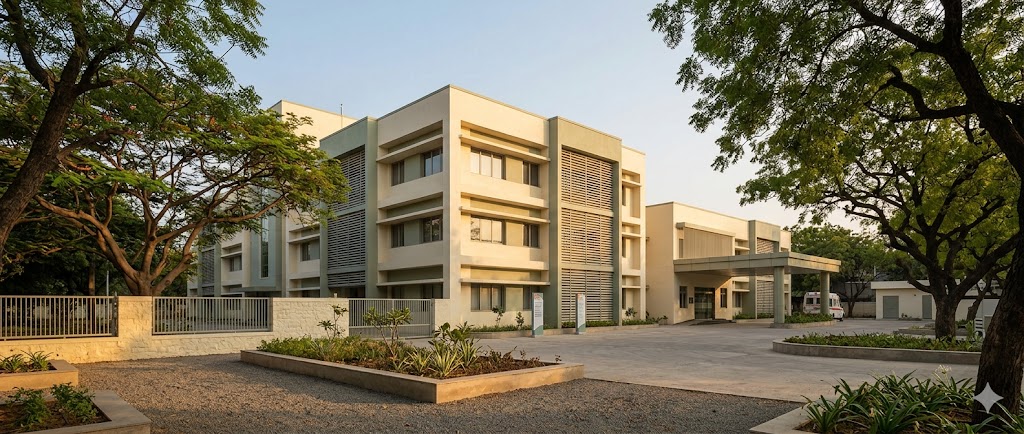
Pandemic Preparedness & Isolation Hospital Design in India
An Architect's Working Reference — AIIR Negative-Pressure Rooms · Cohort Isolation Wards · Surge-Conversion Architecture · Triage & Screening Layers · COVID-19 Lessons · BSL-3 Sample Rooms · Mortuary Surge Capacity · The Pandemic-Ready Hospital Master Plan
Pandemic preparedness is the typology of Indian healthcare architecture that has transformed most decisively in the last six years. The COVID-19 pandemic of 2020–2022 did to Indian hospital architecture what the AIDS epidemic did to American hospital architecture in the 1980s — it revealed which design assumptions were robust, which were inadequate, which were actively dangerous, and which buildings worked and which did not. The architectural learning has now been substantially codified — in the post-pandemic update to NABH 5th Edition, in PM-ABHIM critical-care block specifications, in revised state PWD standardised drawings, in international guidance from WHO and CDC HICPAC — and a new working brief has emerged for hospital projects that did not exist before 2020. Pandemic preparedness is now part of the architectural baseline, not a specialty add-on.
This guide is a facility-type deep-dive in the Studio Matrx healthcare architecture series. It assumes the reader has read the pillar regulatory reference, is familiar with NBC 2016 Group C and the basic typology of Indian healthcare practice, and has reviewed the HVAC for healthcare facilities guide (because pandemic preparedness is largely an HVAC problem expressed architecturally). Here we focus on what is specific to pandemic preparedness — the disease-transmission classification that drives every isolation decision, the three-layer preparedness model from always-on baseline through surge-conversion to dedicated facility, the AIIR room as the pre-eminent pandemic-architectural typology, the surge-conversion ward as the most consequential post-COVID innovation in Indian hospital design, the triage and screening layer at hospital entry, the never-mix flow segregation principle, the PPE donning/doffing architecture, the mortuary surge planning that COVID-19 made visible, the healthcare-worker protection brief that the pandemic made non-negotiable, and the failure modes that recur across Indian projects.
The position this guide takes is specific: pandemic preparedness should now be a baseline architectural commitment for every secondary and tertiary Indian hospital — not a specialty add-on for a few national institutes. The 5–10% baseline single-room provisioning, the surge-conversion HVAC capability, the always-on triage screening capacity, the dedicated isolation entry route, the PPE donning/doffing infrastructure, and the mortuary surge plan are the new minimum. Hospitals that omit these are designed for a world that ended in March 2020, and will face the next epidemic with the same operational chaos that COVID-19 produced. The architects who internalise the pandemic learning produce buildings that the next epidemic will treat well; the architects who do not produce buildings that the next epidemic will overwhelm.
"COVID-19 taught Indian hospital architecture more in three months than it had learned in fifty years. The question now is whether the architects will remember what was learned. The country cannot afford for the lesson to be forgotten." — Dr. Randeep Guleria (b. 1958), former Director, AIIMS Delhi, paraphrased from a 2022 lecture on pandemic preparedness
"The cost of pandemic-ready architecture is small if you build it in. It is enormous if you have to retrofit while patients are arriving. The architect's gift to the country is to build it in." — Dr. Soumya Swaminathan (b. 1959), former WHO Chief Scientist, paraphrased from a 2021 keynote
1. Why Pandemic Preparedness is its Own Typology
A general hospital is designed for endemic disease patterns at expected volume. A pandemic-prepared hospital is additionally designed for disease patterns at unpredictable volume, with new pathogens, with novel transmission characteristics, and with operational protocols that cannot be drilled in advance. The architectural logic is different.
Six characteristics make pandemic preparedness distinct from general hospital design:
- The threat is invisible until it isn't. Pandemic-relevant pathogens are typically airborne or droplet-transmitted. The architecture must protect staff and other patients before clinical diagnosis is established — by the time the first COVID-19 case was clinically recognised at most Indian hospitals in March 2020, secondary spread had already begun in OPD and ED.
- Surge is the operational reality. A pandemic does not present at endemic-baseline volume. It presents in waves of 5×–20× normal volume over 4–12 weeks. Static-capacity hospital design fails this; surge-capable design accommodates it.
- The hospital itself becomes a source of transmission if not designed correctly. Nosocomial transmission of COVID-19, MERS, SARS, and (in some Indian outbreaks) H1N1 influenza has been substantial. The hospital is therefore part of the public-health control problem, not only the treatment problem.
- Healthcare worker protection becomes architecturally consequential. During COVID-19, India lost over 1,800 healthcare workers to the disease. The protection of staff — through PPE, ventilation, accommodation, decontamination — is no longer a secondary brief.
- Operational protocols are the inverse of normal hospital operations. Family-attendant restriction, visitor exclusion, dirty-clean corridor segregation, mortuary protocol modification — pandemic operations contradict every assumption of routine Indian hospital practice. The architecture must support both.
- The protocol changes with each pathogen. Pandemic preparedness cannot be designed for a specific pathogen — only for a set of capabilities (airborne isolation, droplet cohort, contact precaution, surge capacity, triage filter, donning/doffing, separate flows). Each new pathogen reconfigures the protocol; the architecture must accept the reconfiguration.
The composite effect is that pandemic preparedness is a capability layered onto a hospital, not a facility in itself. The architect's task is to design the capability into routine commission, not to wait for a pandemic to retrofit it.
2. The Disease Transmission Classification
Every isolation decision derives from the transmission mode of the pathogen. The architectural response varies materially by mode.
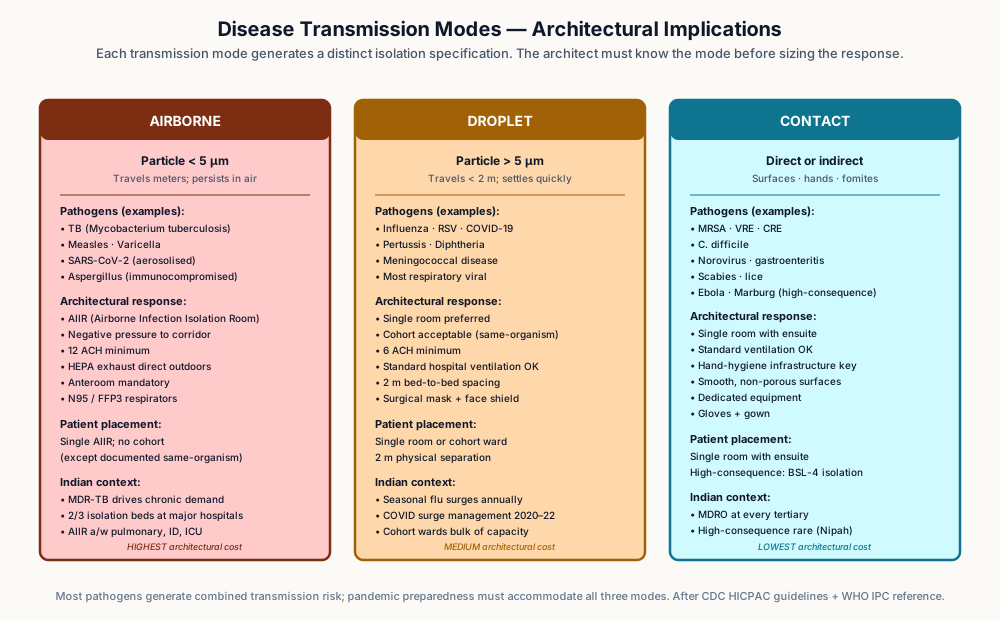
Airborne transmission — particles < 5 μm, capable of suspended-air travel for meters or hours. Pathogens: Mycobacterium tuberculosis (especially MDR-TB and XDR-TB), measles, varicella, SARS-CoV-2 (in aerosol-generating procedures and at high viral load), Aspergillus (for immunocompromised patients). Architectural response: Airborne Infection Isolation Room (AIIR) with negative pressure to corridor, 12 ACH minimum, HEPA exhaust direct to outdoors, anteroom mandatory, N95/FFP3 respirator for staff. Patient placement: single AIIR; no cohort except documented same-organism. Highest architectural cost.
Droplet transmission — particles > 5 μm, settle within 1–2 m of the source. Pathogens: influenza, RSV, COVID-19 (most transmission), pertussis, diphtheria, meningococcal disease, most respiratory viral. Architectural response: single room preferred; cohort acceptable for same-organism; 6 ACH minimum; standard hospital ventilation acceptable; 2-m bed-to-bed spacing; surgical mask plus face shield for staff. Patient placement: single room or cohort ward with 2-m physical separation. Medium architectural cost.
Contact transmission — direct or indirect surface/hand/fomite. Pathogens: MRSA, VRE, CRE, C. difficile, norovirus, scabies, Ebola/Marburg (high-consequence). Architectural response: single room with ensuite preferred; standard ventilation acceptable; hand-hygiene infrastructure key; smooth non-porous surfaces; dedicated equipment per patient; gloves and gown for staff. Patient placement: single room with ensuite; high-consequence pathogens require BSL-4-grade isolation. Lowest architectural cost.
The combined-mode reality. Most pathogens generate multiple-mode risk. SARS-CoV-2 transmits by droplet routinely and by airborne in aerosol-generating procedures (intubation, high-flow oxygen, nebulisation). MDR-TB transmits airborne and by surface contact. Pandemic preparedness must accommodate all three modes simultaneously. The working principle: design to airborne (highest tier), and the lower tiers are automatically covered.
3. The Three-Layer Pandemic Preparedness Model
A pandemic-prepared hospital architecture works at three layers simultaneously: an always-on baseline used in routine practice, a surge-conversion capability activated during outbreaks and seasonal spikes, and a dedicated infectious-disease facility for high-consequence pathogens and reference work.
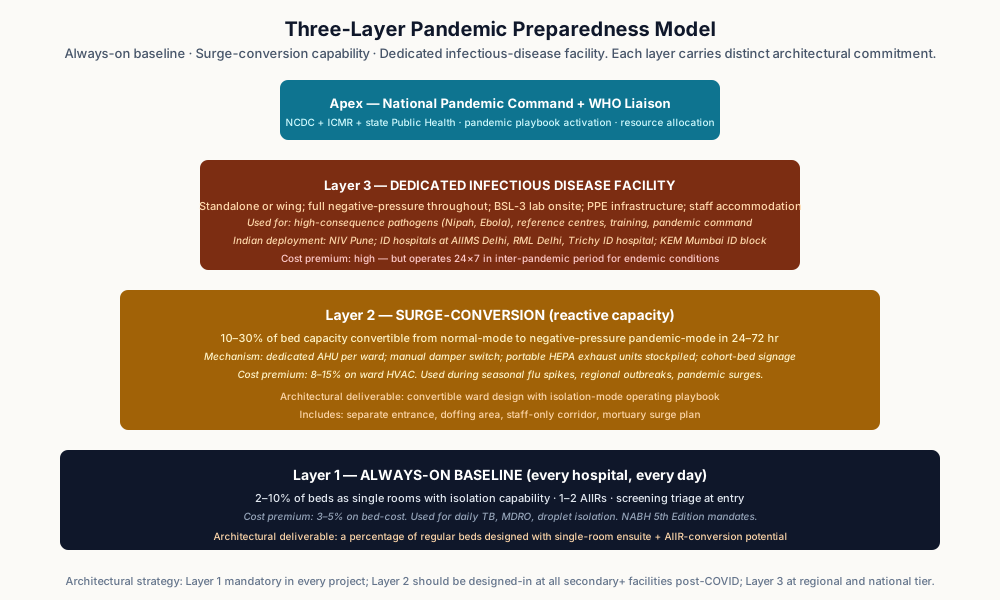
Layer 1 — Always-on baseline. Every secondary and tertiary hospital should have:
- 5–10% of beds as single rooms with ensuite (for routine droplet/contact isolation)
- 1–2 AIIRs at minimum (for routine airborne isolation — TB, measles, varicella)
- Triage screening capability at the OPD entry (for daily symptom screening)
- Dedicated specimen collection room with appropriate ventilation
- Adequate PPE supply with rotation and training
Cost premium: 3–5% on bed-cost. Justified by routine TB, MDRO, droplet isolation. Mandated by NABH 5th Edition for accredited facilities.
Layer 2 — Surge-conversion. 10–30% of bed capacity should be convertible from normal-mode to negative-pressure pandemic-mode in 24–72 hours. Mechanism: dedicated AHU per ward with a manual damper switch; portable HEPA exhaust units stockpiled for deployment; cohort-bed signage and access-control playbooks; separate entrance, donning/doffing area, staff-only corridor designed-in; mortuary surge plan documented.
Cost premium: 8–15% on ward HVAC. Used during seasonal flu spikes, regional outbreaks, pandemic surges. The most consequential post-COVID architectural addition for Indian hospitals.
Layer 3 — Dedicated infectious-disease facility. Standalone facility or dedicated wing with full negative-pressure throughout, BSL-3 lab onsite, full PPE infrastructure, integrated staff accommodation. Indian deployment: NIV Pune (national reference), AIIMS Delhi ID hospital, RML Delhi ID block, KEM Mumbai ID block, several state ID hospitals (Trichy, Beliaghata Kolkata, Naidu Hyderabad, Mahatma Gandhi ID Hospital Pune).
Used for: high-consequence pathogens (Nipah outbreaks 2018 / 2021 / 2023, Ebola response capability, future Disease X), reference centres, training, pandemic command. Cost premium: high, but operates 24×7 in inter-pandemic period for endemic conditions (TB, HIV/AIDS-related opportunistic infections, influenza, pertussis outbreaks).
Apex — National pandemic command. NCDC + ICMR + state Public Health systems coordinate the pandemic playbook activation. Architectural deliverable: command-and-control space (typically at the District Hospital and State Health Headquarters levels) with epidemiological-surveillance workstations, video-conference capability for inter-state coordination, and resource-allocation interface.
The architect's strategic choice. Layer 1 is mandatory in every hospital project from 2026 onward. Layer 2 should be designed-in at every secondary+ facility post-COVID. Layer 3 is a tertiary or national-tier commission. A hospital that only has Layer 1 will be overwhelmed at the first surge; a hospital with Layers 1 + 2 will weather most pandemics; a hospital with all three is part of the country's strategic infrastructure.
4. The AIIR — Airborne Infection Isolation Room
The AIIR is the pre-eminent pandemic-architectural typology. A well-designed AIIR contains an airborne pathogen; a poorly-designed AIIR exports it to the corridor.
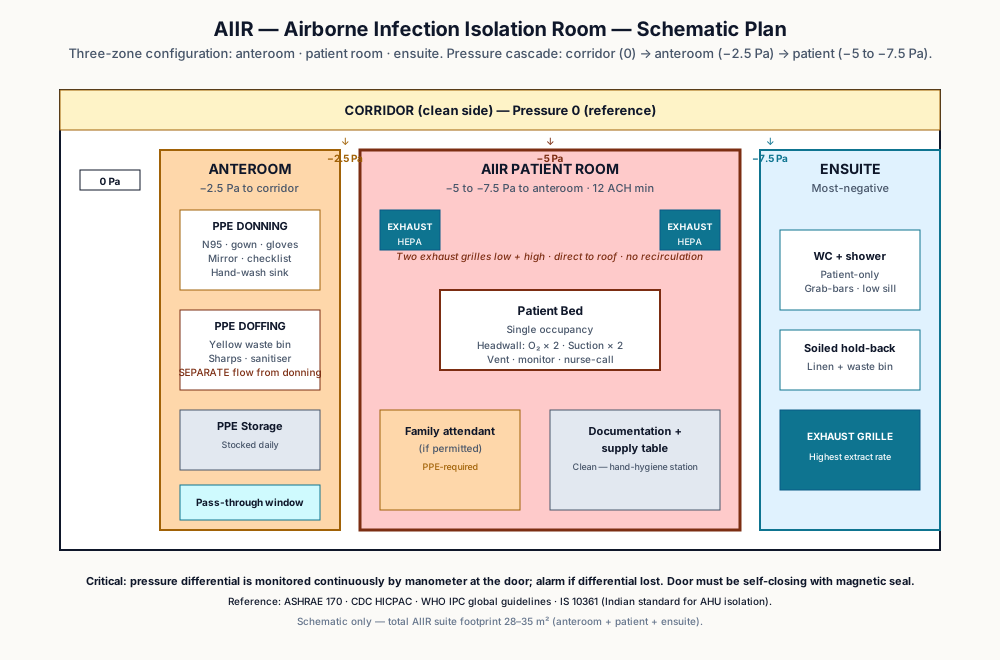
Three-zone configuration:
- Anteroom (4–6 m²) — pressure −2.5 Pa to corridor; donning + doffing + storage; pass-through window for clean supplies
- Patient room (16–20 m²) — pressure −5 to −7.5 Pa to anteroom; bed + family attendant zone (if permitted) + documentation; HEPA exhaust direct to outdoors
- Ensuite (4–5 m²) — most-negative pressure; dedicated patient WC + shower; soiled linen and waste hold-back
Total AIIR suite footprint: 28–35 m².
Critical specifications:
| Parameter | Specification |
|---|---|
| Pressure cascade | Corridor (0 Pa reference) → anteroom (−2.5 Pa) → patient room (−5 to −7.5 Pa) → ensuite (most negative) |
| Air change rate | 12 ACH minimum (some protocols specify 15 ACH for high-acuity) |
| Air supply | 100% outdoor air; no recirculation |
| Air exhaust | HEPA-filtered direct to roof; minimum 25 ft from any air intake; minimum 8 ft above roof |
| Pressure monitoring | Continuous manometer at door; visible to staff; audible alarm if differential lost |
| Door | Self-closing; magnetic seal; observation pane (privacy-blind on patient side) |
| Anteroom interlock | Doors should not both be open simultaneously; signage and discipline (full physical interlock optional) |
| Patient observation | CCTV recommended; reduces door-opening events |
| Headwall services | Two oxygen outlets; two suction; air; nurse-call; vital-signs monitor data port; ventilator power |
| Communication | Intercom anteroom-to-patient; pass-through window for non-contact supply transfer |
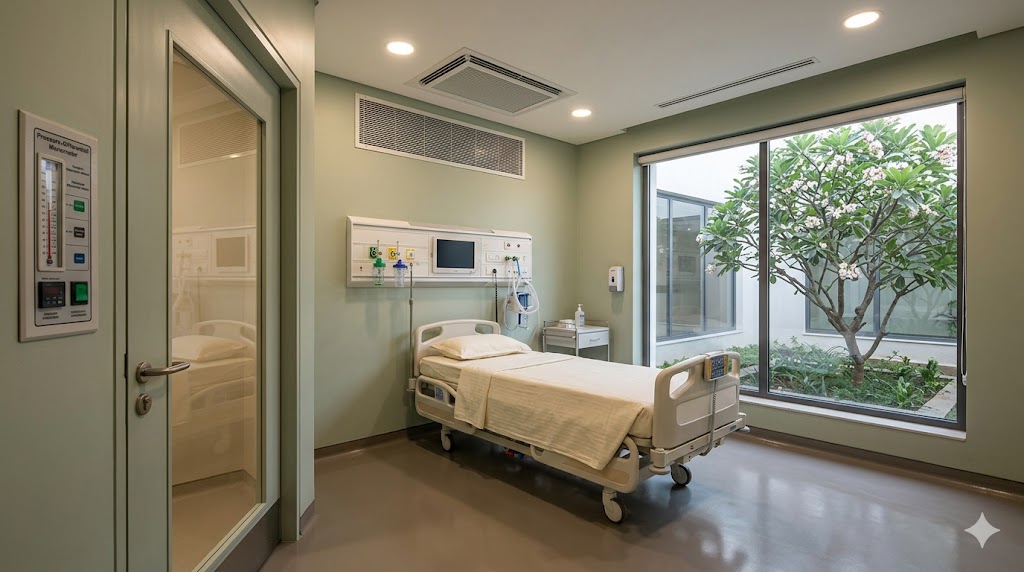
The pressure differential is the architecture. An AIIR is only an AIIR while the pressure differential is maintained. Loss of differential — through a stuck damper, an open door, a failed AHU, a power outage — converts the AIIR into a contaminated room with the door open to the corridor. Continuous monitoring and alarm are therefore part of the architecture, not an operational extra.
Number of AIIRs — sizing guide for Indian hospitals:
| Hospital Tier | Routine AIIR Count |
|---|---|
| PHC / CHC | 0 (refer up) |
| Sub-District Hospital | 1–2 |
| District Hospital (200-bed) | 3–5 |
| District Hospital (500-bed) | 6–10 |
| Tertiary / Medical College | 10–20 |
| National Institute (AIIMS, NIV) | 20+ |
Surge multiplier: during pandemic, the AIIR demand can rise 5–10× baseline. The Layer 2 surge-conversion capability is intended to meet this multiplier without requiring permanent AIIR construction.
5. Surge-Conversion Ward — Normal Mode to Pandemic Mode
The surge-conversion ward is the single most consequential post-COVID architectural innovation in Indian hospital design. The principle: design wards that can flip from routine general-ward operation to pandemic-mode cohort isolation in 24–72 hours, without permanent commitment of the AIIR cost premium.
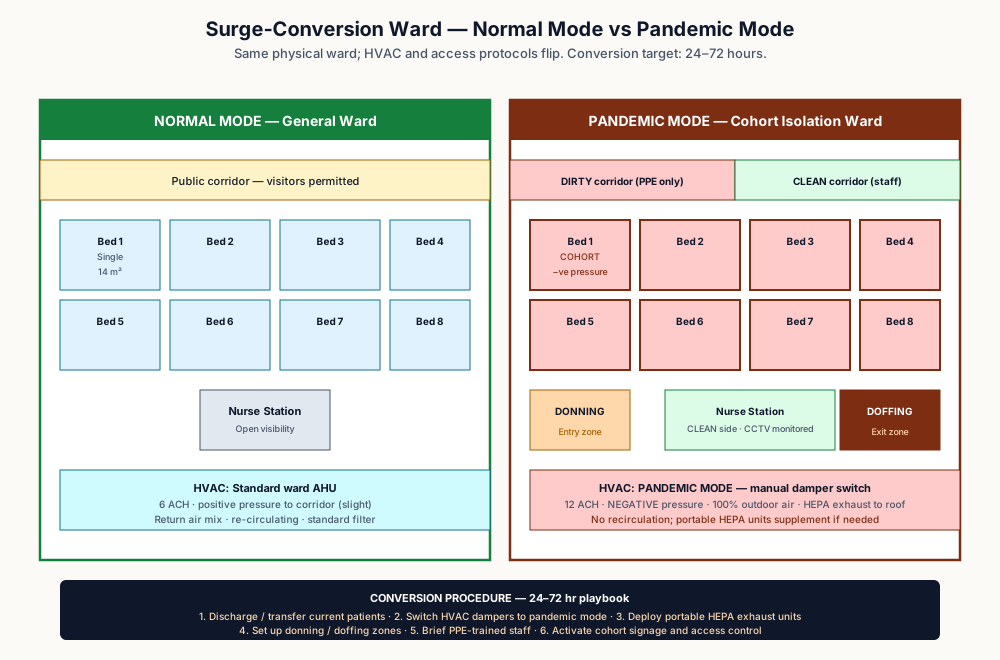
Normal mode (general ward): standard hospital operation — public corridor, visitor permitted, standard AHU at 6 ACH with positive pressure (slight) to corridor, return-air recirculation with standard filter, single rooms with ensuite or 2-bed cohort.
Pandemic mode (cohort isolation ward): the same physical ward, with HVAC and access protocols flipped — corridor split into "dirty" (PPE-required) and "clean" (staff side); donning area at entry, doffing at exit; nurse station moved to clean side with CCTV monitoring; HVAC switched to negative pressure with 12 ACH and 100% outdoor air; HEPA exhaust deployed; cohort-bed signage; access control activated.
Conversion procedure (24–72 hour playbook):
1. Discharge or transfer current patients (24 hours)
2. Switch HVAC dampers from normal-mode to pandemic-mode (manually, by maintenance team — 4 hours)
3. Deploy portable HEPA exhaust units stockpiled for surge (4 hours)
4. Set up donning and doffing zones with PPE supply, mirror, checklist (8 hours)
5. Brief PPE-trained staff on protocol (4 hours)
6. Activate cohort-bed signage and access control (4 hours)
Total: 48 hours typical; 24 hours under pressure.
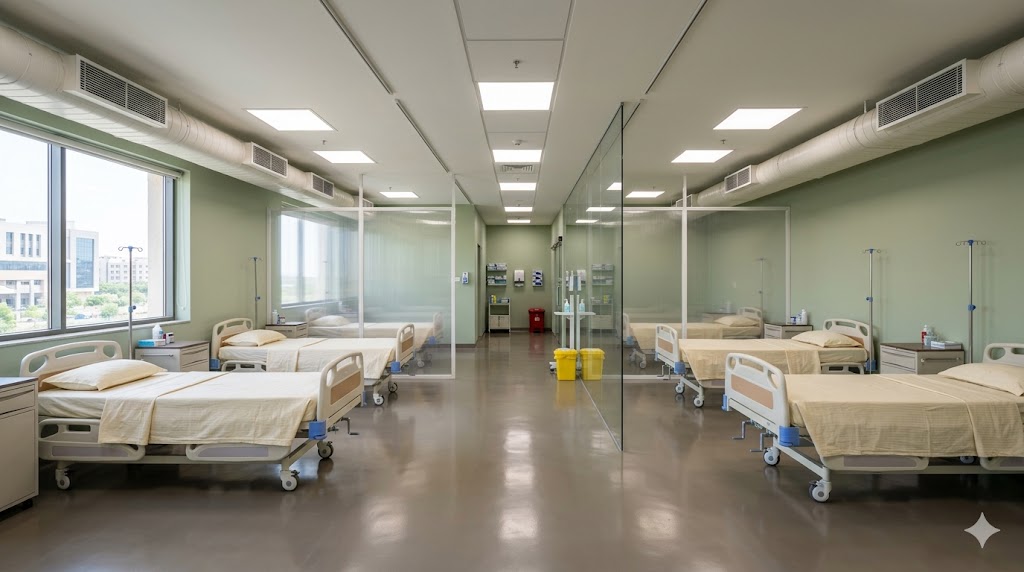
The HVAC architecture. The single most important design move is the dedicated AHU per surge-convertible ward, with a manual damper switch from normal-mode (recirculating, standard filter) to pandemic-mode (100% outdoor air, no recirculation, HEPA-filter exhaust). The damper switch is operated by the maintenance team, not the clinical team, but the switch design and access location is the architect's deliverable.
The portable HEPA exhaust unit. A 1,000–1,500 CFM portable HEPA filter unit (HEPA-14 or H13 grade) can be deployed in a normal-mode ward to add temporary negative-pressure capability. Stockpiling 2–4 portable units per surge-capable ward is the recommended addition. The architectural contribution: pre-design the duct stub-out and electrical outlet for portable unit connection.
Indian deployment. During COVID-19, several Indian hospitals (AIIMS Delhi, KEM Mumbai, Apollo Chennai, Manipal Bengaluru) successfully converted general wards to COVID isolation wards using ad-hoc versions of this approach. The architectural learning has been codified and is now a routine specification at PM-ABHIM critical-care blocks.
6. The Triage and Screening Layer at Hospital Entry
In pandemic mode, no symptomatic patient should enter the main hospital corridor. The triage and screening layer at the hospital entry is the architectural device that prevents this.
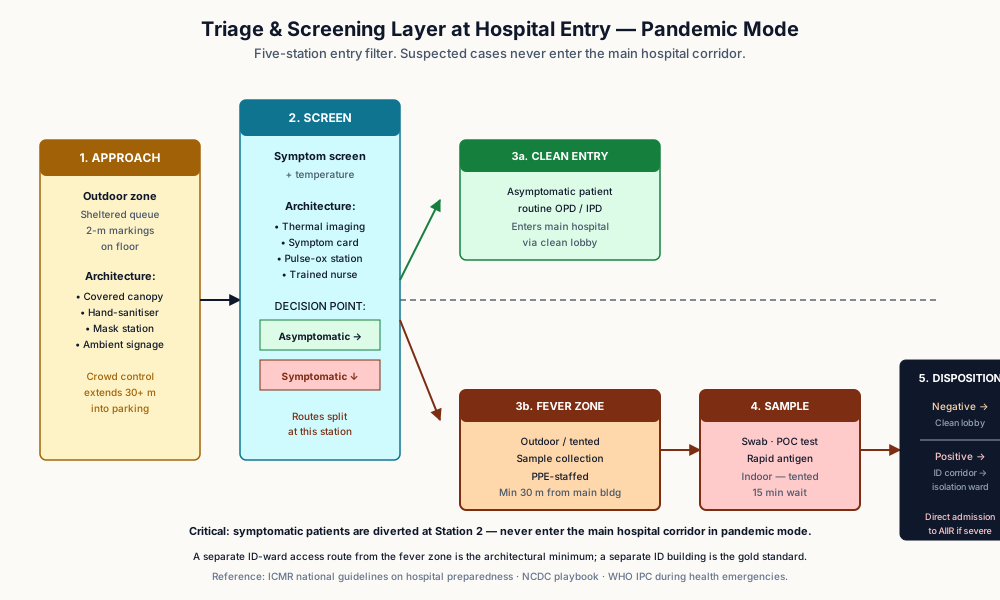
Five-station entry filter:
| Station | Function | Architecture |
|---|---|---|
| 1. Approach | Outdoor queue; 2-m markings | Sheltered canopy; mask station; hand-sanitiser; ambient signage |
| 2. Screen | Symptom screen + temperature | Thermal imaging; pulse-oximeter; trained nurse |
| 3a. Clean entry | Asymptomatic → routine OPD/IPD | Main hospital lobby |
| 3b. Fever zone | Symptomatic → outdoor / tented | 30+ m from main building; PPE-staffed |
| 4. Sample | Swab + POC test | Tented; rapid antigen; 15-min wait |
| 5. Disposition | Negative → clean lobby; positive → ID corridor → isolation | Decision point with separate routes |
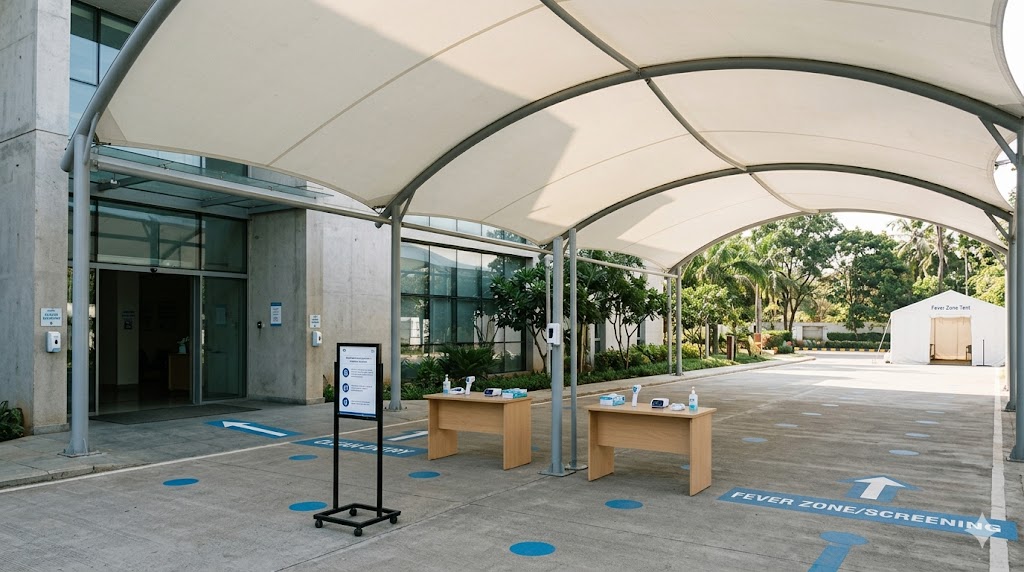
The architectural minimum: a separate ID-ward access route from the fever zone, so suspected positives never traverse the main hospital corridor. The architectural gold standard: a physically separate ID building or wing, with its own entry, lab interface, mortuary route, and staff accommodation.
Indian deployment lessons. During COVID-19, hospitals that had the architectural separation in place (typically the older ID hospitals — Beliaghata, Naidu, KEM ID block) performed dramatically better on nosocomial-transmission metrics than hospitals that retrofitted the separation under surge conditions. The architectural decision made years before pandemic is the decisive factor.
7. The Five Never-Mix Flows — Patient, Staff, Supply, Soiled, Visitor
Once a hospital is in pandemic mode, five flows must never cross. The architectural separation prevents cross-contamination; operational discipline maintains it. Both are required.
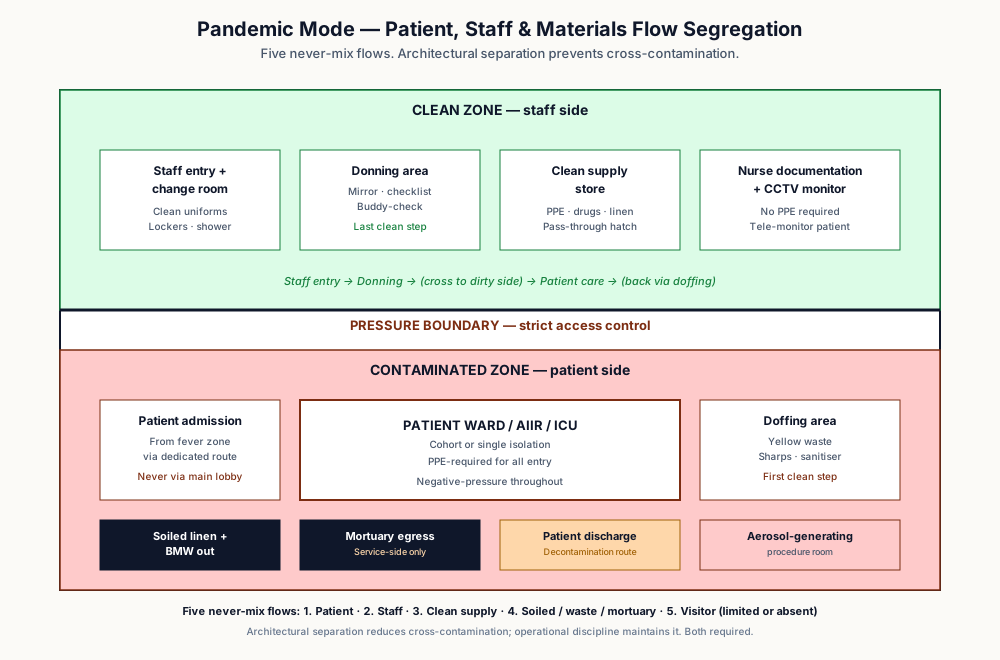
Flow 1 — Patient. Suspected and confirmed cases enter via the dedicated ID route from the fever zone. They never traverse the main hospital corridor. Discharge follows a separate decontamination route. Architectural deliverable: dedicated patient lift, dedicated patient corridor on the isolation floor, dedicated discharge route with decontamination.
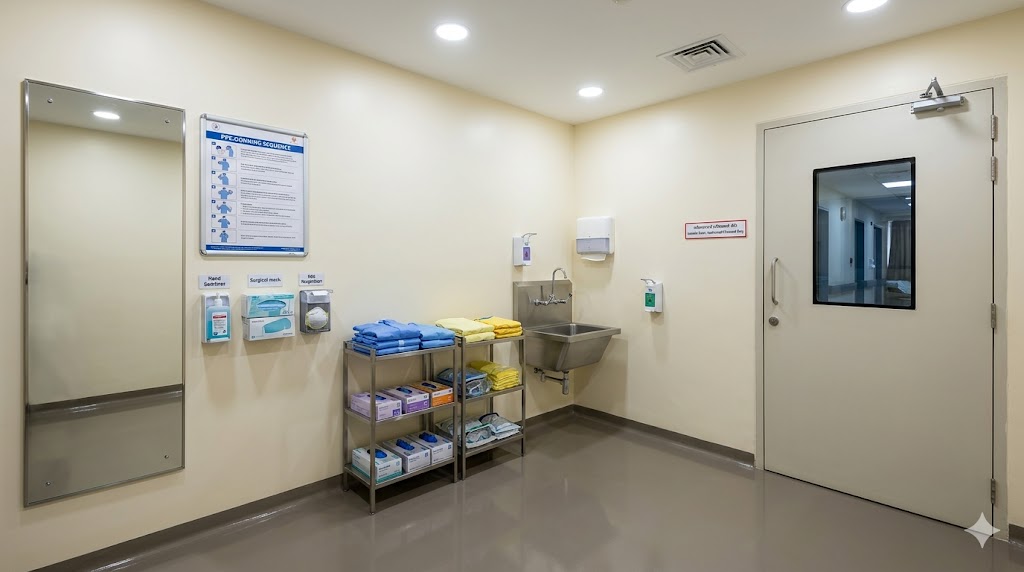
Flow 2 — Staff. Clinical staff enter the clean side via the staff entry, change into clean uniforms, don PPE in the donning area, cross to the dirty side for patient care, and exit via doffing back to the clean side. Architectural deliverable: clean entry route, change room, donning area, doffing area (separate from donning), shower/decontamination on clean side.
Flow 3 — Clean supply. PPE, drugs, linen, medical supplies enter via the clean supply corridor and pass through to the patient zone via a pass-through hatch (dedicated transfer cabinet) — supplies cross the boundary, but personnel do not. Architectural deliverable: clean supply lift, clean storage room on the clean side, pass-through hatch to the dirty side.
Flow 4 — Soiled / waste / mortuary. Soiled linen, biomedical waste, and deceased-patient remains exit via the service-side dirty corridor. They never re-enter the clean zone. Architectural deliverable: dedicated soiled lift, BMW holding (cooled, with extended-capacity sizing), dedicated mortuary access route. Mortuary surge capacity is the post-COVID specification — see §8 below.
Flow 5 — Visitor. In pandemic mode, visitor flow is typically suspended or severely limited. The architectural deliverable is a visitor-meeting room at the boundary (one-way glass + intercom) for compassionate exception cases. In Indian context, this is challenging — family attendance is culturally expected — but pandemic operational protocols override.
The architectural separation of these five flows is the anti-nosocomial-transmission architecture. A hospital that has all five flows physically separated will weather a pandemic; a hospital that mixes any two will not.
8. Mortuary Surge Capacity — The Brief COVID Made Visible
COVID-19 made mortuary capacity a visible architectural failure mode for the first time. Hospitals that had designed mortuaries for routine hospital mortality (1–3 deaths per day) found themselves in 5–15 deaths per day surge, with bodies in corridors, in tents, on floors. The pandemic-preparedness architectural correction is significant.
Mortuary surge specifications (post-COVID):
| Parameter | Routine (pre-COVID) | Pandemic-prepared (post-COVID) |
|---|---|---|
| Body holding capacity | 4–8 bodies (200-bed hospital) | 16–32 bodies (200-bed hospital, 4× surge) |
| Cooling temperature | 2–8°C | 2–8°C (unchanged) |
| Body-bag protocol | Optional | Mandatory for infectious cases; PPE for handling staff |
| Family viewing | Open viewing common | Limited to one designated family member; PPE required |
| Religious rituals | On-site space | Outdoor space designated for last-rites; reduced family attendance |
| Body release | Single-route | Dedicated ambulance-only egress; no public viewing route |
| Surge expansion plan | None | Pre-designated outdoor area for refrigerated container deployment (2–4 × 40-ft containers) |
The architectural deliverables:
1. Permanent mortuary at 4× surge capacity — for a 200-bed hospital, 16–32 body holding (vs the historical 4–8). Most retrofit projects can add capacity through a mortuary annex.
2. Pre-designated outdoor area for refrigerated container deployment — adjacent to the mortuary, with electrical capacity for 2–4 × 40-ft refrigerated containers. Used during extreme surge (post-March 2020 wave 1, April 2021 wave 2).
3. Dedicated body-release route — service-side; never through a public corridor; ambulance bay separate from arrival ambulance bay.
4. Outdoor last-rites space — for families unable to enter the hospital; sheltered; near the mortuary; private.
Indian context. Hindu cremation tradition typically requires same-day ritual. Muslim and Christian burial traditions have specific timelines. Architectural design should support these without requiring family in-hospital movement during pandemic mode. The outdoor last-rites space is often the most useful single addition.
9. Healthcare Worker Protection — The Brief COVID Made Non-Negotiable
India lost over 1,800 healthcare workers to COVID-19 between March 2020 and December 2022. The architectural protection of staff is no longer a secondary brief.
Healthcare worker architectural deliverables:
| Element | Specification |
|---|---|
| Donning area | 6–8 m²; mirror; checklist poster; sanitiser dispenser; hand-wash sink; PPE storage adjacent |
| Doffing area | 8–10 m²; SEPARATE from donning; yellow waste bin; sharps; sanitiser at every step; trained observer space |
| Staff change room | 16–20 m²; lockers; shower (minimum 2); separate clean and dirty change zones |
| Staff rest area | 30–40 m²; not in the clinical zone; food + drink + couch; outside view; staff-only access; mobile-charging |
| Staff accommodation (during surge) | On-site dormitory or partner-hotel; 12–14 m² per bed; ensuite shared 1:4; for staff who cannot return home |
| Staff decontamination route | Shower in change room; uniforms via laundry chute; decontamination of personal effects |
| Mental-health support space | 14–20 m²; private; counsellor on-call; for staff burnout / grief support during surge |
| PPE training + drill space | 30–40 m²; can double as conference room in routine times; with practice mannequins, mirrors, video review |
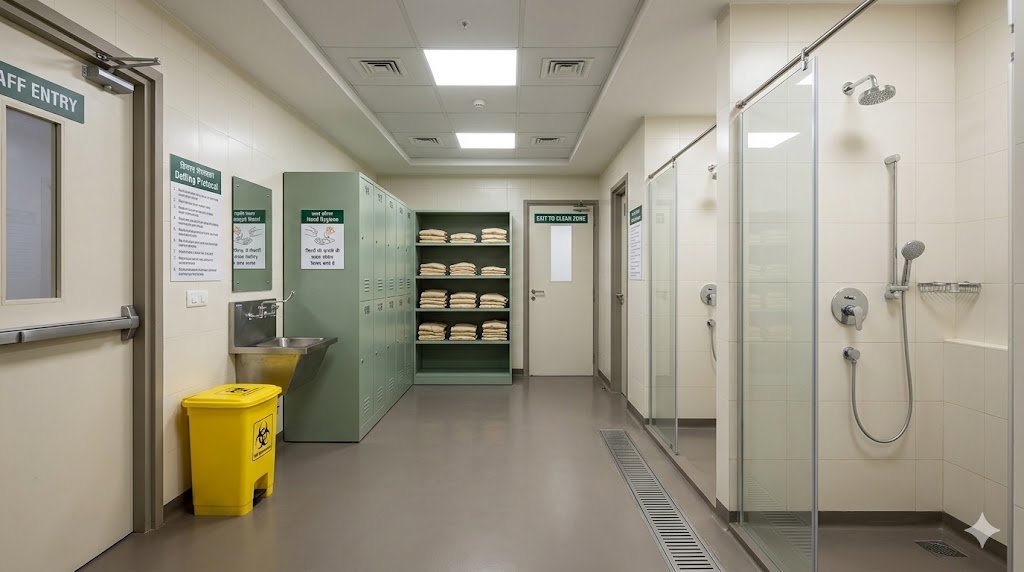
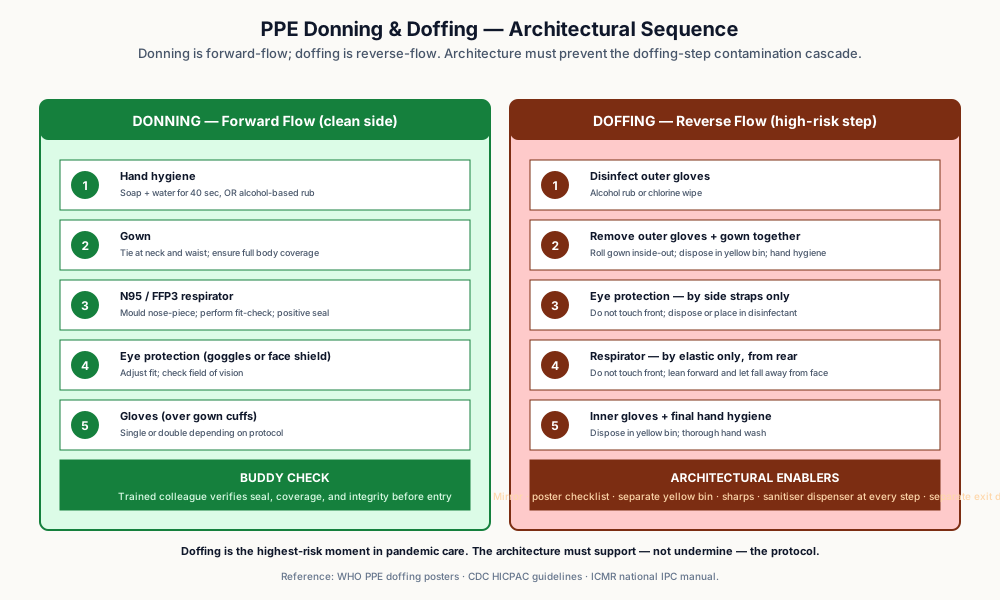
The buddy-check architecture. PPE donning includes a final buddy-check by a trained colleague to verify seal, coverage, integrity. The donning area should accommodate the buddy — minimum 6 m² (2 people, mirror, check space). Many existing donning areas in Indian hospitals are 3 m² and prevent the buddy-check from being conducted properly.
Staff accommodation during surge. During COVID waves, many Indian hospitals operated "stay-over" rosters where staff stayed on-site for 7–14 days at a time to reduce family-transmission risk. The architectural deliverable: on-site dormitory accommodation OR formal partnership with adjacent hotel. Several large Indian hospitals built dormitory accommodation during COVID-19; this should now be a routine commission for tertiary hospitals.
"The country owes its surviving healthcare workers a debt that the architecture can partly pay back. A hospital that protected its staff during COVID protected them with its design as much as with its protocols. The architects who designed those hospitals before 2020 saved lives without knowing they were doing it." — Dr. Naresh Trehan (b. 1946), cardiac surgeon and healthcare entrepreneur, paraphrased from a 2022 address
10. The PM-ABHIM Critical-Care Block — Pandemic Readiness as National Programme
The Pradhan Mantri Atmanirbhar Bharat Health Infrastructure Mission (PM-ABHIM, 2021) is India's principal post-COVID architectural investment. Every district hospital is receiving a 50–100 bed critical-care block under this scheme; integrated public health labs are being built at every district; tertiary capacity is selectively upgraded.
PM-ABHIM Critical-Care Block — typical specifications:
| Element | Specification |
|---|---|
| Total beds | 50–100 (depending on district size); typically 16–40 ICU + 24–60 HDU |
| AIIR rooms | 4–8 dedicated AIIRs; remaining beds surge-convertible |
| HVAC | 100% backup-power-conditioned; pandemic-mode capable; 12 ACH minimum across the block |
| Oxygen plant on-site (PSA) | Mandatory under post-COVID scheme; typically 500–1,500 LPM capacity |
| Liquid Medical Oxygen tank (LMO) | Backup; PESO-licensed; 3,000–10,000 L typical |
| Negative-pressure capability | Throughout the block; switchable per ward |
| Separate entry / corridor | Dedicated isolation entry route from ED |
| Donning + doffing infrastructure | Multiple stations distributed through the block |
| Mortuary surge | Adjacent or within easy access |
| PSA oxygen plant | The single most consequential post-COVID addition; site-located adjacent to the block |
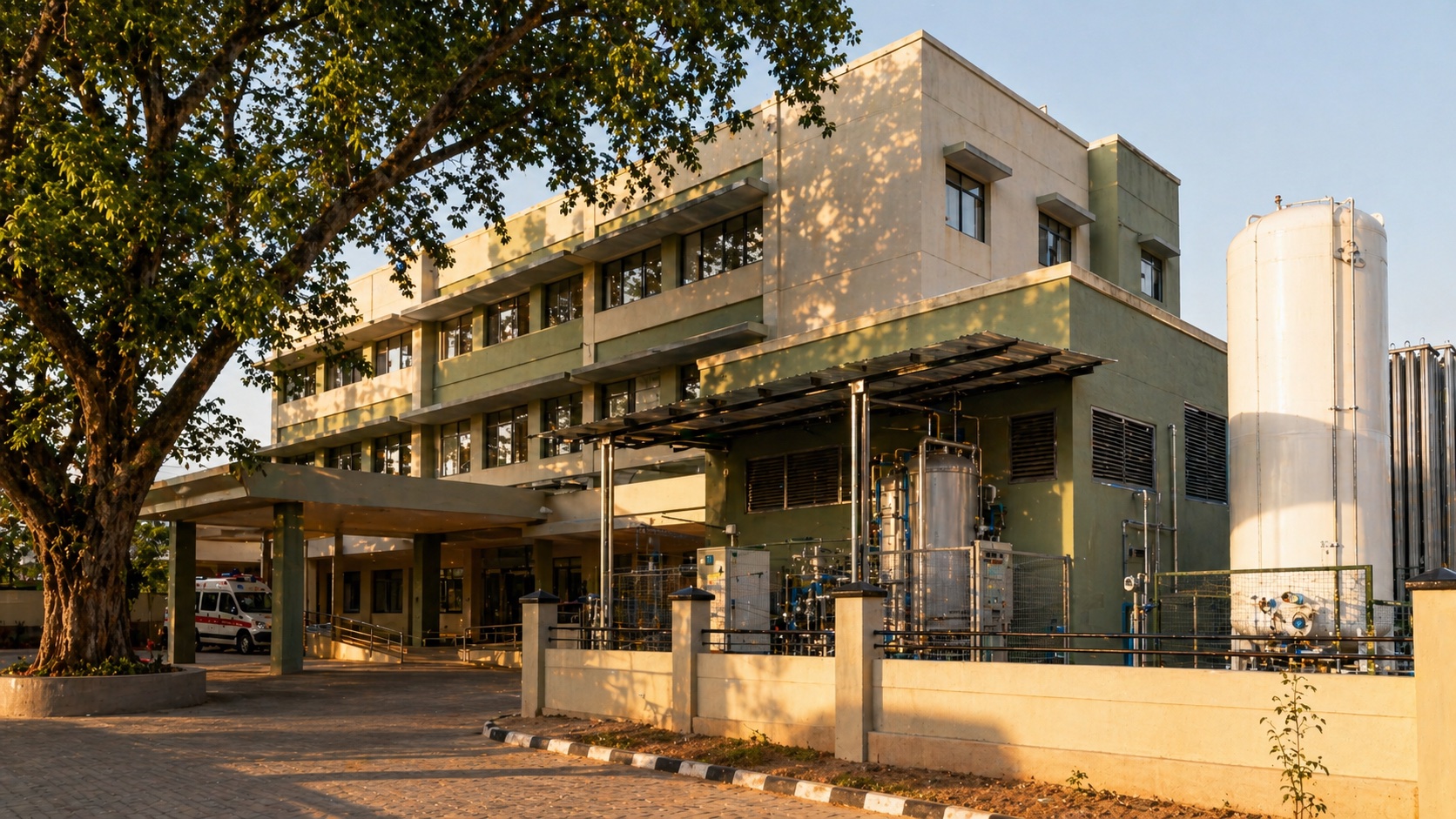
The PSA oxygen plant. Pressure Swing Adsorption oxygen generation on-site eliminates the LMO supply-chain failure that made the second COVID wave's oxygen crisis fatal in many cities. Every PM-ABHIM block now includes a PSA plant. Architecturally a 50–80 m² annex with electrical capacity, noise insulation (PSA plants are noisy), and connection to the central medical-gas pipeline. The post-COVID architectural baseline.
Indian deployment. As of 2026, PM-ABHIM critical-care blocks have been commissioned at ~400 of India's 770 district hospitals; the remaining are in construction or planning. Architects working on government tertiary projects today are typically designing within the PM-ABHIM brief.
11. The Dedicated Infectious-Disease Hospital
Beyond the always-on baseline and surge-conversion, India has a small but growing network of dedicated infectious-disease (ID) hospitals. These operate at Layer 3 of the preparedness model and deserve their own architectural treatment.
ID hospital characteristics:
- 80–300 beds typical; all single-occupancy with ensuite
- Full negative-pressure throughout the inpatient zone
- BSL-3 sample collection room and on-site lab (BSL-2 + BSL-3 capability)
- Multiple AIIRs (typically 30–50% of total beds)
- Pandemic-grade triage and screening at entry
- Dedicated mortuary with surge capacity
- Staff accommodation on-site
- High security around the perimeter (controlled access)
- Pharmacy with antiviral and antimicrobial stocking
- Training and education facility for IPC
Indian ID hospitals worth studying:
- NIV Pune (National Institute of Virology) — apex national ID research and reference; not primarily a clinical hospital but reference for diagnostic protocols
- Naidu Infectious Diseases Hospital, Pune — 1899 founding; 200+ beds; reference for plague, cholera, COVID-19
- Beliaghata ID Hospital, Kolkata — 1907 founding; one of India's oldest ID hospitals
- Trichy ID Hospital, Tamil Nadu — modern dedicated ID facility
- Mahatma Gandhi ID Hospital, Pune — modern facility
- AIIMS Delhi ID block — within the AIIMS campus
- RML Delhi ID block — within RML
- KEM Mumbai ID block — within KEM
- Kasturba Hospital, Mumbai — 1892 founding; primary COVID receiving in 2020
Architectural lineage. The older ID hospitals (Naidu, Beliaghata, Kasturba) follow the late-19th-century pavilion plan — separate single-storey blocks with deep verandahs, high ceilings, large windows for cross-ventilation, generous landscape between blocks. This pre-antibiotic-era architecture turns out to be remarkably effective for airborne pandemic management because the pavilion separation prevents inter-block transmission and the natural ventilation supports outdoor-air operation. Contemporary ID hospital design is rediscovering these principles.
The architect's read. A new ID hospital commission should reference both the historical pavilion tradition (block separation, deep verandahs, cross-ventilation) and the contemporary technical specification (negative pressure, HEPA filtration, BSL-3 lab, controlled access). The synthesis is the discipline.
12. Common Failure Modes — Codified from COVID-19
A pattern audit of stalled or COVID-overwhelmed Indian hospital projects reveals recurring failures:
| # | Failure Mode | Root Cause | Consequence | Prevention |
|---|---|---|---|---|
| 1 | No always-on baseline isolation capability | Pre-pandemic design template | Forced retrofit during surge; incomplete isolation | 5–10% baseline single rooms with isolation capability |
| 2 | AIIR without working pressure differential | HVAC commissioning failure | AIIR effectively non-functional | Continuous pressure monitoring; commissioning verification |
| 3 | Donning and doffing combined in one space | Brief overlooked separation | Cross-contamination during doffing | Separate donning and doffing rooms |
| 4 | Buddy-check space inadequate (3 m² donning) | Generic small-room sizing | PPE protocol cannot be followed | 6+ m² donning area |
| 5 | Mortuary at routine capacity only | Pre-pandemic baseline | Body overflow during surge | 4× surge capacity from concept |
| 6 | No outdoor last-rites space | Cultural assumption | Family forced into clinical zones | Outdoor space designated near mortuary |
| 7 | LMO supply-chain dependence (no PSA) | Cost-driven | Oxygen crisis during surge | PSA plant on-site (post-COVID standard) |
| 8 | Surge-conversion HVAC not designed-in | Pre-pandemic template | 24-hour conversion impossible | Per-ward AHU with damper switch |
| 9 | Patient flow forced through main lobby | No separate ID entry route | Nosocomial transmission to OPD/ED | Dedicated ID entry from concept |
| 10 | Healthcare worker accommodation absent | Cost-driven | Staff cannot stay-over during surge | On-site dormitory or hotel partnership |
| 11 | Staff decontamination shower absent | Generic change-room | Staff carry pathogen home | Decontamination shower in clean change |
| 12 | Visitor management infrastructure absent | "Visitors always allowed" assumption | Pandemic visitor restriction has no architectural support | Visitor-meeting room at boundary |
| 13 | BMW holding undersized | Routine sizing | BMW spillover during surge | Extended-capacity BMW from concept |
| 14 | Aerosol-generating procedure room non-isolated | Routine OT spec | Intubation produces ward-wide aerosol | AIIR or negative-pressure procedure room |
| 15 | Air-handling recirculation across zones | Cost-driven shared AHU | Pathogen redistribution | Dedicated AHU per ward; no cross-zone recirculation |
| 16 | Backup power inadequate (HVAC only on partial) | Routine backup spec | Pandemic-mode HVAC fails on power loss | 100% backup-power-conditioned for pandemic-mode HVAC |
| 17 | Triage tent improvised at entry | Pre-pandemic entry only | Symptomatic patients enter main lobby | Pandemic-mode triage architecture pre-designed |
| 18 | No mental-health support space for staff | "Wellness is optional" | Burnout and PTSD during surge | Dedicated quiet room for staff support |
13. Pre-Design Audit Framework for Pandemic Preparedness
A 14-question audit at concept stage. Three or more "no" answers indicate the brief is not pandemic-ready.
| # | Audit Question | Why It Matters | Required Output |
|---|---|---|---|
| 1 | Is the always-on baseline isolation provisioned (5–10% single rooms + 1–2 AIIRs)? | Layer 1 minimum | Baseline isolation count |
| 2 | Are the surge-convertible wards designed with dedicated AHUs and damper switches? | Layer 2 capability | Per-ward HVAC strategy |
| 3 | Is the dedicated ID entry route designed (separate from main lobby)? | Symptomatic patient routing | Site plan with ID entry |
| 4 | Is the triage and screening architecture designed (5-station pre-designed)? | Pandemic mode entry filter | Triage layer plan |
| 5 | Are the donning and doffing areas separate, ≥ 6 m² each? | PPE protocol enabler | Donning/doffing layout |
| 6 | Is the mortuary at 4× routine surge capacity? | Post-COVID standard | Mortuary sizing |
| 7 | Is the outdoor last-rites / refrigerated-container space designated? | Cultural and surge requirement | Mortuary site plan |
| 8 | Is the PSA oxygen plant on-site? | Post-COVID standard for tertiary | PSA plant site plan |
| 9 | Is the LMO + PSA backup configuration adequate for pandemic surge? | Oxygen crisis avoidance | Medical gas plan |
| 10 | Is HVAC backup power 100% (not partial)? | Pandemic-mode HVAC continuity | Power schema |
| 11 | Are the five never-mix flows architecturally separated? | Anti-nosocomial transmission | Flow segregation plan |
| 12 | Is the staff accommodation provisioned (on-site or partnership)? | Surge stay-over enabler | Accommodation plan |
| 13 | Is the staff decontamination shower in the clean change room? | Family transmission prevention | Change-room plan |
| 14 | Is the BSL-3 sample collection room provisioned? | Pandemic diagnostics | Sample lab plan |
14. The Architect's Pandemic-Preparedness Compliance Deliverables
Beyond general healthcare deliverables (see pillar reference), the pandemic-preparedness deliverables are:
| # | Deliverable | Recipient | Stage |
|---|---|---|---|
| 1 | Pandemic preparedness strategy declaration (Layers 1, 2, 3 in scope) | Client / state Health | Concept |
| 2 | Always-on baseline isolation count (single rooms + AIIR) | Client / NABH | Concept |
| 3 | Surge-conversion ward strategy with per-ward HVAC | HVAC consultant | Preliminary |
| 4 | Dedicated ID entry route + triage architecture | Client | Preliminary |
| 5 | AIIR detailed layouts (anteroom + patient + ensuite) | NABH / IPC team | Detailed |
| 6 | Pressure cascade diagram for all isolation zones | HVAC consultant | Detailed |
| 7 | Donning + doffing infrastructure layout | IPC team | Detailed |
| 8 | Five never-mix flow segregation drawing | Client / IPC team | Detailed |
| 9 | Mortuary surge plan (permanent + outdoor container area) | Client | Detailed |
| 10 | PSA oxygen plant + LMO plan | PESO / Medical Gas consultant | Detailed |
| 11 | Backup-power-conditioned HVAC plan | Electrical consultant | Detailed |
| 12 | Staff accommodation block (on-site dormitory) | Client | Detailed |
| 13 | Staff decontamination shower + change-room | Client | Detailed |
| 14 | BSL-3 sample collection room (linked to lab) | IBSC / lab consultant | Detailed |
| 15 | Visitor-meeting room at boundary | Client | Detailed |
| 16 | PPE training + drill space | Client | Detailed |
| 17 | Pandemic playbook (architectural conversion procedure) | Client / facilities team | Pre-handover |
| 18 | Pandemic-mode commissioning verification | All | Pre-handover |
"Pandemic preparedness is not a niche specialty; it is the new architectural baseline for Indian hospital design. The architect who treats it as optional is designing for the world that ended in 2020. The architect who treats it as default is designing for the world that exists." — Dr. K. Srinath Reddy (b. 1949), former President, Public Health Foundation of India, paraphrased from a 2023 lecture
References
- ASHRAE (2021) Standard 170-2021: Ventilation of Health Care Facilities. Atlanta: American Society of Heating, Refrigerating and Air-Conditioning Engineers.
- Bureau of Indian Standards (2008) IS 10361 — Air Conditioning of Hospitals. New Delhi: BIS.
- Bureau of Indian Standards (2016) National Building Code of India 2016, Part 4 — Fire and Life Safety; Part 8 — Building Services. New Delhi: BIS.
- Centers for Disease Control and Prevention (2003, updated 2019) Guidelines for Environmental Infection Control in Healthcare Facilities. Atlanta: CDC HICPAC.
- Centers for Disease Control and Prevention (2020) Interim Infection Prevention and Control Recommendations for Healthcare Personnel During the Coronavirus Disease 2019 Pandemic. Atlanta: CDC.
- Facility Guidelines Institute (2022) Guidelines for Design and Construction of Hospitals — Chapter on Infection Control Architecture. St. Louis: FGI.
- Government of India (2021) Pradhan Mantri Atmanirbhar Bharat Health Infrastructure Mission (PM-ABHIM) — Operational Guidelines. New Delhi: MoHFW.
- Indian Council of Medical Research (2020) National Guidelines for Hospital Preparedness for COVID-19. New Delhi: ICMR.
- Indian Council of Medical Research (2020) National Guidelines for Bio-medical Waste Management for COVID-19. New Delhi: ICMR.
- Klompas, M., Baker, M.A. and Rhee, C. (2020) 'Airborne transmission of SARS-CoV-2: theoretical considerations and available evidence', JAMA, 324(5), pp. 441–442.
- Memarzadeh, F. and Xu, W. (2012) 'Role of air changes per hour (ACH) in possible transmission of airborne infections', Building Simulation, 5(1), pp. 15–28.
- Ministry of Health and Family Welfare (2020) Guidelines on Hospital Infrastructure for COVID-19 Care. New Delhi: MoHFW.
- Ministry of Health and Family Welfare (2021) Guidelines on Setting Up of COVID Care Centres, Dedicated COVID Health Centres and Dedicated COVID Hospitals. New Delhi: MoHFW.
- Morawska, L. and Cao, J. (2020) 'Airborne transmission of SARS-CoV-2: the world should face the reality', Environment International, 139, p. 105730.
- NABH (2020) Standards for Hospitals, 5th Edition — Infection Control Chapter. New Delhi: National Accreditation Board for Hospitals & Healthcare Providers, Quality Council of India.
- National Centre for Disease Control (2020) Operational Guidelines for Containment of COVID-19. New Delhi: NCDC.
- Olmsted, R.N. (2003) Pavilion Hospitals — A Historical Review. New York: McGraw-Hill (reprint of 1898 original).
- Otter, J.A., Yezli, S., Salkeld, J.A.G. and French, G.L. (2013) 'Evidence that contaminated surfaces contribute to the transmission of hospital pathogens and an overview of strategies to address contaminated surfaces in hospital settings', American Journal of Infection Control, 41(5 Suppl), pp. S6–S11.
- Saunders-Hastings, P., Crispo, J.A.G., Sikora, L. and Krewski, D. (2017) 'Effectiveness of personal protective equipment and oseltamivir prophylaxis during avian influenza A (H7N9) epidemic, China, 2014', Emerging Infectious Diseases, 23(8), pp. 1368–1370.
- Siegel, J.D., Rhinehart, E., Jackson, M., Chiarello, L., Healthcare Infection Control Practices Advisory Committee (2007) 2007 Guideline for Isolation Precautions: Preventing Transmission of Infectious Agents in Healthcare Settings. Atlanta: CDC HICPAC.
- Ulrich, R.S., Zimring, C., Zhu, X., DuBose, J., Seo, H.B., Choi, Y.S., Quan, X. and Joseph, A. (2008) 'A review of the research literature on evidence-based healthcare design', HERD: Health Environments Research & Design Journal, 1(3), pp. 61–125.
- World Health Organization (2009) Natural Ventilation for Infection Control in Health-Care Settings. Geneva: WHO.
- World Health Organization (2020) Infection Prevention and Control During Health Care When Coronavirus Disease (COVID-19) Is Suspected or Confirmed. Geneva: WHO.
- World Health Organization (2020) Recommendations to Member States to Improve Hand Hygiene Practices to Help Prevent the Transmission of the COVID-19 Virus. Geneva: WHO.
- World Health Organization (2021) WHO Health Workforce Department: Health Care Worker Mortality from COVID-19. Geneva: WHO.
Author's Note: Pandemic preparedness has crossed from specialty interest to architectural baseline in the last six years. The country lost too much during COVID-19 to permit the lessons to be forgotten. Every hospital commission an Indian architect accepts from 2026 forward is — whether the brief states it or not — also a pandemic-readiness commission. The author's intention with this guide is to support the architects who internalise the new baseline, who insist on the always-on isolation provisioning, the surge-conversion HVAC, the triage architecture, the never-mix flows, the staff protection infrastructure, and the mortuary surge planning, even when the brief is silent on these. The architecture is part of the country's pandemic insurance policy. The series will continue with deeper guides on AIIR design specifically, surge-conversion ward HVAC, the BSL-3 lab interface, and the dedicated ID hospital architectural lineage.
Disclaimer: This article is for informational and educational purposes only. It does not constitute legal, regulatory, clinical, or professional architectural advice. Pandemic preparedness facility design depends on site, state, facility tier, scope, and applicable amendments at the time of design — all of which must be confirmed with the relevant statutory authorities (state health department, NCDC, ICMR, NABH, AERB where radiation diagnostics are involved, IBSC where biosafety levels are at issue, state PWD), qualified clinical consultants (infectious disease, infection prevention and control, microbiology, public health), and qualified design consultants for the specific project. Statute references, ACH rates, pressure differentials, AIIR specifications, surge multipliers, mortuary capacities, and infrastructure norms cited are indicative and subject to change. NABH 5th Edition, ICMR national guidelines, NCDC playbooks, PM-ABHIM operational guidelines, ASHRAE 170, and CDC HICPAC guidelines are periodically revised; practitioners must verify current notifications against the project state and city before any binding design or construction commitment. Studio Matrx, its authors, and its contributors accept no liability for decisions made on the basis of the information contained in this guide, and recommend independent verification with the state health department, NCDC, ICMR, NABH, the state pollution control board, and qualified IPC and design consultants before any binding project decision.
Interactive · Pandemic-mode conversion
Normal mode — toggle to see the transformation
Normal mode — design specifics
Standard ward operations — public entry, free family movement, neutral pressure on patient rooms.
- ▸Patient + visitor entry through main lobby
- ▸Patient rooms at neutral / slight positive pressure
- ▸Family + visitors allowed during visiting hours
- ▸Staff use general locker rooms
- ▸AHU recirculates air with standard filtration (MERV 14)
Design implication
A pandemic-ready ward designs for the worst case in advance: bi-directional AHU with HEPA-exhaust ready, dampers + interlocks, anteroom shells pre-built, dual corridors at masterplan. Retro-fitting during a live outbreak is dangerous + slow.
References: MOHFW Hospital Infection Control 2020, NIDM pandemic-preparedness 2021, ASHRAE pandemic task-force 2020. Hot/warm/cold zoning aligns with WHO + CDC isolation guidance.
Export this guide
Related Guides — Deep-dive reading
Hospital Back-of-House — Kitchen, Laundry & Mortuary Design in India
An Architect's Working Reference — Therapeutic Diet Kitchen · HACCP-Equivalent Flow · Hospital Laundry with Pass-Through Washer-Extractors · Mortuary with Dignified End-of-Life Architecture · Multi-Faith Provision · Service-Side Adjacency · NABH 5th Edition · The Service Heart of the Hospital
Healthcare ArchitecturePatient Room Typology — Inpatient Room Design Deep-Dive in India
An Architect's Working Reference — Single vs Twin vs Cohort · Same-Handed vs Mirrored · Inboard vs Outboard Bath · Indian Family Attendant Accommodation · Headwall Services · Acuity-Adaptable Rooms · NABH 5th Edition Patient-Centred Design · The Five Decisions That Shape Every Inpatient Floor
Healthcare ArchitectureNursing Home Design (10–30 beds) in India: A Compliance Guide
An Architect's Working Reference — State Nursing Homes Acts (Bombay, Delhi, WB), Centre & State CEA Application at Small-Hospital Scale, Scaled-Down Infrastructure, Fire Constraints on Residential Plots, Bungalow-to-Nursing-Home Conversions, and the Compliance Calendar
Healthcare ArchitectureRelated Tools — Try Free
Acoustic Privacy (STC) Visualizer
Indian healthcare acoustic visualizer — compare wall assemblies and noise sources, see received SPL after STC attenuation, and check FGI 2018 / IS 1950 / NABH speech-privacy compliance with live dual-canvas waveform.
Acoustic ToolCircadian Light Meter
Patient-centric circadian lighting visualizer for Indian healthcare design — time-of-day × intensity → CCT, melanopic lux (EML / mEDI), melatonin suppression, and an alertness curve. Calibrated against WELL v2 L03 Circadian Lighting Design, CIE S 026:2018, Brainard 2001, and Lucas et al. 2014.
Circadian ToolHealing View Impact Calculator
Evidence-Based Design dashboard quantifying the recovery impact of nature view + daylight factor on analgesic use, length of stay, and HCAHPS patient-experience uplift. Calibrated against Ulrich 1984 (Science), Park & Mattson 2008, and the CHD EBD evidence base.
EBD Calculator