

Hidden Costs of Home Lift Installation (India): The Bills Beyond the Sticker Price
Shaft, electricals, licences, AMC, GST and the battery you forget — what a lift quote leaves out, and how a quoted figure becomes the true all-in cost.
You ask three vendors for a quote. The number that comes back — say ₹14 lakh — feels like the price of the lift. It is not. It is the sticker price: the cab, the drive, the doors and the standard installation. By the time the lift is running, licensed and warranted, you have often spent 25 to 45 percent more than that headline figure. This guide is about the bills beyond the sticker price — the civil shaft, the electrical upgrade, the state licence, the AMC, the GST, the finishes you will be tempted into, and the battery you will quietly replace in year four.
This is the forgotten-costs deep-dive. For the full, structured all-in benchmark by lift type and floor count, read our master guide, Home Lift Cost in India 2026; to model your own numbers line by line, use the Home Lift Budget Planner. Here we stay narrow on one question: what does the quote leave out, and how much does each gap cost?
All figures are indicative for June 2026, in rupees — confirm with itemised quotes from licensed vendors and your local municipal bye-laws.
Sticker price vs all-in reality
The single biggest source of budget overrun on a home lift is treating the equipment quote as the project cost. Most quotes you receive are for supply plus standard installation only. They assume a shaft already exists, power is already available, and you will handle permissions and maintenance yourself.
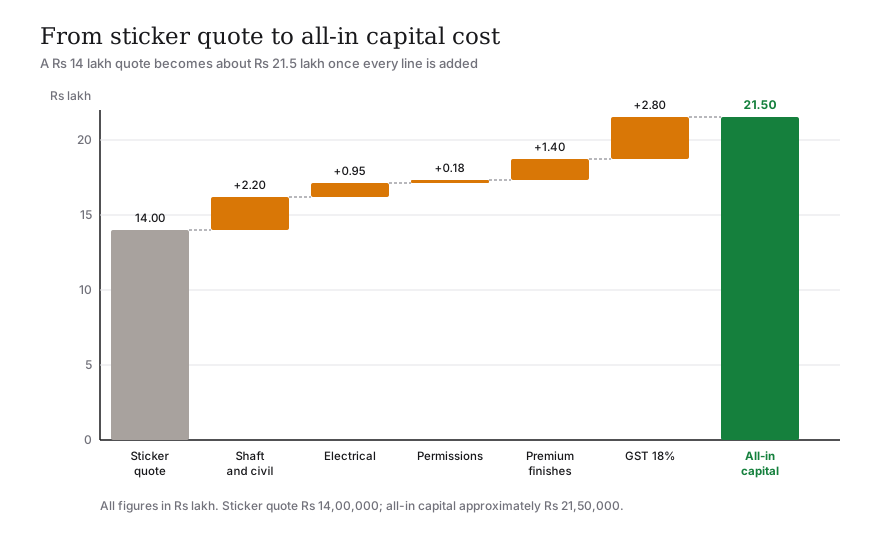
The honest way to read a quote is to ask: does this number include the shaft? the three-phase line? the licence? the first year of AMC? GST? Usually the answer is no to most of them. Each "no" is a line you must add yourself before the figure means anything.
The seven costs the quote forgets
| Hidden cost | What it covers | Indicative range |
|---|---|---|
| Shaft / civil works | RCC shaft or pit, waterproofing, structural opening | ₹1,50,000 to ₹4,50,000 |
| Electrical upgrade | Three-phase connection, dedicated wiring, earthing, stabiliser/SPD | ₹40,000 to ₹1,80,000 |
| Permissions | State Lift Act installation and operating licence, inspection fees | ₹5,000 to ₹40,000 |
| AMC (year 1) | First annual maintenance contract after warranty | ₹20,000 to ₹38,500 |
| GST at 18 percent | Tax on equipment and most services | 18 percent of taxable value |
| Premium finishes | Glass, stainless steel, stone floor, mood lighting | ₹75,000 to ₹4,00,000+ |
| Future battery (ARD) | Backup battery replacement at roughly 3 to 5 years | ₹15,000 to ₹50,000 |
The sections below take each one in turn.
1. Shaft construction and civil works
Unless you are buying a pneumatic vacuum (PVE) or a self-supporting screw lift — both of which need no masonry shaft and only a shallow or zero pit — you are paying for civil work that the lift quote rarely includes.
A conventional traction or hydraulic lift wants an RCC hoistway: a reinforced concrete or block-and-RCC shaft sized to the car, plus a pit at the bottom (≈150 to 300 mm for hydraulic and screw, 300 to 610 mm for traction, sometimes deeper for gearless) and adequate headroom at the top. In an existing house you may also need to cut a floor opening and reinforce around it.
| Civil item | Typical cost | Notes |
|---|---|---|
| RCC / masonry shaft (G+1) | ₹1,20,000 to ₹3,00,000 | Rises with each floor and shaft size |
| Pit excavation and casting | ₹25,000 to ₹70,000 | Deeper pit for traction costs more |
| Waterproofing (pit + shaft base) | ₹15,000 to ₹50,000 | Skipping this invites pit flooding |
| Floor opening + structural reinforcement | ₹40,000 to ₹1,20,000 | Retrofit only |
Waterproofing the pit is the line owners cut first and regret most: pit flooding is an act-of-God exclusion in most AMCs, so the repair is on you.
Why a PVE or screw lift can erase this line: with no shaft and no real pit, the civil bill collapses to almost nothing — which is a large part of why these self-supporting types look expensive on the sticker but can be competitive all-in for a retrofit. For how that trade-off plays out by type, see Home Lift Cost in India 2026.
2. Electrical upgrades
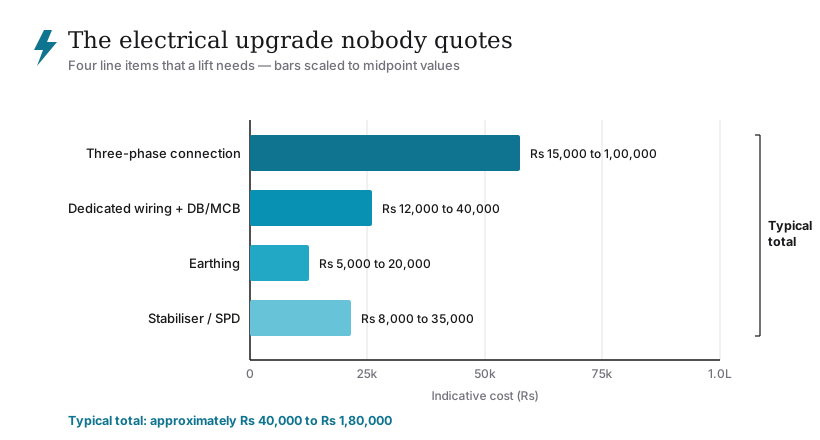
A small single-phase home lift may run off your existing supply. But the moment you choose a larger traction lift, you usually need a sanctioned three-phase connection — and that is a separate application, deposit and wiring job that no lift quote covers.
| Electrical item | Indicative cost | Why you need it |
|---|---|---|
| Three-phase connection (sanction + deposit) | ₹15,000 to ₹1,00,000 | Required by most traction lifts; varies by DISCOM and load |
| Dedicated wiring and DB / MCB | ₹12,000 to ₹40,000 | Lift must be on its own protected circuit |
| Proper earthing | ₹5,000 to ₹20,000 | Safety and warranty condition |
| Voltage stabiliser / SPD | ₹8,000 to ₹35,000 | Protects the controller from spikes and brownouts |
In much of India the controller is the most spike-sensitive — and most expensive — part of the lift. A stabiliser and surge protection device (SPD) is cheap insurance against a five-figure board replacement. Note this is distinct from the ARD battery (covered below), which keeps the car moving during an outage rather than protecting it from one.
3. Permissions and licences
Lifts are state-regulated in India. Roughly ten states run a Lift Act — Maharashtra, Gujarat, Karnataka, Kerala, Tamil Nadu, Assam, West Bengal, Delhi, Haryana and Himachal Pradesh — and in those states you typically owe three things:
- An installation licence before commissioning;
- An operation licence / registration to run the lift;
- Periodic safety inspection by the State Electrical or Lift Inspectorate (a government inspector, never a private company).
| Permission item | Indicative cost | Notes |
|---|---|---|
| Installation licence | ₹3,000 to ₹15,000 | Before commissioning, in Act states |
| Operating licence / registration | ₹2,000 to ₹12,000 | Renewable; periodic |
| Inspection / inspector fee | ₹1,000 to ₹10,000 | Where applicable; per visit |
The cash amounts are modest; the time and paperwork are the real cost, and an uninspected lift can void insurance and warranty. In states without an Act, registration may not be mandated, but IS 14665 and NBC 2016 (Part 8, Section 5) remain the right benchmark. A good vendor handles most of this for you — confirm in writing whether their quote includes liaisoning. For the full process, see our approvals walkthrough linked under Home Lift Cost in India 2026.
4. Maintenance contracts (AMC)
The warranty covers year one. After that you need an Annual Maintenance Contract, and the choice of contract type changes your lifetime cost more than almost anything else.
| AMC type | Year-1 cost (small residential) | What it includes |
|---|---|---|
| Non-comprehensive (semi) | ₹20,000 to ₹38,500 | Inspection, lubrication, adjustment, labour; major parts billed separately |
| Comprehensive (bumper-to-bumper) | ≈60 to 70 percent more | Most spare parts and major repairs included |
A standard contract is about 12 monthly preventive visits a year plus emergency breakdown calls, and many contracts carry roughly 5 percent annual escalation. Comprehensive cover costs more upfront but caps the surprise bills — a replaced controller or motor on a semi-contract can dwarf a year of premiums.
Read the fine print: even "comprehensive" contracts commonly exclude acts of God (pit flooding), vandalism, aesthetic modernisation, and sometimes the motor, controller, rope or pulley.
For the AMC decision in depth — what to include, what to negotiate, and how to read exclusions — see the AMC guide linked from Home Lift Cost in India 2026. This guide treats the AMC only as the forgotten first-year line in your install budget.
5. GST at 18 percent
GST is the most-forgotten line of all because it sits on top of almost everything. A 18 percent GST applies to the equipment and most associated services. On a ₹14 lakh quote that is about ₹2.5 lakh — frequently shown separately at the bottom of a quote, or not shown at all until the tax invoice arrives. Always confirm whether a headline number is inclusive or exclusive of GST before you compare vendors.
6. Premium finishes
The base quote assumes standard finishes. Glass cabins, stainless steel, stone or vinyl flooring, mood lighting, automatic telescopic doors in place of manual swing doors — each is an upsell.
| Finish upgrade | Indicative add-on |
|---|---|
| Automatic telescopic / sliding doors (per landing) | ₹40,000 to ₹1,20,000 |
| Glass or panoramic cabin | ₹1,00,000 to ₹3,00,000 |
| Stainless steel / stone interior | ₹50,000 to ₹1,50,000 |
| Mood / accent lighting | ₹15,000 to ₹50,000 |
Automatic doors are not pure vanity — manual swing doors are not wheelchair-friendly, so if accessibility matters, the door upgrade is a need, not a want.
7. Future battery replacement (ARD)
Every Indian home lift should ship with an Automatic Rescue Device (ARD) — a battery that brings the car to the nearest floor and opens the doors during a power cut. It is essential, not optional. But the battery is a consumable: expect to replace it at roughly 3 to 5 years, at ₹15,000 to ₹50,000 depending on the system. Budget for it now so it is not a shock later, and check whether your AMC includes or excludes it.
The hidden-cost checklist
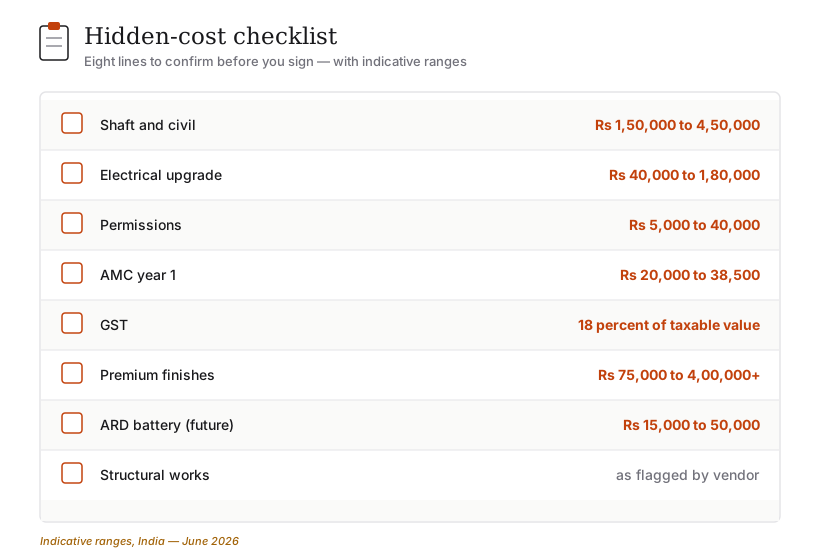
Before you accept any quote, tick off every line below — or write "₹0, confirmed in writing" against the ones that genuinely do not apply (a PVE has no shaft; a single-phase lift needs no new connection).
- Shaft and civil: RCC shaft, pit, waterproofing, floor opening — included or extra?
- Electrical: three-phase sanction, dedicated wiring, earthing, stabiliser/SPD — who pays?
- Permissions: installation licence, operating licence, inspection fees — does the vendor liaise?
- AMC year 1: is the first year bundled, and is it comprehensive or semi?
- GST: is the headline number inclusive or exclusive of 18 percent?
- Finishes: are the doors automatic? Is the cabin finish standard or premium?
- ARD battery: is it fitted, and who pays for the 3-to-5-year replacement?
- Structural works: any beam, slab or foundation reinforcement the vendor flagged?
A worked example: from quote to true all-in
Take a typical G+1 traction lift quoted at ₹14,00,000 (supply plus standard installation, GST shown separately). Here is how that sticker becomes the real number.
| Line | Amount |
|---|---|
| Lift quote (supply + standard install) | ₹14,00,000 |
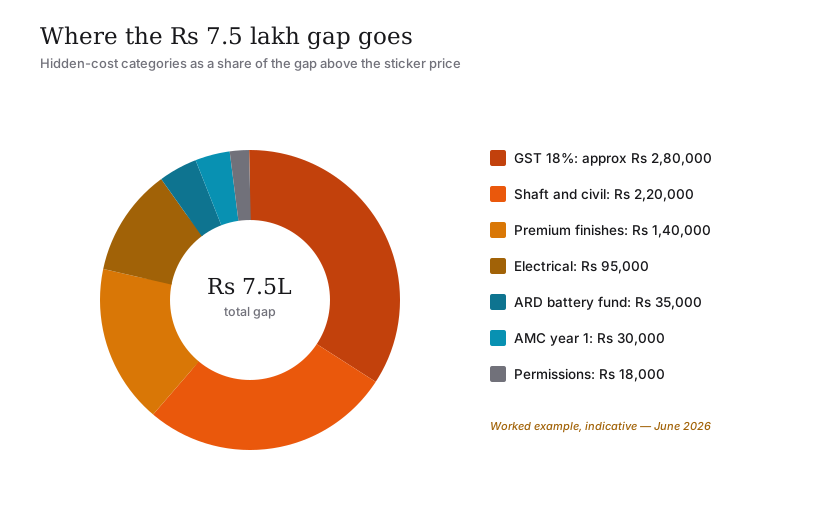
| RCC shaft + pit + waterproofing | ₹2,20,000 |
| Three-phase connection + wiring + earthing + stabiliser | ₹95,000 |
| Permissions (installation + operating + inspection) | ₹18,000 |
| Premium: automatic doors + better cabin | ₹1,40,000 |
| Subtotal (before tax) | ₹18,73,000 |
| GST at 18 percent (on taxable value) | ≈ ₹2,80,000 |
| All-in capital cost | ≈ ₹21,50,000 |
| AMC year 1 (semi) | ₹30,000 |
| ARD battery sinking fund (over ~4 years) | ₹35,000 |
The ₹14 lakh sticker became roughly ₹21.5 lakh all-in capital — about 54 percent more in this example — before a single year of maintenance. Even stripped of the premium finishes, the floor is around ₹19.5 lakh. This is exactly why the master benchmark, Home Lift Cost in India 2026, quotes all-in ranges rather than sticker prices, and why the Home Lift Budget Planner asks you for each line separately.
How to protect your budget
- Ask for an itemised quote, not a single number — and ask explicitly which of the eight checklist lines are included.
- Get the civil and electrical scope in writing before signing; these are where "we assumed you would handle it" lives.
- Choose the AMC type deliberately — comprehensive costs more but caps your downside.
- Compare vendors on all-in, GST-inclusive numbers, never on stickers.
- Match the lift type to the building: a PVE or screw lift can wipe out the shaft line entirely on a retrofit, changing which "expensive" option is actually cheapest.
For the structured benchmark across types and floors, return to Home Lift Cost in India 2026; to plug your own figures into each line above, open the Home Lift Budget Planner.
References
- India home-lift market price benchmarks (June 2026), Studio Matrx fact base — indicative ₹ ranges by type, floor and AMC.
- IS 14665 (Electric Traction Lifts), Part 1 — Outline dimensions (BIS): https://law.resource.org/pub/in/bis/S05/is.14665.1.2000.pdf
- IS 14665, Part 2 — Installation, operation and maintenance (BIS): https://law.resource.org/pub/in/bis/S05/is.14665.2.1-2.2000.pdf
- National Building Code of India 2016, Part 8 Section 5 (BIS): https://www.bis.gov.in/standards/technical-department/national-building-code/
- Lift regulations in India (state Lift Acts overview), 99acres: https://www.99acres.com/articles/know-all-about-the-lift-regulations-in-india.html
- Maharashtra licence to operate a lift, National Government Services Portal: https://services.india.gov.in/service/detail/maharashtra-license-to-operate-lift
Export this guide
Related Guides — Deep-dive reading
Types of Home Lifts in India (2026): Complete Comparison and How to Choose
All seven home-lift options on one comparison table, plus a five-question decision framework to pick the right one
Home Lifts & AccessibilityResidential Elevator Buyer's Guide (India 2026): Types, Cost, Sizing, Regulation & How to Choose
Everything an Indian homeowner needs to choose, size, budget, license and maintain a home lift the right way.
Home Lifts & AccessibilityPower Failure Safety in Elevators (India): What Happens and What to Do
A power cut does not drop the car. Here is exactly what happens, why an ARD is non-negotiable in India, and how to protect the controller so your lift restarts safely.
Home Lifts & AccessibilityRelated Tools — Try Free
Home Lift Budget Planner
Full line-item budget for a home lift — equipment, finishes, civil, GST, AMC and contingency.
Lift PlannerElectrical Safety & Load Audit
Home electrical audit — 10 categories, 65+ checkpoints across earthing, RCCB, MCB, wiring, switchboards, appliance circuits, DG/inverter backup.
Safety AuditLift Shaft Size Calculator
Required hoistway, pit and headroom dimensions for a home lift by capacity and drive type.
Lift Calculator