
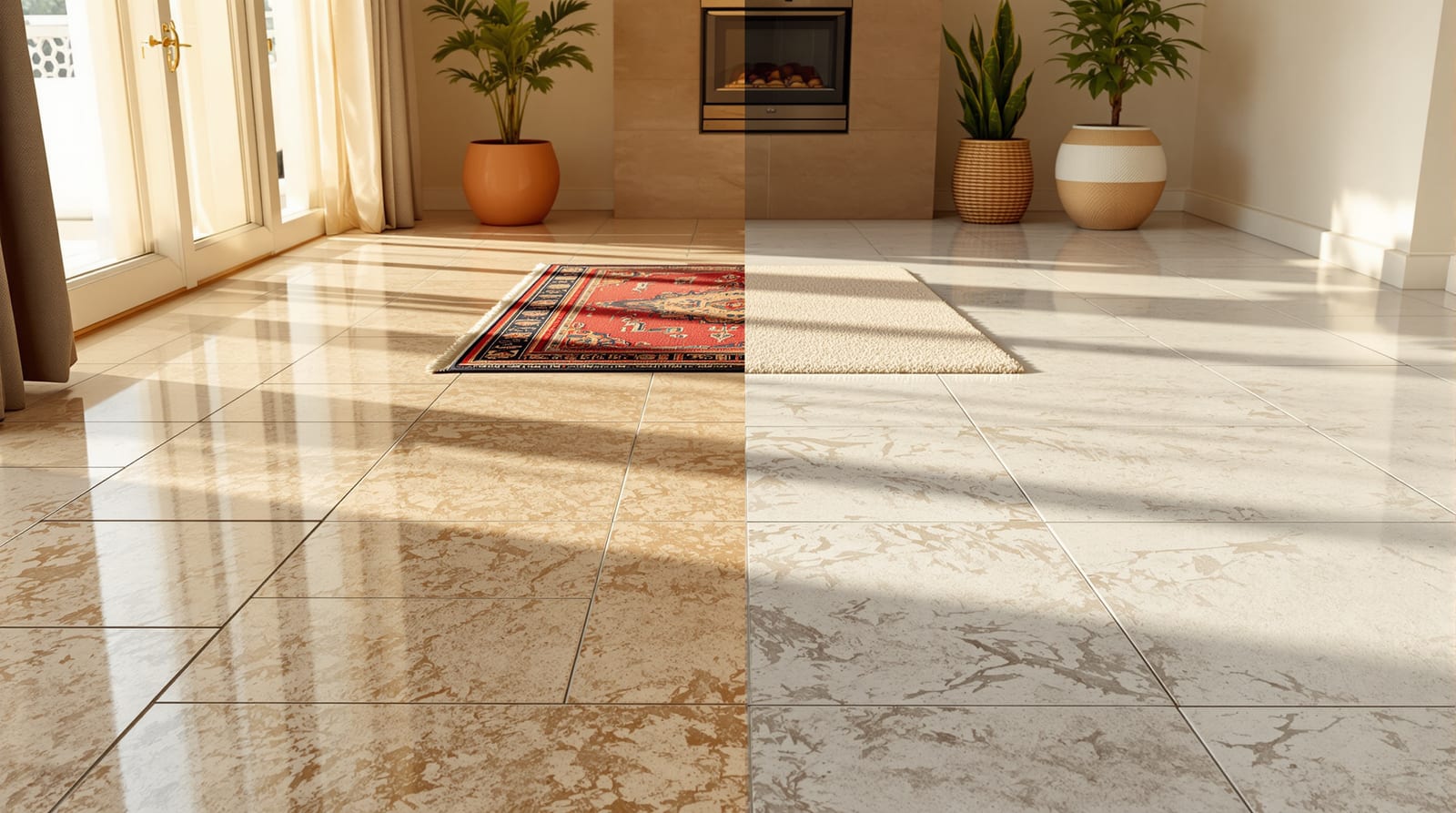
Floor Finish vs Floor Covering: What's the Difference in India? (2026)
A permanent bonded finish (tiles, stone, epoxy, IPS) is part of your building; a covering (carpet, vinyl, SPC click-floor, rugs) is laid over a base and can be lifted — and that distinction changes cost, resale, tenancy and how you build the floor up.
Walk into any tile showroom in India and you will hear "finish" and "covering" used as if they mean the same thing. They do not. A floor finish is bonded permanently into your building — vitrified tiles, granite, marble, epoxy, IPS, polished concrete. A floor covering is laid loose or clicked together over a base and can be lifted again — carpet, sheet vinyl, an SPC click-floor, a rug. That one distinction quietly decides your cost, how disruptive a future change is, what a tenant is allowed to do, and even how the floor is built up beneath your feet. This guide untangles the terms so you can specify the right thing the first time.
The core distinction: bonded vs laid-over
A floor finish becomes part of the structure. Tiles are stuck down with cement mortar or tile adhesive; stone is set in a mortar bed; epoxy, microcement and IPS (Indian Patent Stone, the grey cement floor in older homes) are trowelled wet and cure hard onto the slab. Once it sets, it is monolithic with the building. Removing it means chiselling, dust, debris and often re-doing the surface below.
A floor covering sits on top of a prepared base and is mechanically held, not chemically bonded. A rug is held by gravity. Sheet vinyl and carpet are either loose-laid, taped, or stuck with a peelable adhesive. SPC, WPC, LVT click-planks and laminate "float" — the planks lock to each other, not to the floor, and the whole sheet expands and contracts as one mat. You can unclick a floating floor, roll up a carpet, or lift a rug and the slab underneath is untouched.
Then there is a genuine in-between: engineered wood and laminate laid as floating floors. The material itself feels permanent and looks like a finish, but mechanically it behaves like a covering — no bond to the slab, a foam or cork underlay beneath, and a 4-8 mm expansion gap at every wall. It can be lifted and, in theory, relaid. This is why the same engineered-wood plank can be glued down (acting as a finish) or floated (acting as a covering) — the install method, not the material, decides which camp it sits in.
Why the label matters
The bonded-versus-laid difference is not academic. It changes five practical things.
| Factor | Floor finish (bonded) | Floor covering (laid-over) |
|---|---|---|
| Permanence | Permanent; part of the building | Removable; lifts cleanly |
| Typical materials | Vitrified, ceramic, porcelain, granite, marble, kota, terrazzo, epoxy, microcement, IPS, polished concrete | Carpet, rugs, sheet vinyl, LVT/SPC/WPC click-floor, laminate, engineered wood (floated) |
| Indicative ₹/sq ft (material) | Ceramic 30-80; vitrified 40-150; granite 50-250; marble 80-350; epoxy 80-300; microcement 250-800 | Carpet 40-300; vinyl 40-150; LVT 120-350; SPC 90-250; WPC 100-300; laminate 80-250 |
| Replacing it | Demolish, cart away debris, re-screed, relay — disruptive and dusty | Unclick or lift and roll; minimal mess; often DIY |
| Resale signal | Reads as "real" flooring; buyers value stone/vitrified | Reads as temporary; click-floors can be seen as a stop-gap |
| Tenancy | Owner's domain; tenants rarely allowed to change | Tenant-friendly — lift on move-out, no damage |
All material costs are indicative for 2026 and vary by city, grade and vendor; they are material-only and attract 18% GST, with laying, adhesive, grout and skirting extra. For a project total, the Studio Matrx flooring cost calculator folds in laying and wastage.
Cost and labour are not the same story
Coverings are not automatically cheaper. A premium LVT or wool carpet can out-cost a basic vitrified tile. What changes is the installed cost. A bonded tile finish adds laying labour of roughly ₹15-60/sq ft, plus tile adhesive (₹12-30/sq ft) or a traditional cement-sand bed, plus grout and skirting. A floating click-floor often needs only an underlay and an installer who clicks planks — faster, less wet work, sometimes DIY. So a covering can win on speed and labour even when the material costs more.
Permanence and resale
In the Indian resale market, a buyer walking through a flat reads bonded finishes — granite, vitrified, marble — as the "real" floor and a sign the home is finished to keep. A click-floor or carpet can read as temporary, even when it is good quality. That perception matters for owner-occupied homes you may sell. It matters far less for a rental, where you actively want something you can replace cheaply between tenants.
Tenancy: why renters prefer coverings
If you rent — or you are a landlord furnishing for renters — coverings are the rational choice. A tenant cannot chisel out the landlord's tiles, but they can lay a click SPC floor or a large rug over an ugly existing surface and lift it on move-out with zero damage. Landlords, conversely, often put down a durable bonded finish (vitrified is the default) precisely because tenants will not damage it and it survives many tenancies. The covering protects the tenant's deposit; the finish protects the landlord's asset.
The floor build-up: where finish and covering diverge
To specify either correctly you need to picture the floor in section — the stack of layers from structure up. In an Indian home it usually goes: structural slab (the RCC floor or roof slab), then a screed / levelling layer (cement-sand mortar that flattens and falls the slab to drains), then either the finish bonded onto the screed, or an underlay plus covering laid over it.
The screed is the unsung hero. A bonded finish is laid into or onto the screed while one or both are workable. A floating covering, by contrast, demands a screed that is flat, dry and clean — most click-floor failures (lippage, hollow clicking, peaking) trace back to an uneven or damp base, not the planks. Coverings are fussier about the base precisely because nothing glues them down to forgive imperfections.
For the deeper layer-by-layer detail — damp-proof membranes, expansion gaps, moisture barriers and acceptable screed tolerances — a dedicated layers reference (the "flooring layers" guide in this cluster) walks the full section. For how each material in the table actually behaves, see flooring materials explained.
Climate and wet areas tilt the choice
India's climate pushes hard toward bonded finishes in the places that get wet. Bathrooms, balconies, terraces, utility areas and kitchens want anti-skid vitrified, porcelain or stone — bonded, sealed at the joints, and laid to a fall so water drains. A laid-over covering in a wet area is asking for water to creep under it, trap, and rot or breed mould; sheet vinyl can work in a dry kitchen but loose coverings have no place in an Indian bathroom. Slip resistance here is graded by DIN 51130 R-ratings (R10 and above for wet and outdoor zones) and reinforced by NBC 2016 and the RPwD Harmonised Guidelines 2021 for level, non-slip access.
In humid and coastal homes, solid wood and many coverings suffer — swelling, cupping and salt damage. This is exactly where moisture-stable coverings like SPC earn their place over engineered wood; SPC's rigid stone-polymer core barely moves with humidity. The trade-off between rigid-core coverings is covered in SPC flooring in India. For the bonded side, vitrified and granite remain the durable, low-maintenance default for high-traffic joint-family homes precisely because they are part of the building and shrug off heavy use.
A simple decision frame
Ask three questions. Do you own and intend to keep the home? Lean to a bonded finish — it reads as permanent, adds resale confidence and lasts decades. Is it a rental, or do you expect to change the look in a few years? Lean to a covering — replaceable, less disruptive, deposit-safe. Is the area wet or high-traffic? Bonded anti-skid finish, almost always.
For a whole-home plan that mixes both sensibly — bonded finishes in wet and public zones, coverings or floated wood-look floors in bedrooms — the complete home flooring guide for India ties room-by-room choices together.
Frequently asked questions
Is laminate a floor finish or a floor covering?
Mechanically it is a covering. Laminate is almost always floated — the planks click to each other over a foam underlay, with an expansion gap at the walls, and nothing bonds them to the slab. You can lift and relay it. It looks like a finish but behaves like a covering, which is exactly why it suits renters and quick refreshes.
Can I lay a floor covering directly over my existing tiles?
Often yes — that is a major appeal. A click SPC, WPC or laminate floor, or a large rug, can go straight over sound, flat existing tiles without ripping them out, as long as the surface is level, dry and clean and you account for the small height gain at doors. It is the standard rental-friendly way to change a floor's look without demolition.
Why is a covering fussier about the base than a bonded finish?
Because nothing glues it down. A bonded finish is set into adhesive or mortar that fills small dips and locks it in place. A floating covering rests on the base, so any unevenness shows up as lippage, hollow spots or planks that lift and peak. A flat, dry, clean screed matters more for a covering than for a tile.
Does a floor covering hurt resale value in India?
It can send a "temporary" signal in an owner-occupied flat, where buyers expect bonded granite, vitrified or marble. For a rental it is a non-issue and often a plus, since a landlord values a floor that lifts and replaces cheaply between tenants. Match the choice to whether the home is to keep or to let.
Is engineered wood a finish or a covering?
It depends on how it is installed. Glued down to the screed, it behaves as a bonded finish; floated over an underlay with an expansion gap, it behaves as a covering. The plank is the same — the install method decides. Most Indian installs float it, putting it on the covering side of the line.
Export this guide
Related Guides — Deep-dive reading
Flooring & Finishes Specification for Indian Architects
Performance Criteria, IS Codes, and Detailing for Residential Floors and Wall Finishes
Materials & FinishesFlooring Materials Explained: Every Type for Indian Homes (2026)
One scannable reference to every flooring material family — tiles, natural stone, wood, resilient and seamless — with look, durability, water resistance, ₹/sq ft cost band and where each suits Indian homes.
Flooring & SurfacesAnti Slip Flooring for Bathroom and Wet Areas in India: R-Ratings, Finishes and Genuinely Safe Tile Choices
How to choose genuinely safe flooring for bathrooms, kitchens, balconies, pools, entrances and elderly- or child-friendly homes — the R-rating system, finishes that grip wet feet, anti-skid natural stone, slope to drains and the tiles to avoid.
Flooring & SurfacesRelated Tools — Try Free
Flooring Cost Calculator
Estimate the all-in cost of a floor — material, laying, wastage, skirting and GST — by area and material.
Flooring CalculatorDoor Material Comparison Tool
Compare 2–4 door materials on cost, durability, maintenance, security and moisture resistance.
Comparison ToolCross-Ventilation Analyzer
Estimate airflow and air changes per hour (ACH) from room size, window areas, layout, and local wind — with NBC 2016 Part 8 compliance check.
Ventilation Calculator