
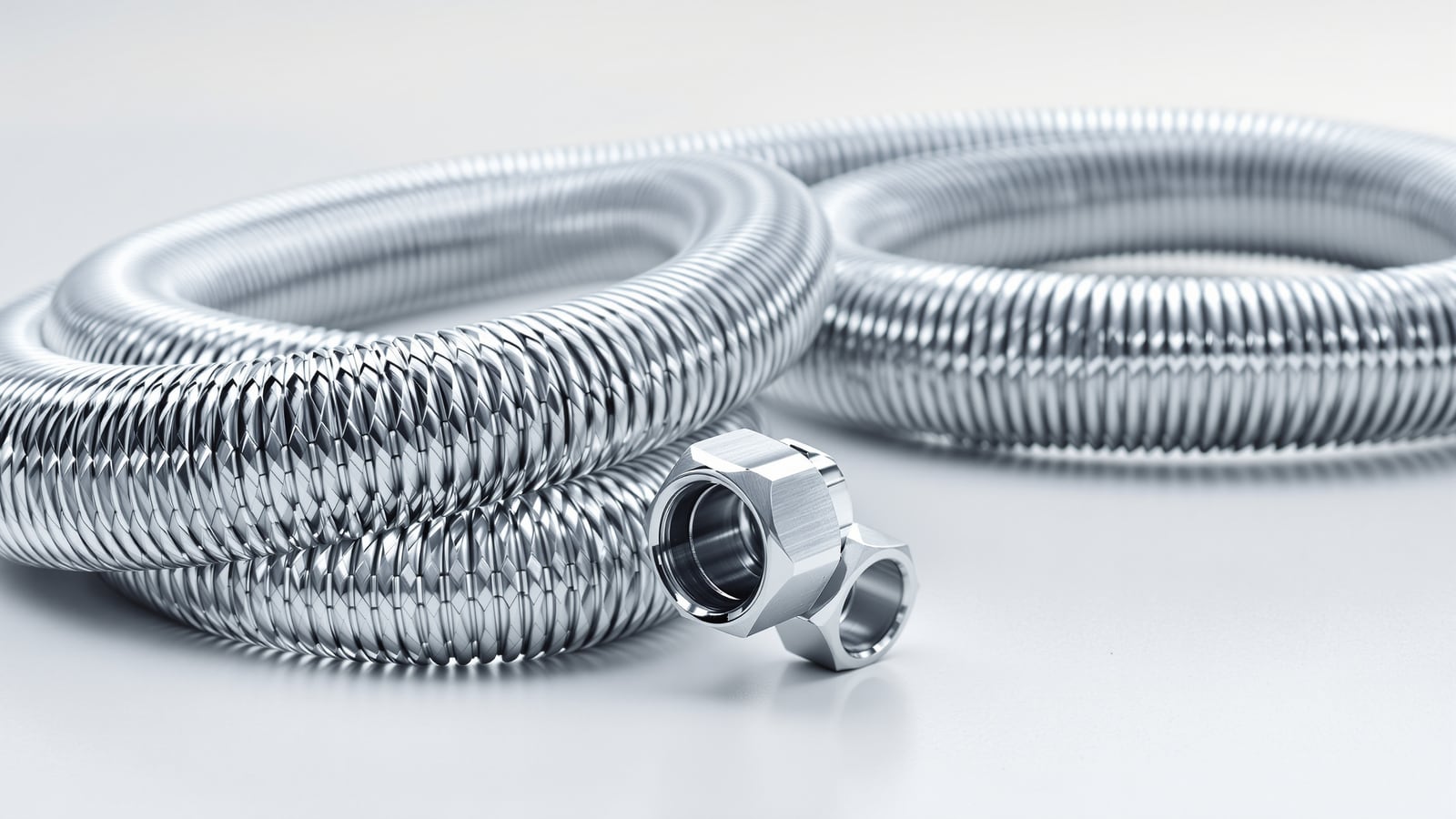
Flexible Pipes & Connectors in India: The Last 30 cm to Your Tap
The braided stainless-steel hoses and corrugated connectors that make the final link from your angle valve to the tap, WC, geyser and basin — where they are used, how to size and choose them, why they burst, and when to replace them before they flood the house.
Almost every tap, toilet, geyser and washbasin in a modern Indian home ends not in a rigid pipe but in a short, bendy hose — a flexible pipe, usually a silver braided tube barely thirty centimetres long. It is the cheapest component in the whole plumbing system and the one most likely to fail catastrophically. A ten-rupee washer weeps; a failed braided hose can empty your overhead tank across the floor while you are at work.
This guide sits within the Studio Matrx Plumbing Pipes hub and covers only the connector pipe — the final, movable link between a fixed supply point and a fixture. For the wall-embedded supply lines that feed those angle valves, see the CPVC vs uPVC comparison and the composite pipes guide; for how these connectors fit into a bathroom install, see the bathroom plumbing guide.
A flexible connector is the one plumbing part with a genuine expiry date. Rigid CPVC in a wall can last decades; a braided hose is a wear item — treat it like a car tyre, not a brick.
What a flexible connector actually is
Behind the shiny braid, a flexible connector is a layered tube:
- An inner core that carries the water — usually EPDM rubber, sometimes PEX or PVC. This is the part that ages, hardens and eventually splits.
- A braided sleeve woven over it — stainless-steel wire on quality hoses, aluminium or nylon on cheap ones. The braid takes the pressure so the soft core does not balloon and burst.
- End fittings crimped on: typically a brass nut and a rubber-sealed cone or a threaded male tail, sized to standard plumbing threads.
The braid is the tell. On a good hose it is bright, tightly and evenly woven stainless steel; on a poor one it is dull aluminium that corrodes to a white powder and frays into sharp whiskers within a year or two in humid Indian bathrooms.
Braided steel vs corrugated vs PVC flexible
Three families get called "flexi pipe" and they are not interchangeable:
- Braided stainless-steel hose — the default for pressurised supply to taps, basins and geysers. Handles mains and pump pressure, tolerates a bit of hot water, and holds its shape.
- Corrugated flexible pipe — a ribbed, all-metal or coated tube that bends without a soft core. Common on WC cistern feeds and some geyser connections where a longer, self-supporting bend is wanted.
- PVC / plastic flexible pipe — a plain plastic bellows connector, cheapest of all, used mostly on low-pressure WC and cistern fills. It will not survive mains pressure or hot water and should never go on a geyser or a pressurised tap.
| Type | Best for | Handles hot water? | Pressure | Typical life |
|---|---|---|---|---|
| Braided stainless-steel hose | Taps, basins, geysers, appliances | Yes, if hot-rated | Mains + pump | ~5-7 years |
| Corrugated flexible pipe | WC feed, longer self-supporting bends | Some grades | Moderate | ~5-7 years |
| PVC / plastic flexi | Low-pressure WC and cistern fills only | No | Low | ~3-5 years |
Where flexible connectors are used in the home
The connector's job is always the same: absorb the small misalignment between a fixed pipe stub-out and a fixture that has to be positioned, tightened and occasionally removed.
- Angle valve to faucet — the classic pairing. The angle valve (stopcock) comes out of the wall; a braided hose runs from it up to the threaded tail of the tap or mixer. Two hoses for a hot-and-cold mixer, one for a single tap.
- Basin and sink taps — the tap's own inlet tails are often too short or awkwardly placed, so a flexible connector bridges the gap under the counter.
- WC and cistern feed — from the angle valve to the cistern inlet float valve. Low pressure, so a corrugated or PVC flexi is common here.
- Geyser connections — inlet (cold) and outlet (hot) to the storage water heater. These see heat and must be rated for hot water; a cold-only hose on a geyser outlet is a frequent, avoidable failure.
- Washing-machine and RO points — braided inlet hoses, often supplied with the appliance.
Sizes and thread connections
Getting the size right is mostly about the thread, not the hose diameter. Indian fittings follow BSP (British Standard Pipe) threads, quoted in inches.
- Half-inch (1/2", 15 mm) is the near-universal domestic size for taps, basins, geysers and most cistern valves. A standard hose is 1/2" female nut × 1/2" female nut, or 1/2" nut × 1/2" male where the tap tail is female.
- Three-eighths (3/8", 10 mm) appears on some imported and designer faucets and on RO connections.
- Length is chosen so the hose runs in a gentle curve — never pulled dead straight (it will strain the crimp) and never kinked into a tight loop (it will crack the core). Common stock lengths are 30, 45 and 60 cm.
Match the thread at each end to what it screws onto: the angle valve outlet at the bottom, the fixture tail at the top. When in doubt, take the old hose to the shop and buy like-for-like.
| Connector spec | Typical size / rating | Where it fits | Notes |
|---|---|---|---|
| Nominal thread | 1/2" BSP (15 mm), some 3/8" | Angle valve & fixture tail | Female-female or female-male |
| Inner bore | ~8-10 mm | All domestic connectors | Sets flow rate, not thread size |
| Working pressure (quality SS braid) | ~10 bar (indicative) | Mains + pump supply | Cheap hoses far lower — verify on pack |
| Burst pressure (quality SS braid) | ~30 bar (indicative) | Safety margin | Not a licence to over-pressurise |
| Temperature limit (hot-rated) | Up to ~90 C (indicative) | Geyser inlet/outlet | Cold-only hoses harden fast on hot |
| Standard lengths | 30 / 45 / 60 cm | Sized to a gentle curve | Never taut, never kinked |
Lifespan and failure risk — the flooding you can prevent
This is the part homeowners underestimate. A braided flexible connector is a consumable. The EPDM core hardens with age, heat and chlorinated water; the braid corrodes if it is not true stainless; and the crimped end is under constant tension. When it lets go, it does not drip — it releases the full supply pressure behind it.
- Typical service life is roughly 5-7 years for a good stainless hose, less for cheap aluminium-braided ones in a hot, humid bathroom. Treat any hose over about five years old as a replacement candidate.
- The classic failure is a burst on a geyser hose or a supply left under mains pressure while the house is empty — a slow leak becomes a steady jet, and an unattended flood follows.
- Warning signs to act on immediately: rust or a white powder on the braid, frayed or "whiskered" wires, bulging or stiffness in the tube, green corrosion at the brass nut, or any weep at the connection.
Replace flexible connectors on a schedule, not on failure. Changing a five-year-old hose costs a few hundred rupees and ten minutes; a burst one can mean ruined flooring, a soaked ceiling below, and a claim your insurer may question.
Two cheap habits prevent most disasters: close the main or the angle valves when you leave the house for days, and inspect every hose whenever you clean under a basin.
Choosing a quality connector
Price tells you almost everything here, and the gap between a bad hose and a good one is a few tens of rupees — the single best-value upgrade in plumbing.
- Insist on 304-grade stainless-steel braid, not aluminium. A magnet-and-eye test: quality braid stays bright; aluminium dulls and powders.
- Brass nuts, not zinc/pot-metal. Cheap nuts crack when tightened or corrode green at the threads.
- Buy hot-rated hoses for geysers and anything on the hot line; check the pack for a temperature figure.
- Reputable brands (for example Jaquar, Prayag, Hindware and other established fittings makers) carry pressure and temperature ratings on the packaging; unbranded loose hoses usually do not.
- Do not over-tighten. These are seated by a rubber cone or washer — hand-tight plus a quarter turn with a spanner. Cranking harder splits the seal, not fixes it.
Pros and cons at a glance
- Pros: cheap; absorb misalignment; let you remove a tap or geyser without cutting pipe; quick to fit; isolate vibration; available in every hardware shop.
- Cons: finite life and a real burst/flood risk; quality varies wildly; the inner core is invisible so ageing is hard to judge; easy to kink or over-tighten during a DIY fit; not for concealing in walls — they must stay accessible for inspection and replacement.
Indicative cost
Connectors are sold individually and prices are modest; the cost of not replacing an old one is what matters.
- PVC / plain plastic flexi (WC, low pressure): around ₹40 to ₹120 each.
- Aluminium-braided hose (avoid for anything important): around ₹60 to ₹150.
- 304 stainless-steel braided hose, 30-45 cm: around ₹150 to ₹450 depending on brand and length.
- Hot-rated / heavy-duty branded hose (geyser): around ₹350 to ₹800.
- Corrugated stainless flexible pipe: around ₹200 to ₹600.
Budget to replace every accessible connector in a bathroom — say four to six hoses — for well under ₹3,000, and do it proactively every five to seven years rather than after a flood.
References
- Bureau of Indian Standards — IS 554 covers dimensions of pipe threads (BSP) used on these fittings; confirm the current edition and the applicable thread and pressure class with a licensed plumber. Flexible connector hoses are typically supplied to manufacturer specification rather than a single household IS grade.
- National Building Code of India (NBC) 2016, Part 9 — Plumbing Services — the governing framework for water-supply plumbing and the requirement that connections remain accessible.
- Manufacturer pressure and temperature rating labels — the authoritative figures for any specific hose; verify working pressure, burst pressure and temperature limit on the pack before fitting, especially on hot-water and geyser connections.
Export this guide
Related Guides — Deep-dive reading
Pillar Taps India: The Single-Supply Basin Tap, Quarter-Turn vs Washer, Cost & Where They Still Win (2026)
What a pillar tap (pillar cock) actually is, why it stays the default on Indian basins, quarter-turn ceramic-disc versus conventional washer types, sizes, finishes, rupee costs, and an honest comparison with a basin mixer.
BathroomsBathroom Leak Repair in India: Find & Fix Common Leaks (2026)
A practical, India-first guide to finding and fixing the everyday bathroom leaks — dripping taps, weeping traps and angle valves, a running cistern, failed silicone seals — plus how to tell a simple fixture leak from a waterproofing failure that needs a professional.
BathroomsBathroom Water Supply India: Cold & Hot Feed, Pipe Sizing, Pressure & Booster Pumps (2026)
How water actually reaches your fixtures in an Indian home — gravity-fed cold from the overhead tank, hot from the geyser, the pipe sizes that decide whether your shower gushes or dribbles, isolation valves at every fixture, booster pumps and hard-water protection, all mapped to IS 1172.
BathroomsRelated Tools — Try Free
Plumbing Pressure-Test & Leak Checklist
Pre-closure pressure and leak test — 9 categories, 60+ checkpoints across water supply, drainage, fixtures, waterproofing, hot water, tanks.
Pre-Closure TestBefore vs After — Cost Reality Check
Compare what you expected to pay vs what you actually paid, category by category.
Reality CheckFalse Ceiling Cost Estimator
Live ₹/sqft across 8 ceiling types — POP, gypsum, designer, metal, PVC, wooden — with cove and spot lighting for 20 Indian cities.
Cost Calculator