
Composite (Multilayer) Pipes in India: PEX-AL-PEX for Hot, Cold and Underfloor Heating
The five-layer pipe with an aluminium core sandwiched between plastic — how it is built, why the metal barrier tames oxygen ingress and thermal movement, how it joints with press and compression fittings, and where it earns its price against CPVC and PPR in India.
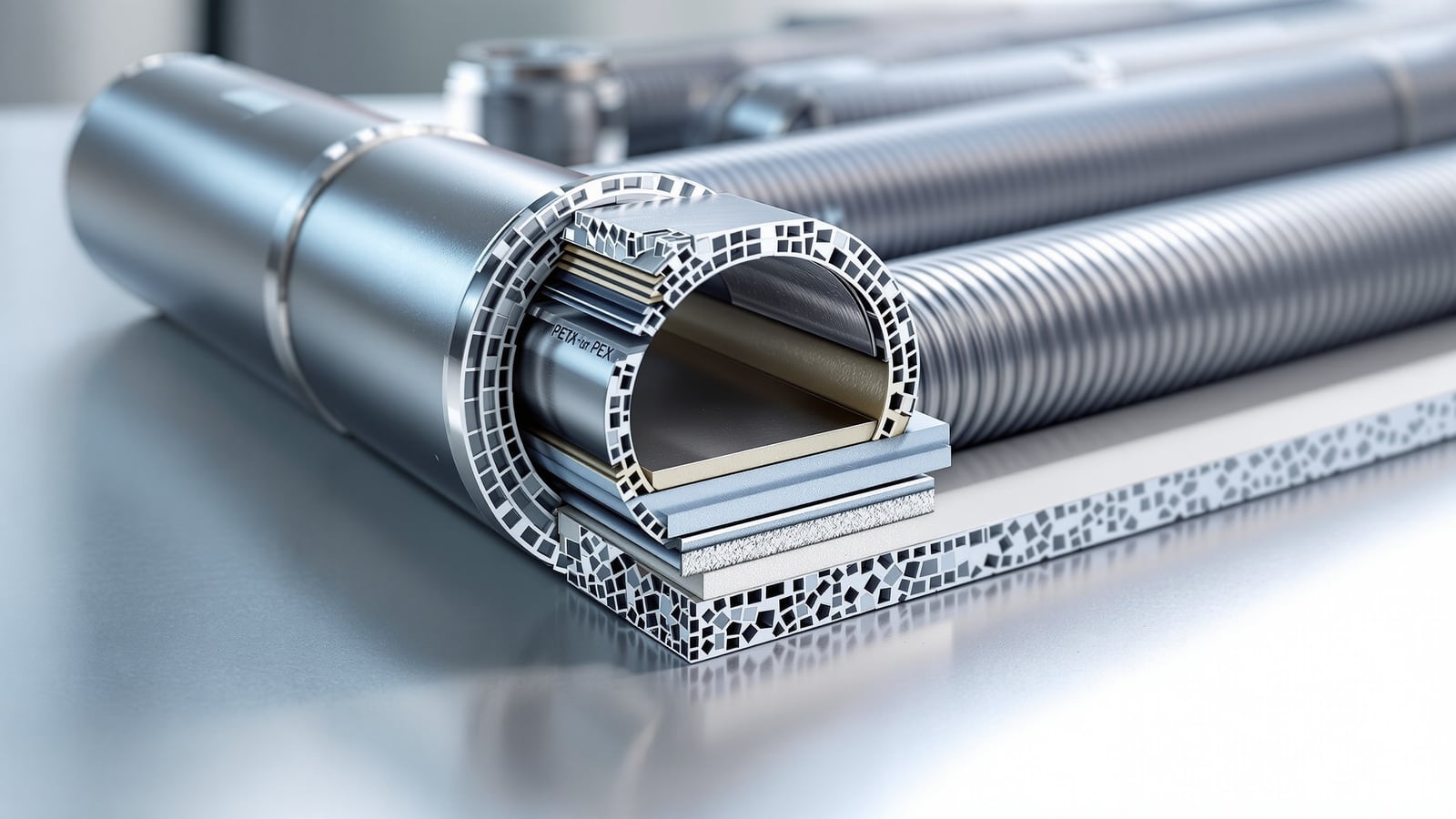
Most plumbing pipe is a single material — solvent-welded CPVC, heat-fused PPR, threaded steel. Composite pipes, often called multilayer or MLCP pipe, are different by design: a thin tube of aluminium is wrapped in plastic on both faces, so the finished pipe behaves neither like pure plastic nor like pure metal, but takes the best of each. Bend it and it stays bent. Heat it and it barely grows. This guide is the material profile within the Studio Matrx Plumbing Pipes hub — what the layers do, how the pipe joints, and where its higher price is justified in Indian work.
For the plastic-only alternatives it competes with, see the sibling profiles on CPVC pipes and PPR pipes; for the coiled, bendable behaviour it shares, the flexible pipes guide.
A composite pipe is a compromise made deliberately: the aluminium gives it the memory and the barrier a plastic pipe lacks, while the plastic gives it the corrosion resistance and quiet smooth bore that metal lacks.
What a composite pipe actually is
Read a cross-section from the inside out and there are five bonded layers:
1. Inner plastic layer — usually crosslinked polyethylene (PEX) or raised-temperature polyethylene (PERT). This is the water-wetted surface: smooth, corrosion-proof, scale-resistant.
2. Adhesive layer — a thin bonding film that welds plastic to metal so the layers cannot delaminate.
3. Aluminium core — a tube of aluminium, longitudinally butt- or overlap-welded, typically a few tenths of a millimetre thick. This is the layer that changes everything.
4. Second adhesive layer.
5. Outer plastic layer — PEX or PERT again, protecting the aluminium from the outside and giving the pipe its finished skin.
Because the two most common builds use crosslinked polyethylene either side of aluminium, the pipe is universally called PEX-AL-PEX; the PERT variant is PERT-AL-PERT. The naming tells you the sandwich at a glance.
What the aluminium core buys you
The metal layer is the reason the pipe exists. Three properties follow directly from it:
- Oxygen barrier. Bare polyethylene is slightly permeable to oxygen — over time, dissolved oxygen diffuses through the pipe wall and into the water. In a closed heating circuit that oxygen corrodes steel boilers, pumps and radiators. The aluminium is a 100 percent oxygen-diffusion barrier, which is precisely why composite pipe is the default for underfloor heating and closed hot-water loops.
- Low thermal expansion. Plastic pipe grows a lot when it heats — a long PEX or PPR hot run can lengthen noticeably and must be clipped loose with expansion offsets. The aluminium restrains the plastic, cutting the pipe's expansion to roughly a quarter to a fifth of an all-plastic pipe's. Long hot runs stay put instead of bowing and creaking.
- It holds its shape when bent. Bend an all-plastic coil and it springs back; bend a composite pipe by hand or with a spring former and the aluminium takes a permanent set — the pipe stays in the curve you gave it. That memory means fewer elbow fittings, cleaner routing, and neat coils that unroll flat.
Sizes, classes and temperature limits
Composite pipe in India is sold by outer diameter, typically in coils for the smaller sizes and straight lengths for the larger. The wall carries the aluminium plus plastic, so the bore is generous for the outer size. Ratings below are indicative — the printed pipe class and the manufacturer's pressure-temperature table govern any real installation.
| Outer dia (mm) | Typical wall (mm) | Common form | Continuous rating (indicative) | Typical use |
|---|---|---|---|---|
| 16 | 2.0 | Coil | Around 10 bar at 70 degC | Underfloor heating loops, single fixtures |
| 20 | 2.25 | Coil | Around 10 bar at 70 degC | Hot and cold branches to fixtures |
| 25 | 2.5 | Coil / length | Around 10 bar at 70 degC | Sub-mains, risers to a bathroom group |
| 32 | 3.0 | Length | Around 10 bar at 70 degC | Mains and distribution runs |
| 40-63 | 3.5-6.0 | Length | Around 10 bar at 70 degC | Larger mains, commercial distribution |
Most domestic composite pipe is rated for continuous service near 70 degC with short excursions higher (commonly quoted around 90-95 degC peak), at a nominal 10 bar — but pressure rating falls as temperature rises, so class the pipe for the hottest the water can reach. Confirm against the printed class and the maker's table.
Because the aluminium restrains movement, the pipe suits hot and cold potable supply, closed heating circuits, and radiant underfloor heating equally. It is not a drainage or soil pipe, and it is not for high-temperature industrial process lines — for those, see the relevant material and use guides in the hub.
Jointing: press and compression, not glue or heat
This is where composite pipe departs most sharply from its plastic rivals. There is no solvent cement as with CPVC and no heat fusion as with PPR. The aluminium core means the pipe cannot be chemically welded to itself, so it joints mechanically onto fittings — and every fitting relies on the same discipline: calibrate and de-burr the cut end first, so the reamer restores a true round bore and chamfers the edge for the fitting's O-rings.
- Press (crimp) fittings. A fitting with a stainless sleeve slides over the calibrated pipe end; a battery press tool crimps the sleeve permanently, biting the pipe onto the fitting's O-rings. Fast, leak-tight, and the industry default for volume work and concealed runs — but the joint is not reusable and the tool and jaws are an investment.
- Compression fittings. A brass body, split ring and nut grip the pipe as the nut is tightened with two spanners — no power tool. Slower per joint and better suited to exposed or serviceable connections, but they let a small contractor start without a press machine.
- Push-fit (push-to-connect). Available from some brands for quick demountable joints; check the specific system's approval for concealed and hot-water use before relying on it in a wall or screed.
The golden rule with every method: an un-reamed, un-calibrated end cuts the O-rings and leaks later. The tool that matters most is the cheap calibrator, not the expensive press.
Composite versus CPVC and PPR
The plastic-only pipes cost less and joint with tooling most Indian plumbers already own. Composite earns its premium where the aluminium's three gifts matter — a heating circuit that needs an oxygen barrier, a long hot run where expansion is a nuisance, or a routing job where hold-your-shape bending saves a dozen fittings.
| Factor | Composite (PEX-AL-PEX) | CPVC | PPR |
|---|---|---|---|
| Joining | Press / compression (mechanical) | Solvent cement (glued) | Heat fusion (welded) |
| Oxygen barrier | Yes (aluminium) | Not applicable to closed loops | Not applicable to closed loops |
| Thermal expansion | Very low (metal-restrained) | Moderate | High |
| Bends and holds shape | Yes, by hand / former | No, rigid | No, rigid |
| Tool to start | Calibrator + press or spanners | Cutter + cement | Fusion welding machine |
| Underfloor heating | Excellent, the default | Uncommon | Possible, less common |
| Relative material cost | Highest of the three | Lower | Lower |
For a fixture-level plastic-versus-plastic decision, the Bathrooms hub's CPVC vs uPVC comparison covers the cold-supply end of that trade-off.
The honest verdict for most Indian homes: for ordinary hot-and-cold potable supply, CPVC or PPR is cheaper and entirely adequate. Composite becomes the right answer when you are laying radiant underfloor heating, running a closed heating loop that must exclude oxygen, or want the clean routing and low expansion of an aluminium-cored pipe on long concealed runs.
Availability, cost and standards in India
Composite pipe is a specialist product in India rather than a hardware-shop staple. It is stocked mainly through plumbing distributors and heating-system suppliers, and is most often specified on villa, hospitality and high-end residential projects — frequently alongside imported underfloor-heating manifolds. Several international system brands sell here, and a growing number of domestic manufacturers offer MLCP ranges.
- Material cost runs well above CPVC and PPR — indicative rates land roughly in the ₹120 to ₹350 per metre band for common 16-25 mm sizes, with fittings a further significant cost. Treat these as indicative and get a current project quote.
- Tooling. A press system means a battery tool plus size-specific jaws — a real capital cost that pays back only on volume work; compression fittings avoid it at the price of slower joints.
- System discipline. Mixing one brand's pipe with another's press fitting is a common and dangerous error — the crimp profile and O-ring geometry are brand-specific. Use pipe and fittings from one approved system.
On standards: composite multilayer pipe is governed internationally by ISO 21003 (multilayer piping systems for hot and cold water installations inside buildings) and, in North American practice, by ASTM F1281 for PEX-AL-PEX and ASTM F1282 for PE-AL-PE composite pressure pipe. Confirm the current standard, class and potable-water approval printed on the pipe and stated by the manufacturer for your specific application before you specify it.
Getting it right — a short checklist
- Match the pipe class to the hottest the water can reach; the nominal rating falls as temperature rises.
- Always calibrate and de-burr every cut end before pressing or compressing — this single step prevents most joint leaks.
- Keep pipe and fittings within one approved system; never cross brands on a press joint.
- Use composite where the aluminium earns its keep — underfloor heating, oxygen-barrier heating loops, long low-expansion runs — and CPVC or PPR where it does not.
- Pressure-test concealed runs before screed or plaster closes them; a buried press joint gets no second chance.
- Treat every figure here as indicative and confirm sizing, class and cost with a licensed plumber and current supplier quotes.
Composite pipe is not a replacement for CPVC or PPR across the board — it is the specialist that wins a specific set of jobs. Where you need a pipe that excludes oxygen, barely expands and holds the shape you bend it into, the aluminium-cored multilayer pipe does what no single-material plastic can, and does it cleanly.
References
- ISO 21003 — Multilayer piping systems for hot and cold water installations inside buildings — the international standard series governing composite multilayer pipe and fittings. Confirm the current edition and class.
- ASTM F1281 — Standard Specification for Crosslinked Polyethylene/Aluminum/Crosslinked Polyethylene (PEX-AL-PEX) Pressure Pipe.
- ASTM F1282 — Standard Specification for Polyethylene/Aluminum/Polyethylene (PE-AL-PE) Composite Pressure Pipe.
- National Building Code of India (NBC) 2016, Part 9 — Plumbing Services — the governing framework for water supply and hot-water distribution in Indian buildings.
- Manufacturer pressure-temperature rating tables and system approvals for the specific composite pipe, fittings and press system chosen. Verify all limits, sizing, potable-water approval and cost locally with a licensed professional.
Export this guide
Related Guides — Deep-dive reading
CPVC vs UPVC Pipe: Which Is Better for Bathroom Plumbing? (India)
A fair, India-first head-to-head: CPVC carries HOT water (geyser lines), UPVC is cold-only. Pressure and temperature ratings, cost, jointing, where each belongs, IS standards, and why confusing the two causes concealed-wall failures.
BathroomsPlumbing Pipes Guide: Every Material & How to Choose (India)
The section pillar for plumbing pipe materials in India — the full family of thermoplastics, metals, iron, concrete and clay, which pipe belongs on hot supply, cold supply, drainage, underground and sewer duty, a comparison-at-a-glance table, sizing basics, jointing methods, and a plain-language method for choosing.
PlumbingBathroom Pipe Material in India: CPVC, UPVC, PEX, PPR & PVC Compared
A brand-neutral, India-first guide to choosing supply and drainage pipes for your bathroom — CPVC for hot and cold, UPVC and PEX for cold, PPR, why old GI corrodes and chokes, temperature ratings, jointing, IS/ASTM standards, a comparison table and ₹ cost.
BathroomsRelated Tools — Try Free
Window Material Comparison Tool
Compare uPVC, aluminium, wood, steel and composite windows on cost, life, upkeep and insulation.
ComparePlumbing Pressure-Test & Leak Checklist
Pre-closure pressure and leak test — 9 categories, 60+ checkpoints across water supply, drainage, fixtures, waterproofing, hot water, tanks.
Pre-Closure TestBathroom Drainage Pipe Calculator
Recommended drain and waste pipe sizes, slopes and stack size for a bathroom's fixtures — indicative IS 1172 / NBC plumbing practice.
Bathroom Calculator