
Facial Recognition CCTV Cameras in India: What They Do, and Why Your Home Almost Certainly Should Not Use Them
Face recognition turns a face into a template and matches it against an enrolled list. Here is honestly what that means, why it is the wrong tool for almost every home, and how to do it responsibly only where a genuine, consented, professional use exists.
Facial-recognition CCTV cameras are marketed as the clever end of home security: a camera that does not just record a visitor, but knows who they are. It is worth understanding exactly what that claim means, because the honest version is very different from the sales version. This guide is the plain-spoken explainer in Studio Matrx's CCTV hub, and it takes a clear position from the start: for almost every home, face recognition is the wrong tool. It is unnecessary, it is less accurate than people assume, and it carries privacy and legal weight that a household is rarely equipped to carry responsibly.
That is not a fashionable opinion. It is the conclusion you reach once you know what the technology actually does and what it demands of you in return. So this guide does three things: it explains what face recognition is, it explains why you almost certainly should not use it at home, and it explains how to do it responsibly if — and only if — a genuine, consented, professional use exists.
Scope, safety & privacy. This is educational guidance, not legal advice. It helps you decide and, where relevant, coordinate a professional install; mounting at height, cabling and mains-electrical work belong to licensed professionals. Cameras belong only on your own property and shared areas — never bathrooms, bedrooms or changing areas. Where the reading below touches the Digital Personal Data Protection Act, 2023 and privacy law, it is described generically; verify current obligations with a qualified professional before you rely on any of it.
Detection is not recognition — the distinction that matters most
The single most important thing to understand is that "the camera sees a face" and "the camera knows whose face it is" are two completely different features, with completely different consequences.
- Face DETECTION finds that a face is present in the frame. It is anonymous. It powers things like framing a snapshot, blurring faces, or triggering a "person at the gate" alert. It builds no database of who people are. Most so-called smart home cameras do only this.
- Face RECOGNITION goes much further. It converts the face into a template — a string of numbers, a mathematical fingerprint of that face — and then matches that template against an enrolled list of known people. The output is an identity: "this is Staff #3," or "no match / unknown," or "watch-list alert."
That template is biometric data. It is the point where a camera stops being a passive record and becomes a system that catalogues and identifies individuals. Everything difficult about face recognition flows from this one step.
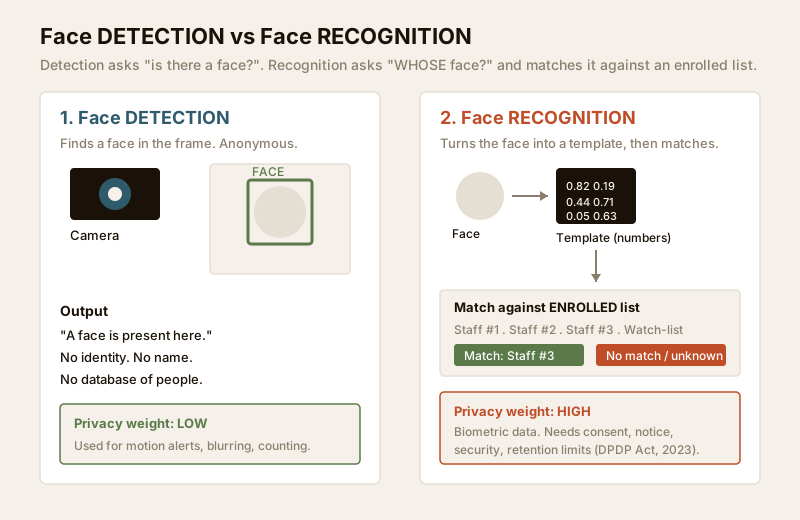
If what you actually want is "alert me when a person or vehicle appears," that is detection and analytics — not recognition — and the AI-powered CCTV guide covers exactly that: human and vehicle detection, line-crossing, loitering and smart alerts, none of which need to identify anyone by name.
| Face detection | Face recognition | |
|---|---|---|
| Question it answers | "Is there a face?" | "Whose face is it?" |
| Creates a face template? | No | Yes — biometric data |
| Needs an enrolled database? | No | Yes — a list of known people |
| Typical use | Motion alert, blur, snapshot framing, counting | Staff access, watch-list, attendance |
| Privacy weight | Low | High |
| DPDP Act, 2023 exposure | Limited | Significant — biometric processing |
| Right tool for a typical home? | Often, yes | Almost never |
The narrow, legitimate uses
Face recognition is not evil; it is specific. It has a small number of genuine, defensible uses, and they share a shape: a defined organisation, a narrow purpose, and people who have consented.
- Staff access at a controlled door. An office or factory where employees have agreed to face-based entry as an alternative to a card or PIN. The enrolled list is the staff; the purpose is access control; consent is part of employment onboarding.
- A watch-list alert at a commercial site. A shop or campus that maintains a small list of individuals it has a lawful reason to be alerted about, checked against people entering a clearly-notified area.
- Attendance or time-and-attendance in a workplace that has told staff, offers an alternative, and secures the data.
Notice what every one of these is not: it is not a private household running recognition on everyone who walks past the gate. The legitimate uses are bounded, consented and accountable. A home is none of those things by default, and that is the crux of the problem.
Why it is the wrong tool for almost every home
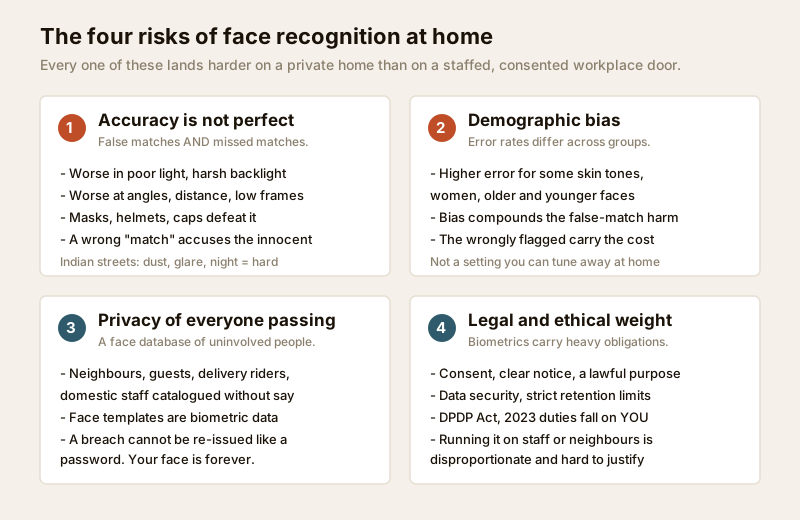
Set aside the marketing and look at four hard realities. Each of them is manageable in a staffed, consented workplace and largely unmanageable at a private home.
1. Accuracy is not perfect
Recognition makes two kinds of mistakes: false matches (it says a stranger is someone on your list) and misses (it fails to match someone it should). Both get worse in exactly the conditions Indian homes live with — poor street lighting, harsh backlight, dust and glare, faces at an angle or at distance, low-resolution night frames, and anyone wearing a helmet, cap or mask. A visitor's two-wheeler helmet defeats it entirely. A false match is not a harmless glitch: it can mean confronting or accusing an innocent person on the strength of a computer's guess.
2. Demographic bias is real
Independent testing has repeatedly shown that recognition systems do not perform equally across all faces — error rates can differ by skin tone, by gender, and at the extremes of age. This is not something you can tune away with a settings menu at home. It means the burden of the system's mistakes falls unevenly, and the people most likely to be wrongly flagged are often those least able to challenge it.
3. It builds a face database of everyone who passes
To recognise anyone, the system holds templates. Run it at a home gate and you are, in effect, cataloguing the biometrics of every neighbour, guest, delivery rider and domestic worker who comes near — people who never agreed to be enrolled. A face template is not a password: if it leaks, it cannot be reset. Your face is with you for life. Amassing that data on uninvolved people is disproportionate, and disproportion is precisely what privacy law is built to prevent.
4. The legal and ethical weight lands on you
Biometric processing is among the most sensitive categories under the Digital Personal Data Protection Act, 2023. Broadly, it expects a lawful purpose, clear notice, meaningful consent, real data security, and defined retention — and when you run the system, those duties are yours. A household is rarely set up to obtain valid consent from passers-by, to secure biometric templates properly, or to honour deletion requests. Running recognition on domestic staff or neighbours in particular is ethically fraught and very hard to justify. (This is described generically — confirm specifics with a qualified professional.)
"Should you use facial recognition?" — the honest decision table
| Your situation | Recommended answer | Why |
|---|---|---|
| A private home wanting alerts and evidence | No | Detection + human/vehicle analytics + good basics already do this — without a face database |
| A home wanting to "recognise family" for convenience | No | Marginal convenience, disproportionate data; a keypad, tag or app does the same job |
| A home gate on a busy street | No, emphatically | You would enrol every passer-by; poor light and helmets wreck accuracy anyway |
| Small shop, owner-run, no consent process | Not yet | The obligations (notice, consent, security, retention) must exist first |
| Office door, staff have consented, alternative offered | Possibly | A narrow, consented, accountable purpose — the legitimate case |
| Commercial site with a lawful watch-list and notices | Possibly | Bounded purpose, professional data handling, clear signage |
| Anywhere targeting neighbours, staff or the public covertly | Never | Disproportionate, non-consensual, and ethically indefensible |
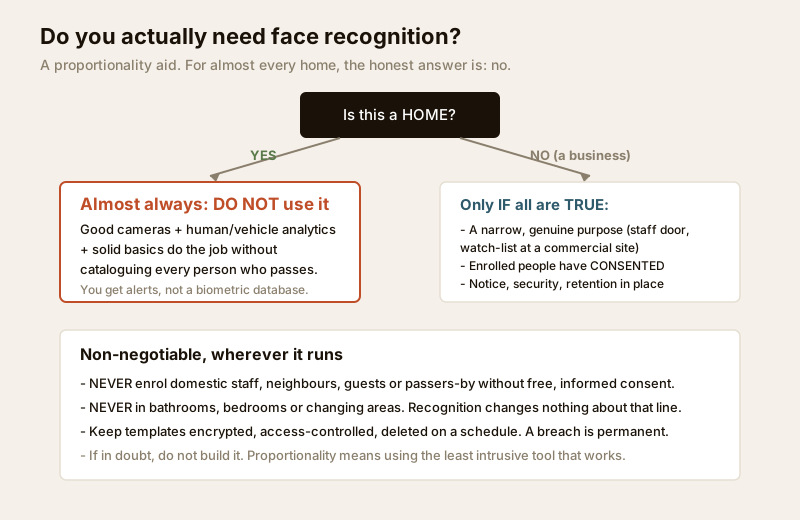
For most readers, the table has one row that applies, and its answer is no. That is not timidity; it is proportionality — the principle of using the least intrusive tool that actually solves your problem.
What to do instead at home
The good news is that everything a household genuinely wants from "smart" cameras is available without recognition:
- Human and vehicle detection for meaningful alerts that ignore cats, leaves and headlights — see the AI-powered CCTV guide.
- Good cameras, well placed, with the camera type selector and honest coverage planning.
- Solid basics — lighting so faces are visible without recognition, no blind spots, a backed-up recorder — covered in the building security systems guide.
- A privacy pass over your whole scheme, so cameras see only what they should — walk it through with the security and privacy assessment.
You get alerts, evidence and deterrence. You do not get a biometric database, a bias problem, or a set of legal duties you are not resourced to meet. That trade is almost always the right one for a home.
If a genuine, consented, professional use really exists
Suppose you are not a household but a small business with the legitimate case above. Then recognition can be done responsibly — and "responsibly" is a high bar, not a checkbox:
- Purpose first, narrow and written. Name the single purpose (e.g. staff-door access). If you cannot state it in a sentence, do not deploy it.
- Consent and an alternative. Enrolled people must agree freely and be offered a non-biometric alternative (card, PIN). Consent extracted from someone who has no real choice is not consent.
- Clear notice. Visible signage tells people recognition is in use, by whom, and why.
- Enrol only the necessary list. The staff or the lawful watch-list — never the general public who merely pass by.
- Secure the templates. Encrypt at rest and in transit, restrict access, log it. Treat a face template like the most sensitive record you hold, because it is.
- Retention and deletion. Keep templates only as long as the purpose needs, delete on a schedule and on request (a leaver, a withdrawal of consent).
- Never on domestic staff or neighbours. This bears repeating as a hard line, not a guideline.
- Never in bathrooms, bedrooms or changing areas — recognition changes nothing about that absolute rule, drawn again in the privacy assessment.
When to bring in a professional. Recognition is not a DIY feature. If you have a legitimate case, engage a qualified integrator to design and secure the system, and take legal advice on your DPDP Act, 2023 obligations before a single face is enrolled. Route mains-electrical work to a licensed electrician (see the electrical hub), mounting and cabling to a licensed installer, and treat the data-protection side as seriously as the wiring. If the responsible version feels too heavy to run properly, that is the system telling you it is disproportionate for your site.
Key takeaways
- Face recognition is not face detection. Recognition turns a face into a biometric template and matches it against an enrolled list; detection just notices a face is present. Only recognition creates the hard problems.
- Its accuracy is imperfect — false matches and misses, worse in poor light, at angles, and with helmets or masks — and it carries real demographic bias you cannot tune away.
- Running it at a home catalogues the biometrics of everyone who passes — neighbours, guests, delivery riders, domestic staff — which is disproportionate and legally heavy under the DPDP Act, 2023.
- For almost every home the answer is: do not use it. Good cameras + human/vehicle analytics + solid basics deliver alerts, evidence and deterrence without a face database.
- Use it only where a narrow, consented, notified, professionally-secured purpose exists — and never on domestic staff or neighbours, and never in private spaces. Sanity-check your whole scheme with the security and privacy assessment.
References
- Digital Personal Data Protection Act, 2023 — biometric data (including face templates) is sensitive personal data; processing generally requires a lawful purpose, notice, consent, security safeguards and defined retention. This guide describes the Act generically; verify current obligations with a qualified professional.
- Independent evaluations of face-recognition systems (e.g. national metrology testing programmes) have documented accuracy limits and demographic differentials in error rates; treat vendor accuracy claims with scepticism and demand independent evidence.
- National Building Code of India (SP 7), Bureau of Indian Standards, and local municipal bye-laws for any structural, electrical or life-safety aspect of an install; verify the current edition via the BIS catalogue: https://www.services.bis.gov.in/
This is an educational overview, not legal advice. Facial recognition involves sensitive biometric data and significant legal duties — take qualified legal advice and engage licensed professionals before deploying it, and verify any standard's current status via the BIS catalogue before relying on it.
Export this guide
Related Guides — Deep-dive reading
Facial Recognition Privacy in India (2026): The Face Is Not Just Another Password
A face is biometric data you can never change if it leaks, and it can be captured without your cooperation. Before you enrol anyone's face into a lock, camera or entry system, understand the privacy duties, the consent it demands, and the alternatives you must always offer.
SecuritySecurity Privacy Assessment for Indian Homes
Getting the privacy side of home security right: camera placement ethics and limits, notice and consent, the extra caution audio demands, and treating footage as personal data you store, retain and delete responsibly under India's DPDP Act 2023 direction.
SecurityAI-Powered CCTV in India: What the Analytics Really Do
What AI-powered CCTV actually means, which analytics are genuinely useful at a home, and how to weigh the cost, accuracy limits and privacy of features like facial recognition before you buy.
SecurityRelated Tools — Try Free
CCTV Detection Feature Selector
Answer four questions and get the right detection feature — basic motion, human/vehicle AI, line-crossing, intrusion-zone, auto-tracking or video analytics.
Detection SelectorCCTV Placement Compliance Checker
A quick DPDP-grounded privacy and safety self-check for where a camera is pointed — flags the items to fix.
ComplianceSecurity Vendor Evaluation Scorecard
Rate a CCTV/security installer or guarding agency across eight weighted criteria for a hire / negotiate / walk-away verdict.
Vendor Scorecard