
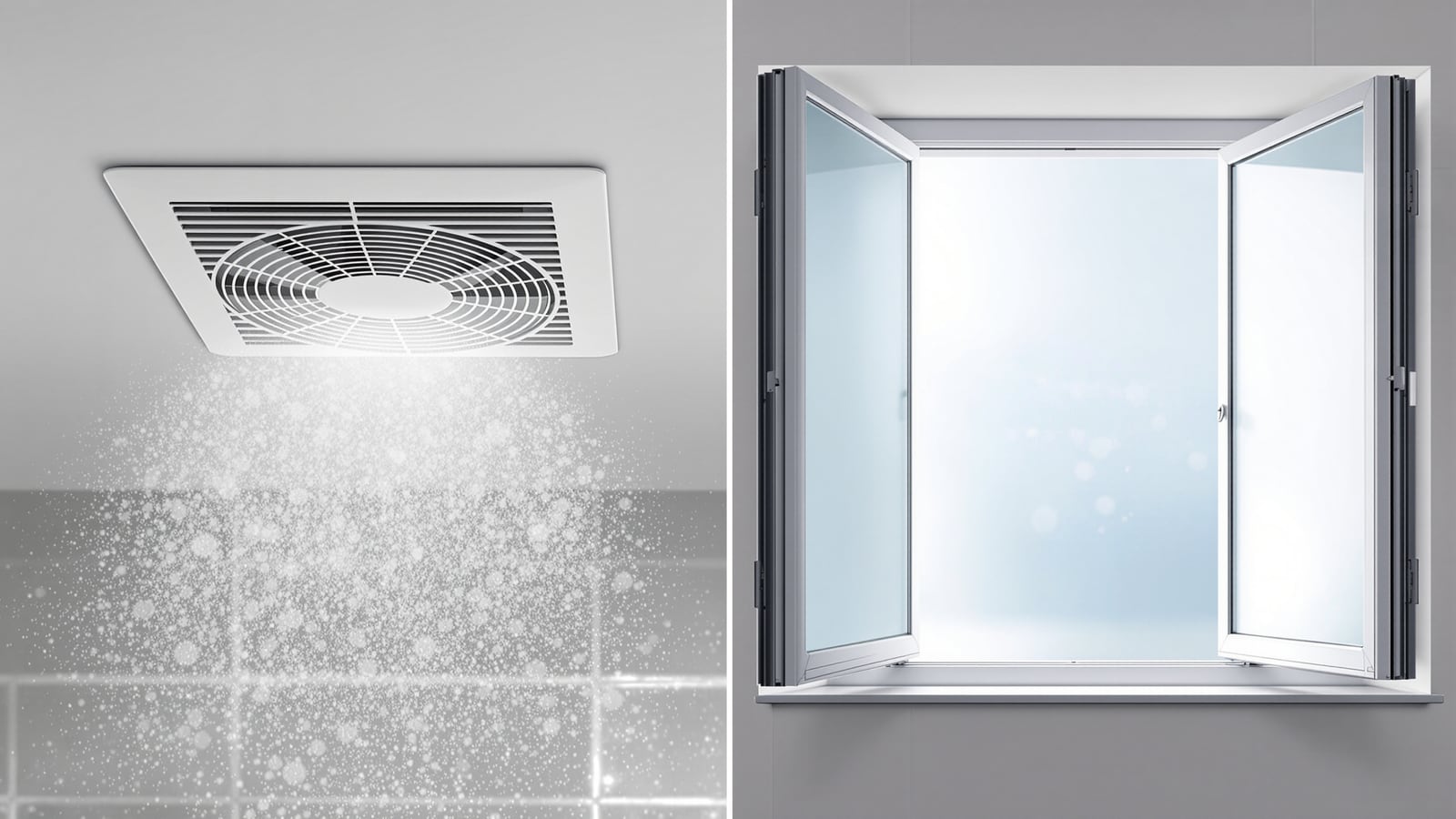
Exhaust Fan vs Natural Ventilation for Indian Bathrooms: Which Actually Keeps It Dry? (India)
A fair, room-by-room verdict on mechanical exhaust fans versus natural window-and-ventilator airflow — moisture and odour removal, the windowless reality, monsoon humidity, running cost, what NBC 2016 demands, and why the honest answer for most Indian bathrooms is 'both'.
Ask two builders how an Indian bathroom should be ventilated and you will get two confident, opposite answers. One swears by a high ventilator and a good window — free, silent, no electricity bill. The other fits an exhaust fan in every bathroom on principle. Both are half right, and the argument matters because ventilation, not tiles or sanitaryware, is what decides whether the room stays dry and mould-free through a decade of monsoons.
This is a head-to-head comparison of the two ways to move humid, smelly air out of a bathroom: a mechanical exhaust fan versus natural ventilation through a window or ventilator. We will score them fairly, attribute by attribute, then give you a clear verdict by bathroom type. For the standalone hardware detail, read this alongside the bathroom exhaust fan guide and the natural bathroom ventilation guide; for how ventilation sits within the whole room, start from the complete bathroom ventilation guide.
The honest answer for most Indian bathrooms is not "fan" or "window" — it is both. A window handles the pleasant, breezy months for free; a fan guarantees the room dries out on a still, saturated monsoon night when the window does nothing. The two cover each other's weak days.
What each one actually is
Natural ventilation moves air through openings — a window, a high-level ventilator, a louvre, or the gap under the door — driven by wind and the fact that warm, moist air rises and escapes. It costs nothing to run, needs no power (which matters during load-shedding), makes no noise, and never breaks down. In a corner bathroom with cross-openings and a decent breeze, it can be genuinely enough for much of the year.
Mechanical ventilation uses a powered exhaust fan, ducted to the outside, to pull a guaranteed volume of air out no matter what the weather is doing. It works on the stillest, wettest day, can be automated with a timer or humidity sensor, and is the only option that works in a bathroom with no external wall. Its costs are the fan, the wiring, a duct route outside, a little electricity, and some noise.
The core difference is reliability versus zero cost. Natural ventilation is free but conditional on weather and geometry; a fan is dependable but has to be bought, wired, ducted, powered and occasionally cleaned.
The head-to-head verdict table
Here is the fair, attribute-by-attribute scorecard. Neither option sweeps it — each wins the rows it deserves.
| Attribute | Natural ventilation | Exhaust fan | Winner |
|---|---|---|---|
| Moisture removal reliability | Good on breezy days, poor on still ones | Consistent in any weather | Fan |
| Odour removal | Slow, drifts back on still air | Pulls it out at the source, fast | Fan |
| Works in a windowless bathroom | Impossible — needs an opening | The only workable option | Fan |
| Monsoon humid, still days | Barely moves air; room stays wet | Runs at full rate regardless | Fan |
| Running cost / energy | Zero | ~₹15–60/month if used sensibly | Natural |
| Upfront cost | Nil (opening already there) | ₹800–4,000 fan + wiring + duct | Natural |
| Power-cut resilience | Always works | Dead without electricity | Natural |
| Noise | Silent | Faint hum to noticeable whir | Natural |
| Maintenance | None | Clean/dust every few months | Natural |
| Controllability / automation | None — weather decides | Timer + humidistat, foolproof | Fan |
| Fresh air & daylight | Brings both in | Extracts only; no daylight | Natural |
| NBC 2016 compliance route | Only if opening area is adequate | Compliant where opening is absent | Depends |
Read the table and the pattern is obvious: natural ventilation wins on cost, silence and simplicity; the fan wins on reliability, odour control and the ability to work when and where the window cannot. In a humid country, reliability is usually the row that matters most — but not always, which is why the choice depends on the room.
The rows that decide it in India
Three realities tip the balance more than anything else in an Indian home.
- The windowless-bathroom reality. A large share of Indian apartment bathrooms are internal — no external wall, no window. Here natural ventilation is not weak, it is impossible, and an exhaust fan is not optional. Nothing else moves the air. NBC 2016 treats compliant mechanical extract as the expected, legal solution for such rooms, so this is not a compromise — it is the correct design.
- Monsoon humidity. Natural ventilation depends on drier outside air flowing in to carry moisture away. Through the monsoon, the outside air is already saturated and often dead still, so an open window barely dries the room — sometimes it makes it damper. A fan keeps pulling its rated airflow regardless, which is exactly when you need it most. This is the single strongest argument against relying on natural airflow alone.
- Odour at the source. A ventilator high on the wall lets smells drift up and out slowly; a fan sited over the WC or shower pulls them out before they spread into the home. For a shared or guest bathroom, that speed matters.
Against all that, natural ventilation's trump cards are cost and resilience. It costs nothing to buy or run, it keeps working through a power cut, and in a well-oriented bathroom with a real breeze it does a genuinely good job for much of the year. Daylight and fresh air are real bonuses a fan cannot give.
Running cost: the fan is cheaper than people fear
The most common objection to a fan is the electricity bill, and it is largely a myth. A typical bathroom exhaust fan draws roughly 15–40 watts. Run for an hour a day, that is well under a unit of electricity a week — on the order of ₹15–60 a month even if used generously. Set against the cost of repainting a mould-stained ceiling, replacing a swollen vanity, or scrubbing black silicone every few months, a fan is the cheapest durability insurance in the bathroom. Natural ventilation still wins the running-cost row at exactly zero — but the fan's "expense" is small enough that it rarely deserves to decide the choice.
Which should you choose? Verdict by bathroom type
There is no single winner — the right answer is set by the room.
| Bathroom type | Choose | Why |
|---|---|---|
| Windowless / internal apartment bath | Exhaust fan (mandatory) | No opening exists; the fan is the only air path and the NBC route |
| Bathroom with a good window, breezy site | Natural + a fan for backup | Free most of the year; fan covers still monsoon days |
| Shower / wet room | Fan (plus any window) | High steam load needs guaranteed, high-rate extract |
| Guest / powder room (odour-critical) | Fan | Fast odour clearance at the source beats slow drift |
| Ground-floor bath with big openings, dry climate | Natural, fan optional | Strong cross-ventilation can genuinely suffice |
| Any AC-tight or high-end home | Fan (or HRV) | Sealed rooms need mechanical extract to dry out |
The pattern across the table is consistent: wherever moisture load is high or the opening is inadequate, the fan wins; wherever there is a genuine window, a breeze and a dry-ish climate, natural ventilation earns its keep — and adding a modest fan as backup turns a good-most-days system into a dries-every-day one.
Why "both" is the real answer
Set as rivals, the two options look like an either/or. In practice the best Indian bathrooms run them as a team. The window and ventilator do the easy work for free through the pleasant months, bring in daylight, and keep the fan's running hours — and its bill — low. The fan sits there as the guarantee: on the dead-still, saturated monsoon night when the open window is doing nothing, it dries the room out anyway. Fit a timer or humidistat switch so the fan runs through the shower and 15–20 minutes after, leave a 10–15 mm undercut under the door so replacement air can get in, and you have a system that is cheap to run and never lets the room stay wet.
Whichever you land on, condensation is the symptom to design against — the surface-warming, drainage and run-on-fan detail is in the bathroom condensation prevention guide. For the hardware itself, size and specify from the bathroom exhaust fan guide and natural bathroom ventilation guide, and see how it all fits the room in the complete bathroom ventilation guide.
References
- National Building Code of India (NBC) 2016, Part 8 (Building Services, Section 1 Lighting and Ventilation) and Part 9 (Plumbing Services) — natural-ventilation opening-area rules and mechanical air-change requirements for bathrooms and water-closets.
- IS 3103 — Code of practice for industrial ventilation (Bureau of Indian Standards), for air-change-rate principles.
- Central Public Health and Environmental Engineering Organisation (CPHEEO) manuals — ventilation and humidity-control guidance for sanitary and wet spaces.
- CPWD specifications and general guidance — mechanical exhaust provisions for internal toilets and bathrooms.
- Bureau of Energy Efficiency (BEE) — appliance power-rating references used to estimate exhaust-fan running cost.
Export this guide
Related Guides — Deep-dive reading
Bathroom Ventilation India: The Complete Guide to Moisture, Mould, NBC 2016 Air Changes & Windowless Solutions
Why bathroom ventilation matters more than any fitting in an Indian home — how moisture, mould and odour build up, natural versus mechanical options, what NBC 2016 actually requires, how to size a fan by air changes and CFM, and how to ventilate a windowless bathroom that stays dry through the monsoon.
BathroomsBathroom Exhaust Fan India: CFM Sizing, Wall vs Ceiling vs Inline, Ducting, Sones & Cost
How to specify a bathroom exhaust fan that actually clears steam in an Indian home — sizing by CFM from room volume and air changes, choosing wall, ceiling or inline, ducting it to outside air (never into a false-ceiling void), and picking backdraft-damper, humidity-sensor and timer models at the right noise and IP rating.
BathroomsSolar vs Electric Water Heater: Which to Choose for Your Home in India
The energy-source decision for whole-home hot water — a solar water heater's high upfront cost and near-free running against an electric geyser's cheap install and steep monthly bill. Upfront vs running cost, payback, roof needs, seasonal reliability, and a clear verdict by household.
PlumbingRelated Tools — Try Free
Cross-Ventilation Analyzer
Estimate airflow and air changes per hour (ACH) from room size, window areas, layout, and local wind — with NBC 2016 Part 8 compliance check.
Ventilation CalculatorWindow Size Calculator
Get the right window size, glazing area and openable area for any room using NBC daylight rules.
Window ToolHome Ventilation Score Calculator
Rate any room's natural ventilation 0 to 100 from openable area, layout and fan or stack assist.
Window Tool