
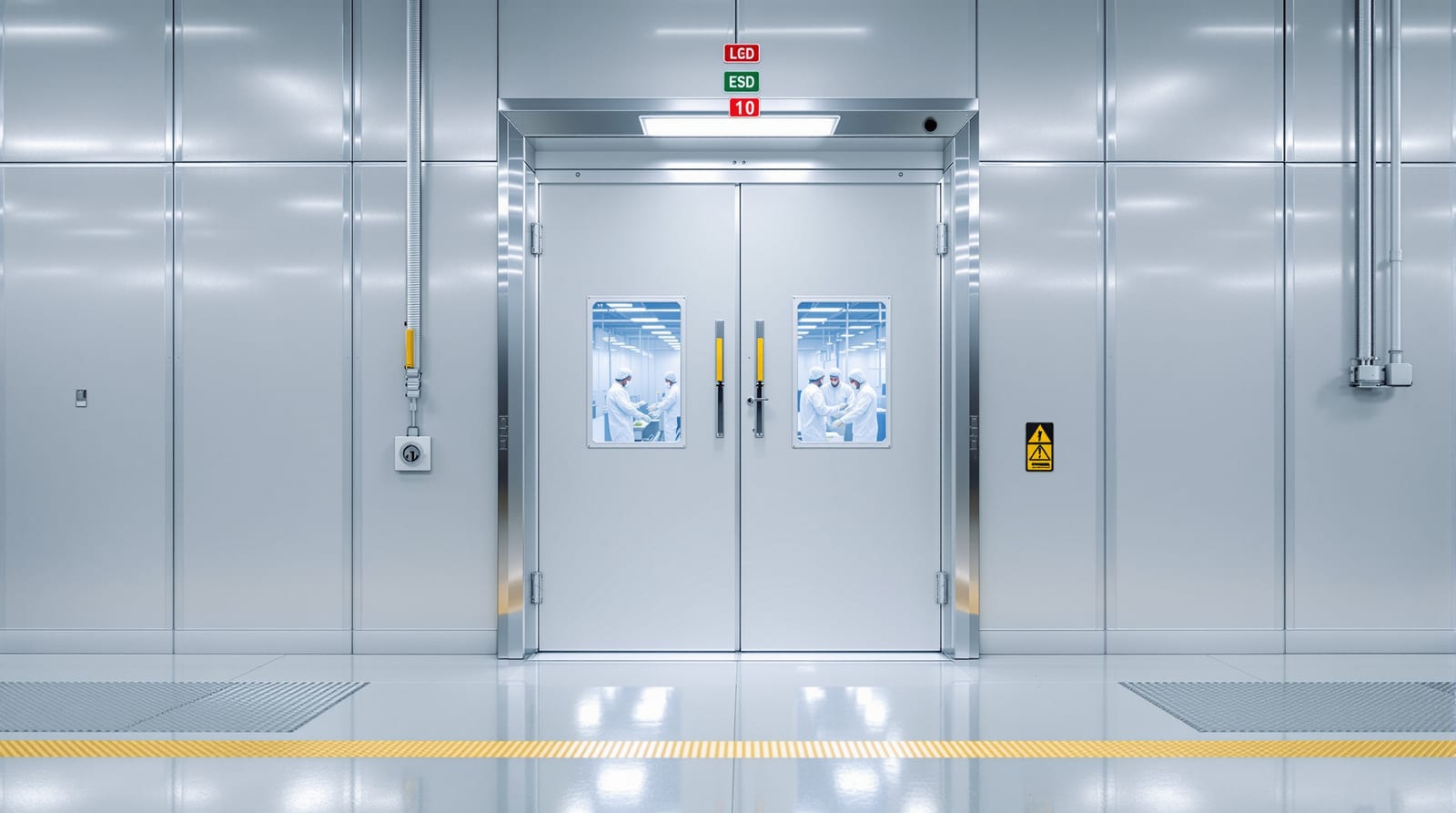
ESD Anti-Static Doors for EPA & Cleanrooms (India 2026)
How dissipative-surface, earthed ESD doors protect electronics and semiconductor EPAs — surface resistivity, grounding and S20.20 context in India.
In any electronics, PCB-assembly or semiconductor environment, the humble doorway is a charge-generation point that most specifiers overlook. People walking up, gloved hands gripping a handle, and a swinging leaf rubbing against gaskets all build triboelectric charge that a stray touch can dump straight into sensitive devices. ESD anti-static doors close that gap: they present a static-dissipative surface and a continuous earth path so charge bleeds away to ground at a controlled rate rather than discharging through a microchip. They are a core element of any properly designed EPA (ESD-protected area) and must be engineered alongside ESD flooring, wrist straps and grounded workbenches — not bought as an afterthought.
This guide is specifier-grade and India-focused. For the wider family of advanced door types see specialty doors and the cluster complete door guide. ESD doors sit close to — and often inside — pharma and electronics cleanrooms, so read them with pharma cleanroom doors and hermetic doors.
Why ESD anti-static doors matter
Electrostatic discharge damages semiconductors in two ways: catastrophic failures you can find at test, and latent defects that pass test but fail in the field. Modern devices are vulnerable to discharges of just a few volts. An ungrounded person can carry several kilovolts after a short walk on insulating floor. The control philosophy of an EPA is simple — keep everything in the area at the same potential and tie it all to a common ground, so there is no voltage difference to drive a discharge.
A standard painted or laminated door defeats this. Its surface is insulating, it holds charge, and its handle becomes a discharge point. An ESD door instead uses a static-dissipative surface (not a fully conductive one) bonded through hardware and frame to the building's ESD earth. "Dissipative" is deliberate: a hard conductive surface would discharge too fast (a spark), while an insulator never discharges; the dissipative middle ground bleeds charge gently and safely.
Surface resistivity: the defining number
ESD materials are classified by how readily charge moves across or through them, measured as surface resistivity in ohms per square (Ω/sq). The dissipative target for door surfaces is the band below.
| Class | Surface resistivity (Ω/sq) | Behaviour | Use on doors |
|---|---|---|---|
| Conductive | < 1 × 10^4 | Discharges very fast, risk of spark | Avoid for general leaf surfaces |
| Dissipative | 1 × 10^6 to 1 × 10^9 | Controlled, safe bleed-off | Target for ESD door surfaces |
| Anti-static (low-charging) | 1 × 10^9 to 1 × 10^11 | Resists charge generation only | Curtains, strip-screens, low-spec areas |
| Insulative | > 1 × 10^12 | Holds charge | Never in an EPA |
The 1 × 10^6 to 1 × 10^9 Ω/sq dissipative window is what a leaf face, edge banding and laminate should achieve. Note that surface resistivity (Ω/sq) and resistance-to-ground (Ω) are different tests; an ESD door must satisfy both — a dissipative face is useless if it is not also earthed.
Standards and where ESD doors are required
India does not have a stand-alone door code for ESD; specification follows the international EPA standards that Indian electronics and semiconductor clients adopt, plus the cleanroom codes when the door is also a partition element.
| Standard | Scope | Relevance to doors |
|---|---|---|
| ANSI/ESD S20.20 | EPA programme (US, widely adopted in India) | Requires all EPA surfaces — including doors — to be grounded and within resistance limits |
| IEC 61340-5-1 / 5-3 | Protection of electronic devices from ESD | International equivalent; resistance-to-ground and material limits |
| IEC 61340-4-1 | Flooring/surface test methods | Governs how surface/ground resistance is verified |
| ISO 14644 / Schedule M | Cleanroom classification (when applicable) | ESD door must also meet flush, gasketed, washdown cleanroom build |
| IS/IEC 60079 (ATEX context) | Explosive/flammable atmospheres | Anti-static doors specified so they cannot become an ignition source |
ESD doors are required wherever an EPA boundary crosses a doorway: semiconductor fabs and assembly, PCB and SMT lines, hard-disk and connector manufacturing, defence and aerospace electronics, and medical-device electronics. A separate, important case is explosive or flammable atmospheres — solvent stores, paint/spray booths, some pharma and petrochem spaces — where IS/IEC 60079 (the Indian adoption of the IEC 60079 / ATEX framework) demands that surfaces, including doors and any strip curtains, be anti-static so a static spark cannot ignite vapour. The dissipative requirement there is about ignition prevention rather than device protection, but the build is similar.
As always with specialty doors, the final specification is project-engineered against the client's EPA programme and verified by their ESD coordinator — treat the bands here as a planning guide, not a guarantee.
Grounding: leaf, frame and hardware as one earth path
A dissipative surface only works if it is connected to ground. The whole assembly — leaf, frame and hardware — must form a continuous, low-resistance path to the building's ESD earth, which is itself tied to the equipment-grounding conductor (the same star point the ESD floor and benches use).
Key grounding details a vendor must engineer:
Bonding straps
A flexible braided earth strap links the leaf to the frame, bypassing the hinges (hinge bearings are an unreliable electrical path, especially once greased or worn). The frame then connects to the building earth busbar with a dedicated conductor.
Hardware
Handles, push plates, locks and any vision-panel frame are dissipative or conductive and bonded into the same path, so a hand touching the handle is at floor potential.
Resistance-to-ground verification
After installation, the EPA team measures resistance from the leaf face and the handle to the common ground point; ANSI/ESD S20.20 and IEC 61340 give the acceptance band (typically below 1 × 10^9 Ω). This must be re-tested periodically as part of the EPA audit — a once-good door drifts as gaskets age and straps loosen.
Construction and finishes
ESD door leaves are usually flush stainless or powder-coated steel (matching cleanroom build) or FRP, with one of these dissipative finishes:
- ESD powder coat — a carbon-loaded coating giving a dissipative face on a steel leaf; durable and washable.
- ESD/HPL laminate — static-dissipative high-pressure laminate with an embedded conductive grid, bonded with conductive adhesive and earthed via a copper foil.
- ESD FRP / vinyl — for washdown or chemical areas.
- Dissipative vision glazing — flush-glazed panels treated or framed conductively so the glass is not a charge trap.
Perimeter gaskets should be the low-charging type, and any door-mounted strip curtain at the EPA threshold must be anti-static PVC rather than ordinary PVC — see PVC strip-curtain doors. The leaf integrates with the floor system, so coordinate threshold and floor earthing with your ESD flooring contractor at design stage.
Indian cost bands (2026)
Prices are project-specific and largely supply-only; installation, the bonding/earthing works and EPA commissioning are extra and often subcontracted to the ESD-floor or electrical team. GST on doors is 18%.
| Item | Indicative band (₹) | Notes |
|---|---|---|
| ESD powder-coated steel door, single | 18,000 - 45,000 | Supply-only; size and finish dependent |
| ESD HPL-faced cleanroom door + frame | 30,000 - 70,000 | When also a cleanroom partition element |
| Dissipative vision-glazed leaf upgrade | 5,000 - 15,000 | Add-on |
| Bonding straps + earth termination kit | 1,500 - 6,000 | Per door, supply |
| Anti-static PVC strip curtain (EPA threshold) | 4,000 - 12,000 | Per opening |
| EPA resistance commissioning + report | Project quote | Usually bundled with floor commissioning |
As a rule of thumb, the door hardware is a small part of EPA cost; the value is in correct earthing and verified continuity. Always get a vendor specification against the client's S20.20 / IEC 61340 programme and have it signed off by the ESD coordinator.
Choosing an ESD anti-static door
Work through: (1) Is this a device-protection EPA or an ignition-prevention (IS/IEC 60079) area? (2) Is the door also a cleanroom partition (then it must meet flush/gasketed/washdown build too)? (3) What surface-resistivity and resistance-to-ground bands does the client's programme demand? (4) How will the leaf bond to frame, hardware and the building earth, and who commissions it? (5) Does it tie cleanly into the existing ESD floor? Use the specialty door selector to shortlist by environment and the specialty door cost estimator to budget. For neighbouring environments, compare food-grade doors (washdown hygiene) and high-speed doors (throughput at controlled-area thresholds).
Frequently asked questions
What surface resistivity should an ESD door have?
The leaf face and touchable hardware should fall in the static-dissipative band, 1 × 10^6 to 1 × 10^9 Ω/sq. Below 1 × 10^4 is conductive (spark risk); above 1 × 10^11 is anti-static/insulative and will not bleed charge fast enough. The door must also meet resistance-to-ground limits, typically below 1 × 10^9 Ω, verified after install.
Is an anti-static door the same as a grounded door?
No — and you need both. "Anti-static" or "dissipative" describes the surface material; grounding is the continuous earth path (bonding straps, earthed hardware, frame-to-busbar conductor) that actually carries charge away. A dissipative leaf that is not earthed offers little protection.
Which standards govern ESD doors in India?
There is no separate Indian door code; specification follows the EPA standards the client adopts — ANSI/ESD S20.20 and IEC 61340-5-1 for the programme and resistance limits — plus ISO 14644 / Schedule M if the door is also a cleanroom element. For explosive/flammable atmospheres, IS/IEC 60079 drives the anti-static requirement to prevent ignition.
How does the door integrate with ESD flooring?
Both must connect to the same building ESD earth (common ground point), so leaf, hardware and floor sit at one potential. Coordinate the threshold detail and earth terminations with the flooring contractor at design stage, and commission door resistance-to-ground together with the floor.
Do ESD doors need re-testing?
Yes. Resistance-to-ground drifts as gaskets age, straps corrode or loosen, and finishes wear. EPA programmes under S20.20 require periodic verification, so the door is re-measured as part of the regular ESD audit, not just at handover.
Export this guide
Related Guides — Deep-dive reading
Anti-Static & ESD Flooring in India: Conductive vs Dissipative Floors, Resistance Ranges, IEC 61340, Cost & Earthing
Anti-static and ESD flooring — conductive or static-dissipative vinyl, epoxy/PU, rubber and raised-access panels that drain electrostatic charge safely to earth — is mandatory in electronics and semiconductor plants, data centres, telecom, labs, operation theatres, cleanrooms and explosive-risk areas. Here are the types, resistance ranges, IEC 61340 standards, install and earthing, testing, costs of ₹150–600 per sq ft and care.
Flooring & SurfacesHygienic food-grade doors: washdown specs, India 2026
Spec SS304/316 and FRP washdown doors for food, dairy, beverage and meat plants — sealed, crevice-free and FSSAI/HACCP-ready.
Home Doors & EntrancesPharma Cleanroom Doors: GMP Flush Door Guide India 2026
Specifier's guide to flush GI/SS304 cleanroom doors, double vision panels, full gaskets, interlocked airlocks and Schedule M / ISO 14644 compliance.
Home Doors & EntrancesRelated Tools — Try Free
Window Hardware Cost Calculator
Estimate window hardware cost — hinges, handles, locks, rollers and multipoint gears.
Window CalculatorWindow Cost Calculator
Estimate window price plus installation by type, frame material, size, glass and quantity.
Window CalculatorCCTV Commissioning & Handover Checklist
An interactive go/no-go checklist to run at handover — cameras day and night, recording, alerts, passwords and documents — before you clear the final bill.
Handover Checklist