
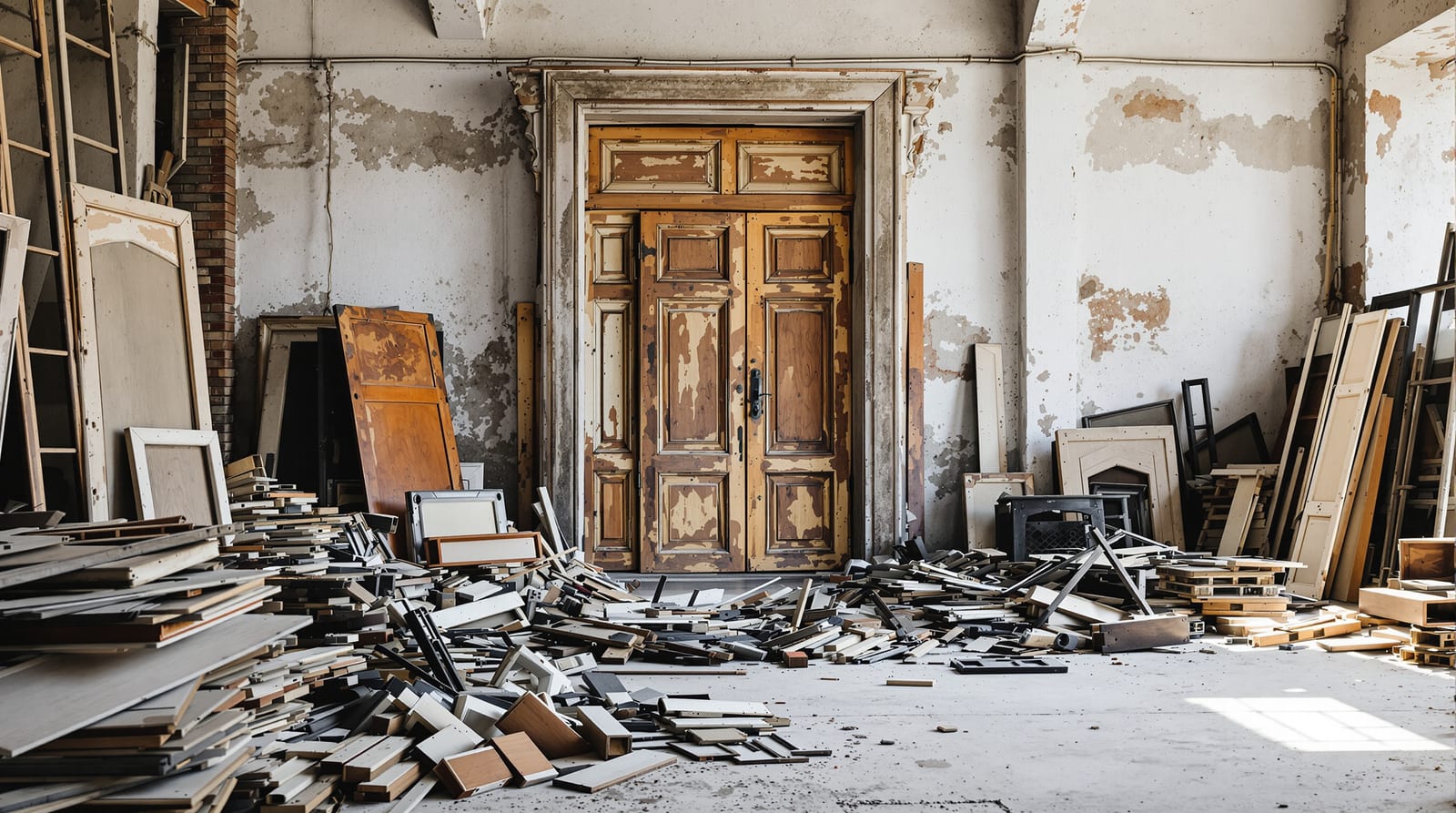
Door Recycling & End-of-Life Disposal Guide (India 2026)
What happens to old doors in India — the reuse-before-recycle waste hierarchy, recyclability by material, scrap markets and how to retire a door responsibly.
Every door eventually comes off its hinges — but where it goes next decides most of its final environmental footprint. Door recycling and end-of-life thinking is the part of sustainability that Indian homeowners skip most often: a perfectly reusable teak shutter gets dumped in a debris skip, an aluminium frame worth real money goes to the bin, and a flush door that could have been firewood ends up in a landfill. Yet India already has a remarkably efficient informal recovery system — the kabadiwala and scrap chain — that, used well, can divert almost any old door from the dump. This Studio Matrx guide walks through the waste hierarchy, what is actually recyclable by material, where the reuse and scrap markets sit, and how to retire a door responsibly. It is the closing of the loop that the circular economy doors guide opens; for the wider sourcing picture, see the sustainable doors Act pillar.
The waste hierarchy: reuse before you recycle
The single most important idea in door recycling and end-of-life is that recycling is not the top choice — it is a middle one. The waste hierarchy ranks the options from best to worst by how much value and embodied energy each keeps:
1. Reuse / refurbish — keep the whole door working. A sanded, re-hung old teak door has near-zero new impact and the lowest carbon of any option.
2. Recycle — break the door back into raw material (re-melt aluminium, re-grind plastic). Good, but it spends energy reprocessing.
3. Energy recovery — burn timber or biomass for heat/power. Releases the stored carbon but displaces other fuel.
4. Landfill — the worst outcome: lost material, lost energy, and slow decomposition or none at all for plastics.
A door at the top of this ladder keeps its shape, its joinery and its embodied carbon intact. Every step down throws more of that away. So before you think 'how do I recycle this door', ask 'can this door simply be used again' — by you, by a salvage dealer, or by someone building a cheaper home. The reclaimed wood doors guide shows the buyer's side of exactly this market.
Recyclability by material — which doors come back
Not every door retires the same way. The material decides whether it climbs the hierarchy or slides to landfill. Here is the realistic India picture in 2026.
Aluminium is the star. It is fully and infinitely recyclable, secondary aluminium uses roughly 90% less energy than primary metal, and crucially it has high scrap value — so the informal sector collects it eagerly. An old aluminium door or frame almost never reaches landfill in India; the kabadiwala pays for it. Steel doors and frames are likewise highly recyclable with a healthy scrap market, magnetically easy to sort and re-melt.
Solid timber sits high on the hierarchy through reuse rather than recycling: a sound teak, sal or seasoned-hardwood door is refurbished and resold, repurposed into furniture or shelving, or — when too far gone — used as biomass fuel or composted (untreated, unpainted wood only). Painted or chemically treated timber should not be burnt domestically or composted. The reclaimed wood doors market thrives precisely because old Indian hardwood is so valuable.
uPVC is recyclable — it can be re-ground and re-extruded — but India's collection and reprocessing network for door/window uPVC is thin, so much of it is downcycled or landfilled despite being technically recoverable.
WPC, flush and engineered doors are the hard cases. WPC fuses plastic and wood flour together, so it cannot be cleanly separated; flush doors glue a hollow or particle core inside ply skins; both usually end up downcycled or in landfill. Their environmental case rests on durability and on what went in, not on coming back out — exactly as the recycled material doors guide explains.
| Material | Recyclability | Best end-of-life route | India reality |
|---|---|---|---|
| Aluminium frame / door | High — infinite | Recycle (re-melt) | High scrap value; kabadiwala collects readily |
| Steel frame / door | High | Recycle (re-melt) | Strong scrap market; magnetically sorted |
| Solid timber (teak, sal) | Reuse / biomass | Reuse → biomass → compost | Salvage market thrives; reuse first |
| uPVC | Moderate | Recycle (re-grind) | Recyclable in theory; thin collection network |
| Recycled / virgin WPC | Low | Downcycle / energy | Fused fibre + plastic; usually landfilled |
| Flush / engineered door | Low | Downcycle / energy | Glued composite; hard to separate |
| Glass (in glazed doors) | High | Recycle separately | Remove and recycle glass before scrapping frame |
India's reuse and scrap markets
India recovers materials better than most countries assume, mostly through the informal sector. Three channels matter for a retiring door.
The kabadiwala / scrap dealer. For metal, this is the default and it works: aluminium and steel doors and frames carry scrap value, so a local scrap dealer will buy or take them. Get a rough rate-per-kg before you hand anything over.
Architectural salvage and second-hand markets. Old solid-wood doors — especially carved, panelled or antique teak — have a lively resale market through salvage dealers, antique restorers and second-hand building-material yards in most Indian cities. A good old door is worth refurbishing and reselling, not skipping.
Donation and reuse. Sound doors that you simply no longer want can go to NGOs, low-cost housing projects, site offices, farmhouses or domestic staff quarters. Reuse keeps the door at the very top of the hierarchy with zero reprocessing energy. The broader door lifespan and durability guide explains how to judge whether a door has reuse life left in it.
The weak link in India is the organised recycling of composite doors (WPC, flush, engineered) and door uPVC — collection networks are immature, so these often default to landfill. Designing them out, or choosing recyclable materials up front, is the real fix; see doors for green buildings for how rating systems reward this.
Design for disassembly
The easiest door to recycle is one built to come apart. Design for disassembly means mechanical fixings (screws, bolts) over permanent glue, separable glass beads, and frames that detach cleanly from the leaf — so at end of life the aluminium, glass, timber and hardware can be sorted into clean streams instead of going to landfill as a fused lump. Ask about this when specifying, not when demolishing.
How to retire a door responsibly — a homeowner's checklist
1. Reuse first. Can the door be re-hung elsewhere, sold to a salvage dealer, or donated? If sound, this beats every other route.
2. Refurbish to extend. Sanding, re-finishing and new hardware can give a tired solid door another decade — the greenest move of all. The door painting guide covers refinishing.
3. Separate the streams. Remove glass, hardware, hinges and handles before scrapping; sort metal from timber from composite.
4. Sell the metal to a kabadiwala. Aluminium and steel have real scrap value and will be recycled.
5. Send untreated timber to biomass or compost; resell treated/painted timber for reuse rather than burning it.
6. Treat WPC, flush and uPVC as the last resort — donate or reuse if possible; otherwise they usually go to construction-and-demolition (C&D) waste handling.
Run a candidate door through the door recyclability checker to see how its material scores at end of life, and the door sustainability scorer to weigh recyclability against durability and embodied carbon when choosing your next door. The honest lesson is that the smartest end-of-life decision is made at purchase: buy a durable, recyclable or reusable door now, and its retirement looks after itself. For the full cradle-to-grave view, the door life cycle assessment guide sets the framework, and the cluster pillar complete door guide covers doors end to end.
Frequently asked questions
Can old doors be recycled in India?
It depends entirely on the material. Aluminium and steel doors are highly recyclable and have real scrap value, so the informal kabadiwala sector collects them readily. uPVC is recyclable but India's collection network is thin. Solid timber is best reused or used as biomass rather than recycled. WPC, flush and engineered doors are hard to recycle because their materials are fused, and usually end up downcycled or in landfill. The door recyclability checker scores any door by material.
What is the best thing to do with an old wooden door?
Reuse it. A sound solid-wood door can be re-hung elsewhere, refurbished and resold through a salvage dealer, repurposed into furniture or a tabletop, or donated to a low-cost housing or site project. Only if it is beyond repair should untreated timber go to biomass fuel or compost — never burn painted or chemically treated wood at home. The reclaimed wood doors guide shows the resale market in action.
Do aluminium doors have scrap value?
Yes, significant value. Aluminium is infinitely recyclable and secondary aluminium uses roughly 90% less energy than primary metal, so scrap dealers pay well for old aluminium doors and frames. This is why aluminium almost never reaches landfill in India. Get a rate-per-kg from a local kabadiwala, and remove glass and hardware first so the metal is a clean stream.
Why are WPC and flush doors hard to recycle?
Because they are composites. WPC fuses plastic and wood flour into a single material that cannot be cleanly separated, and flush doors glue a hollow or particle core inside ply skins. Without separable streams, recyclers cannot recover clean material, so these doors are usually downcycled or landfilled. Their sustainability case rests on lasting a long time, not on being recycled — as the circular economy doors guide explains.
What is the waste hierarchy for doors?
Ranked best to worst: reuse or refurbish the whole door, then recycle it into raw material, then energy recovery (biomass), and landfill as the last resort. Each step down throws away more embodied energy and value. The goal is to climb as high up the pyramid as the door's material allows — reuse a teak door, recycle an aluminium frame, and avoid sending anything to landfill.
How do I dispose of a door responsibly in India?
Reuse or sell it first; refurbish if it has life left. If scrapping, separate glass, hardware and hinges, then sell metal frames to a kabadiwala for recycling, send untreated timber to biomass or compost, and treat WPC, flush and uPVC doors as the last resort through donation or construction-and-demolition waste handling. Buying a durable, recyclable door in the first place — guided by the door life cycle assessment framework — makes responsible disposal far easier.
Export this guide
Related Guides — Deep-dive reading
Circular Economy Doors in India: Buyer's Guide (India 2026)
How to design, specify and buy doors for a circular loop — durability, repairability, design-for-disassembly, reuse, take-back and recyclable materials.
Home Doors & EntrancesRecycled Building Materials in India: The Circular-Economy Guide (2026)
What recycled construction materials actually are, where they can and cannot go into a building, and how to specify recycled content without gambling on quality - a specify-and-select guide for Indian homes and projects.
Building MaterialsCircular Economy in Construction: A Homeowner's Guide to Building Without Waste in India
How to move from take-make-waste to keeping materials in use, on your own plot
SustainabilityRelated Tools — Try Free
Door Material Comparison Tool
Compare 2–4 door materials on cost, durability, maintenance, security and moisture resistance.
Comparison ToolWindow Material Comparison Tool
Compare uPVC, aluminium, wood, steel and composite windows on cost, life, upkeep and insulation.
CompareMaterial Decision Framework (M-Score)
Score 30+ Indian construction materials across cost, durability, climate fit, maintenance, and sustainability.
Materials