
Door cost in Delhi-NCR (2026): prices, markets, GST guide
What doors actually cost across Delhi, Gurugram, Noida, Faridabad and Ghaziabad in 2026 — worked prices with 18% GST and where to buy.
Working out the door cost in Delhi-NCR means treating the region as one market with several price tiers stacked inside it. Delhi, Gurugram (Gurgaon), Noida, Greater Noida, Faridabad and Ghaziabad share suppliers and timber routes, but a teak door quoted in a polished Gurugram showroom can land 25-35% above the same leaf bought from a Ghaziabad or Faridabad wholesale market. On our national index the whole NCR sits at 1.12 — about 12% above the pan-India average — but that single number hides a wide spread you can use to your advantage. This guide gives you worked prices including 18% GST, the markets people actually shop, and the regional quirks that move quotes.
How the door cost in Delhi-NCR price index works
Every price below starts from a national supply-only average (one standard 7×3 ft / 2.1×0.9 m leaf, before installation and GST), then we apply the NCR multiplier of 1.12. "Supply only" means the door leaf alone — frame, hardware, fitting and GST are separate line items. Always ask a dealer whether a quote is supply-only or installed, because the gap is large.
| Door type | National avg (₹) | Delhi-NCR ≈ ×1.12 (₹) | +18% GST (₹) |
|---|---|---|---|
| Hollow-core flush (commercial) | 1,800–3,000 | 2,000–3,360 | 2,360–3,965 |
| Solid-core flush (BWR) | 3,000–5,500 | 3,360–6,160 | 3,965–7,270 |
| Laminate / membrane flush | 4,000–7,000 | 4,480–7,840 | 5,285–9,250 |
| WPC door | 4,500–7,500 | 5,040–8,400 | 5,950–9,910 |
| PVC door (bathroom) | 1,800–4,000 | 2,015–4,480 | 2,380–5,285 |
| uPVC door | 8,000–16,000 | 8,960–17,920 | 10,575–21,150 |
| Sal / hardwood panel | 9,000–16,000 | 10,080–17,920 | 11,895–21,150 |
| Teak panel / carved | 22,000–45,000+ | 24,640–50,400+ | 29,075–59,470+ |
| Designer main door | 30,000–80,000+ | 33,600–89,600+ | 39,650–105,730+ |
These are indicative ranges, not quotes. Use the door cost by city calculator to apply the 1.12 index to your exact spec, and the door GST calculator to add the 18% cleanly.
A worked example
A solid-core BWR flush door that averages ₹4,000 nationally runs about ₹4,480 supply-only in Delhi-NCR. Add a sal frame (~₹2,800 here), a basic hardware set (~₹1,800) and fitting (~₹1,900), and you are at roughly ₹10,980 before tax — about ₹12,960 with 18% GST for one fully fitted internal door. Multiply across a 3BHK and the maths gets real fast.
What a whole 3BHK costs in NCR
A typical Delhi-NCR 3BHK has 10–14 doors: one statement main door, bedroom and study doors, and 2–4 bathroom doors. The mix you choose matters more than the city.
| 3BHK door package (10–12 doors, installed, +GST) | Indicative total |
|---|---|
| Value: hollow/solid-core flush + PVC baths, budget main door | ₹1.3L–₹1.9L |
| Mid: laminate solid-core + WPC baths + decent sal/laminate main door | ₹2.2L–₹3.2L |
| Premium: membrane/veneer doors + designer teak main door + uPVC balcony | ₹3.5L–₹5.5L+ |
The single biggest swing is the main door. A laminate or sal main door keeps you in the value band; a carved teak or designer main door in a Gurugram showroom can be ₹40,000–₹1L on its own. See main door cost in India and teak door cost in India for spec-by-spec detail.
Where to buy doors in Delhi-NCR
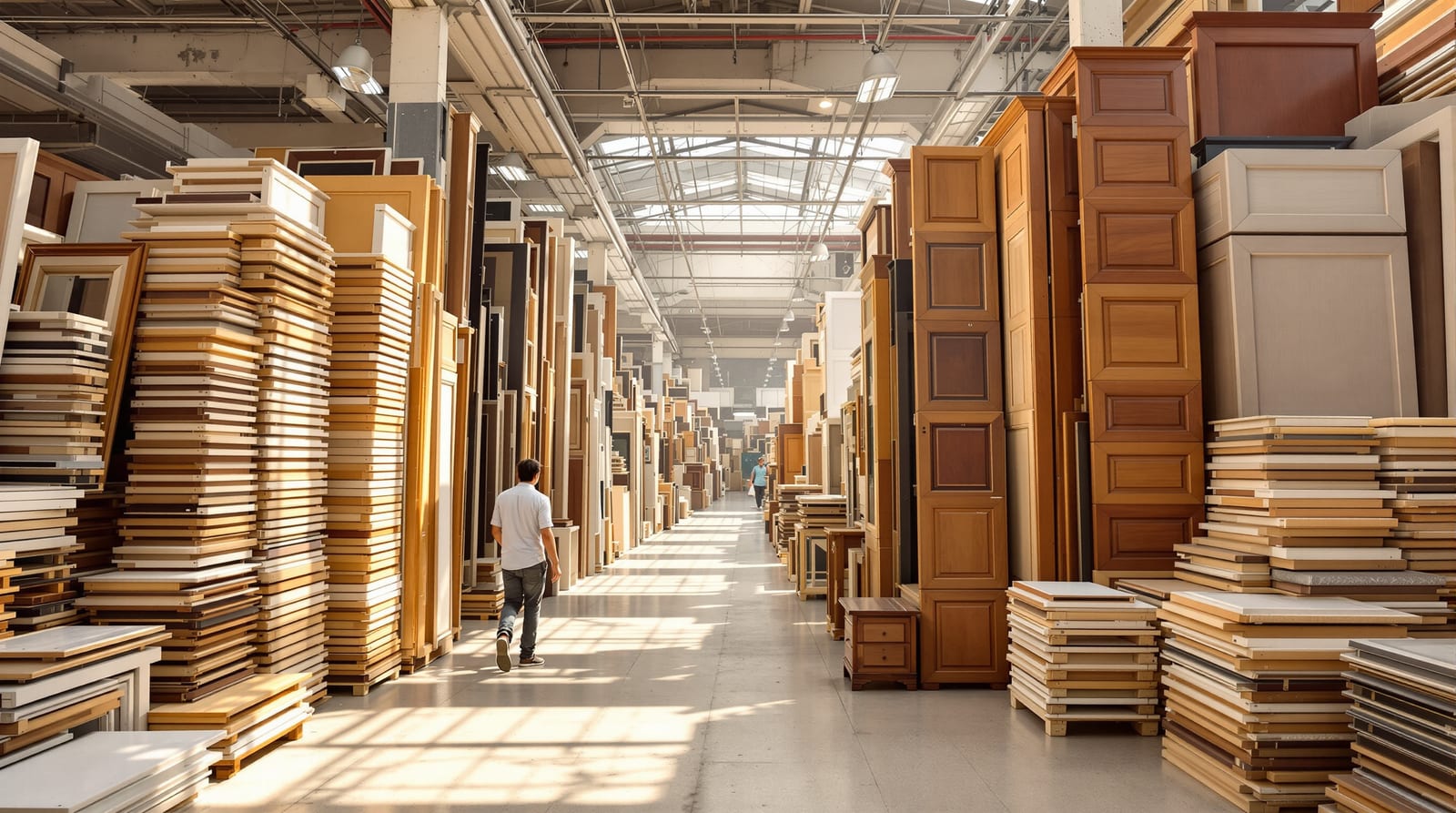
NCR is one of India's deepest door markets, with everything from raw timber yards to premium uPVC showrooms.
- Kirti Nagar (West Delhi) — the region's best-known furniture and door market. Hundreds of shops sell flush doors, laminate and membrane doors, carved teak main doors, frames and hardware. Good for range and bargaining; quality varies shop to shop, so inspect edges and core.
- Timber and plywood markets — Delhi's older timber trade clusters (around areas like the Tri Nagar / Bara Tooti and the established plywood wholesale lanes) supply sal and hardwood for frames and panel doors, often at the keenest rates for those buying timber direct.
- Gurugram showrooms — branded uPVC, WPC and designer-door showrooms along the main commercial belts (MG Road, Sohna Road, Golf Course Road areas) and large home-improvement formats. Premium fit and finish, fixed-ish pricing, real estate cost baked into the quote.
- Noida & Greater Noida — sector furniture markets and home-décor hubs serve the eastern NCR; competitive on flush and WPC doors, with a growing number of brand dealers.
- Faridabad & Ghaziabad — value-oriented wholesale and trade markets. Faridabad's furniture and hardware clusters and Ghaziabad's timber/wholesale trade are where builders and budget-conscious homeowners often find the best per-door rates in the region.
For branded buying, door dealers and distributors in India and where to buy doors in India explain how authorised dealers, warranty and pricing fit together.
What drives the price gap inside NCR
The 1.12 index is a regional average; within it, the spread is driven by a few honest factors.
- Showroom and real-estate cost. Premium Gurugram and central Delhi showrooms carry higher rent and overheads, which shows up in the quote. The same leaf is cheaper in a Ghaziabad or Faridabad trade market.
- Labour rates. NCR carpentry and fitting rates sit above the national average; installation here is typically ₹1,500–₹2,500 per door rather than the lower national floor.
- Transport and timber. NCR is not a timber-growing region, so sal, hardwood and teak are railed/trucked in, adding to panel and frame prices versus southern hubs closer to plantations.
- Brand vs. market. A branded uPVC or WPC door bought through a dealer carries warranty and service but a premium over an unbranded equivalent from a market shop.
Climate: why NCR favours stable doors
Delhi-NCR has one of India's harshest seasonal swings — 45°C+ dry summers and near-freezing winters, with a humid monsoon in between. Solid timber doors that are not properly seasoned can warp, swell or develop joint gaps as they expand and contract through the year. This is why many NCR homeowners now lean toward engineered and solid-core flush doors, WPC and uPVC for stability, keeping solid teak for the main door where it is treated and well maintained. For bathrooms, where monsoon humidity is brutal, WPC doors in India and uPVC doors in India are popular precisely because they shrug off moisture. Weigh the trade-offs in best door material in India.
GST, quotes and saving money
GST on doors is 18% — wooden and flush doors under HSN 4418, uPVC/PVC under HSN 3925. A GST invoice protects your warranty and is non-negotiable for branded buying. Get it in writing and read door GST and HSN in India.
To spend well in NCR:
- Get 3 quotes across tiers — one Gurugram/Delhi showroom, one Kirti Nagar shop, one Faridabad/Ghaziabad market — for the same spec, all supply-only + GST, so you compare like for like.
- Separate the main door from the internal doors. Splurge on the main door, standardise the rest.
- Buy frames and fitting as part of a package to avoid surprise labour bills.
- Negotiate — Kirti Nagar and the trade markets expect it. See negotiating door prices in India and avoid the traps in door buying mistakes in India.
For benchmarks beyond NCR, start with the master 2026 door cost guide and the door cost by city pillar, and price your full project with the door budget planner.
Frequently asked questions
How much does a single fitted door cost in Delhi-NCR?
For a standard internal solid-core flush door, budget roughly ₹11,000–₹15,000 fully fitted including frame, hardware and 18% GST. Bathroom PVC/WPC doors are cheaper; a teak or designer main door can run ₹40,000–₹1L+ on its own.
Why is Gurugram more expensive than Faridabad or Ghaziabad for the same door?
Gurugram's premium showrooms carry higher rent and overheads, and tend to stock branded products with warranty. The identical leaf bought from a Faridabad or Ghaziabad trade market can be 25-35% cheaper, with bargaining built in.
Where in Delhi do most people buy doors?
Kirti Nagar in West Delhi is the best-known furniture and door market, with hundreds of shops covering flush, laminate, membrane and carved teak doors plus frames and hardware. Inspect edges and core before you commit, as quality varies shop to shop.
Which doors handle Delhi's extreme heat and cold best?
Engineered options — solid-core flush, WPC and uPVC — are the most dimensionally stable through NCR's 45°C summers and cold winters. Well-seasoned, treated solid teak is fine for a maintained main door, but cheap unseasoned solid timber tends to warp.
Is GST always charged on doors here?
Yes — 18% GST applies to doors (HSN 4418 for wooden/flush, 3925 for uPVC/PVC). Always insist on a GST invoice; it protects your warranty and confirms the dealer is legitimate.
What should a 3BHK door budget be in NCR?
From about ₹1.3L–₹1.9L for a value package of flush and PVC doors, ₹2.2L–₹3.2L for a mid-range mix, and ₹3.5L–₹5.5L+ for premium doors with a designer teak main door — all installed and including GST.
Export this guide
Related Guides — Deep-dive reading
Door Cost in Indore (2026): Prices, Markets & Buying Guide
What doors really cost in Indore in 2026 — city index 0.93, worked examples with 18% GST, and the real markets where homeowners buy.
Home Doors & EntrancesDoor Cost in Hyderabad: Prices, Markets, GST Guide 2026
What doors really cost in Hyderabad in 2026 — city index 1.05, worked examples with 18% GST, and the markets where people actually buy.
Home Doors & EntrancesDoor Cost in Jaipur (2026): Prices, Markets & Buying Guide
What doors really cost in Jaipur in 2026 — city index 0.95, worked examples with 18% GST, real timber markets and the carved-wood heritage premium.
Home Doors & EntrancesRelated Tools — Try Free
Door Cost Calculator
Estimate the all-in cost of a door — leaf, frame, hardware, fitting and GST — by type, material and size.
Door CalculatorDoor Material Comparison Tool
Compare 2–4 door materials on cost, durability, maintenance, security and moisture resistance.
Comparison ToolFalse Ceiling Cost Estimator
Live ₹/sqft across 8 ceiling types — POP, gypsum, designer, metal, PVC, wooden — with cove and spot lighting for 20 Indian cities.
Cost Calculator