
Curtain & Window Treatment Trends 2026 (India)
Wave-fold clean lines, ceiling tracks and floor-to-ceiling drops, natural textured fabrics, earthy and jewel tones, mainstream motorisation, layered sheers and considered Indian craft — what's in for 2026, with honest trend-versus-timeless guidance.
Curtains move slowly as a category, but they do move. Walk into the better Indian showrooms and design studios in 2026 and the same shifts keep showing up: cleaner folds, taller drops, more natural cloth, quieter hardware and a motor hidden in the track. None of it is loud "fashion" — it is a steady migration toward calm, tactile, considered windows and away from shiny, fussy, over-pelmeted ones. This guide is your map to what is genuinely in for 2026, what suits which kind of home, and — just as important — where chasing the trend will cost you money you should not spend.
A window dressing is the longest-lived soft furnishing in the house. Buy the trend that is really a return to good fundamentals; skip the one that will date before the fabric does.
If you want the full system behind every choice — opacity, fullness, tracks, costs — start with the complete curtain guide for Indian homes, or browse the whole window treatments cluster. This page is about direction: where taste is heading and how to ride it sensibly.
The 2026 mood, in one sentence
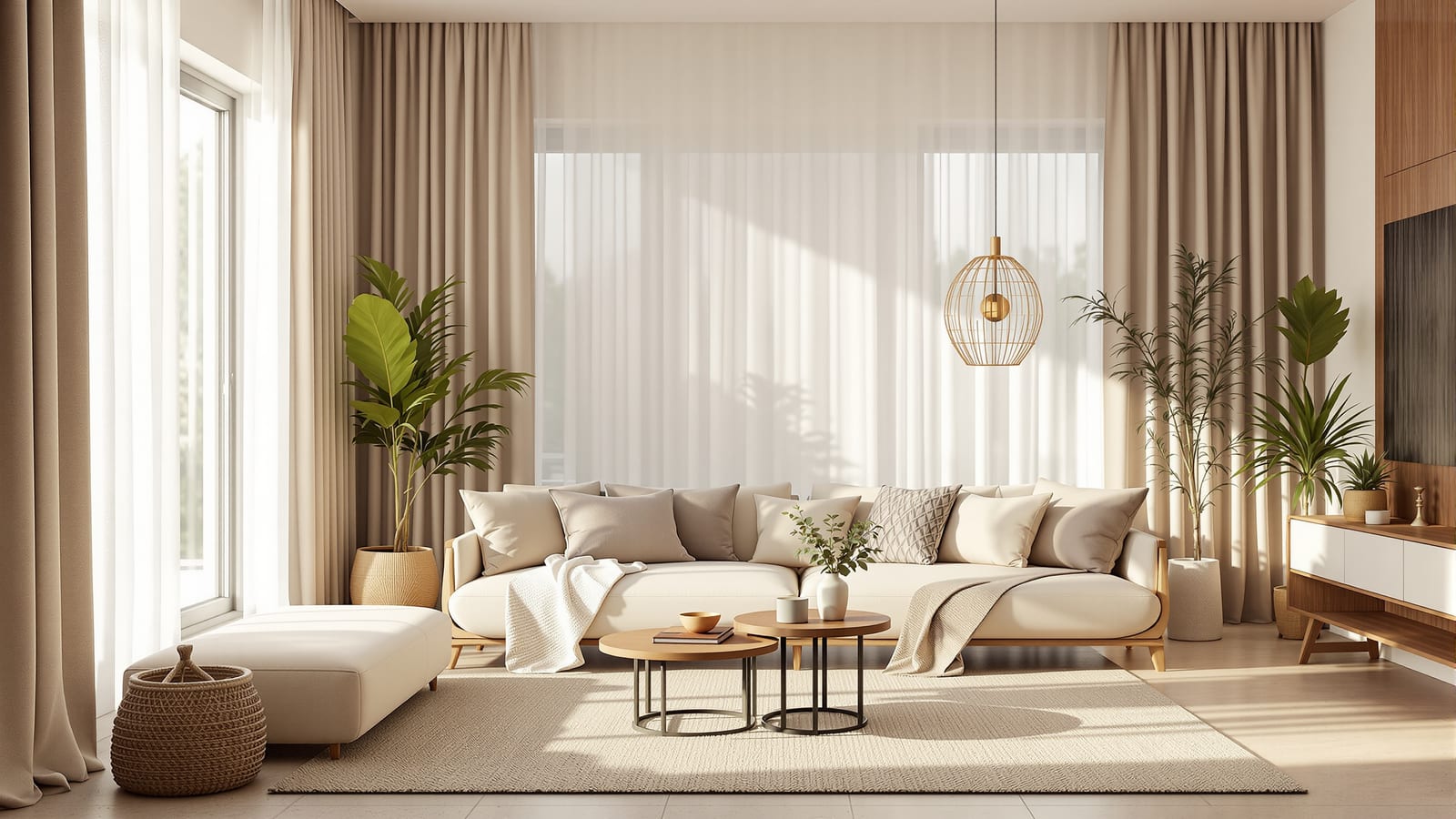
The defining idea of 2026 is quiet, tactile and architectural. Curtains are being treated less as decoration bolted on at the end and more as part of the room's structure — which is why they are getting taller, calmer and made of cloth you want to touch. The flashy synthetic sheen, the heavy stitched pelmets and the busy florals of the 2010s are out; texture, restraint and a little honest Indian craft are in.
The eight trends that define the year
| Trend | What it actually is | Who it suits |
|---|---|---|
| Wave / ripple-fold clean lines | A continuous, even S-curve on a corded track — no stitched pleats, no gathered top | Modern and minimalist homes; glass-walled apartments |
| Floor-to-ceiling, ceiling tracks | The curtain falls from a recessed ceiling slot to the floor, making the room read taller | Anyone with a false ceiling planned; rooms wanting more height |
| Natural textured fabrics | Linen, cotton, slubby weaves and handloom over shiny polyester | Homes after warmth and a lived-in, tactile feel |
| Earthy and jewel tones | Terracotta, olive, sand, clay — and deep emerald, sapphire, plum as accents | Most Indian interiors; warm light flatters both palettes |
| Layered sheers | A daytime sheer plus a dim-out or blackout behind, on a double track | Every living room and bedroom — privacy by day and by night |
| Mainstream motorisation | App, voice or schedule-driven curtains on the windows you use most | Tech-forward homes; tall or hard-to-reach windows |
| Minimalist hardware | Slim tracks, recessed channels, thin matte rods — the hardware disappears | Contemporary and Japandi interiors |
| Considered Indian craft | Handloom cotton, ikat, khadi, block-print used with restraint, not kitsch | Homes wanting personality and provenance over mass-market sameness |
Each of these stands on its own below — but notice how they reinforce one another. A floor-to-ceiling natural-linen wave curtain on a recessed ceiling track, motorised and layered with a sheer, is essentially all eight trends at once. That is the 2026 look in a single window.
Clean lines: wave fold takes over
The single biggest aesthetic shift is the move to wave (ripple-fold) headings — a uniform, mechanical S-curve created by the track, not by stitched pleats. It reads as the calmest, most "designed" way a curtain can hang, and it is the natural partner for motorisation because the fold is engineered, not gathered. If your home leans modern, this is the heading to specify; the deep dive lives in the wave curtains guide, and the broader contemporary look in modern curtain design.
The corollary is that hardware is meant to disappear. Slim tracks, recessed ceiling channels and thin matte-black or brushed rods are in; ornate finials, scrolled brackets and heavy box pelmets are out. The most current windows hide the track in a ceiling slot entirely — which is why this is a decision to make before the false ceiling goes in, not after.
Taller, leaner, floor-to-ceiling
Curtains are climbing. The most up-to-date Indian rooms hang the curtain from a ceiling-mounted track right down to the floor, even when the window itself is shorter — the fabric becomes a full wall of cloth and the ceiling reads dramatically higher. Floor-length (just kissing the floor, or with a small "break") almost always looks more expensive than a sill-length curtain, and the ceiling track is what makes the effect work.
This pairs naturally with the contemporary leaning of the year, covered in contemporary Indian curtain design. The one caveat: ceiling tracks need planning, and floor-length sheers in dusty or high-traffic Indian homes need washable fabric and a habit of cleaning the hem.
Natural, textured fabric beats shiny synthetic
If 2026 has one material story, it is texture over sheen. Linen, cotton, slubby blends, raw weaves and handloom are firmly in; high-gloss polyester satin is firmly out. Natural and textured cloth diffuses Indian daylight beautifully, ages with character, and feels like a considered choice rather than a showroom default. The trade-offs are real — pure linen creases and pure cotton can fade on a harsh west window — so many homes land on linen-cotton blends or quality textured synthetics that mimic the hand without the upkeep.
- Linen — the texture darling of the year; relaxed, breathable, premium. See linen curtains.
- Cotton and handloom — warm, washable, full of Indian craft potential.
- Smart synthetics — when you need fade-resistance and easy care but still want a matte, textured face.
Crucially, the natural-fabric trend overlaps with the sustainability trend: organic cotton, recycled fibres, low-impact dyes and durable cloth you keep for a decade are increasingly part of the brief. The sustainable curtain fabrics guide covers how to choose responsibly without greenwashing.
Colour: earthy base, jewel accents
Two palettes define 2026, and they work together. The base is earthy — terracotta, clay, olive, sage, sand, oatmeal, warm greige — calm, grounded tones that flatter India's warm daylight and read sophisticated rather than trendy. Against that, jewel tones return as accents: deep emerald, sapphire blue, plum and burnt ochre on a feature window or as the dim-out layer behind a neutral sheer. The look to avoid is the dated cool grey-on-grey of the last decade and the high-contrast florals before it.
Layering goes standard
What used to be a designer flourish is now the default: two layers per window — a sheer for daytime softness and privacy, plus a dim-out or blackout behind it for night, heat and sleep. A double track makes it effortless, and the layered look is both more functional and more current than a single heavy curtain. This is the single most useful "trend" because it is really just good design becoming mainstream.
Motorisation goes mainstream
Motorised curtains have crossed from villa-only luxury to a sensible upgrade on the windows you use most. Battery and rechargeable motors now retrofit onto existing tracks without rewiring; app, voice and schedule control let a curtain close against the afternoon sun or open gently at dawn. The motorised curtains guide covers wired-versus-battery and ecosystems (Alexa, Google Home, Matter). Motorise selectively — the living room and main bedroom repay it; the guest room rarely does.
Blinds are riding the same wave: the dual-layer zebra (day-night) blind keeps gaining ground for its instant light tuning and clean profile — see zebra blinds — and motorised versions are increasingly common.
Trend versus timeless: the honest part
Here is the caveat the showrooms will not give you. Curtains are a big spend on a long-lived item, so spend most of your budget on the parts that will still look right in ten years, and reserve trend-chasing for the cheap, swappable parts.
- Buy timeless with the expensive, hard-to-change elements: neutral or earthy natural fabric, a quality track, floor-to-ceiling proportion, layered sheers, a clean heading. None of these will date.
- Treat as trend the cheap, swappable bits: a jewel-tone accent panel, a bold tieback, a seasonal sheer. Change these when taste moves, not the whole window.
- Be cautious with anything ultra-fashionable and costly at once — a very of-the-moment colourway in a premium fabric, or hardware in a finish that may look dated by the next cycle.
A good test: if you would be unhappy living with a choice for ten years, do not put it on the layer that costs the most to replace. The wave fold, the ceiling track and natural linen are trends precisely because they are a return to fundamentals — they will age well. A neon colourway or a novelty print will not.
How to apply 2026 to your home
Match the trend to your home rather than copying a mood board wholesale. Not sure where to start? The Window Treatment Selector walks you from room, light and privacy needs to a shortlist in a couple of minutes, and the Curtain Cost Calculator prices the fabric and hardware so a trend stays a plan, not a surprise bill.
- Modern apartment — wave fold, ceiling track, natural linen in earthy tones, layered sheer, motorised living room.
- Family home with character — handloom or block-print cotton used with restraint, earthy base, one jewel accent window.
- Tight budget — keep the timeless bones (good fabric, floor-length, layered) and skip the motor for now; add it later on the one window you use most.
Find your 2026 window in two clicks. Start with the Window Treatment Selector to turn your room, light and privacy needs into a shortlist — then read the complete curtain guide for Indian homes for the full system behind every choice. Trends come and go; a well-planned window stays right for a decade.
Export this guide
Related Guides — Deep-dive reading
Minimalist Curtain Design: Quiet, Clean Windows (India 2026)
Restraint as the whole look — one clean layer, wave folds, hidden tracks and tonal neutrals — plus the two things minimalism quietly trades away and how to solve them without spoiling the calm.
Window TreatmentsModern Curtain Design Ideas for Indian Homes (2026)
The contemporary look decoded — wave fold, floor-to-ceiling drops, hidden ceiling tracks, restrained neutral palettes, sheer-plus-dim-out layering, motorisation and the 2026 trend directions from Japandi calm to contemporary Indian.
Window TreatmentsLuxury Curtain Design Trends for Indian Homes (2026)
What actually makes a curtain read expensive — generous fullness, floor-length drops, premium fabrics, tailored headings, layering, concealed tracks and motorisation — plus the honest cost reality for Indian villas and penthouses.
Window TreatmentsRelated Tools — Try Free
Curtain Cost Calculator
Get the fabric metres you need plus the total curtain cost by window size, fabric, pleat, lining and hardware.
Curtain CalculatorWindow Treatment Selector
Curtains, blinds or a layered system? Answer five questions about your room and get a specific recommendation.
SelectorCross-Ventilation Analyzer
Estimate airflow and air changes per hour (ACH) from room size, window areas, layout, and local wind — with NBC 2016 Part 8 compliance check.
Ventilation Calculator