
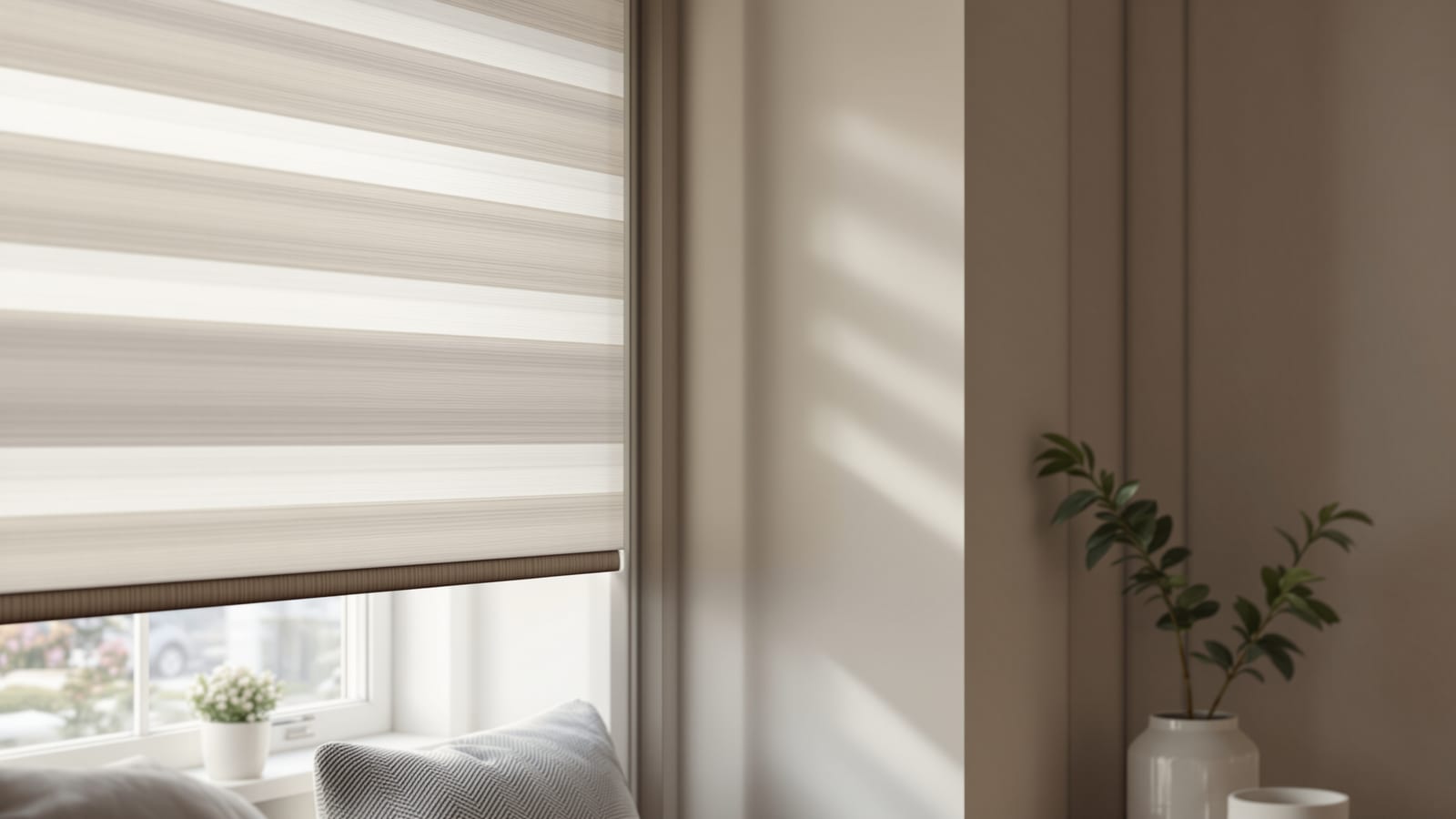
Zebra Blinds Explained: Day-Night Control in One Blind (India 2026)
How the dual-layer sheer-and-solid mechanism works, why Indian apartments love them, manual versus motorised, real rupee costs, the night-privacy caveat nobody mentions, and the rooms they suit best.
Walk through any new apartment showroom in Bengaluru, Pune or Gurugram and you will see them on almost every window: blinds with crisp horizontal stripes of sheer and solid fabric that seem to dissolve into clear glass with one gentle pull. These are zebra blinds, and they have quietly become the default window treatment in urban Indian flats. The appeal is real, but so is the confusion around them. They are sold under at least four names, their cleverest feature has a genuine limitation, and the price gap between a good one and a flimsy one is wide. This guide explains exactly how zebra blinds work, why they fit Indian homes so well, what they cost, and the one caveat every salesperson skips.
A zebra blind is two roller blinds printed onto one fabric loop. Slide the bands into line and you get filtered daylight; slide them out of line and you get a solid screen. The genius is that one blind does both, in any blend between.
What exactly is a zebra blind?
A zebra blind is a dual-layer roller blind. Instead of one flat sheet of cloth, the fabric is a continuous loop printed with alternating horizontal bands: a stripe of opaque (solid) fabric, then a stripe of sheer (see-through) fabric, repeating top to bottom. The loop wraps front and back around a single tube, so at any moment there is a front layer and a back layer hanging in front of the glass.
When you operate the blind, the front and back layers shift relative to each other:
- Bands aligned — the sheer stripes on the front sit exactly over the sheer stripes on the back. Light passes through cleanly and you can see out: this is the soft, filtered "open" state.
- Bands offset — pull the blind a few centimetres and the solid stripes on the front slide to cover the sheer stripes on the back. The window becomes a near-continuous solid screen.
- Anything in between — because the shift is stepless, you can park the bands at any blend, dialling the room from clear to filtered to mostly closed.
You are not raising or lowering a blind in the usual sense. You are nudging two striped layers into and out of register. That single trick is why one blind can behave like a sheer curtain in the morning and a privacy screen by evening.
Why they are called dual, duo and combi blinds
Half the confusion shoppers face is that the same product travels under several names. They are all the same thing:
| Name you will hear | Where it comes from |
|---|---|
| Zebra blinds | The black-and-white striped look, the most common Indian term |
| Day-night blinds | The marketing angle — one blind for both states |
| Dual / duo blinds | Refers to the two fabric layers |
| Combi blinds | "Combination" of sheer and solid in one loop |
| Vision / layered blinds | Brand and importer names |
If a vendor quotes you "duo blinds" and another quotes "zebra blinds," compare them like-for-like. The mechanism is identical; the only real differences are fabric quality, the smoothness of the roller mechanism, and whether the control is a chain, a cordless spring, or a motor.
Why Indian apartments love them
Zebra blinds suit the way Indian flats are actually built and lived in, which is why uptake has been so fast:
- One blind solves the two-state problem. Most windows need bright filtered light by day and privacy in the evening. A plain roller blind forces a choice; a zebra blind gives you both from one fitting, without the cost and bulk of layering a sheer plus a separate blind.
- They are compact. The roll stacks into a slim tube at the top, so they suit the narrow reveals and shallow pelmets common in apartments. They sit neatly inside a window recess.
- They read modern and minimal. The clean horizontal lines match the contemporary, hard-finish look of new flats far better than heavy pleated drapes.
- Easy to clean. A wipe with a dry microfibre cloth or a light vacuum on low suction handles the dust that settles fast in Indian cities. There is no washing, ironing or re-hanging.
- Glare control for screens. In a work-from-home corner, you can knock down harsh daylight on a monitor without plunging the room into darkness.
For a wider comparison of where blinds beat curtains and where they do not, the curtains versus blinds guide lays out the trade-offs, and the broader window treatments pillar puts zebra blinds in context with every other option.
The honest caveat: night privacy is not total
This is the part showrooms gloss over, and it is the single most important thing to understand before you buy.
When the bands are offset (closed), a zebra blind gives good privacy and you can leave it that way at night. But the moment you open the bands even partway to let in light, the sheer stripes become see-through — and after dark, with your room lit and the street dark outside, anyone outside can see in through those sheer bands. The same physics that makes a sheer curtain a "stage at night" applies to the sheer stripes of a zebra blind.
So the real behaviour is:
- Day, bands open — privacy is good (it is brighter outside than in, so the sheer reads as opaque to outsiders).
- Night, bands closed — privacy is good, but the room is also dark to that window.
- Night, bands open for light or view — privacy is lost through the sheer stripes.
Zebra blinds also do not give true blackout even when fully closed: the solid bands are opaque but light leaks at the band joins and around the edges, so a bedroom that needs darkness for sleep will not get it from a zebra blind alone. If you want darkness, pair the blind with a blackout layer or choose a dedicated roller blind in a blackout fabric, and read the complete curtain guide for layering strategy. Plenty of Indian homes solve it by adding a heavy curtain or a separate blackout roller behind the zebra blind in bedrooms.
Manual versus motorised
You operate a zebra blind in one of three ways, and the choice changes both the price and the daily feel:
- Chain (cord loop) — the cheapest and most common. A bead chain on one side rolls the loop. Reliable and easy to service, but the chain is a strangulation hazard near small children, so use the supplied cleat or a child-safety device.
- Cordless / spring — a gentle push or pull moves the blind with no dangling chain. Cleaner-looking and child-safe, slightly more expensive, best on smaller windows.
- Motorised — a tubular motor inside the tube moves the bands at the touch of a button, a remote, an app or a voice command.
Motorisation makes the most sense on tall, wide, or hard-to-reach windows (above a kitchen counter, behind a sofa, in a double-height living room) and on the windows you adjust several times a day. A rechargeable battery motor retrofits to almost any zebra blind without wiring, while wired motors are best planned during a renovation. If you are weighing automation seriously, the smart blinds guide covers ecosystems (Alexa, Google Home, Matter), schedules and what actually earns its keep.
What zebra blinds cost in India
Prices move with fabric quality, mechanism, motor and city, so treat these as honest 2026 ranges rather than quotes. Custom-made and fitted is the norm; cheap ready-made rolls exist but rarely hang well.
| Specification | Indicative cost (per sq ft) |
|---|---|
| Basic chain-operated, standard fabric | around 90 to 180 |
| Mid-range chain or cordless, better fabric | around 180 to 350 |
| Premium fabric, branded mechanism | around 350 to 600 |
| Motorised (battery, per blind, motor + fabric) | adds roughly 4,000 to 12,000 per window |
A single average living-room window (say 4 ft by 5 ft, 20 sq ft) lands roughly in the 2,000 to 7,000 band for a good manual blind, with motorisation pushing a single window well past 10,000. Larger or premium installations climb from there. To size and price a full set of windows against curtains and other treatments, run the numbers through the curtain cost calculator — it works out per-window cost from your dimensions and helps you compare a zebra-blind quote against a layered-curtain alternative on the same window.
The cost driver people underestimate is fabric grade and mechanism smoothness, not the colour. A cheap blind feels notchy, the bands drift out of alignment over months, and the fabric sags; a good one glides and holds register for years. Pay for the mechanism.
Best rooms for zebra blinds
- Living and dining rooms — the sweet spot. You want bright filtered daylight and the option of an evening screen, and you are usually awake and present, so the night-privacy limit rarely bites.
- Home office / study — excellent for stepless glare control on a screen without working in the dark.
- Kitchen — compact, wipe-clean, and they suit the high windows above counters; choose a fabric that resists grease and moisture.
- Bedrooms — with care. Lovely by day, but pair them with a blackout layer for sleep and remember to close the bands fully at night for privacy. On their own they are not a sleep solution.
- Bathrooms and balconies — only with moisture-tolerant fabric, and accept that the sheer bands give no night privacy if left open.
Not sure whether a zebra blind, a sheer curtain, or a plain roller suits a specific window? The sheer curtains guide and the broader types of window blinds guide help you match the treatment to the room's real job.
Care and longevity
Zebra blinds are low-maintenance, not no-maintenance:
- Dust weekly with a dry microfibre cloth or a vacuum on low suction with a brush head. Dust settles into the sheer bands fast in Indian cities.
- Spot-clean marks with a barely-damp cloth and mild soap; never soak the fabric, which can warp the bands and ruin alignment.
- Keep the mechanism clean. Grit in the chain or tube is what causes bands to drift out of register over time.
- Avoid harsh direct sun on cheap fabric — lower grades fade and stiffen under prolonged UV, exactly the condition Indian windows provide. On a bright west window, spend up on a fade-resistant fabric.
A well-made zebra blind comfortably lasts several years of daily use. The first thing to fail on a cheap one is band alignment, which is irreversible — another reason the mechanism, not the print, is where your money should go.
The honest verdict
Zebra blinds deserve their popularity. For a living room, study or kitchen in an Indian apartment, one blind genuinely delivers bright filtered daylight, a stepless dimmer, an evening privacy screen and a clean modern look, at a sensible price and with almost no upkeep. Just buy them with eyes open: they are not blackout, and their cleverest feature — the see-through sheer bands — is also why they cannot guarantee privacy at night when open. Treat them as a brilliant day-and-evening tool, add a blackout layer where sleep or full night privacy matters, and pay for the mechanism over the print.
Find the right window treatment for each room with Studio Matrx. Match your room, light and privacy needs in the window treatment selector, price your windows with the curtain cost calculator, and explore the full range in the window treatments pillar guide.
Export this guide
Related Guides — Deep-dive reading
Roman Blinds: The Complete Guide for Indian Homes (2026)
The soft fabric blind that folds up in neat stacks — flat vs hobbled folds, lining and blackout, fabrics, cord vs chain vs motor, costs and cleaning, decoded for Indian rooms.
Window TreatmentsCurtains vs Blinds: The Complete Comparison for Indian Homes (2026)
Light, privacy, heat, noise, cleaning, cost and looks — a head-to-head verdict on curtains and blinds, plus the under-rated answer most good designers actually use: both.
Window TreatmentsRoller Blinds: The Complete Guide for Indian Homes (2026)
How roller blinds work, the four fabric families that change everything, chain vs spring vs motorised, inside vs outside mount, sizing, the best rooms and honest Indian costs — the one read before you order.
Window TreatmentsRelated Tools — Try Free
Curtain Cost Calculator
Get the fabric metres you need plus the total curtain cost by window size, fabric, pleat, lining and hardware.
Curtain CalculatorWindow Treatment Selector
Curtains, blinds or a layered system? Answer five questions about your room and get a specific recommendation.
SelectorCross-Ventilation Analyzer
Estimate airflow and air changes per hour (ACH) from room size, window areas, layout, and local wind — with NBC 2016 Part 8 compliance check.
Ventilation Calculator