
Modern Curtain Design Ideas for Indian Homes (2026)
The contemporary look decoded — wave fold, floor-to-ceiling drops, hidden ceiling tracks, restrained neutral palettes, sheer-plus-dim-out layering, motorisation and the 2026 trend directions from Japandi calm to contemporary Indian.
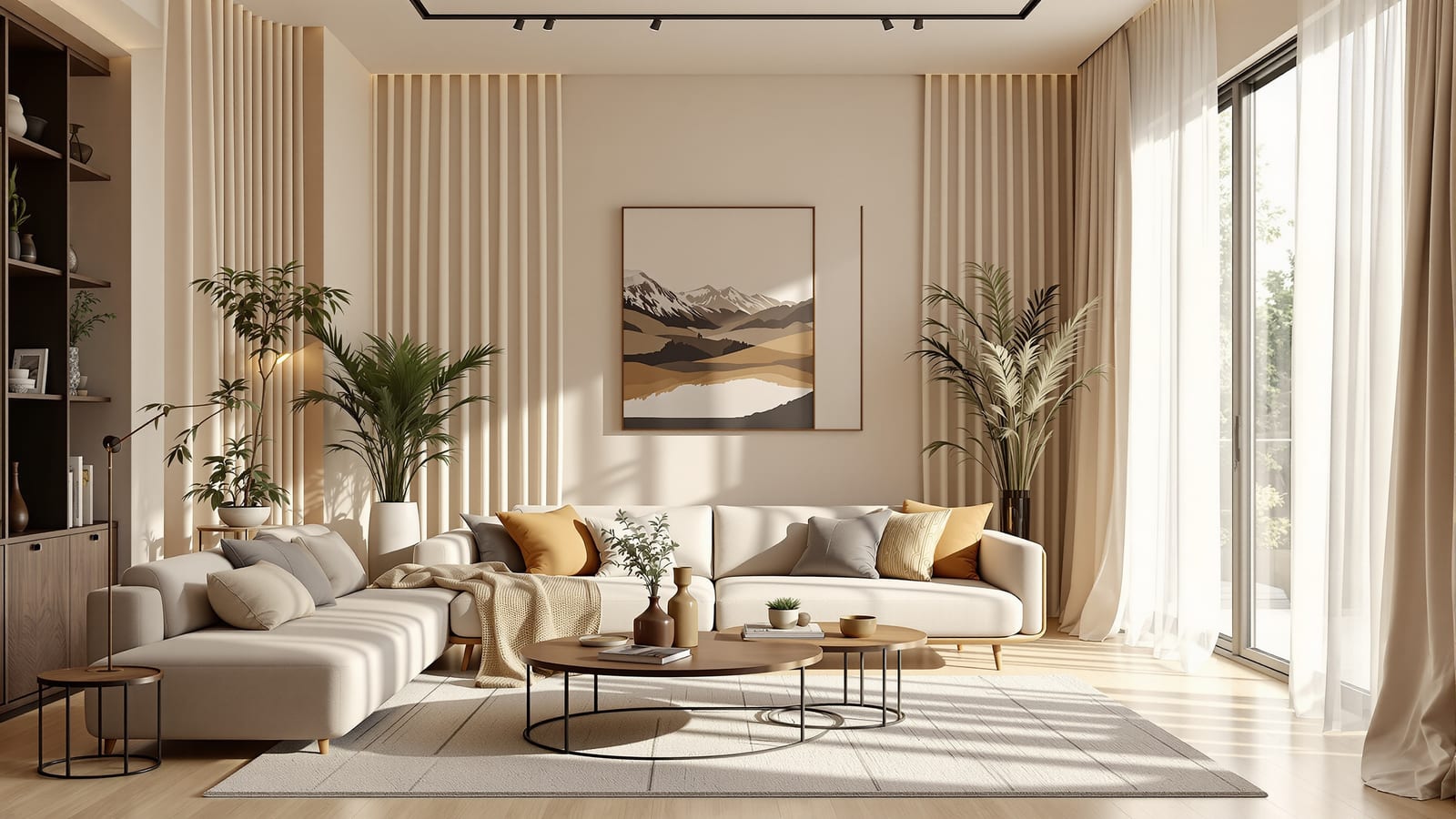
Walk into almost any beautifully photographed home of the last few years and the curtains are doing something specific. They are not busy. There is no heavy print fighting the sofa, no swag, no tassels, no valance with a scalloped edge. Instead the cloth falls in one calm, unbroken sheet from the ceiling to the floor, the folds are even and soft, and the colour is so quiet you almost do not notice it. That restraint is the modern look. Getting it is less about buying an expensive fabric and more about understanding a handful of decisions — how the curtain pleats, where it starts and stops, how many layers it has, and what it is made of rather than what is printed on it.
This guide is idea-led but practical. It walks the contemporary directions that actually define modern curtain designs in Indian homes for 2026, then grounds each one in how to specify it and roughly what it costs. For the full A-to-Z of types, fabrics and tracks underneath these ideas, the complete curtain guide for Indian homes is the parent reference.
Modern curtains are quiet on purpose. The contemporary look is built from proportion, texture and a single restrained colour — not from print. Spend your decisions on how the curtain hangs, not on what is on it.
The wave fold: the single most modern heading
If one detail separates a contemporary curtain from a traditional one, it is the wave (or ripple) fold heading. Instead of the stitched, pinched groups of a pinch pleat, a wave heading runs on a special track with evenly spaced gliders so the fabric falls in a continuous, regular S-curve — like a gentle, frozen ripple from top to bottom. It reads as effortless and architectural, it stacks back beautifully, and it is the natural partner for both sheers and motorisation.
Wave fold needs a track, never a rod, and it uses a generous fullness (around 2 to 2.5 times the width) to keep the S even. It costs a little more than a pencil pleat for that reason, but it is the heading that does the most to make an ordinary fabric look designer. If you read only one section here, make it this one. The full menu of headings — eyelet, pencil, pinch, goblet, wave — and which suits which room is laid out in the curtain pleats and headings guide.
Floor-to-ceiling, and where the curtain starts
The second move that instantly modernises a window is height. A traditional curtain starts just above the window frame and ends at the sill. A contemporary one starts at the ceiling and ends at the floor, regardless of where the actual window sits. That single unbroken vertical sheet makes the ceiling read taller and the window grander, even when the glass is small.
To get it cleanly you want the track at or near the ceiling — ideally hidden inside a recessed pocket in the false ceiling, so the curtain appears to fall straight from the slab with no visible hardware. This is unusually achievable in Indian homes because gypsum and POP false ceilings are near-universal in living rooms and bedrooms. The catch is timing: the pocket must be built into the ceiling, not cut in afterwards. The full how-to — pocket depths, clearances, the retrofit regret — is in the ceiling-mounted curtains guide, and the height idea on its own in the floor-to-ceiling curtains guide. Decide this before the gypsum goes up.
Restraint: the modern palette
Contemporary curtains live in a narrow band of colour. The dominant 2026 directions for Indian homes:
- Warm neutrals — oatmeal, sand, greige, mushroom, soft taupe. These recede, flatter most wall colours and never date.
- Cool greys and off-whites — for cooler, minimalist and Scandi-leaning rooms.
- Tonal, not contrasting — the curtain a shade or two off the wall, so it blends rather than announces. This is the single most "expensive-looking" trick.
- Deep grounding tones — charcoal, ink, forest or terracotta as a considered accent in one room, used sparingly.
The print-heavy, multi-colour curtain is the look most firmly left behind. If you want interest, get it from texture and weave, not pattern. For choosing the exact tone against your walls, flooring and light, the curtain colour selection guide walks the method.
Texture over print
Because the colour is quiet, the fabric's texture becomes the star. This is where modern curtains earn their richness:
- Linen and linen blends — the defining contemporary fabric: a soft, slightly irregular weave that looks relaxed and natural. Pure linen creases by design; linen-cotton or linen-poly blends behave better in Indian humidity.
- Cotton and slub weaves — breathable, matte, casual-modern, easy to launder.
- Textured sheers — voile, leno and open weaves that filter light into a soft glow rather than a flat screen.
- Velvet, used sparingly — for a single statement window in a cooler room; it adds depth and quiet luxury without any print at all.
The rule of thumb: choose the fabric by how it feels and how it filters light, not by its colour swatch on a screen. The deeper fabric-by-fabric comparison sits in the complete guide.
Layering: sheer plus dim-out, done cleanly
The most useful contemporary idea is also the most practical: two layers. A sheer in front for daytime softness and privacy, and a dim-out or blackout behind it for night, sleep and heat. Modern execution keeps both layers clean — same neutral family, both floor-to-ceiling, both on slim parallel tracks hidden in one pocket — so the window reads as one considered composition rather than a pile of cloth.
This solves a real problem honestly: a single sheer hides you by day but turns the window into a lit stage at night, while a single blackout makes the room cave-dark at noon. Two restrained layers give you the full range with a flick. A double or parallel track is essential, so size the pocket for it from the start.
The 2026 trend directions, compared
The contemporary look is not one style but a family of restrained directions. Here is how the leading ones translate to Indian windows:
| Look | Signature | Palette | Best for |
|---|---|---|---|
| Japandi | Linen, wave fold, floor-to-ceiling, near-invisible hardware | Oatmeal, clay, soft black | Calm living rooms, bedrooms |
| Scandi minimalist | Crisp off-white sheers, light wood rods or hidden tracks | White, pale grey | Bright apartments, small rooms |
| Contemporary Indian | Textured neutrals with one grounded accent tone, generous drops | Sand, terracotta, deep green accent | Family living rooms, formal spaces |
| Warm modern / organic | Slub cotton, linen, tonal layering, matte hardware | Greige, mushroom, caramel | Whole-home, all-rounder |
| Quiet luxury | Velvet or heavy linen, perfect wave fold, motorised | Deep tonal neutrals, charcoal | Statement living/master windows |
The thread running through all of them: simple headings, full-height drops, neutral colour and texture doing the work. Pick the one that matches your room's light and your taste — they share the same underlying recipe. For the pared-back, fewest-elements end of this spectrum, the minimalist curtain design guide goes deeper.
Motorisation: the modern finish
Nothing reads more contemporary than a wall of curtain that glides open by itself at dawn or closes against the afternoon west sun. Motorisation has come down from villa-only luxury to a sensible upgrade on the windows you use most, and it pairs naturally with wave fold and hidden ceiling tracks — the motor and its wiring vanish into the pocket, leaving no box on the wall and no visible cable.
Motorise selectively. The main living room and the master bedroom repay it in daily comfort; the guest room rarely does. Choose a motor that speaks your home's ecosystem — Alexa, Google Home or a Matter hub — so schedules and voice control actually work. If a wired motor is even a possibility, drop a switched 5-amp power point into the curtain pocket during the electrical first-fix; retrofitting it later means chasing the wall.
What the modern look costs in India
Prices swing with fabric, fullness, lining, track and city, so treat these as honest ranges, not quotes:
- Wave-fold tracks and headings cost more than pencil-pleat on a rod, because of the special track, the gliders and the higher fullness — budget a clear step up per window.
- Floor-to-ceiling drops use noticeably more cloth than sill-length, so the longer the room is tall, the more fabric you pay for — price it on your actual ceiling height.
- Two layers roughly means two sets of fabric and a double track, so a layered contemporary window costs meaningfully more than a single curtain.
- Recessed pockets are nearly free if designed into a false ceiling you are already building, and expensive if retrofitted.
- Motorisation adds a per-window motor, an in-pocket power point and an optional hub on top.
The cost drivers people underestimate are fullness, lining and the extra height — not the print, because there is no print. The curtain cost calculator sizes the fabric from your drop, width and pleat and gives a per-window price in seconds, so you can see exactly what the wave-fold, full-height, two-layer look adds before you commit.
Honest caveats
A few things worth saying plainly before you buy into the look:
- Pure linen creases and relaxes — that is the aesthetic, not a defect, but if you want crisp folds choose a linen blend or a tighter weave.
- Very pale neutrals show dust and Indian pollution faster on busy-road windows; plan washable sheers and a cleaning habit, or step a shade darker.
- The look depends on getting the height and fullness right, not on spending big — a modest textured neutral, hung floor-to-ceiling at 2 times fullness on a hidden track, beats an expensive fabric hung short and skimpy every time.
- Sheers and pale fabrics fade in direct Indian UV; choose fade-resistant cloth on bright west and south windows.
How to get the modern look, in five moves
1. Choose a wave or ripple fold heading on a track — the single most contemporary detail.
2. Hang it floor-to-ceiling from a hidden or near-ceiling track, whatever the window height.
3. Pick a restrained neutral, tonal to your walls, and let texture (linen, slub, voile) carry the interest.
4. Layer a sheer in front of a dim-out behind, both clean and full-height on a double track.
5. Motorise the one or two windows you use most, on the ecosystem you already run.
Do those five and the colour — the part everyone agonises over — becomes the easy last decision, exactly as it should be.
Plan your modern windows with Studio Matrx. Find the right contemporary treatment for each window with the window treatment selector, size the fabric and price the floor-to-ceiling, two-layer look with the curtain cost calculator, and start from the complete curtain guide for Indian homes for the full system. Then browse the whole window treatments cluster for fabrics, pleats, ceiling tracks and motorisation.
Export this guide
Related Guides — Deep-dive reading
Luxury Curtain Design Trends for Indian Homes (2026)
What actually makes a curtain read expensive — generous fullness, floor-length drops, premium fabrics, tailored headings, layering, concealed tracks and motorisation — plus the honest cost reality for Indian villas and penthouses.
Window TreatmentsMinimalist Curtain Design: Quiet, Clean Windows (India 2026)
Restraint as the whole look — one clean layer, wave folds, hidden tracks and tonal neutrals — plus the two things minimalism quietly trades away and how to solve them without spoiling the calm.
Window TreatmentsHow to Choose Curtains: A Step-by-Step Guide for Indian Homes (2026)
Eight decisions, in the right order — name the window's job, pick the layers, fabric, pleat, fullness and hardware, settle the colour, then decide whether to motorise. The method that ends in confidence, not a showroom guess.
Window TreatmentsRelated Tools — Try Free
Curtain Cost Calculator
Get the fabric metres you need plus the total curtain cost by window size, fabric, pleat, lining and hardware.
Curtain CalculatorWindow Treatment Selector
Curtains, blinds or a layered system? Answer five questions about your room and get a specific recommendation.
SelectorFalse Ceiling Cost Estimator
Live ₹/sqft across 8 ceiling types — POP, gypsum, designer, metal, PVC, wooden — with cove and spot lighting for 20 Indian cities.
Cost Calculator