
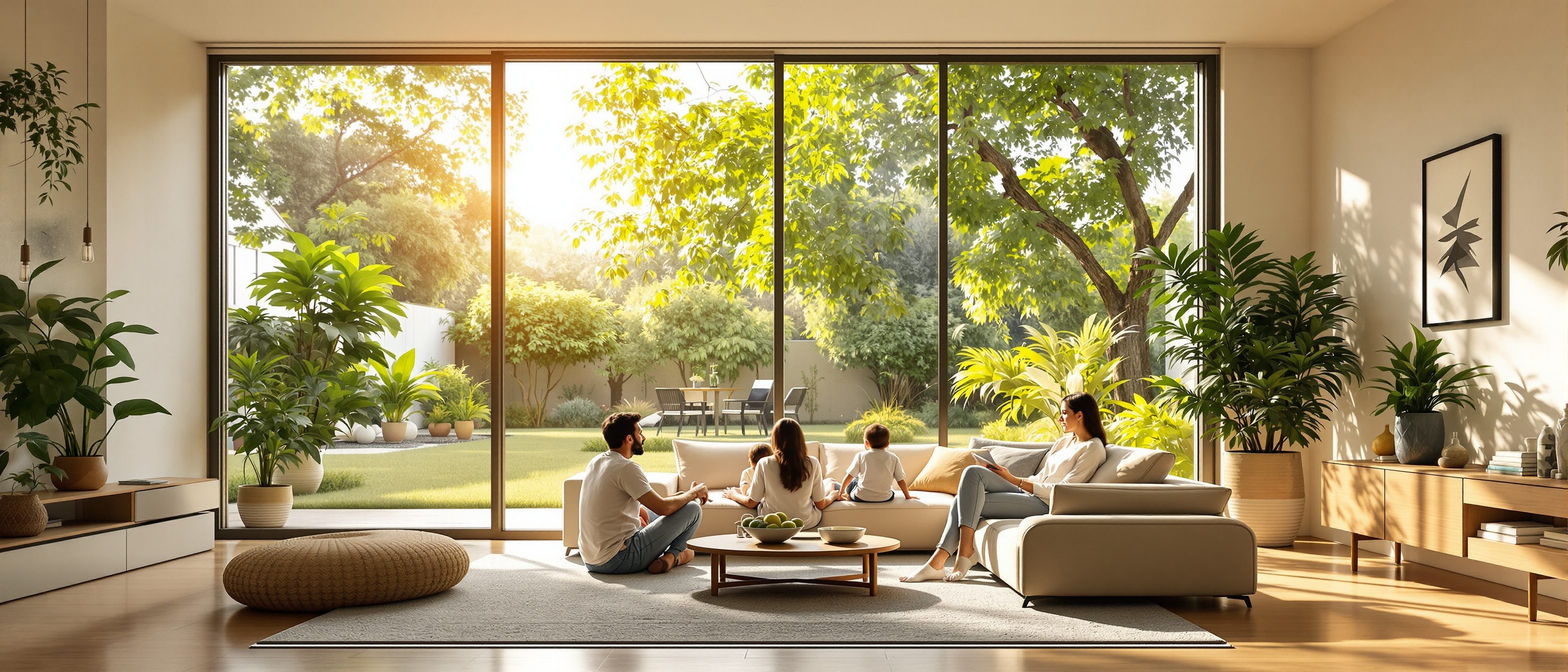
Cost of Floor-to-Ceiling Windows in India (2026): What Full-Height Glass Really Costs
Why full-height glazing costs ₹900 to ₹2,000-plus per sqft installed, a worked living-room glass-wall example, and the add-ons most quotes leave out.
A floor-to-ceiling window turns a wall into a view. It also turns a routine window line in your quote into one of the most expensive single items in the whole house. The question every homeowner asks is the same: why does a sheet of glass that does not even open cost more per square foot than a fully operable casement next to it?
This is the dedicated cost deep-dive. For the full design, heat and glare story — orientation, shading depth, WWR and energy-code compliance — read Floor-to-Ceiling Windows in India: that is the full guide; this is the cost deep-dive that prices it. For the bigger picture across every window type, see the Home Window Cost pillar.
All prices below are indicative for June 2026 in rupees. Add 18 per cent GST, and treat every figure as a starting point — confirm with itemised quotes from fabricators.
Why full-height glass costs more
A standard 4ft by 4ft window is 16 sqft. A living-room glass wall 10ft wide by 9.5ft tall is 95 sqft — six of those windows in one opening. So the first reason is simply area: cost scales with glazing square footage, and full-height runs are large.
But the per-square-foot rate also climbs, for four stacking reasons:
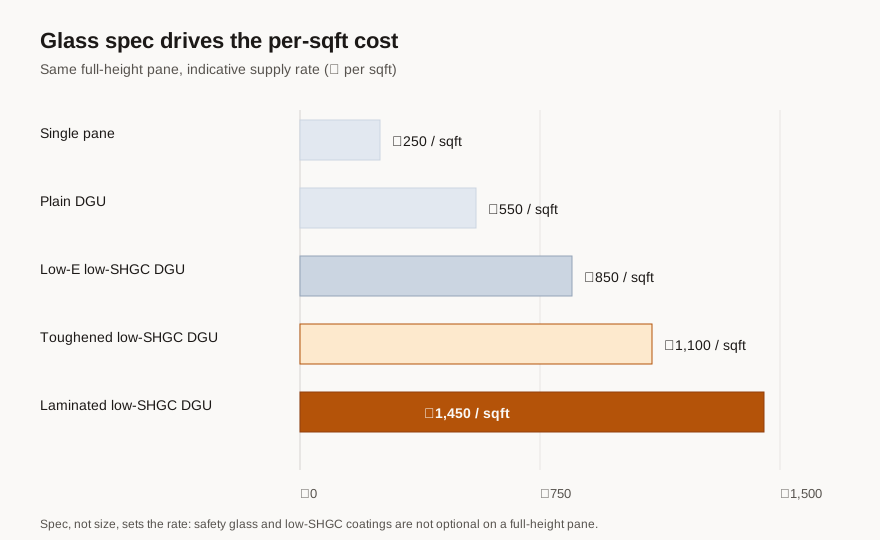
- Higher-spec, low-SHGC glass is not optional. A big south- or west-facing glass plane is a heat collector. To stay liveable and to meet Eco-Niwas Samhita (ENS) targets as your window-to-wall ratio rises, you need low solar-heat-gain double glazing, usually with a Low-E coating. That glass costs far more than the single pane in a budget window.
- Safety glass is mandatory at low level. Any glass a person can walk into — anything reaching the floor — should be toughened or laminated safety glass. Toughened shatters into blunt granules; laminated holds together on a PVB interlayer. This is a cost you cannot value-engineer away on a full-height pane.
- Stronger frames. Tall spans flex. The frame needs deeper sections, often steel-reinforced uPVC or system aluminium, to carry the glass weight and wind load without bowing.
- Sometimes structural support. Where a glass wall replaces load-bearing masonry, you may need a beam or lintel above and a properly detailed sill — a civil cost that small windows never trigger.
The installed rate
For a full-height fixed or sliding glass wall built to do its job in the Indian climate, expect roughly:
| Tier | Frame + glass spec | Indicative rate (installed) |
|---|---|---|
| Entry | uPVC frame, plain toughened DGU | ₹900 to ₹1,100 per sqft |
| Mid | uPVC or powder-coated aluminium, low-SHGC Low-E toughened DGU | ₹1,100 to ₹1,500 per sqft |
| Premium | Thermally-broken system aluminium, low-SHGC Low-E laminated DGU | ₹1,500 to ₹2,000-plus per sqft |
These rates are higher than the ₹250 to ₹950 per sqft you would pay for an ordinary uPVC or aluminium window, precisely because of the glass spec, the safety glass and the frame strength above.
Two windows of the same size can differ by ₹1,000 per sqft purely on glass and frame spec. On a 95 sqft wall that is a ₹95,000 swing — so the spec line is where the real decision sits.
A worked example: a living-room glass wall
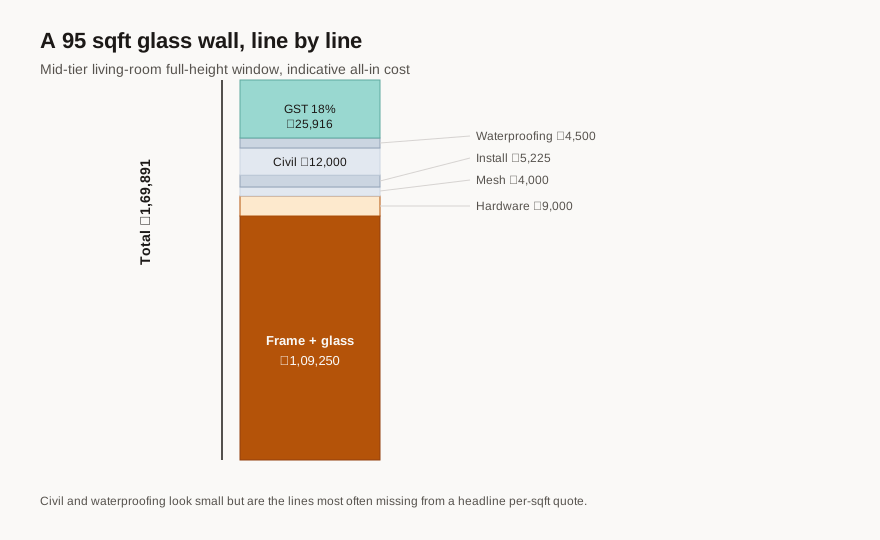
Take a 10ft wide by 9.5ft tall full-height window — 95 sqft of glazing — in a mid-tier home, in a hot city, west-facing (so low-SHGC glass earns its keep). Built as one large fixed pane plus a sliding access door.
| Line item | Basis | Amount (₹) |
|---|---|---|
| Frame plus low-SHGC Low-E toughened DGU | 95 sqft at ₹1,150 | 1,09,250 |
| Sliding hardware, multi-point lock, friction stays | per opening | 9,000 |
| Mosquito mesh panel (sliding section) | per opening | 4,000 |
| Installation and labour | 95 sqft at ₹55 | 5,225 |
| Civil: lintel making-good, sill, plaster repair | lump sum | 12,000 |
| Waterproofing: sealant, backer rod, drip sill | per opening | 4,500 |
| Subtotal | 1,43,975 | |
| GST at 18 per cent | on subtotal | 25,916 |
| Total | ₹1,69,891 |
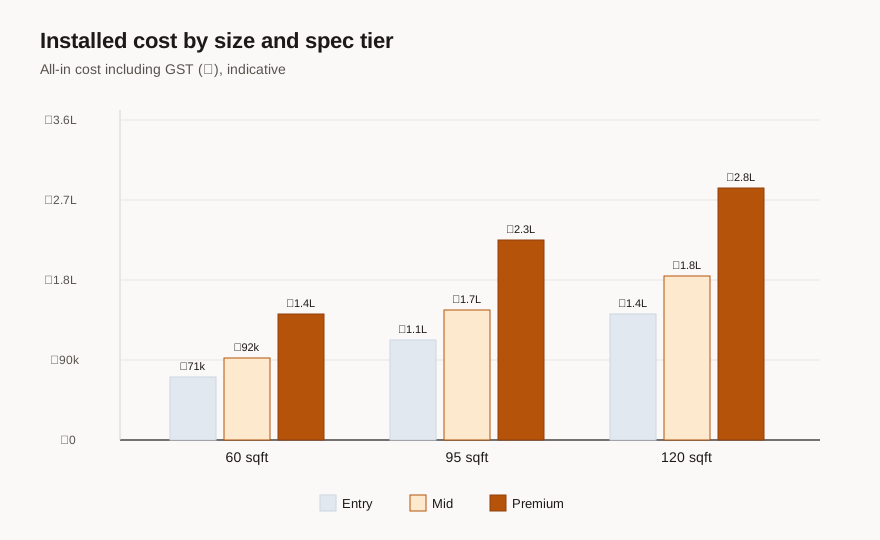
So a single living-room glass wall lands near ₹1.7 lakh all-in at the mid tier. Swap to premium thermally-broken aluminium with laminated glass and the same wall crosses ₹2.3 lakh; drop to entry-tier plain toughened DGU and it falls toward ₹1.4 lakh. The civil and waterproofing lines look small but they are the lines most often missing from a headline "per sqft" quote — always confirm whether they are included.
The add-ons most quotes leave out
Full-height glass brings its own shopping list of extras. Budget for these separately:
- Shading and blinds. A west or south glass wall needs glare and heat control — motorised roller blinds, honeycomb blinds or external louvres. Reckon ₹150 to ₹600-plus per sqft of glass for quality blinds; external shading (a deep overhang or fins) is a civil cost decided at design stage.
- Manifestation. Large clear panes are a walk-into hazard. Subtle frosted bands, dot patterns or a film at eye level cost a few thousand rupees per wall and are genuinely a safety item, not decoration.
- Grilles or security. A ground-floor glass wall often wants discreet grilles, laminated glass (which resists break-in) or a security film — laminated is the elegant route and is already costed into the premium tier above.
- Cleaning access. Tall external glass needs safe cleaning. Factor it in if the wall faces a drop.
The running-cost truth
Here is the honest part. A big glass plane that uses the cheap single pane to save money up front will cost you every summer in cooling load. In the Indian climate, low-SHGC glazing on a full-height window is not optional — it is the difference between a room that the air-conditioner can hold and a greenhouse. ENS makes this explicit: as your window-to-wall ratio rises, the code demands progressively lower-SHGC, spectrally selective glass to keep the envelope's heat transmittance in check.
Saving ₹300 per sqft by downgrading the glass on a 95 sqft wall saves ₹28,500 once. The extra cooling it lets in keeps charging you for the next twenty summers. On full-height glass, spend on the spec.
This is the single biggest reason the cost of a full-height window cannot be compared like-for-like with a small window: the small window can get away with ordinary glass, the glass wall cannot.
How it compares to a fixed picture window
A fixed picture window is the closest cousin in pricing — both are large, view-first, often non-opening panes. The difference: a picture window typically sits within a normal wall, so the frame is lighter and there is no floor-level safety or structural concern. A floor-to-ceiling window adds mandatory low-level safety glass, a stronger frame and sometimes structural support — which is why, square foot for square foot, full-height runs the dearer of the two. That guide prices picture windows; this one prices the full-height case.
Quick budgeting rule
Measure each glass wall in square feet (width times height). Multiply by your tier rate from the table, add roughly 15 to 25 per cent for hardware, civil, waterproofing and shading, then add 18 per cent GST. For most mid-tier living-room glass walls of 80 to 120 sqft, that puts you in the ₹1.4 lakh to ₹2.5 lakh band per opening, installed.
To choose the frame material that carries the glass, see the window frame materials comparison; to weigh full-height against every other window, start at types of home windows in India.
References
- Floor-to-ceiling and full-height glazing — full design guide
- Home Window Cost pillar
- uPVC windows price per sq ft, India 2026 (Building and Interiors)
- Aluminium windows price and installation cost (Alcoi)
- Eco-Niwas Samhita 2018, BEE/ECBC residential energy code
- IS 1948, aluminium doors, windows and ventilators (BIS)
Export this guide
Related Guides — Deep-dive reading
Floor-to-Ceiling Windows (India): Maximum Light, and the Heat Trade-Off
Full-height glazing for Indian homes — how to win the daylight and view without losing the energy code, comfort or safety.
Windows & GlazingEnergy Efficient Windows Explained: The Whole-System Guide for Indian Homes
Treat the window as an energy device — frame, glass, seals, shading, install and rating — and learn why low SHGC and shading beat chasing a cold-climate U-value in hot India.
Windows & GlazingEnergy-Efficient Facades in India: How the Building Skin Cuts Your Cooling, Heating & Lighting Bills
How a building facade drives cooling, heating and lighting energy in India, the three levers of solar-heat-gain control, insulation and daylighting, U-value, SHGC, VLT and WWR in plain terms, ECBC and Eco-Niwas expectations, and real Indian green buildings.
Building FacadesRelated Tools — Try Free
Brise-Soleil Visualizer
Interactive horizontal-louvre cut-off angle calculator — sun altitude, louvre depth, and spacing inputs with a live shadow preview. Computes θ = arctan(spacing/depth) for façade shading, ECBC envelope compliance, hospital daylight design, and tropical sun-control detailing.
Sun Shading ToolWindow Cost Calculator
Estimate window price plus installation by type, frame material, size, glass and quantity.
Window CalculatorGreen Building Window Compliance Tool
Check your window design against Eco-Niwas Samhita — WWR, VLT, SHGC and U-value pass or fail.
ENS Pre-check