
How to Choose CCTV for Your Home in India (2026 Buyer's Guide)
Camera types, resolution, IP vs analog, night vision, storage and AI — a decision framework plus a method to work out how many cameras and how much storage you actually need.
Home CCTV in India has become cheap enough that almost anyone can buy a kit — and that is exactly why so many people buy the wrong one. A four-camera bundle at the price of a phone looks like a bargain until you discover the night footage is useless, the storage overwrites itself in two days, or the outdoor cameras fog up in the first monsoon. Choosing well is not about spending more; it is about matching a handful of specifications to your actual home.
This guide is the decision framework. It walks through camera types, resolution, the IP-versus-analog choice, indoor versus outdoor rating, night vision, field of view, storage and retention, power, AI features and privacy — then gives a concrete method to work out how many cameras and how much storage you need, and honest brand price bands. It pairs with the smart home security systems guide and the wider smart homes pillar guide.
A camera you cannot read at 2 AM is a decoration, not security. Buy for the worst light and the worst weather your home will ever see, not the showroom demo.
Criterion 1 — Camera type
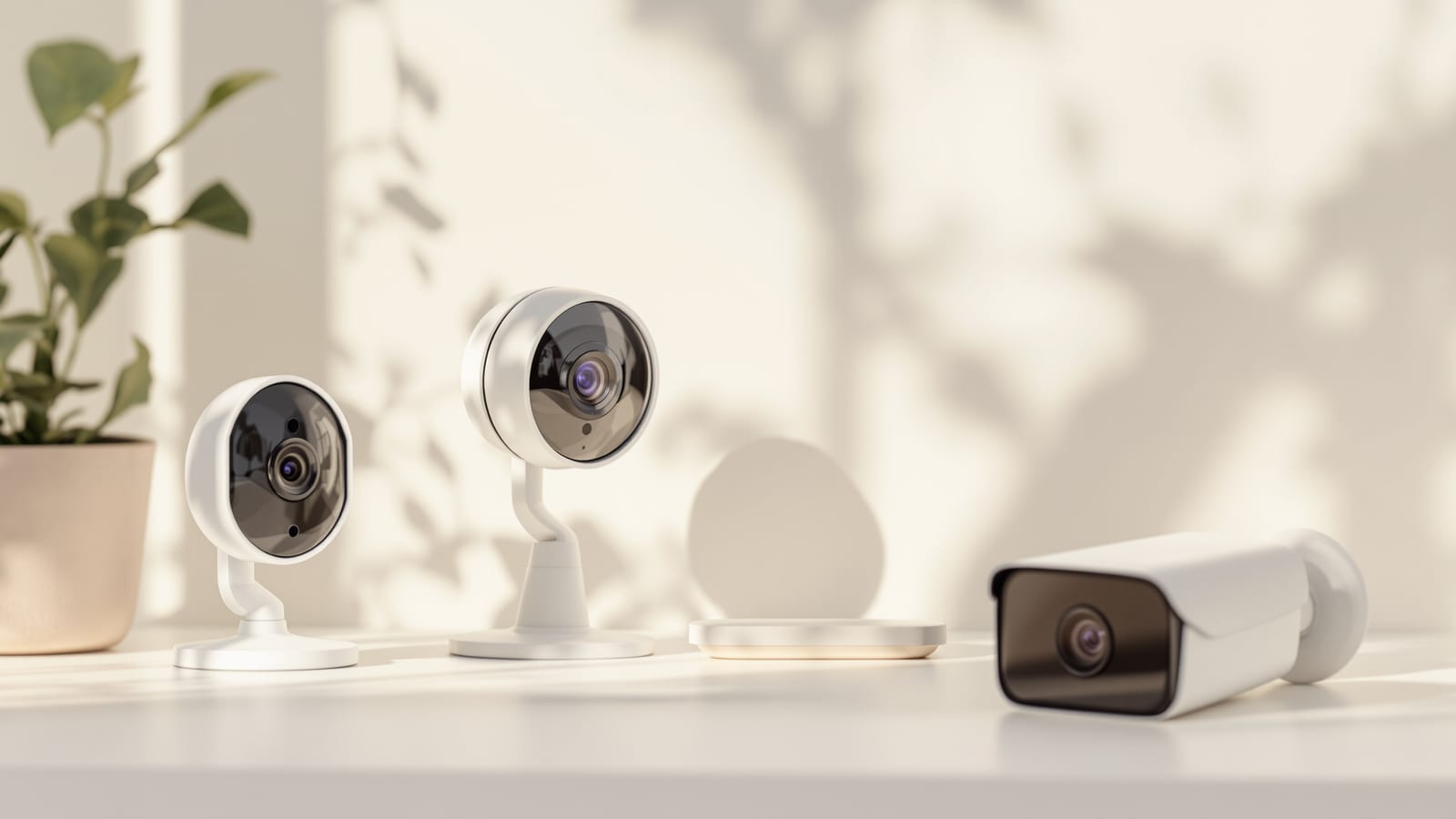
The physical form of a camera decides where it can go and what it does well. Four types cover almost every home need.
Bullets deter at the gate and see far; domes and turrets suit doorways and rooms; a single PTZ can watch a large compound.
Criterion 2 — Resolution
Resolution decides whether you can read a face or a number plate. In India the practical ladder is 2MP (1080p), 4MP and 8MP (4K). Higher resolution needs more storage and bandwidth, so match it to the job: gates and driveways where you want to identify people and plates justify 4MP or 8MP; interior corridors are fine at 2MP.
| Resolution | Also called | Good for | Storage impact |
|---|---|---|---|
| 2MP | 1080p | Indoor rooms, corridors, general view | Lowest |
| 4MP | Super HD | Front gate, driveway, most outdoor | Moderate |
| 8MP | 4K | Wide compounds, plate and face ID | Highest |
Criterion 3 — IP vs analog vs HDCVI
This is the CCTV equivalent of the wired-versus-wireless choice. Analog and HD-over-coax systems (HDCVI, TVI, AHD) run over affordable coaxial cable to a DVR and are the budget mainstay of Indian homes. IP cameras carry digital video over ethernet to an NVR, deliver higher resolution and support single-cable power, and are the future-proof choice for new installs.
| System | Cabling | Resolution ceiling | Best for |
|---|---|---|---|
| Analog / HDCVI (DVR) | Coaxial + separate power | Up to 8MP on newer HDCVI | Budget builds, existing coax runs |
| IP (NVR) | Ethernet, single cable with PoE | 8MP and beyond | New installs, best image, scalability |
Criterion 4 — Indoor vs outdoor and IP rating
Outdoor cameras must survive sun, dust and monsoon. Check the ingress-protection rating: IP66 or IP67 is the sensible minimum for anything exposed, and look for a stated operating-temperature range. Indoor cameras can skip weather sealing but should still handle Indian summer heat. Do not mount an indoor-rated camera under an eave and hope — the first heavy rain usually ends it.
Criterion 5 — Night vision
Most incidents happen after dark, so night performance often matters more than daytime megapixels. Infrared night vision is standard and gives clear black-and-white images in total darkness. Colour night vision (full-colour or ColorVu-type) uses a larger sensor and a warm spotlight to keep colour, which helps identify clothing and vehicles — but needs some ambient light or an active light to work well. For a gate you want to describe an intruder, colour night vision is worth the premium.
Criterion 6 — Field of view and how many cameras
Lens focal length sets the trade between width and reach: a wide lens (2.8mm) covers a room or porch; a longer lens (4mm or 6mm) reaches down a driveway but sees a narrower slice. Plan coverage, not camera count — walk your home and mark every entry point and blind spot. Most Indian homes land at four to eight cameras: gate, main door, rear or service door, and the compound or terrace. Use the smart home security systems guide to plan a complete layered system, not just cameras.
Criterion 7 — Storage and retention
Storage is where kits quietly cut corners. You need to decide how many days of footage you want to keep — a week is a reasonable home minimum, more if you travel — and that, combined with resolution and recording mode, sets the drive size. Options are an SD card in the camera (simplest, least reliable), an NVR or DVR hard disk (the home standard), or cloud storage (offsite, subscription). Recording only on motion, rather than continuously, can roughly halve the space you need.
Multiply cameras, per-camera bitrate, hours and days to size the drive. Higher resolution raises the Mbps figure; motion recording lowers the hours.
Estimate your own figure with the CCTV camera storage calculator, then buy a drive with headroom — surveillance-rated disks (WD Purple, Seagate SkyHawk) are built for continuous writing and outlast desktop drives.
Criterion 8 — Power: PoE vs DC
IP cameras can draw Power over Ethernet, meaning a single cable carries both data and power from a PoE NVR or switch — cleaner runs and no separate adapter at each camera. Analog and many entry IP cameras use a local DC adapter. PoE is the tidier, more reliable choice for a wired home; plan it in when you install an IP system.
Criterion 9 — AI features
Modern cameras add on-device analytics: person and vehicle detection cut the false alerts that plague basic motion sensing, so you are not woken by every passing cat or shadow. Line-crossing and intrusion zones alert only when someone enters a defined area. These features genuinely improve day-to-day usefulness — prioritise reliable person detection over gimmicks like face recognition, which is legally and practically fraught for homes.
Criterion 10 — Privacy and the DPDP Act
Cameras that watch a public street or a neighbour's property, and cloud services that store your footage, carry real privacy duties under India's Digital Personal Data Protection Act. Point cameras at your own property, avoid covering shared corridors without consent, put up a visible notice, secure the recorder with a strong password, and prefer systems that let you keep footage local rather than on a foreign cloud. This is both courteous and increasingly a legal expectation.
Brands and price bands
India's home CCTV market is well served across budgets. Hikvision and its value sibling supply much of the market; CP Plus is the strong domestic player; Dahua overlaps heavily on technology; Godrej and Qubo (Hero Group) target the app-first consumer.
| Brand | Positioning | Typical per-camera band | Notes |
|---|---|---|---|
| CP Plus | Domestic mainstream | ₹1,500 to ₹6,000 | Wide dealer network, easy service |
| Hikvision | Broad range, entry to pro | ₹1,800 to ₹9,000 | Strong ColorVu and AI line-up |
| Dahua | Technology parity with above | ₹1,800 to ₹9,000 | HDCVI leader, good NVRs |
| Godrej Security | Consumer and SMB | ₹2,500 to ₹8,000 | Trusted brand, local support |
| Qubo (Hero) | App-first Wi-Fi cameras | ₹2,500 to ₹6,000 | Simple DIY, cloud options |
Recommendations by need
Budget DIY apartment. A couple of Wi-Fi cameras from Qubo or CP Plus at the door and balcony, recording to SD or a small cloud plan, cover most flats for well under ₹15,000.
Standard independent home. A four to six camera HDCVI or IP kit with a DVR or NVR, bullets outdoors, turrets indoors, 4MP at the gate, and a surveillance-rated drive sized for a week of retention. Budget ₹25,000 to ₹70,000 installed.
Large villa or compound. A full PoE IP system on an NVR, 8MP at the perimeter, colour night vision at the gate, a PTZ for the yard, AI person and vehicle detection, and two-week retention. Budget ₹1 lakh and up, professionally installed and integrated with your security system and home automation.
Common buying mistakes
The most common regret is buying on megapixels alone. An 8MP camera with a cheap sensor and weak night mode gives you a crisp daytime image and a useless night one — and night is when it matters. Weigh the sensor, the lens and the night-vision mode together, not the headline resolution. The second mistake is under-sizing storage: a bundled kit ships with a tiny drive that overwrites in two or three days, so the one week you were away is exactly the footage that no longer exists. Size the drive from the formula above and add headroom.
Third, people forget bandwidth and network load. Several 4K cameras streaming continuously can saturate a modest home network and a low-end NVR, dropping frames just when you need them. Match the recorder's channel and throughput rating to your cameras, and prefer PoE runs over Wi-Fi for fixed outdoor cameras — Wi-Fi cameras at the far end of a compound routinely drop out. Fourth is neglecting the recorder's own security: an NVR or DVR exposed to the internet with a default password is a well-documented way to get your home footage leaked. Change every default credential, keep firmware current, and do not port-forward the recorder carelessly.
Finally, buyers skip the physical basics — mounting height, cable protection and a small uninterruptible power supply. Cameras mounted within easy reach are simply unplugged or sprayed; exposed cables are cut; and a power cut with no battery backup blinds you at the exact moment an intruder cuts the mains. A modest UPS on the recorder and cameras keeps recording through short outages and is one of the highest-value additions to any home system.
Putting it together
Choose type by placement, resolution by the job, and IP over analog if you are installing fresh. Insist on IP66 outdoors and real night vision at the gate. Plan coverage before counting cameras, then size storage from the formula above and buy a surveillance drive with headroom. Respect your neighbours and the DPDP Act. Do that and a modest budget buys footage you can actually rely on when it matters.
References
- Bureau of Indian Standards — Indian standards for electronic and surveillance equipment.
- Ministry of Electronics and IT — Digital Personal Data Protection Act, 2023 — the privacy law governing footage of identifiable people.
- Hikvision — CCTV product documentation — camera, resolution and ColorVu specifications.
- CP Plus — Product range — India's mainstream home CCTV manufacturer.
- Dahua Technology — Security cameras — HDCVI and IP camera reference documentation.
- Western Digital — WD Purple surveillance drives — surveillance-rated storage guidance.
Export this guide
Related Guides — Deep-dive reading
How to Choose a CCTV Camera (2026): The Homeowner's Decision Guide for India
Cut through the spec-sheet noise and choose the right CCTV camera for each spot around an Indian home. What actually matters — sensor and low-light performance, lens and field of view, form factor, IP and IK ratings, honest smart features — and the marketing claims to ignore.
SecurityPoE vs Wi-Fi CCTV: Which Home Security Cameras Are Better?
One camera type runs power and video down a single Cat6 cable to an NVR and almost never drops out; the other clips to a wall in minutes and streams over your home Wi-Fi. This guide settles PoE vs Wi-Fi CCTV for Indian homes — reliability, video quality and bandwidth, cabling and power, retrofit versus new-build effort, NVR versus SD and cloud storage, hacking risk, real rupee costs, scalability and outdoor use — and gives a clear verdict for each kind of home.
Smart HomeData Storage Cost for CCTV in India (2026): Local Disks vs Cloud, and How to Size It
The running cost people forget when they buy cameras. Where the footage actually lives — a one-time surveillance hard disk in the recorder, or a recurring per-camera cloud plan — and how camera count, resolution, frame rate, recording mode and retention days decide how many terabytes, and how much money, you really need.
SecurityRelated Tools — Try Free
CCTV Camera Coverage & Count Calculator
Estimate how many CCTV cameras you need, the NVR channels, storage in TB for your retention period, and an indicative all-in cost with GST.
CCTV CalculatorCCTV Lens & Field-of-View Calculator
Focal length, sensor and resolution to field-of-view angle, scene width and DORI detect/observe/recognise/identify distances.
Lens & FoVCCTV Cable-Length Calculator
Total cable to buy for a CCTV job and a warning when a run exceeds the cable's maximum length.
Cable Length