
Bow Windows Design Guide (India): The Curved Panoramic Projection
Four to five glass lights on a gentle curve — the softest, widest, and priciest projecting window for Indian homes
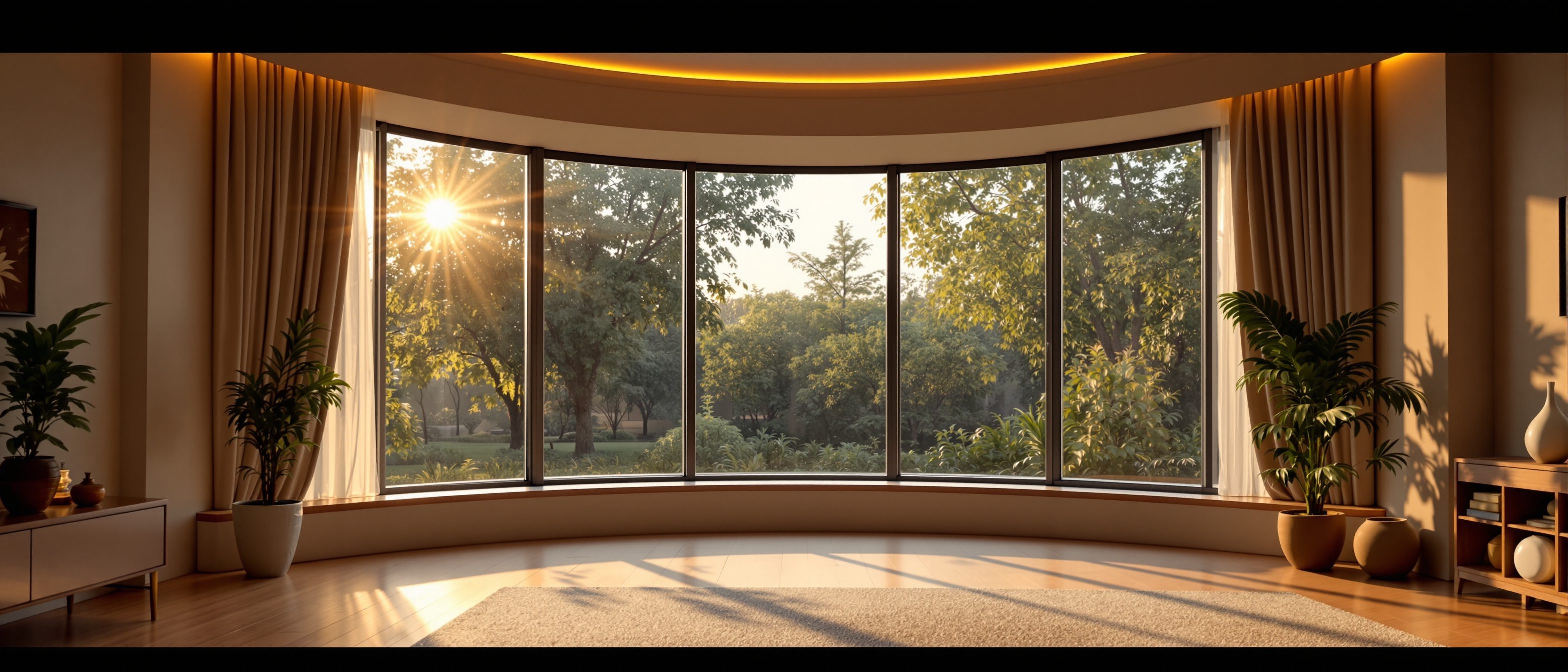
A bow window is the most theatrical window you can build into an Indian home: four to five glass lights set side by side on a gentle curve, sweeping out from the wall to form a soft, rounded bubble of glass. Where a bay window projects in sharp angles, a bow flows in a smooth arc. The result is a wider, gentler panorama, more daylight from more directions, and a piece of architecture that announces a home rather than just lighting a room.
It is also the priciest projecting window you can buy. This guide covers the geometry, the structure and waterproofing of a curved projection, the right frame and glazing for Indian conditions, an honest cost band, and exactly when a bow earns its keep.
A bay turns a corner in three blunt steps. A bow rounds it in five quiet ones. The bow trades a little usable floor for a far softer, wider sweep of glass and view.
For the full menu of window types, start at our pillar guide, Types of Home Windows in India. For a quick combined intro to windows and doors together, see Windows and Doors Design for Indian Homes — this guide goes much deeper on the curved projecting window specifically.
What a bow window is — the geometry
A bow window is built from four or five equal glass lights, each a narrow flat panel, joined at small angles so that together they describe an arc of a circle. Because the panels are equal and the joint angles are gentle (typically 10 to 15 degrees between lights), the projection reads as a continuous curve rather than a set of facets.
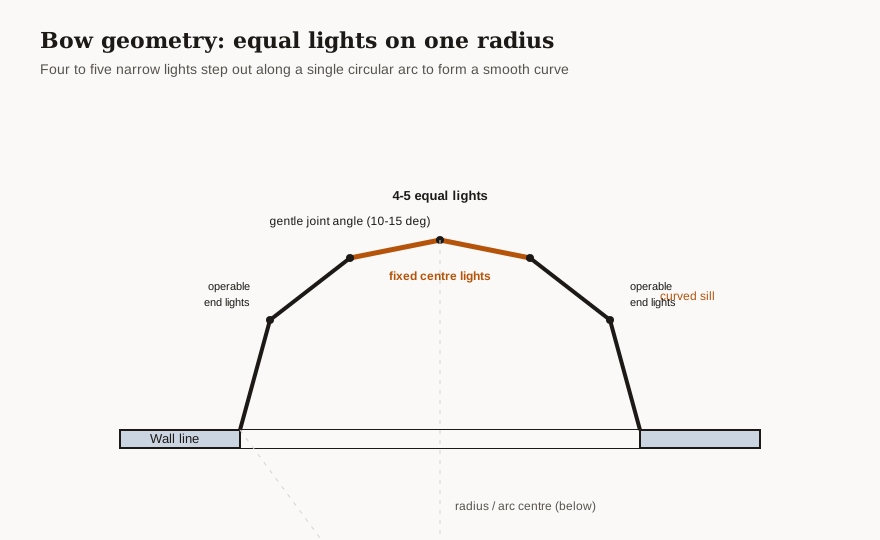
In plan, the centre line of each light sits on a single radius, so the whole assembly is a slice of a circle stepping out from the wall. Compare this with a bay, which is built from just three units — a wide flat centre light flanked by two angled sides — meeting at two sharp corners.
| Geometry | Bow window | Bay window |
|---|---|---|
| Number of lights | 4 to 5 | 3 |
| Form | Smooth curve on a radius | Angular, two corners |
| Wall opening | Wider, shallower sweep | Narrower, deeper box |
| Floor gained inside | Modest, curved sill | More — a usable box / seat |
| Visual character | Soft, panoramic, premium | Bold, geometric |
| Cost | Highest of all projecting windows | High, but less than a bow |
Bow versus bay — choosing between the cousins
These two are first cousins and people confuse them constantly, so be deliberate. Our Bay Windows Design Guide for India covers the angular, three-part cousin in full. The short version of the difference:
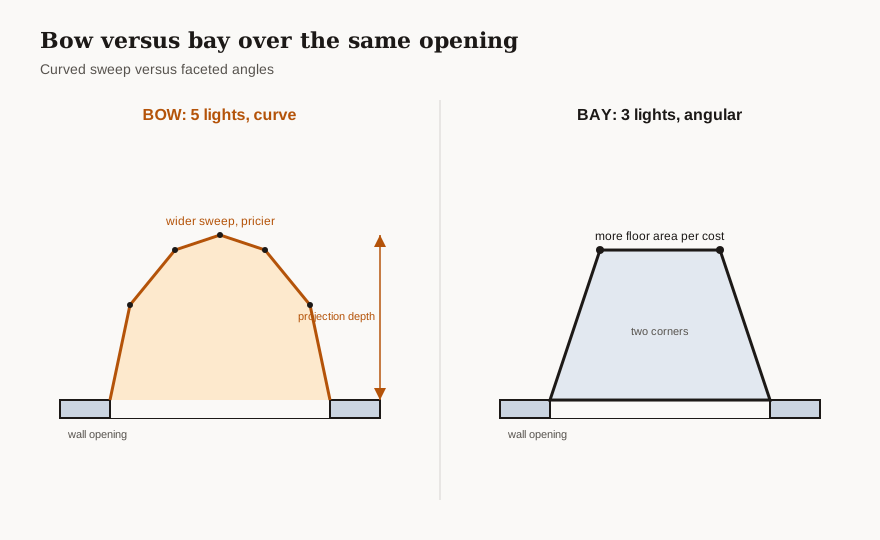
- A bay uses three units and creates a deeper box, so it gives you more usable floor area per rupee — room for a generous window seat, a reading nook, or storage below.
- A bow uses four or five units on a curve, so it gives you a softer, wider panoramic sweep and more even light, but a shallower, more decorative sill — and it costs more.
Rule of thumb: choose a bay if you want extra floor and a defined nook; choose a bow if you want the gentlest, widest glass panorama and curb appeal, and the budget is comfortable.
Light, view and curb appeal
Because the lights fan across a curve, a bow gathers daylight from a broader arc of the sky than any flat or three-part window of the same wall opening. Through the day the sun sweeps across the panels, so the room stays bright from morning to evening without a single harsh hot-spot. The view is panoramic — close to wraparound — and from the street the rounded projection gives a home a distinctly graceful, premium face. For light-planning across the whole house, see Natural Light Planning for Indian Homes.
Typically the central lights are fixed (maximum glass, maximum view, perfect seal) with one or two operable casement lights at the ends for ventilation. That keeps the panorama clean while still letting air in; test the airflow with our Cross-Ventilation Analyzer, and read Cross-Ventilation in Indian Homes for the principles.
Structure and waterproofing of a curved projection
A bow carries its own weight and the weight of the glass out beyond the wall, so it must be properly supported — this is not a DIY swap. Two structural routes are common:
| Support method | How it works | Best for |
|---|---|---|
| Cantilevered floor / brackets | The sill platform cantilevers from the slab or sits on steel brackets tied back into the structure | Most homes; lighter projections |
| Posts / piers to ground | The curved sill is carried on slim columns down to a footing | Large, heavy, or ground-floor bows |
| Suspension from roof | Tension rods carry the roof of the projection back to the structure above | Tall, double-height bows |
The curved roof of the projection is the part that earns the premium. Every joint between the lights and at the curved cill and head must be detailed against the monsoon: continuous flashing, a slight outward slope on the roof and sill to shed water, and high-grade weather-seals at each mullion. A curve has more linear metres of joint than a flat window, so there is more to waterproof — insist on a fabricator who shows you a monsoon-tested curved detail, not a flat-window detail bent around.
The bow's beauty and its risk are the same thing: the curve. More joints means more glass and more light, but also more metres of seal to get right before the first monsoon.
Frame and glazing
The frame must hold a multi-light curve true and resist deflection, so material choice matters.
| Frame | Fit for a bow | Notes |
|---|---|---|
| Aluminium (thermally broken) | Excellent | Strong, slim, holds large curved spans with minimal frame; insist on a polyamide thermal break or bare metal conducts heat. Per IS 1948:2024 |
| uPVC (steel-reinforced) | Very good | Best all-round value, great thermal and acoustic insulation, low maintenance; needs steel reinforcement for the spans |
| Wood (timber) | Premium / heritage | Warm and classic, suits luxury bows; needs sealing against the monsoon and costs 2.5 to 4 times uPVC over ten years |
For the glass, a bow is a lot of area facing the sky, so glazing discipline keeps it comfortable and code-compliant:
- DGU (double-glazed unit) as the baseline for thermal and acoustic insulation.
- Low-E coating to reflect radiant heat — essential across most of India; aim for low SHGC with adequate VLT.
- Toughened (safety) glass on the large low lights, and laminated where security, acoustics or UV-cut matter.
A large bow pushes up the window-to-wall ratio (WWR), and under Eco-Niwas Samhita 2018 a higher WWR demands lower-SHGC, spectrally selective glazing to keep the envelope's RETV within the 15 W/m² ceiling for composite, hot-dry, warm-humid and temperate zones. More glass simply means smarter glass. Ventilation still follows the NBC 2016 rule of thumb of an openable area of at least one-tenth of floor area, met through the operable end lights.
Cost band — the priciest projecting window
A bow is the most expensive standard window you can specify, and the cost is driven by the curved fabrication, multiple lights, structural support and specialty fitting.
| Component | Indicative June 2026 |
|---|---|
| Frame + glazing (uPVC / aluminium, DGU + Low-E) | ₹900 to ₹1,500+ per sqft |
| Premium architectural aluminium / timber | higher again |
| Specialty fitting (bay / bow / French) | ₹500 to ₹800 per sqft |
| Structure (brackets, posts, flashing) | project-specific — budget separately |
These are indicative — always confirm with itemised quotes from fabricators, as a bow's curved geometry, span and support method swing the price more than almost any other window.
Pros and cons
| Pros | Cons |
|---|---|
| Softest, widest panoramic sweep of any window | Highest cost of all projecting windows |
| Most daylight, from the broadest arc | More joints to waterproof — monsoon risk if poorly detailed |
| Strong curb appeal — a signature feature | Needs structural support and specialty fitting |
| Even light through the day, few hot-spots | Less usable floor gained than a bay |
| Suits large, luxury rooms | High WWR demands disciplined low-SHGC glazing |
Choose a bow if / Avoid a bow if
Choose a bow window if:
- You have a large living room, master suite or formal space that can carry a wide projection.
- You want a panoramic, softly curved view and standout curb appeal.
- The budget is comfortable with the highest projecting-window cost.
- You want the most daylight a single wall opening can deliver.
Avoid a bow window if:
- The budget is tight, or you want floor area per rupee — pick a bay instead.
- The room is small or the wall opening narrow — the curve needs width to read well.
- The home is in a heavy monsoon exposure and you cannot commission a properly detailed, tested curved waterproofing detail.
- You only need ventilation or a simple view — a casement, sliding or picture window does that for far less.
References
- IS 1948 (aluminium doors, windows and ventilators), BIS: https://law.resource.org/pub/in/bis/S03/is.1948.1961.pdf
- IS 1081 (fixing and glazing of metal doors and windows), BIS: https://law.resource.org/pub/in/bis/S03/is.1081.1960.pdf
- BIS Guide for Using NBC 2016: https://www.bis.gov.in/wp-content/uploads/2022/08/Booklet-Guide-for-Using-NBC-2016.pdf
- Eco-Niwas Samhita 2018 (BEE / ECBC): https://ecbc.in/econiwas.html
- uPVC windows price per sq ft 2026 (Building and Interiors): https://buildingandinteriors.com/upvc-windows-price-per-sq-ft-india-2026-cost-guide/
Export this guide
Related Guides — Deep-dive reading
Floor-to-Ceiling Windows (India): Maximum Light, and the Heat Trade-Off
Full-height glazing for Indian homes — how to win the daylight and view without losing the energy code, comfort or safety.
Windows & GlazingBay Windows for Indian Homes: Light, Floor Area and a Window Seat
How an angular three-unit bay adds floor area, light from three angles and a window seat, and what it takes to build one well in India.
Windows & GlazingTypes of Home Windows in India (2026): Complete Comparison and How to Choose
Every window type compared on ventilation, cost and best use, plus a frame, glazing and climate framework to choose right.
Windows & GlazingRelated Tools — Try Free
Cross-Ventilation Analyzer
Estimate airflow and air changes per hour (ACH) from room size, window areas, layout, and local wind — with NBC 2016 Part 8 compliance check.
Ventilation CalculatorWindow Material Comparison Tool
Compare uPVC, aluminium, wood, steel and composite windows on cost, life, upkeep and insulation.
CompareFuture Home Comfort Score
Score your home 0 to 100 on daylight, ventilation, thermal and acoustic comfort and find the weak link.
Window Tool