
Biomimetic and Adaptive Facade Systems in India: How Buildings Borrow Nature's Cooling Tricks
From termite-mound towers and humidity-sensing wood to India's own jaalis and stepwells — a candid look at facades that copy nature's strategy, not just its shape, and which ideas are truly deployable here.
A termite, blind and barely a centimetre long, builds a mound that holds its internal climate steady while the African savannah outside swings from freezing nights to 40°C afternoons. A pinecone opens and closes its scales to track the weather, with no muscles, no motor and no brain — it has been dead for months. The lotus leaf shrugs off mud and water without ever being scrubbed. Across millions of years of relentless trial and error, nature solved almost every problem a building facade faces: keep heat out, let air through, manage glare, stay clean, and adapt to changing conditions — all without a power bill.
Biomimetic architecture is the discipline of borrowing those solutions. The crucial word is strategy. Biomimicry does not mean carving a building to look like a leaf or a seashell — that is decoration. It means asking how the leaf moves water, how the mound moves air, how the pinecone moves without machinery, and then translating that working principle into a building skin. Done honestly, a biomimetic facade can shade, ventilate and even move using nothing but the materials' response to sun, heat and humidity. Done lazily, it is a sculptural gimmick wearing nature's costume.
This is part of our Building Facades series, and it has a deliberate sibling. Our guide to smart, kinetic and parametric facades covers the motorised world — electric louvers, sensors, control software, electrochromic glass that tints on command. This guide is the other half of the story: the nature-inspired, often motorless, material-driven approach. Where the kinetic guide needs actuators and electricity, the biomimetic and adaptive ideas here often need neither. And as you will see, India's own tradition — the jaali and other traditional facades — turns out to be one of the oldest and most successful biomimetic facade systems on earth.
1. What biomimicry actually means (and what it doesn't)
Biomimicry is innovation inspired by nature's functioning — copying the mechanism, not the appearance. The term was popularised by biologist Janine Benyus, whose Biomimicry Institute frames nature as a 3.8-billion-year-old R&D lab whose surviving designs are, by definition, the ones that worked.
The trap to avoid is confusing it with biomorphism — looking like nature. A column shaped like a tree trunk is biomorphic. A facade that distributes structural load the way a tree distributes wind load is biomimetic. The first is a styling choice; the second is an engineering strategy. Most buildings marketed as "biomimetic" are honestly just biomorphic, and we will be candid about which is which.
A few more terms you will meet:
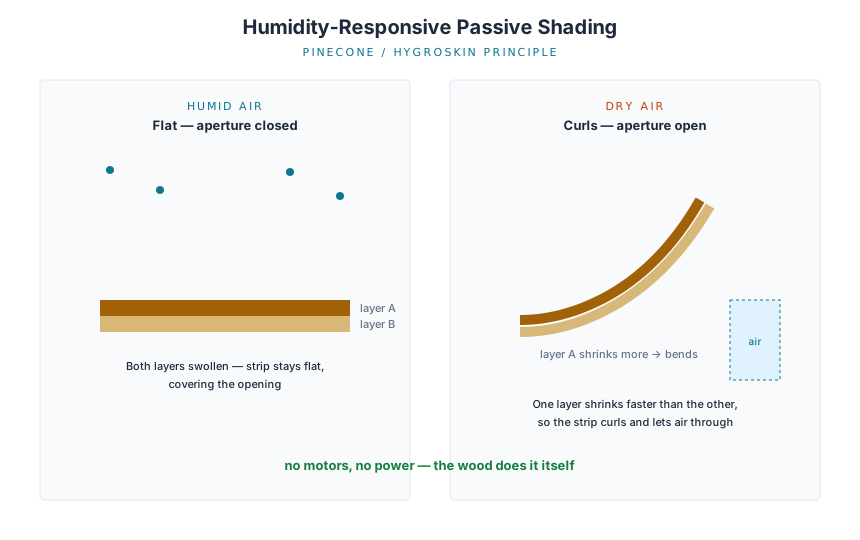
- A stimulus-responsive (or smart) material changes a property — shape, porosity, colour — in direct response to an environmental trigger such as humidity, heat or light, with no external control system. Wood swelling in the monsoon is the everyday example.
- A compliant mechanism moves by bending rather than through hinges and joints. A blade of grass bowing in the wind and springing back is a compliant mechanism; so is the bird-of-paradise flower that inspired the Flectofin shading system below.
- Passive adaptation uses the building's materials and geometry to respond to conditions with no energy input. Active adaptation uses sensors, motors and power. The kinetic-facade guide lives in the active world; this guide lives mostly in the passive one.
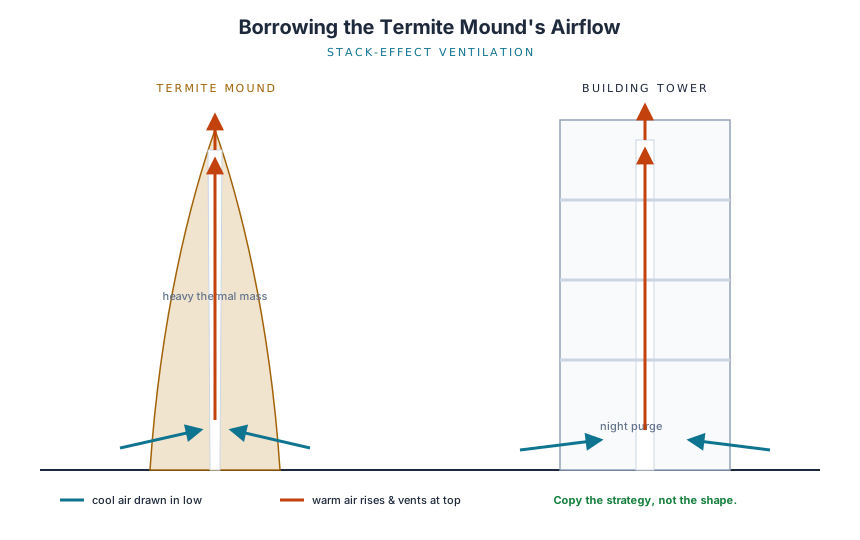
- The stack effect (or chimney effect) is the tendency of warm air to rise and escape through high openings, drawing cooler air in low — the engine behind both termite mounds and most traditional Indian ventilation.
2. The three levels of biomimicry
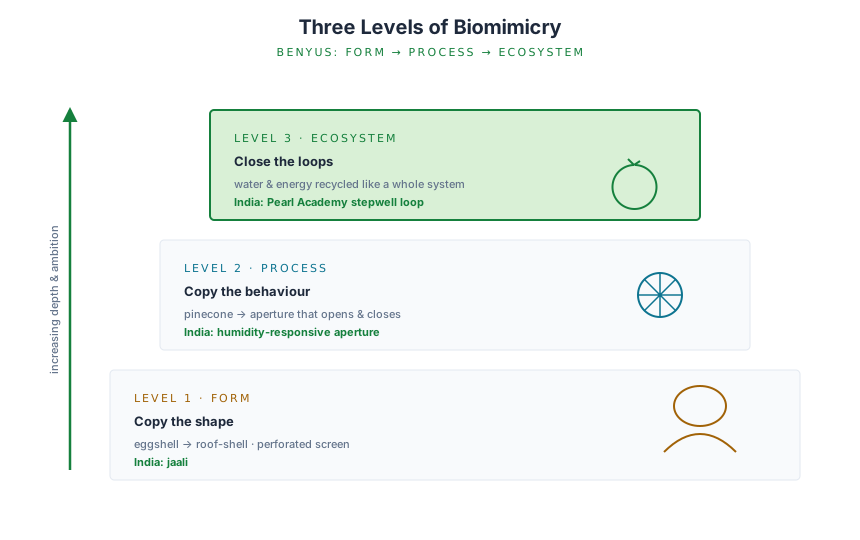
Benyus identifies three levels at which a design can imitate nature, and they are a useful ladder for judging any "biomimetic" claim.
Level 1 — Form. Copying a natural shape or structure. A roof shell modelled on an eggshell's curved geometry to get maximum strength from minimum material. This is the shallowest level, and it shades into mere biomorphism. Most "nature-inspired" facades stop here.
Level 2 — Process / behaviour. Copying how nature does something. A facade aperture that opens and closes with humidity the way a pinecone scale does; a shading fin that flexes like a flower petal. This is where the genuinely exciting facade work sits, because the building actually behaves like the organism.
Level 3 — Ecosystem. Copying how a whole ecosystem works — closed loops, zero waste, energy from the sun, water cycled rather than consumed. A building that treats and reuses its own water to feed an evaporative cooling cycle is reaching for this level.
India offers clean examples of each. A jaali screen that scatters harsh sun into soft diffuse light is loosely Level 1 (form). The Pearl Academy in Jaipur, where a jaali skin plus a central stepwell drive a self-running cooling loop, climbs toward Levels 2 and 3 — the building behaves like a desert organism and cycles its own resources. Keep this ladder in mind; it is the fastest way to tell engineering from marketing.
3. Nature's strategies, and the facades that borrow them
The most concrete way to understand biomimetic facades is to line up the natural model against the building application — and to be honest about how mature each idea is and how well it fits Indian conditions.
| Nature model | Strategy borrowed | Facade application | Maturity | Honest India fit |
|---|---|---|---|---|
| Termite mound | Stack-effect ventilation; thermal mass buffering swings | Tall vent chimneys + heavy mass + night-purge airflow (Eastgate, CH2) | Built, proven at building scale | Excellent — same logic as our courtyards and havelis; works best in dry climates with big day-night swings |
| Pinecone scale | Humidity-driven bilayer bending, no motor | Wood-composite apertures that open/close with humidity (HygroSkin) | Pavilion / lab | Low for now — humid Indian air and pests challenge bare wood; concept, not product |
| Bird-of-paradise flower | Hingeless flexing (compliant mechanism) | Flexing shading fins with no joints to seize (Flectofin / Flectofold) | Demonstrator / research | Promising but not commercial; durability under UV and dust unproven here |
| Lotus leaf | Super-hydrophobic micro-texture (self-cleaning) | Self-cleaning facade paint (Sto Lotusan) | Mature commercial product | Good and practical — cuts cleaning on dusty, monsoon-streaked facades |
| Mashrabiya / jaali (cultural "nature" of shade) | Perforated screen: shade + airflow + privacy | Static and kinetic lattice second skins (Al Bahar, Institut du Monde Arabe) | Ancient + modern | Native to India; the proven, cheap, deployable version |
| Desert beetle / fog harvesting | Surface wettability to capture water | Fog/dew collection skins | Research / niche | Marginal — relevant only to specific coastal or high-humidity microclimates |
The pattern is hard to miss. The ideas that are built and proven tend to be the ventilation and screen strategies — and those are precisely the ones India has practised for centuries. The motorless responsive-material ideas (pinecone, bird-of-paradise) are genuinely thrilling but still live in pavilions and labs.
4. Real buildings, not renders
Marketing renders of "living facades" are everywhere. Here are the verified buildings that actually stand up — with the honest caveats.
Eastgate Centre, Harare (Mick Pearce, 1996). The famous one. This Zimbabwean shopping-and-office complex uses tall exhaust chimneys, heavy masonry thermal mass and a night-purge cycle to achieve roughly 90% passive climate control, cutting mechanical cooling drastically. Pearce credited termite mounds as inspiration. The honest footnote: the science of the mounds themselves was later revised. Biologist Scott Turner's measurements suggested mounds function less like air-conditioners holding a steady temperature and more like lungs, exchanging oxygen and carbon dioxide for the colony. So Eastgate is a building inspired by a popular understanding of termites that science has since complicated — yet the building works, because the stack-effect-plus-thermal-mass strategy is sound regardless of what the termites are really doing. It is biomimicry's most cited case study and its most useful cautionary tale at once.
Council House 2 (CH2), Melbourne (DesignInc with Mick Pearce, 2006). Pearce's refinement of the same idea, and Australia's first building to pursue biomimicry as an explicit design principle. It pulls termite-mound logic into a city office block: automatic recycled-timber shutters, night-purge ventilation that flushes warm air and cools the exposed concrete mass overhead, and shading on the facade. It earned Australia's first six-star Green Star rating. A cleaner, more measured demonstration than Eastgate.
Institut du Monde Arabe, Paris (Jean Nouvel, 1987). The south facade carries 240 metal screens whose apertures open and close like camera diaphragms, derived from the Arabic mashrabiya. It is a landmark — but be honest: it is motorised, driven by light sensors and small electric motors. It belongs as much to the kinetic-facade story as to this one, and it bridges the two: a nature-and-tradition-derived idea executed with active technology.
Al Bahar Towers, Abu Dhabi (Aedas with Arup, 2012). A 21st-century mashrabiya: more than 2,000 umbrella-like shading units form a computer-controlled second skin that opens and closes as the sun tracks across the towers, cutting solar gain and reportedly saving around 1,750 tonnes of CO₂ a year. Again, this is active and motorised — but it matters here because the strategy is a direct descendant of a passive, culturally evolved screen. It shows how an old biomimetic idea (the screen) can be re-engineered with modern controls.
HygroScope and HygroSkin (Achim Menges, with Steffen Reichert and Oliver David Krieg, 2012–13). This is the real motorless magic. These pavilions use thin wood-composite apertures that open and close in response to ambient humidity alone — no motors, no sensors, no electricity, no control system whatsoever. The wood swells and shrinks with moisture, and clever lamination turns that swelling into bending, exactly as a pinecone scale does. HygroScope was shown at the Centre Pompidou; HygroSkin's apertures respond across roughly 30–90% relative humidity. This is genuine Level-2 biomimicry — but note the scale: these are pavilions, not occupied buildings, and bare responsive wood faces real questions about durability, pests and pollution before it could clad an Indian home.
Flectofin and Flectofold (ITKE Stuttgart, with Freiburg's Plant Biomechanics Group, from 2011). A glass-fibre-reinforced shading fin that flexes open and shut with no hinges at all — a compliant mechanism abstracted from the bird-of-paradise flower (Strelitzia reginae), whose petal flexes sideways when a bird lands. Because there are no joints, there is nothing to seize, jam or wear out — a real advantage in dusty environments. Flectofold refined this for curved facades. Both remain research demonstrators, not commercial products, but they point to a future of facades that move by bending rather than by machinery.
Esplanade, Singapore (DP Architects with Michael Wilford, 2002). Often called the "durian" for its spiky twin domes. Its triangular louvers do adjust to the sun and create a famously beautiful play of dappled light. But be candid: the durian resemblance is biomorphic — a shape association, not a borrowed mechanism. The genuinely useful part is the shading-louver array, not the fruit it looks like. A good reminder that "inspired by nature" is often a marketing line draped over conventional engineering.
5. India's indigenous biomimicry — older and cheaper than any of the above
Here is the point that most international coverage misses: India did not need to import biomimicry. Our vernacular architecture is biomimicry, refined over centuries of climate pressure.
The jaali — the perforated stone or timber screen — is a masterclass. Its small openings accelerate airflow through the Venturi effect (faster air through a narrowing), while simultaneously blocking direct sun, cutting glare, filtering dust and granting privacy. One element solving four facade problems at once: that is exactly the kind of multi-functional elegance biomimicry chases. The Hawa Mahal in Jaipur, with its 953 jharokha windows, is essentially a giant breathing screen using these principles at palace scale.
Stepwells (baolis) and water tanks created cool microclimates through shade and evaporation — buildings reaching toward Level-3 ecosystem thinking by working with the water cycle. The courtyard-and-windcatcher (badgir) tradition runs the same stack-effect engine as the termite mound: cool air drawn in low, warm air vented high, often passed over water to cool further by evaporation. Eastgate and CH2 are, in a real sense, re-discoveries of what a Rajasthani haveli already knew.
And it is not only history. Pearl Academy, Jaipur (Morphogenesis) wraps a contemporary building in a double-skin jaali derived directly from Rajasthani tradition. Drip channels on the inner face of the jaali drive passive downdraft evaporative cooling; the whole building is lifted off the ground so air is drawn underneath and past a central stepwell fed by recycled water, then released up through open courtyards. The result: interiors and courtyards held far cooler than the desert outside — with no mechanical air-conditioning doing the heavy lifting. This is Level-2 and Level-3 biomimicry, built, occupied and Indian. It is the model worth studying, far more than any imported responsive-wood pavilion.
6. Adaptive envelopes without the machinery
If you strip away the motors that define the kinetic-facade world, what passive adaptation is genuinely available?
- Self-cleaning surfaces. The lotus-effect coating (commercialised by Sto as Lotusan since 1999) is the rare biomimetic facade product that is mature, affordable and directly useful in India. Its micro-textured, super-hydrophobic surface means rain beads up and carries dust away, reducing algae, streaking and cleaning costs on monsoon-exposed walls. This is real, buyable biomimicry today — and we cover it in depth in our self-cleaning facades guide.
- Thermal mass and geometry. The most powerful passive "technology" is the oldest: heavy mass to buffer temperature swings, deep shading to keep sun off the wall, and openings placed to drive the stack effect. No moving parts, no failure modes.
- Humidity-responsive movement (emerging). The pinecone/HygroSkin family — apertures that open and close on humidity alone — is the genuine frontier of motorless adaptation. Treat it as a research direction to watch, not a product to specify.
- Compliant shading (emerging). Flectofin-style flexing fins promise movement with nothing to seize up. Exciting, especially for dusty climates, but not yet commercial.
The honest hierarchy: self-cleaning coatings and passive mass/geometry are deployable in India now; responsive-material movement is years from your wall.
7. The honest case
So let us be straight about the field, because it is drowning in greenwash.
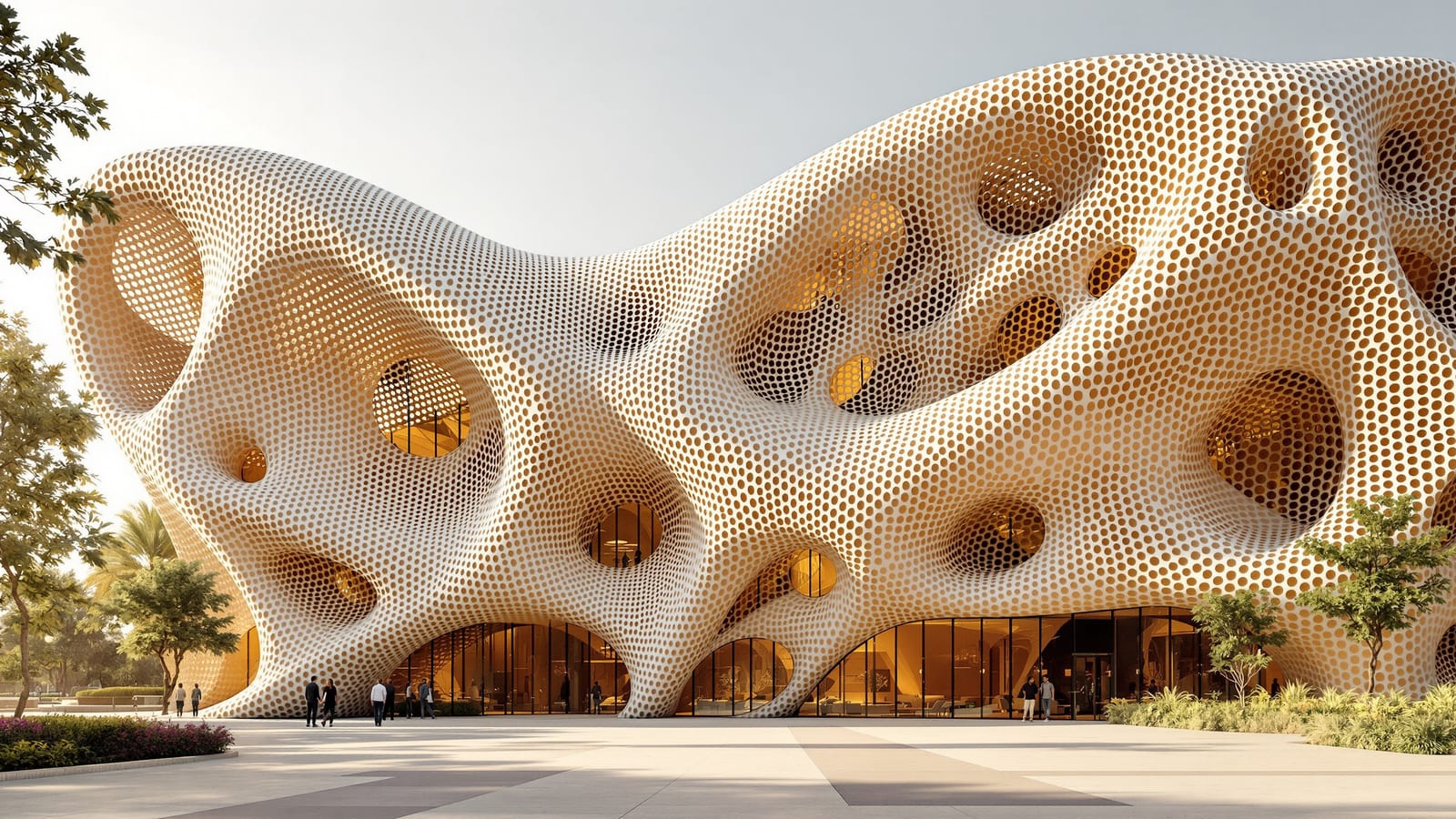
Most "biomimetic facade" projects you will see in glossy magazines are biomorphic, not biomimetic — they look like coral, leaves or honeycomb without borrowing any working principle. A honeycomb-pattern cladding panel is not doing what a honeycomb does; it is wearing the costume. That is fine as architecture, but call it what it is: sculpture.
The genuinely biomimetic, passively adaptive work — HygroSkin, Flectofin, the responsive-material frontier — is real, rigorous and inspiring. It is also, almost entirely, pavilion- and lab-scale. None of it is yet a product you can clad an Indian home or office in, and bare responsive wood faces hard questions about monsoon humidity, termites (the irony is rich), UV degradation and air pollution before it ever could.
Meanwhile, the proven, cheap, deployable version of biomimicry already exists in India — and it is sitting in our own building tradition. The jaali, the courtyard, the windcatcher, the stepwell, the deep verandah: these are time-tested, climate-tuned, multi-functional facade systems that achieve passively what high-tech kinetic skins achieve with motors and software. Pearl Academy proves they scale to modern buildings. The biggest mistake an Indian client can make is to import an exotic "responsive material" facade when a well-detailed jaali double-skin would outperform it on cost, durability and comfort.
8. What this means for you
If you are a homeowner or a practitioner in India thinking about a "nature-inspired" or "adaptive" facade, the climate-smart move is usually counter-intuitive: look backward before you look high-tech.
- Start with the vernacular. A deep jaali screen, a shaded courtyard that drives the stack effect, generous thermal mass, and openings positioned for cross-ventilation will do more for comfort and running cost than any imported responsive material. This is biomimicry — the proven kind. See our jaali and traditional facades guide.
- Buy the mature biomimetic products that exist. Lotus-effect self-cleaning coatings are real, affordable and genuinely useful on dusty, rain-streaked Indian facades.
- Treat responsive-material movement as inspiration, not specification. HygroSkin and Flectofin are wonderful and worth understanding — but they are not yet things you can build a home from. Don't let a vendor sell you a "self-adjusting biomimetic skin" that is really just a fancy pattern.
- If you want a facade that actively moves with the sun, you are in the kinetic world, not this one — and you should read our smart, kinetic and parametric facades guide, with clear eyes about motors, maintenance and Indian dust.
- Demand the function, not the look. Ask any designer pitching "biomimicry": what strategy are you borrowing — ventilation, shading, self-cleaning, movement — and how does the facade actually perform it? If the answer is only "it looks organic," you are buying biomorphism, and you should price it as decoration.
Nature spent millions of years engineering the perfect facade. The good news for India is that our ancestors were paying attention long before the word "biomimicry" existed — and their answers are still the best ones on the shelf.
Sources
- AskNature (Biomimicry Institute) — passively cooled building inspired by termite mounds; a biomimicry primer and the three levels of mimicry.
- Reporting on the revised science of termite-mound function (Scott Turner's "lungs not air-conditioner" findings).
- Project documentation and architectural press for Eastgate Centre, Harare; Council House 2, Melbourne; Institut du Monde Arabe, Paris; and Al Bahar Towers, Abu Dhabi.
- Achim Menges — HygroScope and HygroSkin meteorosensitive pavilions (humidity-responsive wood composites).
- University of Freiburg / ITKE Stuttgart — Flectofin and Flectofold compliant-mechanism shading derived from the bird-of-paradise flower.
- Research on the passive-hydraulic actuation of pine cones (bilayer humidity-driven bending).
- Sto — Lotusan biomimetic self-cleaning facade coating.
- Morphogenesis — Pearl Academy of Fashion, Jaipur (double-skin jaali, stepwell and passive downdraft cooling).
- Janine Benyus, Biomimicry: Innovation Inspired by Nature, and the Biomimicry Institute's levels-of-mimicry framework.
Export this guide
Related Guides — Deep-dive reading
CH2 (Council House 2): The Office That Breathes Like a Termite Mound
Mick Pearce, DesignInc and the City of Melbourne set out to build an office as if it were a living organism — cooled by shower towers, warmed by its own concrete bones, ventilated by yellow wind turbines. Australia's first Six-Star Green Star building is a manifesto for biomimicry, and an honest lesson in the gap between design intent and metered reality.
The Future of ArchitectureSmart, Kinetic & Parametric Facades in India: Skins That Move, Tint and Respond (And When They Are Worth It)
Plain-English guide to parametric, kinetic and smart-glass facades: how moving louvers, electrochromic glass and AI-driven envelopes work, real examples like Al Bahar Towers, and the honest India verdict on cost, maintenance and when fixed shading wins.
Building FacadesJaali & Traditional Indian Façades: India's Original Climate-Smart Screen
Guide to the jaali and traditional Indian façades: history from Mughal and Rajasthani stone screens to Hawa Mahal and Sidi Saiyyed, the building physics of daylight, heat, privacy and breeze, materials from sandstone to GRC and metal, the parametric revival at Pearl Academy Jaipur, and how a homeowner can use a jaali.
Building FacadesRelated Tools — Try Free
Brise-Soleil Visualizer
Interactive horizontal-louvre cut-off angle calculator — sun altitude, louvre depth, and spacing inputs with a live shadow preview. Computes θ = arctan(spacing/depth) for façade shading, ECBC envelope compliance, hospital daylight design, and tropical sun-control detailing.
Sun Shading ToolCross-Ventilation Analyzer
Estimate airflow and air changes per hour (ACH) from room size, window areas, layout, and local wind — with NBC 2016 Part 8 compliance check.
Ventilation CalculatorFuture Home Comfort Score
Score your home 0 to 100 on daylight, ventilation, thermal and acoustic comfort and find the weak link.
Window Tool