
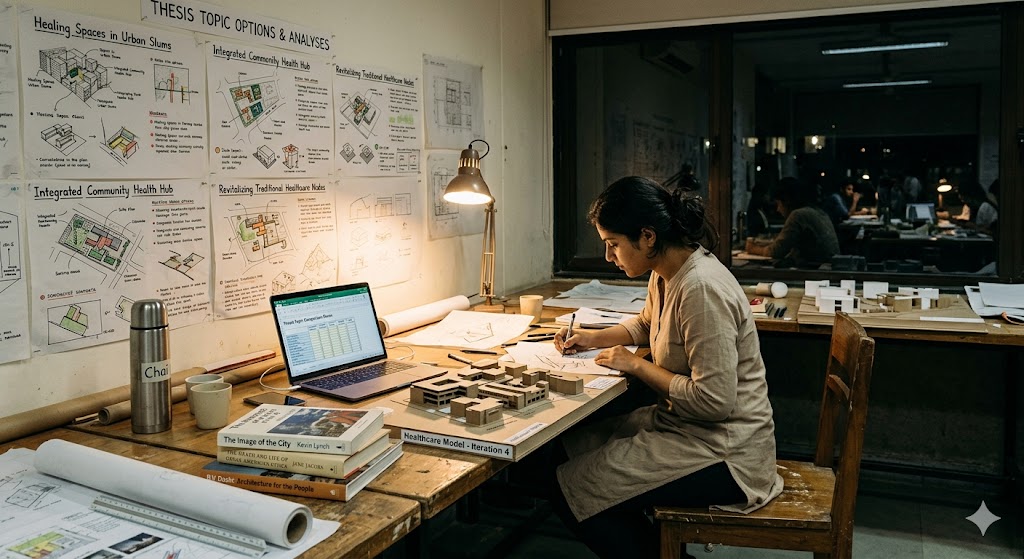
50 Thesis Topics for Indian Architecture Students — A Working Catalogue
Seven Topic Families, 50 Specific Ideas, Six-Criterion Selection Matrix & a 12-Month Timeline
The right thesis topic is not the most novel one — it is the one you can defend with passion for 4 hours of viva after 12-18 months of solitary work. Choosing well is the single highest-leverage decision in your architecture education.
This guide is the working catalogue of 50 B.Arch and M.Arch thesis topics for Indian architecture students 2026-27, grouped into seven topic families, each with site context, recommended methodology, reference codes, difficulty rating, and contribution potential. It also includes the six-criterion topic selection matrix, a 12-month thesis timeline, and an honest assessment of when emerging-frontier topics work and when they fail.
Pick from interest, not from grade aspiration. The best thesis is one with genuine site access, clear methodology, mentor depth, and a contribution you can articulate in one sentence at the end of viva. Topic catalogues evolve — this one is refreshed every 12 months to reflect current Indian discourse.
For the methodology complement (how to actually do thesis research and writing) see Architecture Thesis Methodology in India. For case study analysis discipline, see Architecture Case Study Analysis. For post-thesis pathways see Career Pathways After B.Arch. For portfolio shaping around your thesis see Architecture Portfolio Building.
The Seven Topic Families
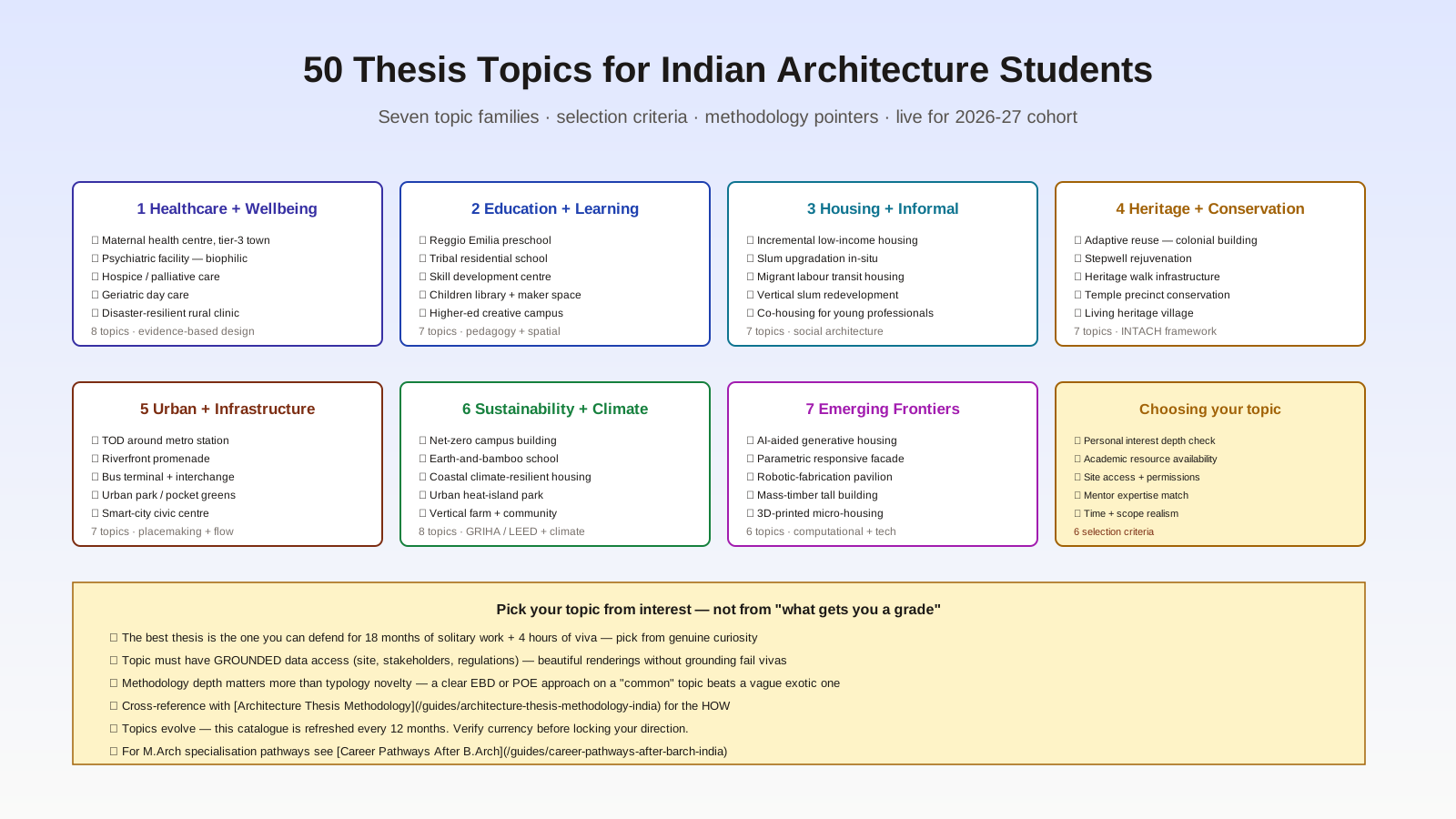
The seven families above cover the bulk of recognised thesis territory in Indian architecture schools. Within each family the topics shown are not exhaustive — they are the most precedented, methodologically tractable, and contribution-rich starters.
A working principle: pick the family by genuine interest first, then choose the specific topic by available site access and mentor expertise. Don't reverse this order — picking a family because "the topics sound impressive" is the most common path to a stalled thesis.
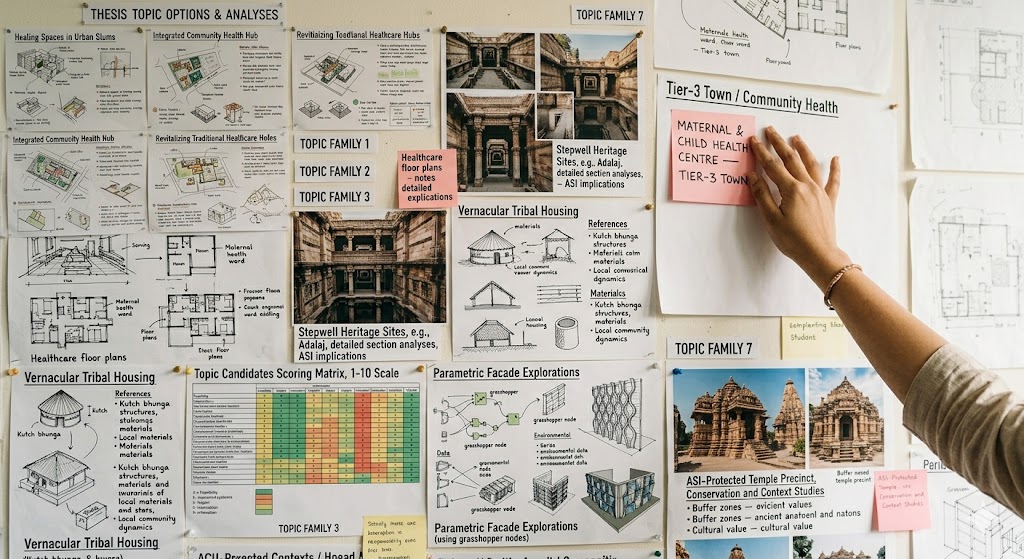
The Full 50-Topic Catalogue
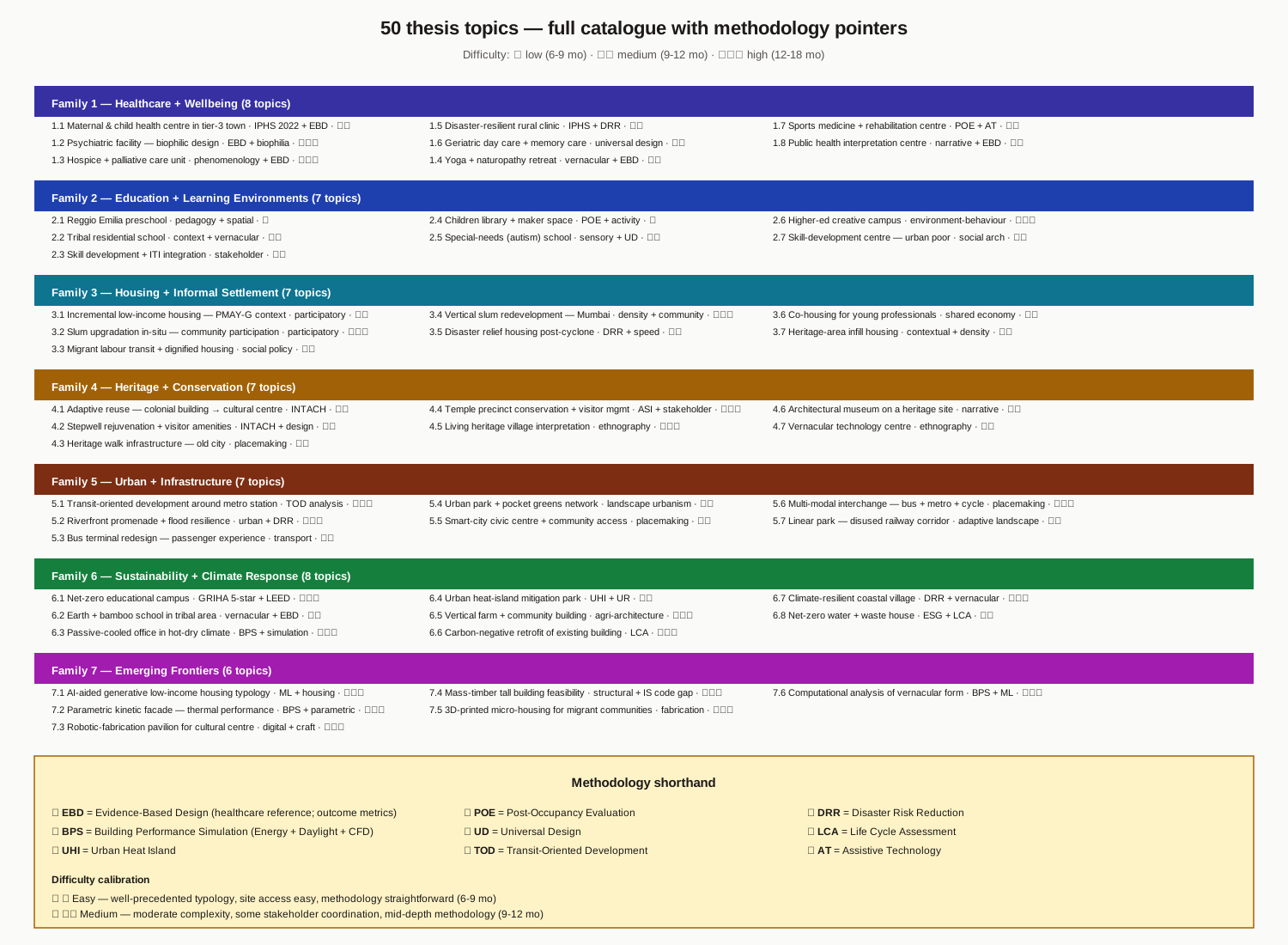
The figure above is the full inventory. Each topic has a numeric code (e.g., 1.1, 3.4) used for cross-reference throughout this guide and in the topic-specific deep-dives below.
Methodology shorthand
- EBD = Evidence-Based Design (healthcare reference; outcome metrics)
- POE = Post-Occupancy Evaluation
- DRR = Disaster Risk Reduction
- BPS = Building Performance Simulation (Energy + Daylight + CFD)
- UD = Universal Design
- LCA = Life Cycle Assessment
- UHI = Urban Heat Island
- TOD = Transit-Oriented Development
- AT = Assistive Technology
Difficulty calibration
- ★ Easy (6-9 months for B.Arch): well-precedented typology, straightforward site access, methodology with clear steps
- ★★ Medium (9-12 months for B.Arch): moderate complexity, some stakeholder coordination, mid-depth methodology
- ★★★ High (12-18 months, ideally M.Arch): demanding methodology, complex stakeholder network, or novel toolchain
Six-Criterion Topic Selection Matrix
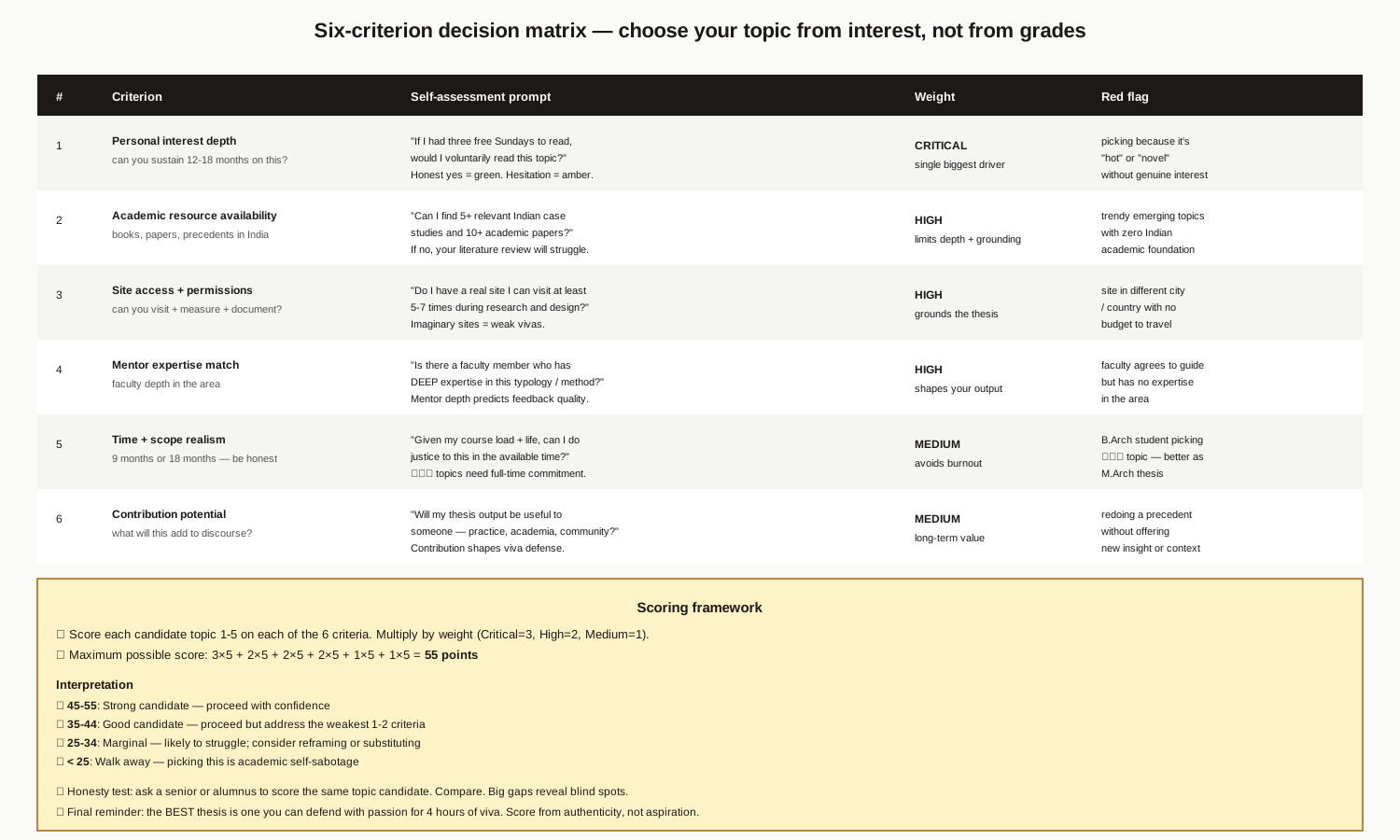
Six factors to score every candidate topic on. The framework converts "what feels exciting" into "what I can actually defend for 18 months."
1. Personal interest depth (CRITICAL)
Self-assessment: "If I had three free Sundays to read, would I voluntarily read about this topic?" Honest yes = green. Hesitation = amber. Picking a topic because it's "hot" without genuine sustained interest is the most common reason theses stall by Month 6.
2. Academic resource availability (HIGH)
Self-assessment: "Can I find 5+ relevant Indian case studies and 10+ academic papers on this topic?" If no, your literature review will struggle. Trendy emerging topics with zero Indian academic foundation make for thin literature chapters and weak viva defense.
3. Site access + permissions (HIGH)
Self-assessment: "Do I have a real site I can visit at least 5-7 times during research and design?" Imaginary sites = weak vivas. Sites in different cities or countries that you can't visit make site analysis hollow. Pick where you can walk, measure, and meet stakeholders.
4. Mentor expertise match (HIGH)
Self-assessment: "Is there a faculty member who has DEEP expertise in this typology / method?" Mentor depth predicts feedback quality. A faculty who agrees to guide but has no expertise in the area gives generic feedback that doesn't sharpen your thinking.
5. Time + scope realism (MEDIUM)
Self-assessment: "Given my course load + life, can I do justice to this in the available time?" ★★★ topics need full-time commitment. A B.Arch student attempting "AI-aided generative housing typology" with a 12-month timeline and three other courses is set up for poor outcomes.
6. Contribution potential (MEDIUM)
Self-assessment: "Will my thesis output be useful to someone — practice, academia, or community?" Redoing a precedent without offering new insight or context is harder to defend than a "common" topic done with novel angle.
Scoring framework
Score each candidate 1-5 on each criterion. Multiply by weight (Critical=3, High=2, Medium=1). Maximum: 55.
| Score | Interpretation |
|---|---|
| 45-55 | Strong candidate — proceed with confidence |
| 35-44 | Good candidate — proceed but address weakest 1-2 criteria |
| 25-34 | Marginal — likely to struggle; consider reframing or substituting |
| < 25 | Walk away — picking this is academic self-sabotage |
Honesty test: ask a senior or alumnus to score the same topic. Compare. Big gaps reveal your blind spots.
Family 1 — Healthcare + Wellbeing (8 topics)
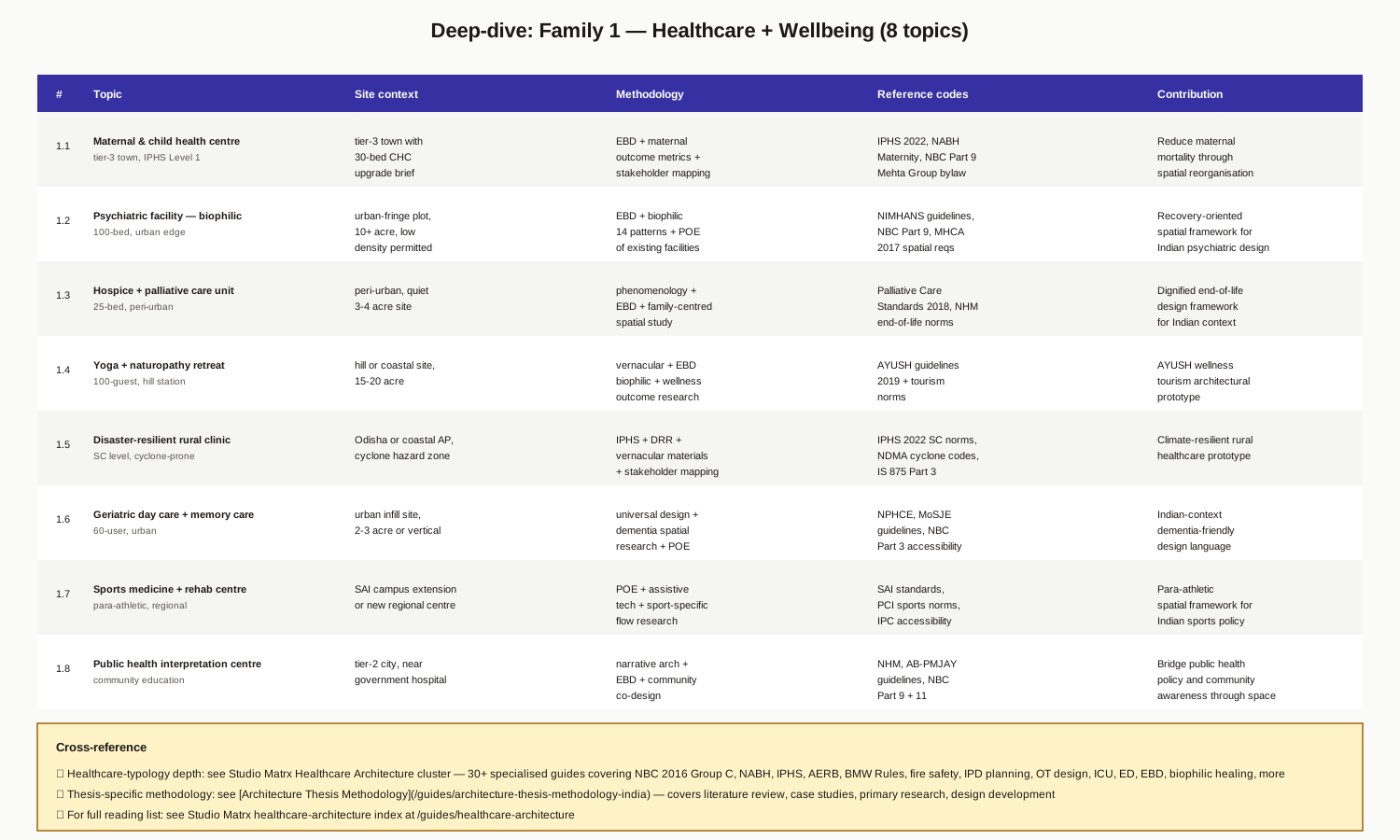
Healthcare architecture is one of the strongest thesis territories for Indian students — significant unmet need, well-developed academic framework (IPHS, NABH, NBC 2016 Group C), and Studio Matrx hosts 30+ specialised healthcare guides as a reference set.
1.1 Maternal & Child Health Centre in Tier-3 Town (★★) — Tier-3 town with existing 30-bed CHC needing IPHS Level-1 upgrade · EBD + maternal outcome metrics + stakeholder mapping · IPHS 2022, NABH Maternity, NBC Part 9 · Contribution: reduce maternal mortality through spatial reorganisation.
1.2 Psychiatric Facility — Biophilic Design (★★★) — Urban-fringe plot 10+ acres · EBD + 14 biophilic patterns + POE of NIMHANS / IHBAS · NIMHANS guidelines, NBC Part 9, Mental Healthcare Act 2017 · Contribution: recovery-oriented spatial framework for Indian psychiatric design.
1.3 Hospice + Palliative Care Unit (★★★) — Peri-urban 3-4 acres · Phenomenology + EBD + family-centred study · Palliative Care Standards 2018, NHM end-of-life norms · Contribution: dignified end-of-life design framework for Indian context.
1.4 Yoga + Naturopathy Retreat (★★) — Hill or coastal 15-20 acres · Vernacular + EBD + biophilic + wellness outcome research · AYUSH guidelines 2019 + tourism norms · Contribution: AYUSH wellness tourism prototype.
1.5 Disaster-Resilient Rural Clinic (★★) — Odisha or coastal AP, cyclone hazard zone · IPHS + DRR + vernacular materials + stakeholder mapping · IPHS 2022 SC norms, NDMA cyclone codes, IS 875 Part 3 · Contribution: climate-resilient rural healthcare prototype.
1.6 Geriatric Day Care + Memory Care (★★) — Urban infill 2-3 acres or vertical · Universal design + dementia spatial research + POE · NPHCE, MoSJE guidelines, NBC Part 3 · Contribution: Indian dementia-friendly design language.
1.7 Sports Medicine + Rehabilitation Centre (★★) — SAI campus extension · POE + assistive tech + sport-specific flow · SAI standards, PCI sports norms, IPC accessibility · Contribution: para-athletic spatial framework.
1.8 Public Health Interpretation Centre (★★) — Tier-2 city near government hospital · Narrative architecture + EBD + community co-design · NHM, AB-PMJAY guidelines · Contribution: bridge public health policy and community awareness.
Healthcare cluster reading: Studio Matrx Healthcare Architecture index at /guides/healthcare-architecture — 30+ specialised guides on NBC 2016 Group C, NABH, IPHS, AERB, BMW Rules, fire safety, OT design, ICU/NICU, ED wayfinding, EBD, biophilic healing, and more.
Family 2 — Education + Learning Environments (7 topics)
Education is the second-strongest territory — enormous unmet need (NEP 2020, ITI expansion, special-needs gap) and pedagogy-spatial integration is increasingly well-researched globally.
2.1 Reggio Emilia Preschool (★) — pedagogy-spatial integration; urban infill site; Reggio + 100 Languages framework; NBC Part 8 + ECCE.
2.2 Tribal Residential School (★★) — context + vernacular; scheduled tribal area; PESA + Eklavya Model norms.
2.3 Skill Development + ITI Integration (★★) — stakeholder + industry-spatial mapping; tier-2 city; NSDC guidelines + workshop pedagogy.
2.4 Children Library + Maker Space (★) — POE + activity-led design; urban site; library science + maker pedagogy.
2.5 Special-Needs (Autism) School (★★) — sensory + universal design; suburban site; autism design framework + RPwD Act 2016.
2.6 Higher-Ed Creative Campus (★★★) — environment-behaviour research; greenfield 25-40 acres; UGC + AICTE norms + studio pedagogy.
2.7 Skill-Development Centre for Urban Poor (★★) — social architecture + participatory design; urban deprived site; PMKVY + community engagement.
Family 3 — Housing + Informal Settlement (7 topics)
The highest-volume thesis territory in India. Discourse is mature, sites everywhere, social impact unambiguous. Don't shy from the "common" topic — the field rewards depth over novelty.
3.1 Incremental Low-Income Housing (★★) — PMAY-G context; participatory; tier-3 site; CHF / Reardon framework + PMAY-G norms.
3.2 Slum Upgradation In-Situ (★★★) — community participation; Mumbai or Delhi; PMAY-U + SDP framework; high stakeholder complexity.
3.3 Migrant Labour Transit + Dignified Housing (★★) — social policy + minimum spatial standards; peri-urban industrial site; MoLE norms.
3.4 Vertical Slum Redevelopment (★★★) — density + community preservation; Mumbai SRA / MMRDA; SRA scheme + cluster-redevelopment.
3.5 Disaster Relief Housing Post-Cyclone (★★) — DRR + speed + cultural fit; Odisha / Bengal coast; NDMA + UNHCR shelter norms.
3.6 Co-Housing for Young Professionals (★★) — shared-economy spatial frameworks; urban site; co-housing literature.
3.7 Heritage-Area Infill Housing (★★) — contextual + density-sensitive; old city site (Pondicherry / Ahmedabad pol); INTACH + heritage byelaws.
Family 4 — Heritage + Conservation (7 topics)
Low-saturation, high-impact territory. Indian heritage discourse is rich and largely under-served by current B.Arch curriculum. INTACH framework provides clear methodology scaffolding.
4.1 Adaptive Reuse — Colonial Building → Cultural Centre (★★) — Mumbai BDD / Calcutta colonial site; INTACH adaptive reuse principles.
4.2 Stepwell Rejuvenation + Visitor Amenities (★★) — Rajasthan / Gujarat / Karnataka stepwell; INTACH + design intervention.
4.3 Heritage Walk Infrastructure — Old City (★★) — Ahmedabad / Pondicherry / Jaipur; placemaking + visitor management.
4.4 Temple Precinct Conservation + Visitor Management (★★★) — Hampi / Khajuraho / Madurai; ASI + stakeholder framework.
4.5 Living Heritage Village Interpretation (★★★) — Mawlynnong / Kuldhara / Hampi; ethnographic methodology.
4.6 Architectural Museum on a Heritage Site (★★) — Delhi Mehrauli / Hyderabad QMR; narrative + curation framework.
4.7 Vernacular Technology Centre (★★) — Rajasthan / Kerala / Northeast site; ethnography + craft documentation.
Family 5 — Urban + Infrastructure (7 topics)
Increasingly popular as Indian metros densify. Require strong site research and stakeholder mapping but reward you with portfolio-defining work that translates well to practice.
5.1 TOD around Metro Station (★★★) — Bangalore / Hyderabad / Pune; TOD analysis + density modelling.
5.2 Riverfront Promenade + Flood Resilience (★★★) — Sabarmati / Yamuna / Brahmaputra; urban + DRR multi-disciplinary.
5.3 Bus Terminal Redesign — Passenger Experience (★★) — tier-1/2 terminal; transport spatial research.
5.4 Urban Park + Pocket Greens Network (★★) — city-scale strategy + local intervention; landscape urbanism.
5.5 Smart-City Civic Centre + Community Access (★★) — Smart Cities Mission city; placemaking + governance integration.
5.6 Multi-Modal Interchange (★★★) — major interchange site; placemaking + transport.
5.7 Linear Park — Disused Railway Corridor (★★) — Mumbai / Delhi / Chennai alignment; adaptive landscape urbanism.
Family 6 — Sustainability + Climate Response (8 topics)
Climate is the defining discourse of contemporary architecture. Sustainability topics command increasing academic legitimacy and translate well to research career pathways.
6.1 Net-Zero Educational Campus (★★★) — greenfield campus; GRIHA 5-star + LEED + BPS; significant simulation workload.
6.2 Earth + Bamboo School in Tribal Area (★★) — tribal-area site; vernacular + EBD + low-embodied-carbon research.
6.3 Passive-Cooled Office in Hot-Dry Climate (★★★) — Jaipur / Ahmedabad / Hyderabad; BPS + simulation-heavy.
6.4 Urban Heat-Island Mitigation Park (★★) — UHI hotspot in tier-1 city; UHI research + urban landscape design.
6.5 Vertical Farm + Community Building (★★★) — peri-urban site; agri-architecture + food security; novel typology.
6.6 Carbon-Negative Retrofit of Existing Building (★★★) — existing public building; LCA + carbon accounting.
6.7 Climate-Resilient Coastal Village (★★★) — Sundarbans / Konkan / coastal TN; DRR + vernacular + sea-level-rise modelling.
6.8 Net-Zero Water + Waste House (★★) — residential prototype; ESG + LCA + closed-loop systems research.
Family 7 — Emerging Frontiers (6 topics)
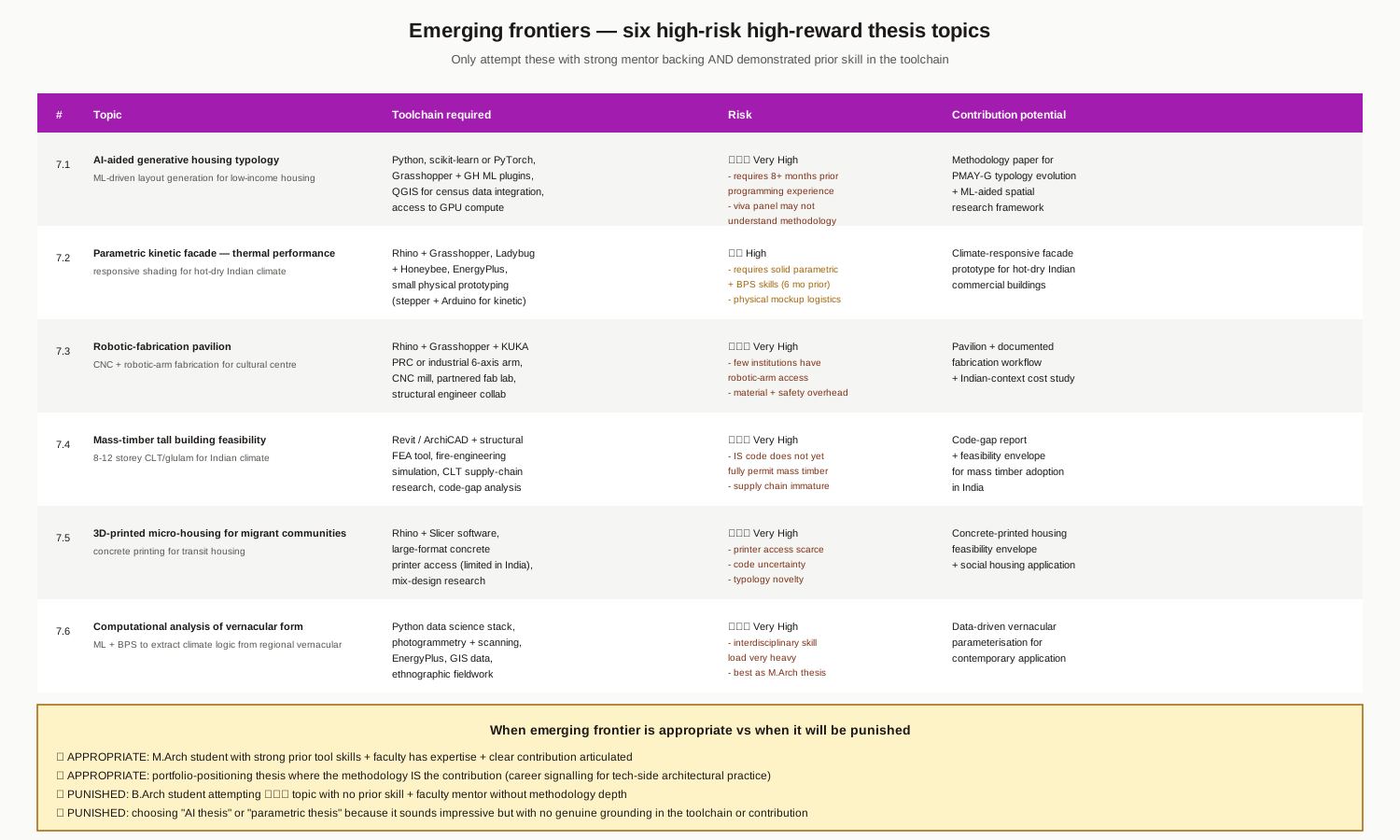
The most demanding family. Only attempt with strong mentor backing AND demonstrated prior toolchain skill. M.Arch thesis territory primarily, though exceptional B.Arch students with prior depth can do well.
When emerging frontier is appropriate
- M.Arch student with strong prior tool skills (8+ months of Grasshopper / Python / specific BPS toolchain)
- Faculty mentor has genuine expertise in the methodology
- Clear contribution articulated upfront (not "I want to use AI" but "I want to test ML-aided spatial pattern extraction for PMAY-G housing")
- Portfolio-positioning thesis where the methodology IS the contribution (career signalling for tech-side architectural practice)
When emerging frontier gets punished
- B.Arch student attempting ★★★ topic with no prior skill in the toolchain
- Faculty mentor without methodology depth — feedback becomes generic
- Choosing "AI thesis" or "parametric thesis" because it sounds impressive but with no genuine grounding
- Vivas where the panel doesn't understand the methodology — output gets misread as "decoration" rather than research
The 6 topics: 7.1 AI-aided generative housing typology · 7.2 Parametric kinetic facade thermal performance · 7.3 Robotic-fabrication pavilion · 7.4 Mass-timber tall building feasibility · 7.5 3D-printed micro-housing for migrant communities · 7.6 Computational analysis of vernacular form.
For toolchain depth, see Parametric Architecture in India, BIM Architecture in India, and Architectural Visualization in India.
The 12-Month Thesis Timeline
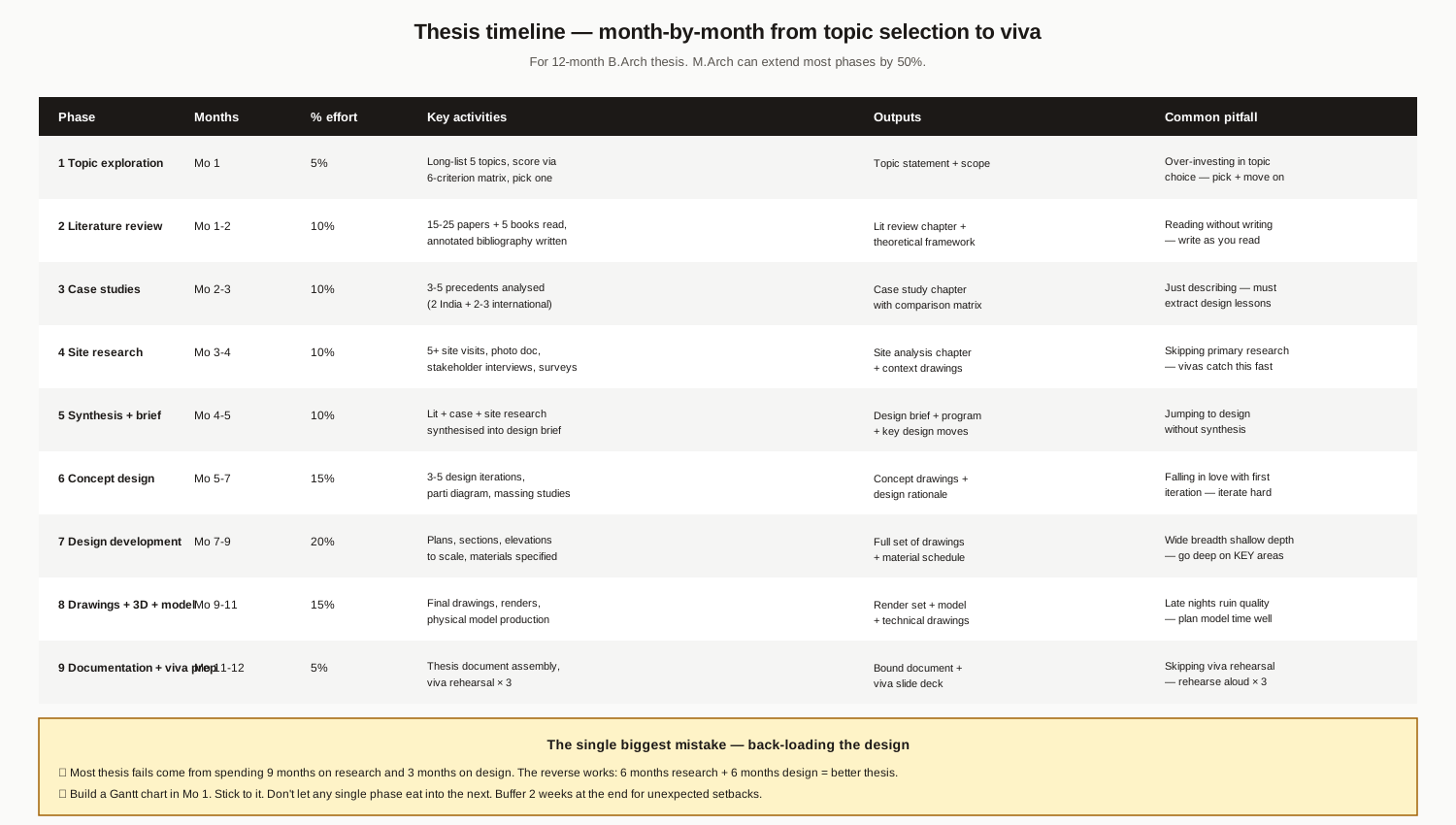
For a 12-month B.Arch thesis. M.Arch can extend most phases by 50%.
| Phase | Months | % effort | Key outputs |
|---|---|---|---|
| 1 Topic exploration | Mo 1 | 5% | Topic statement + scope |
| 2 Literature review | Mo 1-2 | 10% | Lit review chapter + theoretical framework |
| 3 Case studies | Mo 2-3 | 10% | Case study chapter with comparison matrix |
| 4 Site research | Mo 3-4 | 10% | Site analysis chapter + context drawings |
| 5 Synthesis + brief | Mo 4-5 | 10% | Design brief + program + key design moves |
| 6 Concept design | Mo 5-7 | 15% | Concept drawings + design rationale |
| 7 Design development | Mo 7-9 | 20% | Full set of drawings + material schedule |
| 8 Drawings + 3D + model | Mo 9-11 | 15% | Render set + model + technical drawings |
| 9 Documentation + viva prep | Mo 11-12 | 5% | Bound document + viva slide deck |
The single biggest mistake
Most thesis fails come from spending 9 months on research and 3 months on design. The reverse works: 6 months research + 6 months design = better thesis. Build a Gantt chart in Mo 1. Stick to it. Don't let any single phase eat into the next. Buffer 2 weeks at the end for unexpected setbacks.
Six Common Topic Selection Mistakes
1. Picking from a list without scoring. A topic that sounds interesting in a peer's conversation often scores 25/55 in honest self-assessment.
2. Choosing trend over substance. "AI in architecture" without prior tool depth becomes 18 months of frustration.
3. Ignoring site access. A thesis on Northeast vernacular when you can't afford travel becomes literature-only.
4. Mismatching mentor. A faculty who agrees because they're nice but has no expertise gives generic feedback.
5. Scoping too wide. "Sustainable affordable housing for India" is not a thesis — it's a five-year research program.
6. Skipping the contribution articulation. If you can't finish "My thesis contributes ___ to the discourse on ___" in one sentence by Month 4, the thesis lacks a thesis.
Pre-Topic-Selection Checklist
1. Long-listed 5-7 candidate topics across at least 3 families
2. Six-criterion scoring done on each candidate (1-5 per criterion, weighted)
3. Top 2-3 candidates identified with scores > 35
4. Mentor conversations had on top 2-3 — confirmed mentor expertise + availability
5. Site visit to potential site for top candidate
6. Literature spot-check — found 5+ relevant Indian papers and 5+ Indian precedents
7. Reality check — talked to a senior or alumnus, asked them to score your top candidate, compared scores
8. Contribution articulated in one sentence: "My thesis contributes ___ to the discourse on ___"
9. Topic written down with clear scope boundaries (what's IN, what's OUT)
10. Gantt chart drafted for the 12-month timeline before locking commitment
Where to Go Next
- For methodology depth (how to do the work): Architecture Thesis Methodology in India
- For case study analysis discipline: Architecture Case Study Analysis
- For portfolio shaping around your thesis output: Architecture Portfolio Building in India
- For viva preparation and studio jury survival: Studio Jury Survival for Architecture Students
- For post-thesis career pathways: Career Pathways After B.Arch
- For computational toolchain depth: Parametric Architecture in India, BIM Architecture in India, Architectural Visualization in India
- For site analysis discipline: Site Analysis for Architecture in India
- For specialised typology depth: Studio Matrx healthcare cluster at /guides/healthcare-architecture, design styles cluster, and Materials & Finishes guides
- For studio-side foundations: Architecture Software Learning Path, Architectural Drawing Representation Fundamentals
References
1. Council of Architecture (2020). Minimum Standards of Architectural Education Regulations.
2. All India Council for Technical Education (AICTE). Model Curriculum for B.Arch.
3. Krishan, A. (2017). Climate Responsive Architecture. TERI Press.
4. Cherry, E. (1999). Programming for Design — From Theory to Practice. John Wiley & Sons.
5. Groat, L. & Wang, D. (2013). Architectural Research Methods. John Wiley & Sons.
6. Day, C. (2014). Places of the Soul. Routledge.
7. Kellert, S.R., Heerwagen, J., Mador, M. (2008). Biophilic Design. John Wiley & Sons.
8. INTACH (2014). Charter for the Conservation of Unprotected Architectural Heritage and Sites in India.
9. NIUA + Niti Aayog (2020). Transit-Oriented Development Implementation Resource Tool India.
10. Mehrotra, R. (2011). Architecture in India Since 1990. Pictor Publishing.
Author's note: I've reviewed thousands of Indian B.Arch and M.Arch theses across institutions. The pattern that separates strong thesis from weak is rarely topic novelty — it is the depth of conviction the student brings to the work over 12-18 months. The 50 topics in this catalogue are not exhaustive, but they represent the territories where Indian academic discourse is mature, sites are accessible, methodologies are tractable, and contributions are recognisable. Use the six-criterion matrix honestly. Pick from interest, not from grade aspiration. Build the Gantt chart on day one. Articulate the contribution in one sentence by Month 4. These four disciplines — scored selection, interest-led commitment, scheduled execution, articulated contribution — produce defensible thesis. Every other detail follows.
Disclaimer: This catalogue reflects the Indian architectural academic discourse as of 2026-05-21 and is refreshed every 12 months. Topics, references, codes, and benchmarks evolve — verify currency before locking your thesis direction. Specific institutional requirements (COA, AICTE, university bye-laws) take precedence over generic guidance offered here. Studio Matrx, its authors and contributors are not responsible for thesis outcomes or grading decisions. Engage your thesis guide, departmental head, and senior alumni for institution-specific advice. Difficulty ratings (★, ★★, ★★★) are indicative; individual project complexity varies. Methodology shorthand refers to established research methodologies; rigorous application requires reading the foundational literature cited. The emerging-frontiers family carries significantly higher attrition risk; do not attempt without demonstrated prior toolchain skill and mentor expertise.
Interactive · Thesis topic explorer
Sustainability + climate · 5 topics
Climate-responsive design, low-carbon construction, regenerative architecture.
Methodology
Simulation (EnergyPlus) + post-occupancy survey of one built precedent + design proposal
Suggested site
Sector-9, Jaipur (200-unit affordable EWS cluster)
Starter references
- • Manu / Khare 2019
- • BEE residential code 2018
- • Ulrich pre-2020 passive surveys
Topics are starter prompts — sharpen the question, scope, and methodology with your thesis guide. A great Indian thesis pairs primary research at a real site with rigorous theoretical framing.
Export this guide
Related Guides — Deep-dive reading
Case-Study Analysis — How to Read an Architectural Project
Module 7 of the Student Foundations Track — Selecting Case Studies that Match Your Design Problem, Five-Layer Analysis Framework (Site, Programme, Form, Material, Detail), Data Collection Methods, How to Apply Findings to Your Own Studio Project, the Citation Discipline, and a Twelve-Test Pre-Submission Diagnostic for Indian B.Arch Students
Student FoundationsHeritage Documentation & Measured Drawing Studio
The 2026 Working Reference for the Indian B.Arch Year-3/Year-4 Heritage Documentation Studio — Three-Stage Process (Preliminary Survey, Detailed Measurement, Drawing Production), Eight Typologies (Haveli, Temple, Vernacular Cluster, Urban Precinct, Industrial, Colonial, Stepwell, Single Element), Tools (Tape to Total Station to Photogrammetry), Drawing Conventions, INTACH and ASI Frameworks, and the Conservation Career Pathway
Student FoundationsThe Architecture of Recovery: Evidence-Based Design in Contemporary Indian Healthcare
An Architect's Front-Door Reference — EBD Foundations · Biophilic + Circadian + Acoustic + Social Pillars · Indian Cultural Context · Studio Matrx Tool Stack
Healthcare ArchitectureRelated Tools — Try Free
Healing View Impact Calculator
Evidence-Based Design dashboard quantifying the recovery impact of nature view + daylight factor on analgesic use, length of stay, and HCAHPS patient-experience uplift. Calibrated against Ulrich 1984 (Science), Park & Mattson 2008, and the CHD EBD evidence base.
EBD CalculatorCross-Ventilation Analyzer
Estimate airflow and air changes per hour (ACH) from room size, window areas, layout, and local wind — with NBC 2016 Part 8 compliance check.
Ventilation CalculatorAcoustic Privacy (STC) Visualizer
Indian healthcare acoustic visualizer — compare wall assemblies and noise sources, see received SPL after STC attenuation, and check FGI 2018 / IS 1950 / NABH speech-privacy compliance with live dual-canvas waveform.
Acoustic Tool