
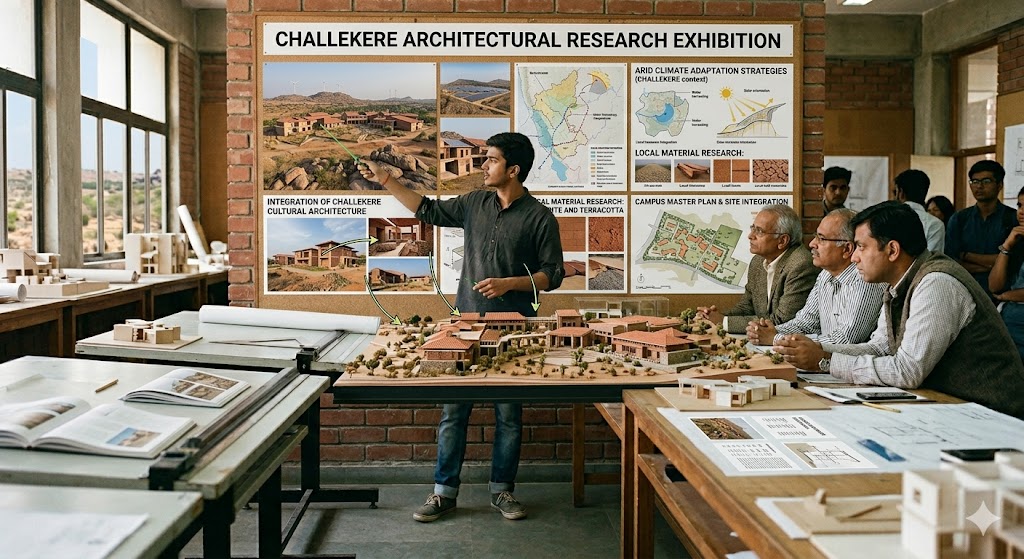
Studio Jury Survival — Presentation, Critique, Iteration
Module 4 of the Student Foundations Track — How to Present Your Work, Take Critique Without Defensiveness, Read Jury Feedback for the Underlying Question, Iterate Productively, and Survive Year-1 to Year-5 Studios with Your Architectural Voice Intact
The studio jury — the periodic review at which you present your work to faculty and external critics — is the social-and-performative spine of architecture school. Every B.Arch student presents at 25-40 juries across five years; how you survive them, learn from them, and bring your work to them shapes your architectural identity more than almost any other classroom experience.
Most architectural pedagogy in India treats jury skills as something students absorb by osmosis. The result, predictably, is that some students figure it out (often the students who came in with prior public-speaking exposure or family architectural background) and many do not. Module 4 is the explicit reference for what studio juries are, how they work, what faculty actually evaluate, how to present your work, how to receive critique productively, and how to iterate after.
The orientation is towards the Indian B.Arch / B.Des student in 2026, attending studios at any of the major Indian schools (CEPT, SPA Delhi, IIT Roorkee, IIT Kharagpur, NIT Calicut, JJ School Mumbai, Manipal, RV Bengaluru, etc.) and increasingly at private architecture schools. The treatment is operational: pre-jury preparation, the seven-minute presentation arc, the listening discipline during critique, the underlying-question framework, post-jury iteration, and a twelve-test diagnostic.
"The jury is not your enemy. The jury is the most concentrated dose of architectural attention you will receive in your career. The student who wastes it defending their work is the student who ages five years in B.Arch. The student who absorbs it is the student who ages twenty years." — Faculty member, CEPT University, paraphrased
1. The Four Jury Types — Each Has a Different Purpose
Not every jury is the same. Recognising the type changes how you prepare and what you should listen for.
| Type | Purpose | Audience | Frequency | What to bring |
|---|---|---|---|---|
| Desk crit (formative) | Mid-project tutoring; faculty + you 1-on-1 | Your studio faculty | Weekly during studios | Work-in-progress sketches, models; specific questions |
| Pin-up review (intra-studio) | Mid-studio peer review | Your studio cohort + faculty | 2-3 per studio | Drawings pinned up; verbal walkthrough |
| Internal jury (mid-term + final) | Formal review against course objectives | Studio faculty + 1-2 internal critics | 2-3 per semester | Full sheet set, model, verbal presentation |
| External jury (final / annual) | Public review with practitioner critics | Studio faculty + 3-5 external architects | End of major studios | Final sheets, polished model, polished presentation |
The student's discipline: prepare differently for each. The desk crit rewards specificity ("can you respond to this issue?"); the external jury rewards narrative ("how does this project move?"). Treating an external jury like a desk crit (showing too much process) is as damaging as treating a desk crit like an external jury (showing only finished work).
2. Pre-Jury Preparation — The 72-Hour Protocol
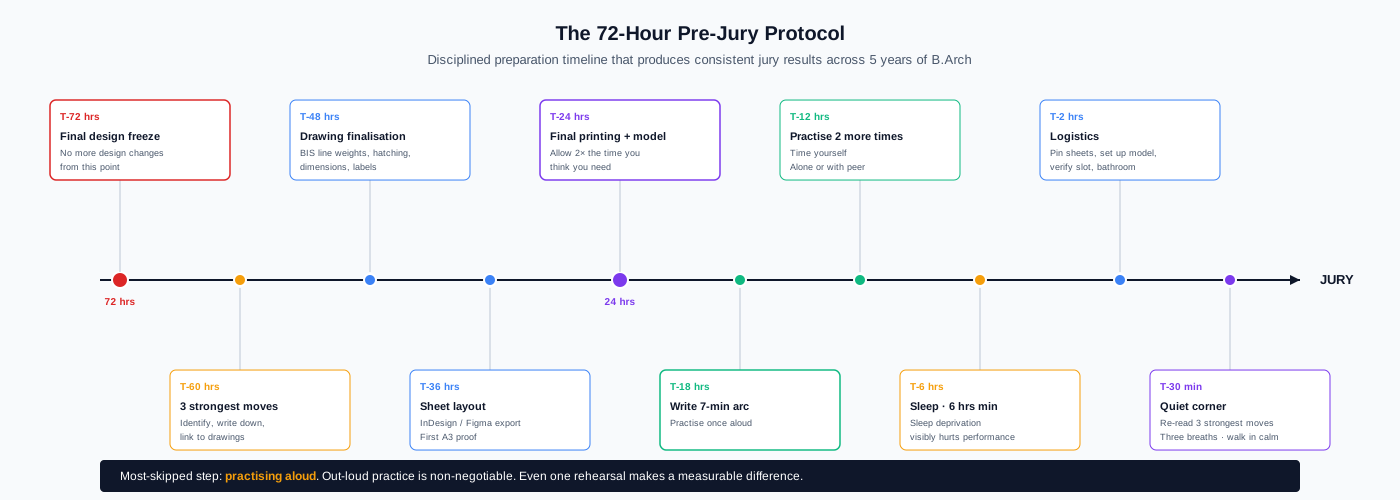
The strongest jury performance comes from disciplined preparation in the 72 hours before. The protocol below is what produces consistent jury results across five years of B.Arch.
| T-minus | Activity |
|---|---|
| 72 hrs | Final design freeze. No more design changes. From this point, only refinement and presentation production. |
| 60 hrs | Identify the 3 strongest moves of the project. These are what you will lead with. Write them down. |
| 48 hrs | Drawing finalisation — line weights, hatching, dimensions, labels per Module 1 BIS conventions. |
| 36 hrs | Sheet layout and InDesign / Figma export. Print first proof at A3. |
| 24 hrs | Final printing (allow 2× the time you think you need; print bureaus run late). Model touch-up. |
| 18 hrs | Write the 7-minute presentation arc (next section). Practise once aloud. |
| 12 hrs | Practise twice more, alone or with a peer. Time yourself. |
| 6 hrs | Sleep — 6 hours minimum. Sleep-deprived students consistently underperform at juries. |
| 2 hrs before | Pin up sheets. Set up model. Verify your slot time. Use the bathroom. |
| 30 min before | Find a quiet corner. Re-read your three strongest moves. Take three breaths. Walk in calm. |
The most-skipped step is practising aloud. Students who only rehearse internally consistently overrun their time, mumble, or freeze. Out-loud practice is non-negotiable. Even one rehearsal in front of a mirror or to an empty room makes a measurable difference.
3. The Seven-Minute Presentation Arc
Most studio juries allow 5-10 minutes of student presentation followed by 15-30 minutes of jury discussion. The structure below is a 7-minute arc that fits the standard slot.
| Minute | Section | What to say |
|---|---|---|
| 0:00 - 0:30 | Project name + 1-line brief | "This project is a [type] in [location], for [user], at [scale]." |
| 0:30 - 1:30 | The site + the question | "The site has [specific characteristic]. The brief raised [specific question]. The project is my response to that question." |
| 1:30 - 3:00 | The three strongest moves | Present each move with one drawing or model reference. Move 1 → drawing 1. Move 2 → drawing 2. Move 3 → drawing 3. |
| 3:00 - 4:30 | Plan-section narrative | Walk through the plan and one section. Show how the moves resolve spatially. |
| 4:30 - 5:30 | Material + experiential | What is it made of? What does it feel like to be in it? One render or photograph. |
| 5:30 - 6:30 | What you learned + what is unresolved | Honest reflection on what worked, what you'd do differently, what remains open. |
| 6:30 - 7:00 | "I'd love to hear your thoughts." | Invite the jury. Stop talking. |
The seven-minute structure is intentionally tight. Most students try to cover 12 minutes of content in 7; the result is rushed, no point landing. Cut content; do not speed up. A clear 5-minute presentation is stronger than a confused 9-minute one.
4. The Listening Discipline During Critique
The jury phase begins after your presentation. It typically runs 15-30 minutes, with critics offering observations, questions, and challenges. The student's instinct is to defend. The discipline is to listen.
The Three Modes of Critique
| Mode | What it is | Your response |
|---|---|---|
| Clarification questions | "What did you mean by …?" or "Can you explain how …?" | Answer directly. 1-2 sentences. |
| Observations | "I see this as …" or "This reminds me of …" | Listen. Take notes. Do not argue. |
| Challenges | "Why didn't you …?" or "What would happen if …?" | The most important to listen carefully to. The challenge contains the underlying question. |
Most students conflate the three modes. They argue with observations (no need — observations are gifts), and they treat challenges as attacks (instead of questions). The discipline is to categorise as the critique unfolds: "this is an observation, this is a challenge, this is a clarification."
The Underlying-Question Framework
Most jury challenges are not the literal challenge stated. The underlying question is the deeper architectural concern the critic is articulating through the challenge.
| Surface challenge | Underlying question |
|---|---|
| "Why didn't you have a courtyard?" | "Have you considered passive cooling and Indian-context climate response?" |
| "The plan looks like the floor plate doesn't work" | "Can you walk me through the structural and circulation logic?" |
| "Is this a residence or a museum?" | "What is the project actually programmed for?" |
| "Why is this material here?" | "Have you justified your material choices?" |
| "I would have done this differently" | "Are you committed to your design moves, or are they tentative?" |
| "Show me the section" | "Have you developed the project beyond plan?" |
| "It feels institutional" | "Does the project's character match its programme?" |
The student's discipline: answer the underlying question, not the surface one. "Why didn't you have a courtyard?" → "I considered a courtyard early — the climate question was real — and chose this internal-light strategy because [specific reason]. Here's the sun-path study that drove the decision." This answer demonstrates that you took the architectural concern seriously, even if the design decision went a different direction.
The framework is articulated in Donald Schön's The Reflective Practitioner (1983) and in critique-pedagogy literature (Anthony, Design Juries on Trial, 1991, 2nd ed. 2012).
5. The Defensive Trap — Why Students Argue, and What It Costs
Students argue at juries for understandable reasons:
- They have spent weeks on the project; the work is emotionally invested
- They feel the critic has misunderstood
- They want to demonstrate competence by responding sharply
- They were never explicitly taught how to receive critique
The cost of arguing is consistent across institutions:
- The critic stops sharing. A defensive student gets less critique, not more. Critics save their best observations for students who absorb them.
- The grade often suffers. Faculty score "engaged with critique" highly; "defensive" is often a flag.
- The portfolio loses opportunities. The critique you absorbed at Year-2 jury is the design move you make at Year-4 thesis.
- Your studio peers learn it too. Critique is not just for you; it's for the room. A defensive student deprives peers of insight.
The discipline: every challenge is treated as a gift, even the ones that feel unfair. Take the note. Thank the critic. Iterate later.
| Defensive response (avoid) | Receptive response (target) |
|---|---|
| "But that's not what I meant" | "Can you say more — I want to make sure I'm understanding" |
| "I considered that but rejected it because…" | "That's interesting — I went a different direction. Here's my reasoning, but I want to think about your point." |
| "The brief required this" | "You're right that this is a constraint. The brief asked for X; I responded by Y. Was there a different way to interpret X?" |
| "I disagree" | "I hear you. Let me reflect on that for the next iteration." |
| Silence + visible discomfort | "Thank you — that's a useful observation. I'll come back to that." |
The receptive responses do not require you to agree. They require you to receive. Disagreement can come later; the jury room is not the place.
6. Post-Jury Iteration — The 48-Hour Protocol
The jury ends. You leave the studio with notes, observations, and (often) emotional residue. The next 48 hours determine whether the jury becomes architectural growth or just a graded event.
| T+ | Activity |
|---|---|
| T+0 to T+2 hrs | Decompress. Eat. Walk. Do not re-read the notes yet. The jury feels harsher in the immediate aftermath than it actually was. |
| T+12 hrs | Re-read your notes from the jury. Add anything you remember that you didn't write down. |
| T+24 hrs | Categorise the feedback: critical (must address) · important (should address) · interesting (consider). |
| T+36 hrs | Identify the 3 strongest pieces of feedback. Write them on a fresh page. These are your action items for the next iteration. |
| T+48 hrs | Sketch the response — how would the project change if you took this feedback? Sketch is faster than software at this stage. |
| T+72 hrs onward | Integrate into next studio iteration. |
The protocol is the iteration discipline. The jury is not the end of the project; it is a calibration point. The student who treats it as the end stops growing; the student who treats it as a calibration grows the fastest in the studio cohort.
7. The Eight Common Jury Mistakes
| Mistake | Consequence | Fix |
|---|---|---|
| 1. Reading from the sheets instead of presenting | Reader-instead-of-architect impression | Memorise the 7-minute arc; refer to sheets, don't read them |
| 2. Apologising for the work ("It's not finished, I had no time…") | Trains the critic to be lenient (which lowers grade) and to underestimate the work | Present the work as if it were complete; honesty about unresolved areas comes in the closing 30 sec |
| 3. Speeding up instead of cutting | Rushed presentation with no point landing | Always cut content; never speed up |
| 4. Defensiveness during critique | Less critique received; lower grade; alienated faculty | Receive every comment; categorise; respond only to clarification questions |
| 5. Sheets pinned up out of reading order | Reader confusion | Match sheet order to presentation arc; left to right; or vertical hierarchy |
| 6. No model (when scale warrants) | Reader cannot read 3D from 2D | Even a quick foam model communicates more than 3 renders |
| 7. Not knowing your own dimensions | Critic asks "what's the floor-to-floor?" and you can't answer | Memorise the 5 most important dimensions before the jury |
| 8. Skipping the post-jury iteration | Jury becomes a graded event, not a learning moment | Run the 48-hour iteration protocol after every major jury |
Students who internalise these eight by Year 2 produce visibly more polished jury performances by Year 3-4.
8. Twelve-Test Pre-Jury Readiness Diagnostic
Before any major studio jury, run the following twelve tests. Failing more than three suggests further preparation is needed.
| Test | Question | Pass criterion |
|---|---|---|
| 1 | Can you state the project in one sentence? | Yes — type, location, user, scale, in 15 words or fewer |
| 2 | Can you state the three strongest design moves? | Yes — written down, each with a drawing reference |
| 3 | Have you rehearsed the 7-minute presentation aloud at least twice? | Yes — including timing |
| 4 | Are all sheets printed at correct scale and pinned up in presentation order? | Yes — verified the morning of jury |
| 5 | Is the model complete (or as complete as you said it would be)? | Yes — or a clear plan to acknowledge missing parts |
| 6 | Do you know the 5 most important dimensions (floor-to-floor, plot dim, key clear span, etc.)? | Yes — memorised |
| 7 | Have you anticipated 3-5 likely jury questions and prepared responses? | Yes — written-out prep |
| 8 | Are your sheets typo-free? | Yes — final read-through done |
| 9 | Have you slept at least 6 hours the night before? | Yes — sleep-deprivation hurts jury performance measurably |
| 10 | Do you have your printed notes / cue card? | Yes — even if you don't refer to them, having them lowers anxiety |
| 11 | Have you visited the actual jury venue / pinned-up wall? | Yes — knows lighting, viewing distance, sightlines |
| 12 | Are you mentally ready to listen, not defend? | Yes — explicit pre-jury intention to receive critique |
Students who pass 10+ tests before each jury produce consistent improvements in jury feedback over their B.Arch.
9. Companion Resources at Studio Matrx
- Module 1 — Architectural Drawing & Representation Fundamentals — the drawing discipline behind your jury sheets
- Module 2 — The Software Stack — InDesign / Figma fluency for sheet layouts
- Module 3 — Building Your Architecture Portfolio — your jury sheets become your portfolio spreads
- Architecture Academy — Student Resources Hub
- Student Foundations Track — full 8-module curriculum
- Essential Soft Skills for Architects & Interior Designers — adjacent practitioner-side reference
10. References
Foundational Pedagogy on Critique
- Anthony, K. H. (1991, 2nd ed. 2012). Design Juries on Trial: The Renaissance of the Design Studio. Wiley. — The canonical critique-pedagogy reference; empirically studies what makes juries productive vs damaging.
- Schön, D. A. (1983). The Reflective Practitioner: How Professionals Think in Action. Basic Books. — On critique as reflection-in-action.
- Schön, D. A. (1985). The Design Studio: An Exploration of its Traditions and Potentials. RIBA Publications. — Explicit on the critique-tradition origins.
Peer-Reviewed Academic References — Studio Pedagogy
- Webster, H. (2008). Architectural education after Schön: Cracks, blurs, boundaries and beyond. Journal for Education in the Built Environment, 3(2), 63–74.
- Cuff, D. (1991). Architecture: The Story of Practice. MIT Press. — Sociology of architectural learning, including critique.
- Salama, A. M. (2016). Spatial Design Education: New Directions for Pedagogy in Architecture and Beyond. Routledge. — Contemporary critique pedagogy.
- Quayle, M. (1985). Ideabook for Teaching Design. Mesa Verde Press.
- Boyer, E. L., & Mitgang, L. D. (1996). Building Community: A New Future for Architecture Education and Practice. Carnegie Foundation. — Critique of jury system from US accreditation perspective.
Indian Pedagogy References
- Council of Architecture (CoA), India — National Architectural Education Standards: studio teaching and assessment frameworks.
- CEPT University, Faculty of Architecture — published critique guidelines for B.Arch programme.
- SPA Delhi, IIT Roorkee, JJ School Mumbai — public studio handbooks describing jury formats.
Companion Studio Matrx Guides
See §9 above for the full cross-reference list.
Author's Note: The studio jury is the architectural equivalent of a martial-arts dojo's sparring round. It looks adversarial; it is not. It is the most concentrated form of architectural attention you will ever receive — your work, evaluated by trained eyes, in real time, with full feedback. The student who treats the jury as a graded event leaves school five years older with a degree and a portfolio. The student who treats the jury as a calibration leaves five years older with a degree, a portfolio, and twenty years of architectural attention compressed into the working memory. The discipline above — preparation, presentation arc, listening, iteration — is what converts juries from an event into an architecture-shaping practice. Do this discipline, every jury, for five years. The compounding is real.
Disclaimer: Studio jury formats vary by institution and faculty; the framework above reflects common B.Arch conventions in India in 2026. Students should follow institution-specific guidelines and instructor instructions where they conflict with this guide. Studio Matrx, its authors, and contributors accept no liability for outcomes based on this guide.
Export this guide
Related Guides — Deep-dive reading
Case-Study Analysis — How to Read an Architectural Project
Module 7 of the Student Foundations Track — Selecting Case Studies that Match Your Design Problem, Five-Layer Analysis Framework (Site, Programme, Form, Material, Detail), Data Collection Methods, How to Apply Findings to Your Own Studio Project, the Citation Discipline, and a Twelve-Test Pre-Submission Diagnostic for Indian B.Arch Students
Student FoundationsInternship Interview Prep & Résumé Content for Architecture Students
The 2026 Working Reference for Indian B.Arch and B.Des Students — Building the One-Page Résumé (Twelve Sections), Writing the Cover Letter That Lands, the Five-Stage Interview Process, the Portfolio Walk-Through, the Sketch Test, Salary Discussion, Offer Evaluation, the Common Failure Modes, and the Sustained Discipline of Internship Application Across Year 3 and Year 4
Student FoundationsArchitectural Drawing & Representation Fundamentals
Module 1 of the Student Foundations Track — Orthographic Projection, Axonometric, Isometric, Perspective, BIS Line-Weight Standards, Material Hatching Conventions, the Sketchbook Discipline, and the Hand-to-Software Translation for Indian B.Arch and B.Des Students
Student FoundationsRelated Tools — Try Free
Cross-Ventilation Analyzer
Estimate airflow and air changes per hour (ACH) from room size, window areas, layout, and local wind — with NBC 2016 Part 8 compliance check.
Ventilation CalculatorMaterial Decision Framework (M-Score)
Score 30+ Indian construction materials across cost, durability, climate fit, maintenance, and sustainability.
MaterialsBefore & After Studio
Generate AI before-and-after renders to preview how your redesign could look.
DesignAI