

Case-Study Analysis — How to Read an Architectural Project
Module 7 of the Student Foundations Track — Selecting Case Studies that Match Your Design Problem, Five-Layer Analysis Framework (Site, Programme, Form, Material, Detail), Data Collection Methods, How to Apply Findings to Your Own Studio Project, the Citation Discipline, and a Twelve-Test Pre-Submission Diagnostic for Indian B.Arch Students
The case study is the architecture student's primary research instrument. Every studio project begins with case-study analysis; every thesis rests on case-study research; every internship interview involves discussing case studies you have read deeply. The student who develops disciplined case-study practice in B.Arch acquires a research instrument they will use for the rest of their architectural career.
Most B.Arch students treat case-study analysis as a Wikipedia-and-Pinterest exercise — collect images, summarise what's there, move on. The result is shallow case studies that produce shallow design work. The discipline below is what produces case studies that genuinely inform your design thinking and that withstand serious scrutiny in studio reviews.
Module 7 is the working case-study reference. It treats case-study analysis as a five-layer research practice — site, programme, form, material, detail — with explicit methods for data collection and application. The orientation is towards Indian B.Arch students undertaking studio projects, electives, and thesis research in 2026.
"Tell me which three case studies you read, and I can tell you what kind of architect you are becoming. The case studies are the canon you are choosing." — Faculty member, SPA Delhi, paraphrased
1. Why Case Studies Matter
A case study is not a Wikipedia summary. It is a deliberate reading of a built or unbuilt project as an architectural argument. The case study extracts:
- The question the project was answering
- The moves the architect made in answer
- The resolution of those moves at site, programme, form, material, and detail levels
- The trade-offs (what was given up to gain what)
- The applicability — which moves can transfer to your own work, and which cannot
Three reasons case-study work matters:
- Design intelligence is acquired through precedent. Architecture is the longest-cumulative discipline (5,000+ years); design intelligence is acquired by studying what others have done, not by inventing from scratch. Students who read 50 case studies in B.Arch design from a wider repertoire than students who read 10.
- Studio reviews reward demonstrated precedent awareness. The student who can name and discuss 3-4 relevant precedents during a review is read more seriously than the student whose only references are "I thought of this myself."
- Internship + thesis interviews are case-study conversations. Every internship interview includes "what projects do you admire?"; every thesis defence rests on the case studies cited. Disciplined case-study practice is interview preparation.
The discipline below is what converts case-study work from Pinterest-grazing into actual research.
2. Selecting Case Studies — The Three-Question Rubric
Most students choose case studies by reflex (the first thing they find on ArchDaily) or by aesthetic preference (the project they like the look of). The three-question rubric below produces case-study selections that genuinely inform design.
| Question | Why it matters |
|---|---|
| 1. Does it share the same design problem? | A residential thesis must include residential case studies. A school-design studio benefits from school case studies. Cross-typology case studies (a museum to inform a school) work only at the strategic level (organisation of public realm, light), not at the programmatic level. |
| 2. Does it answer in a way different from your instinct? | The strongest case studies are the ones that resolve the same problem differently from your first idea. They expand your design space. Confirming case studies (that match your instinct) are the lowest-yield. |
| 3. Is the project documented well enough to study? | Some projects look interesting in photographs but have inadequate drawings published. If you cannot see the plan, the section, the detail, the case study cannot be deeply analysed. |
The Mix Discipline
For a typical studio project, target 3-6 case studies in this mix:
| Type | Count | Purpose |
|---|---|---|
| Canonical international precedent | 1-2 | The discipline-defining example for the typology (e.g., Khan's IIM Ahmedabad for institutional Indian architecture) |
| Indian / South Asian precedent | 1-2 | The closest contextual fit — climate, regulation, vernacular |
| Challenging / unexpected precedent | 1-2 | Outside the obvious typology; widens your design space |
A studio project on a rural school in Gujarat might include: Doshi's Aranya Housing (canonical Indian residential-civic), Hertzberger's Apollo Schools (canonical Western pedagogical), and a Studio Mumbai institutional project (challenging precedent for material and craft).
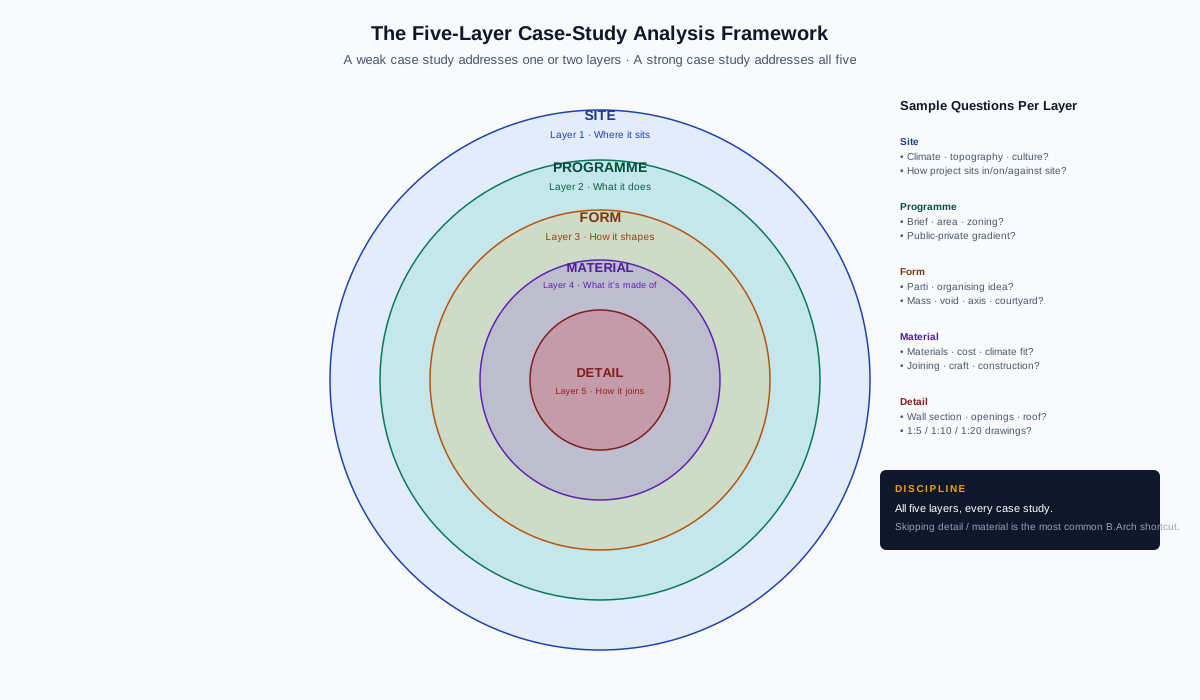
3. The Five-Layer Analysis Framework
A case study analyses a project across five layers. A weak case study addresses one or two layers; a strong case study addresses all five.
Layer 1 — Site
| Question | Data needed |
|---|---|
| What is the site condition (urban / rural / peri-urban)? | Site plan, surrounding context |
| What is the climate context? | Climate zone, sun-path, wind, rain |
| What is the topography? | Section through site, level differences |
| What is the cultural / regulatory context? | Local zoning, heritage, community |
| How does the project sit in / on / against the site? | Site plan, sections, photographs |
Layer 2 — Programme
| Question | Data needed |
|---|---|
| What was the programmatic brief? | Architect's project description, area schedule |
| How was the programme organised? | Plans showing zoning + circulation |
| What are the public-private gradients? | Programmatic diagrams |
| What programmatic moves are distinctive? | Comparison to similar typologies |
| What was added to / left out of the standard brief? | Architect's own writings, monographs |
Layer 3 — Form
| Question | Data needed |
|---|---|
| What is the parti / organising idea? | Concept diagram, axonometric |
| What are the formal moves? (mass, void, axis, courtyard, etc.) | Massing diagrams, sections |
| How does form respond to programme? | Plan + form correspondence |
| How does form respond to site? | Site-section integration |
| What is the formal hierarchy? | Elevations, axonometric |
Layer 4 — Material
| Question | Data needed |
|---|---|
| What materials were specified? | Photographs, material specifications |
| Why these materials? (climate, availability, cost, expression) | Architect's commentary |
| How are materials joined / detailed? | Detail drawings, close-up photographs |
| What was the construction sequence? | Construction photographs |
| How does material support the programmatic / formal intent? | Synthesis question |
Layer 5 — Detail
| Question | Data needed |
|---|---|
| What are the canonical details of the project? | Detail drawings at 1:5 / 1:10 / 1:20 |
| How is the wall section organised? | Wall section drawings |
| How are openings (doors, windows, glazing) detailed? | Detail drawings |
| How does the roof / parapet / floor edge resolve? | Detail drawings |
| What innovations or adaptations are present? | Architect's commentary |
The five-layer framework is what distinguishes a research case study from a magazine-style summary. Apply all five layers; do not skip the difficult ones.
4. Data Collection Methods
The case study rests on data. The methods below are the working set.
Method 1 — Published Drawings
The first source. Magazine and monograph publications typically include:
- Plans (1-3 levels)
- Sections (1-3)
- Elevations (1-2)
- Sometimes: site plan, axonometric, exploded
- Sometimes: 1-3 detail drawings
Sources to consult:
- Architect's monograph (e.g., El Croquis, 2G, Doshi monograph from Vastushilpa Foundation)
- ArchDaily / Dezeen / Architectural Review (free; less drawing depth)
- Architectural Record / Architectural Review India (institutional access usually required)
- Indian Architect & Builder, Architecture+Design (India-specific magazines)
- Council of Architecture publications
Method 2 — Photographs
Used for material, detail, atmospheric, and inhabitation studies. Sources:
- Architect's monograph (canonical photographs)
- Architectural-photography books (e.g., Iwan Baan, Hélène Binet, Edmund Sumner for India)
- Pinterest (for moodboard / atmospheric reference; not citable)
- Instagram (architects' studios often post work-in-progress + completed)
Method 3 — On-Site Visit (When Possible)
The single highest-yield case-study method, when accessible. Indian B.Arch students should visit:
- Within 100 km: a default — mandatory for thesis-relevant case studies
- Within India: 1-2 multi-day trips during B.Arch (often through institution-organised tours)
- International: 1 trip if budget allows — increasingly common via summer-school programmes
What to do on a site visit:
- Photograph systematically — exterior in 4 cardinal directions, interior at all key spaces, all transitions
- Walk the building's circulation as if you were a user
- Make hand sketches of plans, sections, key details — sketching is faster than software for capture
- Note dimensions if measurable (without intruding)
- Talk to occupants where appropriate
Method 4 — Architect Interviews / Talks
Many Indian architects give public lectures, podcasts, conference talks. Mining these is a legitimate case-study research method:
- Pritzker laureate lectures — Doshi 2018 acceptance + retrospective
- Conference proceedings — IIA, CoA, India Habitat Centre
- YouTube architect interviews — Studio Lotus, RMA, Studio Mumbai have substantial public material
- Podcast appearances — About Buildings + Cities, Scratching the Surface, etc.
Method 5 — Critical Literature
Academic and journalistic literature about the project. Found via:
- Google Scholar — peer-reviewed academic articles
- Shodhganga (Indian PhD repository) — Indian academic dissertations
- JSTOR (with institutional access) — back-catalogue of journals
- Architectural Theory Review / Journal of Architecture — peer-reviewed criticism
A strong case study cites 3-5 critical sources alongside the architect's own publications.
5. The Application Protocol — Turning Case Studies into Design
The case study is not the goal; informed design is. The application protocol below is what converts research into your own project.
The Five-Step Application
| Step | Action |
|---|---|
| 1 | Identify the transferable principle — the abstracted move that can apply to your context |
| 2 | Identify the constraints in your project that differ from the precedent |
| 3 | Adapt the principle to your constraints |
| 4 | Document the adaptation in your design narrative — "Drawing on X's resolution of Y, adapted for [my constraint]" |
| 5 | Cite the precedent in your studio submission and document |
The discipline is critical: transfer principles, not images. A student who applies an Indian-courtyard principle (passive cooling, social ambiguity, climate response) to a Year-3 studio in Bengaluru is doing research-informed design. A student who copies a courtyard image from a Doshi project into their plan is doing image transfer, which is plagiarism.
Examples of Principle Transfer
| Precedent | Principle | Adaptation in your project |
|---|---|---|
| Doshi's Sangath — courtyard as climate-and-cultural anchor | Passive-cooling courtyard with semi-public character | Adapt as covered semi-courtyard in a Mumbai monsoon-context, modified for higher density |
| Studio Mumbai — material as primary expression | Local material craft as architectural identity | Adapt with locally-available stone/brick in your Tier-2 city site |
| Kahn's IIM-A — masonry mass as institutional expression | Masonry depth as climate buffer + monumentality | Adapt as RCC-with-masonry-cladding for cost-constrained Indian institutional |
The point is not to make your project look like the precedent; the point is for your project to be informed by the precedent's resolution of the underlying problem.
6. The Citation Discipline
Case-study work shades into plagiarism if not cited carefully. The discipline:
| Practice | Discipline |
|---|---|
| Direct quote from architect's writing | Quotation marks + citation |
| Architect's drawing reproduced | Caption with project name + architect + source |
| Photograph from monograph | Caption with photographer (often) + source publication |
| Idea drawn from precedent | Cite the precedent in your design narrative |
| Image stolen from Pinterest | Don't. Pinterest is not a citation source. |
| AI-generated derivative of a precedent's style | Disclose explicitly |
The standard is the same as academic citation: if it's not yours, attribute it. Indian architecture institutions (CEPT, SPA, IIT, JJ School) increasingly enforce citation standards on B.Arch submissions.
7. Common Case-Study Mistakes
| Mistake | Consequence | Fix |
|---|---|---|
| Pinterest as the primary source | Shallow analysis; no drawings; no citations | Use architect monograph + ArchDaily / El Croquis as primary; Pinterest for atmospheric reference only |
| Single-layer analysis (only photographs) | Site / programme / detail layers absent | Apply five-layer framework; cover all layers |
| All canonical / no Indian precedents | Project disconnected from Indian context | Always include 1-2 Indian / South Asian case studies |
| Image transfer instead of principle transfer | Looks like plagiarism | Abstract the principle; adapt to your context |
| No citation in studio submission | Faculty cannot verify research; appears as plagiarism | Cite every source; use a consistent format (APA / Chicago / institution-mandated) |
| Three case studies that all match your instinct | No design-space expansion | Include at least one challenging / unexpected precedent |
| Case study without site visit when site is local | Missing the highest-yield research method | Visit sites within 100 km; mandatory for thesis case studies |
| Not enough case studies (1 only) | Insufficient breadth | Minimum 3 per studio project; 5-7 for thesis |
The fix in every case is more discipline at the front of the research. Strong case-study work is the difference between informed design and decorative reference.
8. Twelve-Test Case-Study Self-Diagnostic
Before submitting any studio project that uses case studies, run the following twelve tests.
| Test | Question | Pass criterion |
|---|---|---|
| 1 | Have you analysed at least 3 case studies in depth? | Yes — minimum 3, ideally 4-6 |
| 2 | Do at least 1-2 case studies share the same design problem as your project? | Yes — typology / programme match |
| 3 | Is at least one case study Indian / South Asian? | Yes — contextual relevance |
| 4 | Is at least one case study challenging / unexpected? | Yes — design-space expander |
| 5 | Have you covered all five layers (site, programme, form, material, detail) in each case study? | Yes — no shallow case studies |
| 6 | Have you used published drawings as primary source (not just photographs)? | Yes — drawings allow analytical depth |
| 7 | Have you visited at least one case-study site (if accessible)? | Yes — for thesis case studies, this is mandatory |
| 8 | Have you read at least 2-3 critical-literature sources alongside the architect's own writing? | Yes — independent perspectives |
| 9 | Have you abstracted principles from the case studies, not just images? | Yes — principle transfer, not image transfer |
| 10 | Are case studies cited in your studio submission and design document? | Yes — with consistent citation format |
| 11 | Can you discuss each case study aloud for 3-5 minutes? | Yes — interview-ready depth |
| 12 | Have you applied case-study findings explicitly in your design narrative? | Yes — "Drawing on X, adapted for [my context]" |
Students who pass 10+ tests across their studio + thesis case-study work develop a research repertoire that supports their entire architectural career.
9. Companion Resources at Studio Matrx
- Module 6 — Thesis Methodology — case studies are a core thesis research method
- Module 1 — Architectural Drawing & Representation Fundamentals — your case-study drawings are produced via these conventions
- Module 3 — Building Your Architecture Portfolio — case studies cited in your portfolio
- Architecture Academy — Student Resources Hub — Indian architecture timeline + reading list (case-study source material)
- Student Foundations Track — full 8-module curriculum
10. References
Foundational Case-Study Methodology
- Plowright, P. (2014). Revealing Architectural Design: Methods, Frameworks, and Tools. Routledge. — On case-study analysis as design methodology.
- Ching, F. D. K., Jarzombek, M. M., & Prakash, V. (2017). A Global History of Architecture (3rd ed.). Wiley. — Reference for canonical case studies, including Indian.
- Frampton, K. (1995). Studies in Tectonic Culture: The Poetics of Construction in Nineteenth and Twentieth Century Architecture. MIT Press. — Five-layer analysis (especially material and detail) modelled on Frampton's tectonic-cultural framework.
- Lawson, B. (2005). How Designers Think: The Design Process Demystified (4th ed.). Architectural Press. — On precedent's role in design cognition.
Peer-Reviewed Academic References — Architectural Precedent
- Akin, Ö. (2002). Case-based instruction strategies in architecture. Design Studies, 23(4), 407–431.
- Goldschmidt, G. (2014). Linkography: Unfolding the Design Process. MIT Press. — Empirical study of how designers use precedent.
- Eilouti, B. H. (2009). Design knowledge recycling using precedent-based analysis and synthesis models. Design Studies, 30(4), 340–368.
- Heylighen, A., & Verstijnen, I. M. (2003). Close encounters of the architectural kind. Design Studies, 24(4), 313–326.
Indian Case-Study Source Repositories
- Vastushilpa Foundation Ahmedabad — Doshi's complete archive.
- Indian Architect & Builder — back catalogue of Indian projects with drawings.
- DOMUS India — international-quality case studies of Indian projects.
- Architecture+Design (A+D) — long-running Indian architecture magazine.
- Charles Correa Foundation — Correa's archive.
- El Croquis (Spain) — single-architect deep dives, including India-related (Studio Mumbai, Doshi).
Companion Studio Matrx Guides
See §9 above for the full cross-reference list.
Author's Note: Every architect you admire became that architect partly through case-study practice. Doshi studied Le Corbusier; Correa studied Doshi and Wright; Studio Mumbai studies vernacular building cultures from across South Asia; Anupama Kundoo studies craft traditions from across the world. The case study is not a B.Arch homework requirement; it is the discipline that connects you to the architectural canon, that expands your design vocabulary beyond your own instincts, and that builds the research-informed sensibility that distinguishes serious practice from imitative practice. The framework above — five-layer analysis, three-source mix, principle transfer, citation discipline — is what converts case-study work from Pinterest-grazing into actual research. Apply it to every studio project, every thesis, every internship interview. The architectural eye you build through this work is the eye you take with you into practice.
Disclaimer: Citation conventions vary by institution; the framework above reflects general academic-citation discipline. Students should follow institution-specific citation guidelines. Studio Matrx, its authors, and contributors accept no liability for outcomes based on this guide.
Export this guide
Related Guides — Deep-dive reading
Internship Interview Prep & Résumé Content for Architecture Students
The 2026 Working Reference for Indian B.Arch and B.Des Students — Building the One-Page Résumé (Twelve Sections), Writing the Cover Letter That Lands, the Five-Stage Interview Process, the Portfolio Walk-Through, the Sketch Test, Salary Discussion, Offer Evaluation, the Common Failure Modes, and the Sustained Discipline of Internship Application Across Year 3 and Year 4
Student FoundationsArchitectural Drawing & Representation Fundamentals
Module 1 of the Student Foundations Track — Orthographic Projection, Axonometric, Isometric, Perspective, BIS Line-Weight Standards, Material Hatching Conventions, the Sketchbook Discipline, and the Hand-to-Software Translation for Indian B.Arch and B.Des Students
Student FoundationsStudio Jury Survival — Presentation, Critique, Iteration
Module 4 of the Student Foundations Track — How to Present Your Work, Take Critique Without Defensiveness, Read Jury Feedback for the Underlying Question, Iterate Productively, and Survive Year-1 to Year-5 Studios with Your Architectural Voice Intact
Student FoundationsRelated Tools — Try Free
Cross-Ventilation Analyzer
Estimate airflow and air changes per hour (ACH) from room size, window areas, layout, and local wind — with NBC 2016 Part 8 compliance check.
Ventilation CalculatorBrise-Soleil Visualizer
Interactive horizontal-louvre cut-off angle calculator — sun altitude, louvre depth, and spacing inputs with a live shadow preview. Computes θ = arctan(spacing/depth) for façade shading, ECBC envelope compliance, hospital daylight design, and tropical sun-control detailing.
Sun Shading ToolWindow Orientation Planner
Pick the best window type, glass and shading by wall direction — north, east, south and west.
Window Tool