
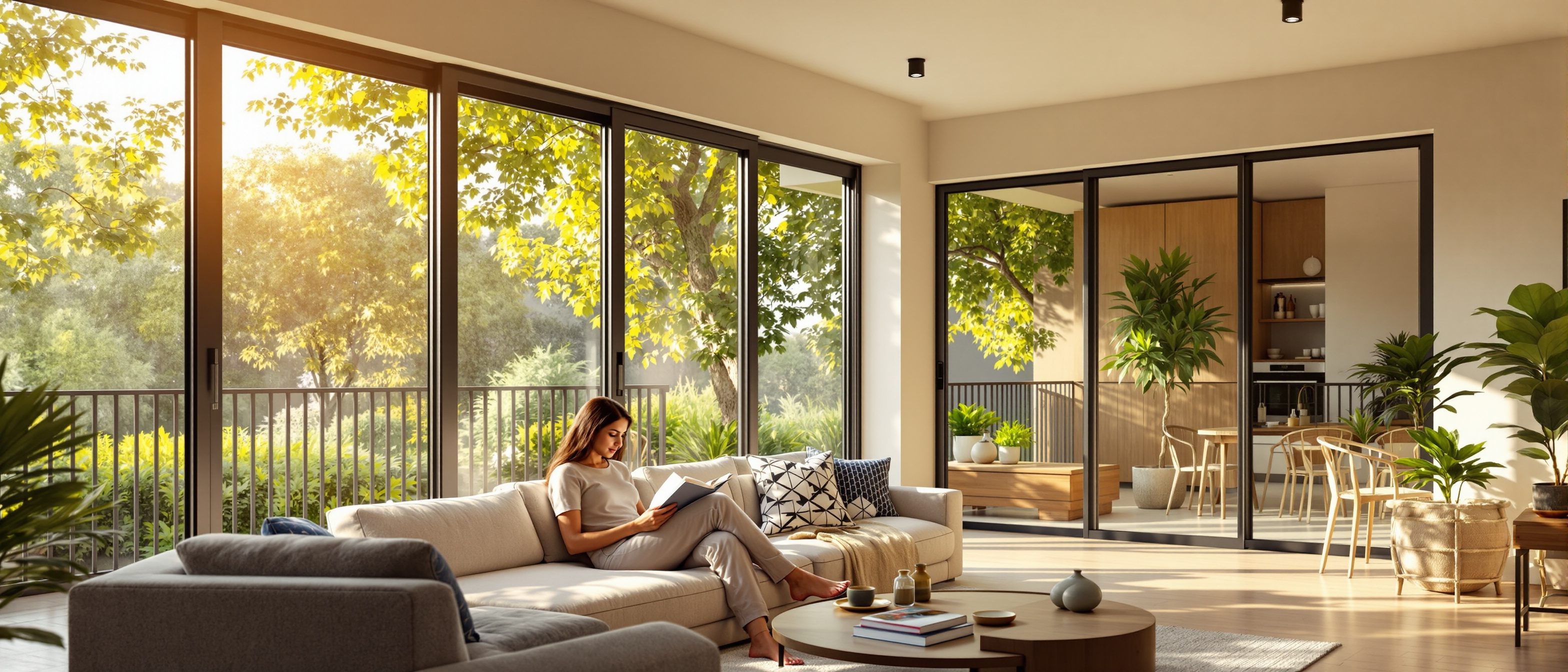
Aluminium Window Cost in India (2026): Powder-Coated to System Profiles
Why aluminium windows span ₹350 to ₹3,000 per square foot — and how to read a quote line by line
Aluminium is the widest-priced window material in India. A basic powder-coated frame can land at ₹450 per square foot, while a thermally-broken, branded system window with high-spec glass can cross ₹3,000 per square foot — a nearly seven-fold spread for what looks, to the untrained eye, like the same slim metal frame. This guide explains where every rupee of that range comes from, so you can read an aluminium quote line by line and know when paying more buys real performance.
Aluminium frames span ₹350 to ₹3,000 per square foot of window — the single widest range of any frame material. The grade of metal, the finish, and whether the frame has a thermal break decide where you land.
This is the dedicated cost deep-dive. For the full material profile — strengths, climate fit, brands, lifespan — read Aluminium Windows in India; that is the full guide, this is the cost deep-dive. For costs across all frame materials, see the pillar Home Window Cost in India. Choosing between metals and plastic? Read uPVC vs Aluminium Windows. All prices below are indicative for June 2026 in rupees and exclude 18 per cent GST unless stated — always confirm with itemised quotes from fabricators.
Why the aluminium range is so wide
Three independent variables stack on top of each other, and each one can roughly double the rate.
1. Grade and finish of the metal — mill-finish (bare), powder-coated, anodised, or marine-grade. This is the coating that protects the frame and decides how it survives sun, rain and coastal salt.
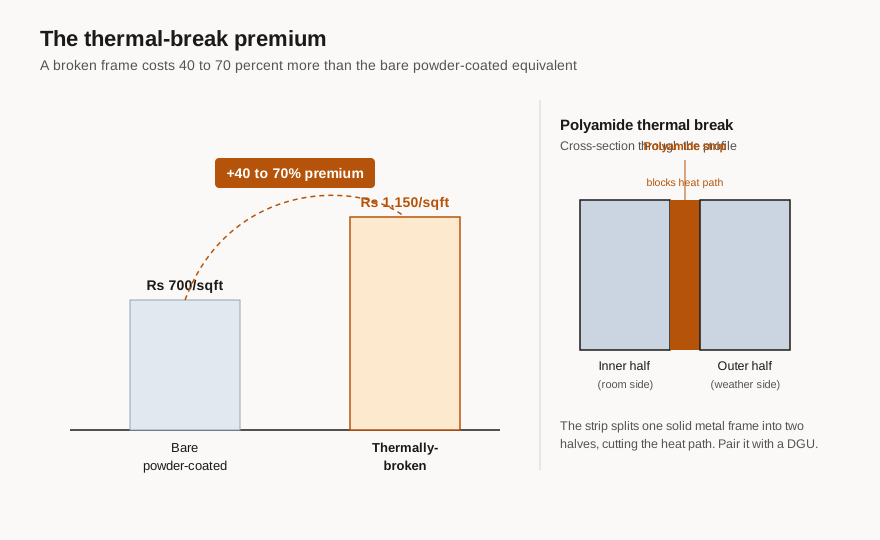
2. Bare versus thermally-broken — an ordinary aluminium profile is one solid metal piece that conducts heat straight through. A thermally-broken profile inserts a polyamide (nylon) strip between the inner and outer halves, cutting that heat path. The break adds material and fabrication cost.
3. Ordinary fabricated versus system or branded — an "ordinary" window is cut and assembled by a local fabricator from generic sections. A system window uses an engineered, tested profile family (gaskets, drainage, hardware all designed together) from a brand like Eternia, Schüco, Technal or TOSTEM, with quality control and warranty.
A budget job sits at the bottom of all three; a premium job sits at the top of all three. That is the seven-fold spread.
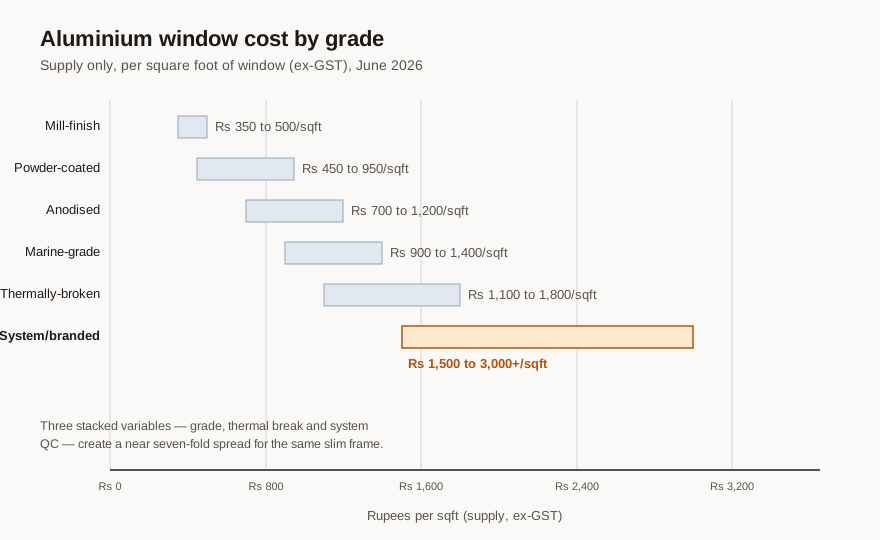
Cost by grade (supply only, per square foot)
| Grade or build | ₹/sqft (supply) | What you are paying for |
|---|---|---|
| Mill-finish (bare aluminium) | 350–500 | No protective coating — silver raw metal; oxidises and pits; only for utility/temporary use |
| Powder-coated (standard) | 450–950 | Baked polyester coating, wide colour range; the mainstream residential choice |
| Anodised | 700–1,200 | Electrochemically hardened surface; tougher, more abrasion- and corrosion-resistant than powder coat |
| Marine-grade (powder/anodised) | 900–1,400 | Thicker/higher-spec coating for coastal salt exposure |
| Thermally-broken (powder-coated) | 1,100–1,800 | Adds the polyamide thermal break; far better heat and condensation control |
| System / branded (thermally-broken + tested) | 1,500–3,000+ | Engineered profile, factory QC, certified weather/wind performance, warranty |
The jump from mill-finish to a coated frame is the single cheapest upgrade with the biggest durability payoff — never buy bare aluminium for a permanent home. Powder coat covers most homes; anodised and marine-grade matter most within a few kilometres of the sea.
The thermal-break premium — and when it is worth it
Bare aluminium is an excellent conductor of heat. In a Delhi summer or a Chennai afternoon, a solid aluminium frame becomes hot to the touch and pumps that heat indoors; in air-conditioned rooms it also sweats with condensation. A thermal break stops that by splitting the frame into inner and outer halves joined by a non-conductive polyamide strip.
The premium is real: a thermally-broken frame typically costs 40 to 70 per cent more than the equivalent bare powder-coated frame, before you add the better glass that usually accompanies it.
When the thermal break is worth it:
- Air-conditioned homes in hot or composite climates (Delhi, Hyderabad, Ahmedabad, Nagpur) — the running-cost saving on cooling, plus no condensation, pays back the premium over the window's life.
- Large glass areas — floor-to-ceiling or full-wall glazing, where the frame-and-glass heat gain is a big slice of the cooling load. Here a thermal break helps you meet Eco-Niwas Samhita (the residential energy code) targets.
- Cold-winter regions — hill stations and the north in winter, to keep heat in and stop frame condensation.
When you can skip it:
- Naturally ventilated, non-AC rooms in mild or coastal climates, where you keep windows open and are not fighting an indoor-outdoor temperature gap.
- Small windows (utility, bathroom, store) where the frame area is tiny and the spend is better put into a thermal break elsewhere.
The thermal break is bought with the glass, not instead of it. A broken frame with single glazing wastes most of the benefit — pair it with a Double Glazed Unit (DGU) and low-emissivity coating.
Glazing add-ons (per square foot, on top of the frame)
The frame is only half the window. Glass is priced separately and can match or exceed the frame cost on a premium build.
| Glazing upgrade | Adds ₹/sqft | What it does |
|---|---|---|
| Single clear glass (baseline) | included | One pane; poor heat and sound control |
| Toughened (tempered) | 80–200 | Safety glass — shatters into blunt granules; expected on large or low panes |
| Double Glazed Unit (DGU) | 250–600 | Two panes plus air or argon gap; big jump in heat and acoustic insulation |
| Low-emissivity (Low-E) coating | 150–400 | Reflects radiant heat; cuts solar heat gain — key for Indian sun |
| Laminated (acoustic or security) | 200–500 | PVB interlayer; best sound-cut, holds together when broken |
A thermally-broken system frame paired with a Low-E DGU is the genuine high-performance combination — and explains why the very top of the range exists.
Installation, civil work and GST
Supply rates above are the frame and glass only. To reach the price you actually pay, add:
- Installation / labour — ₹30 to 65 per square foot, or ₹800 to 2,200 per opening. Upper floors above the third, scaffolding, crane access and heritage buildings push this up.
- Hardware — handles, multi-point locks, friction stays, mosquito mesh and grilles; system windows bundle better hardware (and cost more for it).
- Civil work — cutting or enlarging openings, lintels, sills, chemical anchoring and plaster making-good. Usually quoted separately.
- Waterproofing and finishing — sealant, backer rod and drip sills.
- GST at 18 per cent on both materials and services.
- Removal and disposal of old windows on replacement jobs.
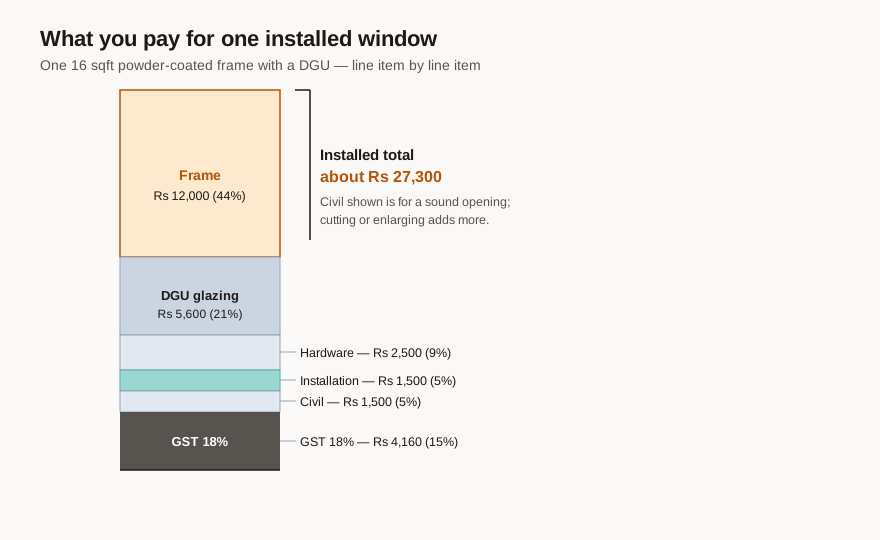
Worked example — one 4ft x 4ft window
A standard window of 4 feet by 4 feet is 16 square feet. Here is the same opening built three ways.
| Line item | Budget powder-coated | Mid powder-coated + DGU | Premium system + Low-E DGU |
|---|---|---|---|
| Frame (₹/sqft) | 500 | 750 | 1,800 |
| Frame subtotal (16 sqft) | ₹8,000 | ₹12,000 | ₹28,800 |
| Glazing upgrade (₹/sqft) | 0 (single) | 350 (DGU) | 550 (Low-E DGU) |
| Glazing subtotal | ₹0 | ₹5,600 | ₹8,800 |
| Hardware (per window) | ₹1,500 | ₹2,500 | ₹5,000 |
| Installation (per opening) | ₹1,000 | ₹1,500 | ₹2,200 |
| Subtotal (before GST) | ₹10,500 | ₹21,600 | ₹44,800 |
| GST at 18 per cent | ₹1,890 | ₹3,888 | ₹8,064 |
| Installed total | ₹12,390 | ₹25,488 | ₹52,864 |
The same opening ranges from roughly ₹12,400 to ₹52,900 installed — and civil work, if the opening must be cut or enlarged, is on top of all three.
Whole-home check
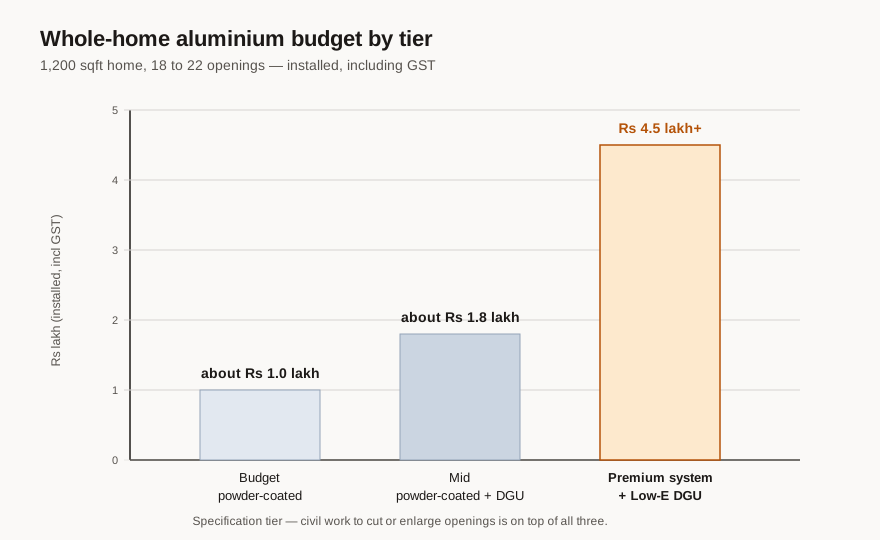
A typical 1,200 square foot home has 18 to 22 openings totalling about 240 to 300 square feet of glazing. At a mid-tier powder-coated-plus-DGU build, expect roughly ₹1.2 to 2.4 lakh for the window package including install and GST; an all-system thermally-broken specification can push a larger home well past ₹4 to 5 lakh.
How to read your aluminium quote
- Ask for the grade in writing — mill-finish, powder-coated, anodised or marine-grade — and the coating thickness in microns.
- Confirm whether the profile is thermally broken, and whether the glass is single, DGU or Low-E DGU. A cheap quote often hides single glazing.
- Check whether it is a named system with test certificates and warranty, or generic sections cut to size.
- Get install, civil and GST itemised separately — a "per square foot" headline rate that quietly bundles or omits these is not comparable across vendors.
For the full picture of aluminium as a material — climate fit, durability and brands — return to Aluminium Windows in India. To compare against the most common alternative, see uPVC vs Aluminium Windows, and for costs across every frame material, the pillar Home Window Cost in India.
References
- Aluminium windows price and installation cost (Alcoi): https://alcoi.in/aluminium-windows-price-and-installation-cost/
- System aluminium windows for Indian monsoons (Alcoi): https://alcoi.in/system-aluminium-windows-indian-monsoons/
- Windows price per square foot 2026 cost guide (Building and Interiors): https://buildingandinteriors.com/upvc-windows-price-per-sq-ft-india-2026-cost-guide/
- Aluminium windows for coastal homes (Eternia): https://www.eterniawindows.com/articles/aluminium-windows-for-coastal-homes/
- IS 1948 — aluminium doors, windows and ventilators (BIS): https://law.resource.org/pub/in/bis/S03/is.1948.1961.pdf
- Eco-Niwas Samhita 2018 (BEE/ECBC): https://ecbc.in/econiwas.html
Interactive · Indicative estimate
80 sqft @ ₹550/sqft
Finish tier (sets an indicative rate)
Indicative total
₹44,000
Total at each tier's indicative rate, for your quantity.
Supplied-and-fixed per sqft — section, glass and hardware drive the tier. Tier rates are indicative starting points — set the rate to the figures in the tables above or your actual quote. Estimate only.
Export this guide
Related Guides — Deep-dive reading
Aluminium Door Cost in India 2026: ₹/Sq Ft by Profile Grade, Finish, Glazing & Hardware
A focused 2026 cost guide for aluminium doors in India — ₹ per sq ft of opening by profile grade (economy domal vs branded system sections vs thermal-break), powder-coat vs anodised vs wood-finish surcharge, glazing, rollers/locks/handles, sliding vs openable, fitting and GST, with a worked balcony/utility example.
Home Doors & EntrancesWindow Frame Materials in India (2026): uPVC vs Aluminium vs Wood vs Steel vs Composite
The buyer's decision guide for choosing a window frame material by budget, climate, thermal priority, look, maintenance and lifespan.
Windows & GlazingAluminium Windows Guide (India): Slim, Strong, and the Thermal-Break Question
Why aluminium gives you the most glass and least frame, why bare metal conducts heat, and how a polyamide thermal break plus DGU fixes it.
Windows & GlazingRelated Tools — Try Free
Window Cost Calculator
Estimate window price plus installation by type, frame material, size, glass and quantity.
Window CalculatorCross-Ventilation Analyzer
Estimate airflow and air changes per hour (ACH) from room size, window areas, layout, and local wind — with NBC 2016 Part 8 compliance check.
Ventilation CalculatorGlass Selection Tool
Single vs double (DGU) vs triple glazing and the right glass type for your climate, priority and sun.
Window Tool