
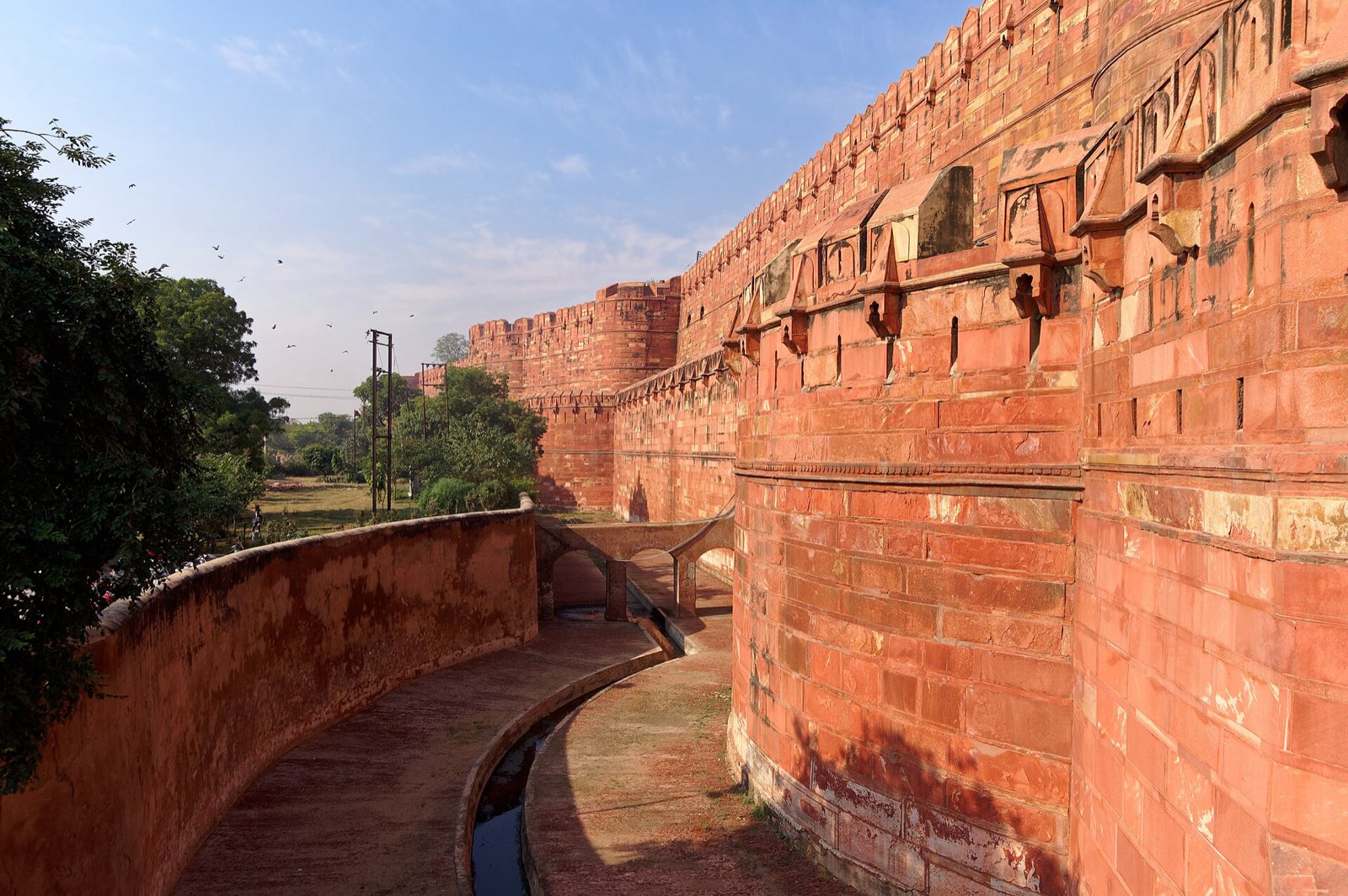
Agra Fort: Where the Mughal Style Was Born, and the Taj Story Ended
How one red sandstone fortress on the Yamuna holds the whole arc of Mughal architecture — from Akbar's muscular red stone to Shah Jahan's delicate marble — and the marble tower where the Taj's builder died gazing at his masterpiece
We have already visited the two supreme monuments of Shah Jahan — the Taj Mahal and the Red Fort at Delhi — and the tomb of Humayun where the Mughal style began. Agra Fort is the building that ties the whole story together, and it deserves its place at the end of this Mughal sequence for two reasons. First, because it is the one place where you can watch the Mughal style change — where Akbar's robust red sandstone architecture stands wall-to-wall with Shah Jahan's delicate white marble, three generations of the dynasty's evolving taste gathered inside a single fortress. And second, because it holds the poignant final chapter of the Taj Mahal's story: it was here, in a small octagonal marble tower, that the emperor who built the Taj spent the last years of his life a prisoner, gazing downriver at the tomb of the wife for whom he had built it.
The seat of the Mughal empire
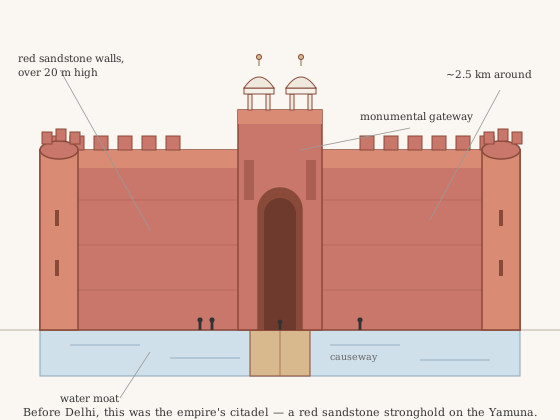
Before Delhi, there was Agra. For much of the sixteenth and seventeenth centuries, Agra on the Yamuna river was the capital of the Mughal empire, and Agra Fort was its citadel and palace — the true centre of Mughal power at its height. The Emperor Akbar, the greatest of the Mughals, rebuilt it from around 1565 as a massive stronghold of red sandstone: walls some two and a half kilometres in circuit, over twenty metres high, ringed by a moat, and entered through great gates. Within these walls, Akbar and his successors Jahangir and Shah Jahan built and rebuilt their palaces over some seventy years — and because each ruler built in the taste of his own time, the fort became a living record of how Mughal architecture developed.
Reading the change of style
The single most instructive thing at Agra Fort is to stand where Akbar's work meets Shah Jahan's, and see the difference with your own eyes.
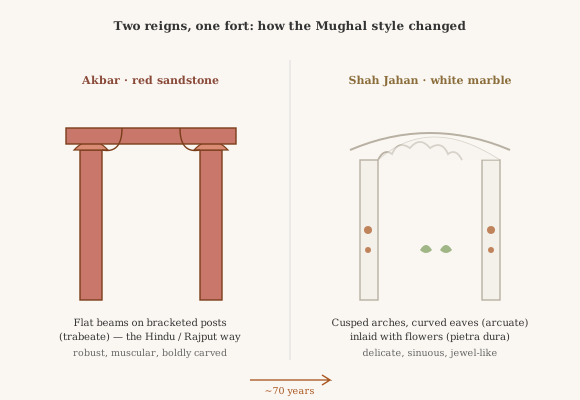
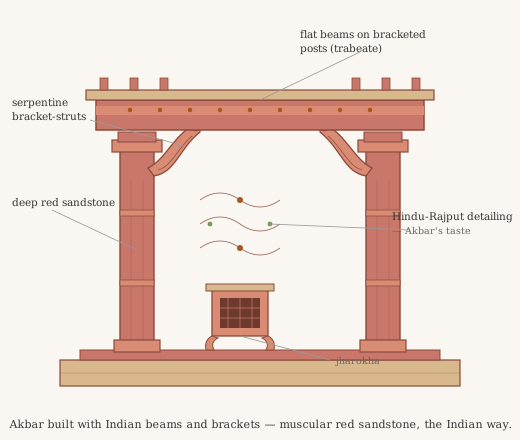
Akbar's architecture, seen best in the Jahangiri Mahal palace within the fort, is built of deep red sandstone and is robust, muscular and boldly carved. Crucially, much of it is trabeate — built with flat beams resting on posts and brackets, the ancient Indian post-and-beam method we saw in the Hindu and Jain temples of this series — rather than with true arches. Akbar, who ruled a largely Hindu empire and employed Hindu and Rajput craftsmen and married Rajput princesses, deliberately embraced Indian building traditions: bracketed capitals, serpentine struts, carved stone beams, a solid Rajput muscularity. His red sandstone architecture is Mughal power expressed through Indian strength.
Shah Jahan's architecture, two generations later, could hardly be more different. His additions to the fort — the Khas Mahal, the Diwan-i-Khas, the marble palaces along the river — are built of white marble and are delicate, sinuous and jewel-like. They use the arcuate system of true and cusped (scalloped) arches; they curve their eaves in the bangla form; and they are inlaid with pietra dura, flowers of coloured semi-precious stone set into the marble, the same technique that flowers on the Taj Mahal. Where Akbar's work is muscular red stone, Shah Jahan's is refined white marble; where Akbar built with beams in the Indian manner, Shah Jahan built with arches in the Persian; where Akbar carved, Shah Jahan inlaid. In the span of one fort you can walk from one world to the other and read, in stone and marble, the whole trajectory of Mughal taste — from bold synthesis to exquisite refinement.
This is why Agra Fort is such a valuable building to understand: it is a textbook of the Mughal style laid out in three dimensions. Set it against the buildings already in this series and the sequence completes itself — Humayun's Tomb with its early red-and-white boldness, Akbar's own city at Fatehpur Sikri in carved red sandstone, and then the marble perfection of the Taj and the Red Fort. Agra Fort holds the hinge between the two halves of that story.
The prisoner and the Taj
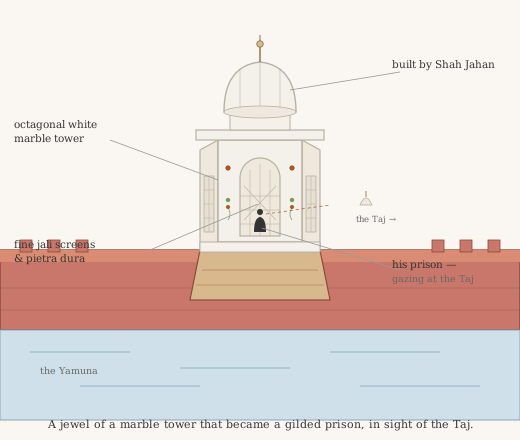
And it holds the story's ending. Along the river wall of the fort stands the Musamman Burj, an exquisite octagonal tower of white marble, screened with fine jali and inlaid with pietra dura, built by Shah Jahan himself as a private pavilion for the imperial household, open to the breeze off the Yamuna.
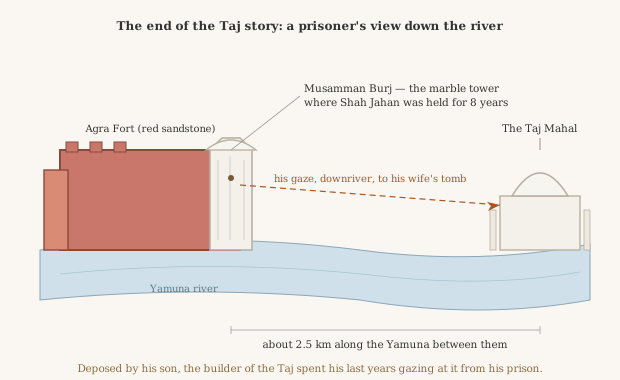
In 1658, Shah Jahan fell ill, and his sons fought over the succession. The victor was his ruthless third son, Aurangzeb, who seized the throne, killed his brothers, and placed his aged father under house arrest inside Agra Fort. There Shah Jahan spent the last eight years of his life, deposed and confined — but confined in his own marble tower, the Musamman Burj, which happens to look downriver, along a bend of the Yamuna, to the Taj Mahal about two and a half kilometres away. And so the emperor who had built the most beautiful tomb in the world, in his grief for his wife Mumtaz Mahal, spent his own final years gazing at it from a distance, unable to go to it, until he died in 1666 — after which his body was carried down the river and laid beside her, at last, inside the Taj.
It is one of the most moving stories attached to any building in the world, and it makes the Musamman Burj a place of extraordinary pathos: a jewel of a marble tower that became a gilded prison, from which the greatest builder of the age looked out at his own masterpiece across the water. The Taj Mahal is a monument to love and loss; the little tower in Agra Fort is where its builder lived out the loss himself, in sight of the love.
Why Agra Fort matters
Agra Fort earns its place in this series as the keystone of the Mughal story. It is the seat from which the empire was ruled at its height; it is the single richest place to read the evolution of the Mughal style, from Akbar's Indian-inflected red sandstone to Shah Jahan's Persian-inflected marble; and it holds, in the Musamman Burj, the human ending of the tale that the Taj Mahal begins. To visit the Taj and not the fort is to see the monument without its maker's fate; to see them together, across the river, is to hold the whole arc of Mughal architecture and Mughal tragedy in a single view.
Stand on the river wall of Agra Fort where Akbar's red sandstone gives way to Shah Jahan's white marble, look downstream to the pale dome of the Taj shimmering above the Yamuna, and you are standing at the very centre of the Mughal world — at the place where its architecture was born, transformed, perfected, and, in the person of its greatest patron, quietly ended.
Part of the Architectural Wonders series. Read the monument it looks out on, the Taj Mahal; its sister fort, the Red Fort at Delhi; and the earlier Mughal architecture at Humayun's Tomb and Fatehpur Sikri.
Hero photograph: “Moat and walls of Agra Fort” by Jakub Hałun, via Wikimedia Commons, licensed under CC BY-SA 4.0.
Export this guide
Related Guides — Deep-dive reading
The Red Fort, Delhi: Shah Jahan's Palace of Paradise on the River
How the emperor who built the Taj Mahal raised a whole walled palace-city in red sandstone and white marble — a fortress on the outside, a garden threaded with running water within, and the stage on which modern India was born
Architectural WondersThe Taj Mahal: A Building Made of Love and Loss
How a grieving emperor turned his sorrow into the most beautiful building on earth — a white marble tomb of flawless symmetry, set in a garden of paradise, broken by a single, deeply human flaw. The architecture of remembrance, and what it can teach anyone who builds.
Architectural WondersHadrian's Villa at Tivoli: The Emperor Who Rebuilt the World He Loved
The Roman emperor Hadrian had travelled almost the whole of his vast empire — and then, in the hills outside Rome, he built himself a private pleasure-world the size of a city, where he recreated the places he had loved on his journeys. It is a memory-palace of an entire empire, a laboratory of daring curved concrete a millennium and a half ahead of its time, and a monument quietly shaped by grief. The fifth article in our chapter on the palaces and pleasures of worldly power.
Architectural WondersRelated Tools — Try Free
Before & After Studio
Generate AI before-and-after renders to preview how your redesign could look.
DesignAIAI BOQ Generator
AI generates detailed Bill of Quantities with city-specific rates and labour breakdown.
ArchitectAIAI Measurement Tool
Measure your room using voice, photos, or video sweep — no tape measure needed.
DesignAI