
Nari Gandhi
India's great organic architect — Frank Lloyd Wright's hands-on heir
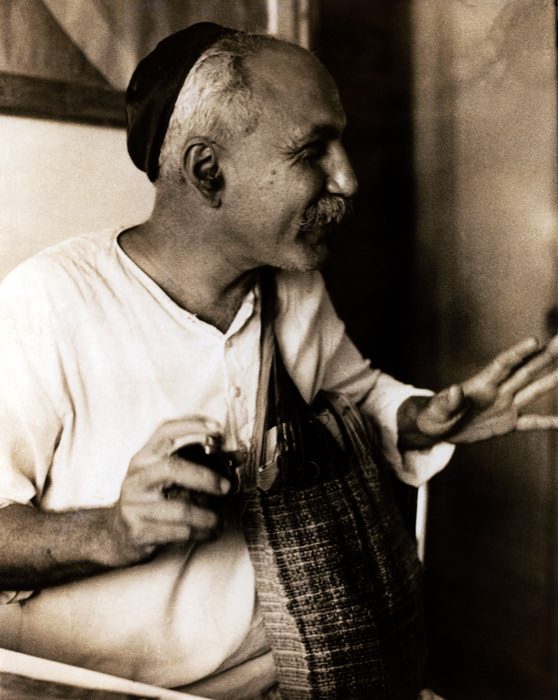
Photo: Foundation ForArchitecture, Attribution (free for any purpose), via Wikimedia Commons
Movements
Signature works
- Private organic houses along coastal Maharashtra
- Homes around Lonavala and Alibaug
- Hill and coastal residences near Mumbai and Pune
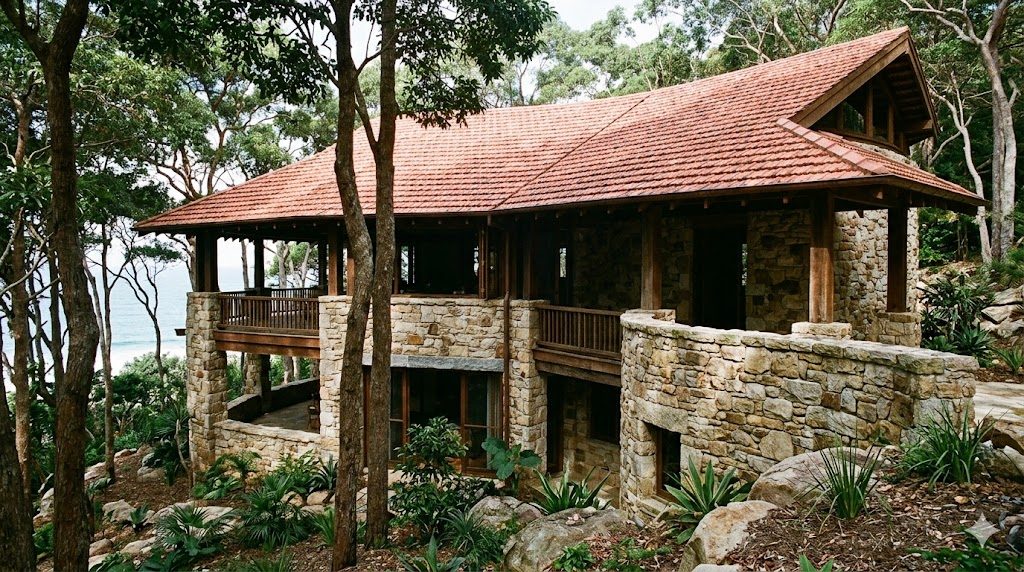
Somewhere on the Maharashtra coast, down a track that the road map does not name, there is a house with no straight walls. Its stone rises in slow curves, set by hand against the slope it sits on. A spiral stair winds up through the half-light. A tree grows through the plan rather than being cleared for it, and the roof of Mangalore tiles dips and turns to follow the land. There were no drawings for this house. There was a man, his masons, the rock, the trees, the sea light — and months of patient, improvised making.
That man was Nariman "Nari" Gandhi (1934–1993), and he is the most quietly radical architect modern India has produced. A Parsi from Mumbai who trained at the feet of Frank Lloyd Wright, he spent his entire career building private homes by hand along the coast and in the hills of the Western Ghats, and almost none of it was published while he lived.
Gandhi is India's great organic architect: the man who took Wright's idea — that a building should grow out of its site like a living thing — and proved it could be built, by hand, in Indian stone and brick and tile. He worked without conventional drawings, designing and constructing directly on site with his craftsmen, shaping each house to its ground, its light, its trees and its rock. He is the road not taken in Indian architecture — the organic, craft-driven, anti-industrial path that ran quietly alongside the Corbusian concrete mainstream.
The idea: a building should grow from its ground
Most modern architecture begins with a drawing — a plan worked out at a desk, then handed to a contractor to execute. Gandhi inverted this almost completely. For him the design did not exist on paper at all. It existed in the site, and in his hands and his masons' hands as they worked.
He would study a plot for a long time before anything was built — the way the land fell, where the rock outcrops sat, which trees should stay, where the morning light came in, how the monsoon would run. Then he and his craftsmen would build, adjusting and inventing as they went. A wall would curve because the rock asked it to. A stair would spiral because the volume wanted it. A room would turn to catch a particular view. The "design" emerged through making rather than preceding it.
This is organic architecture in its most literal and demanding form. Wright had spoken of a building being "of the hill" rather than "on the hill," of organic form as something integral and grown rather than applied. Gandhi did not merely admire this idea; he lived inside it for thirty years, on real sites, in real stone, with no safety net of drawings to fall back on. Every house became a single, unrepeatable object — a piece of inhabited sculpture married to its ground.
It is worth dwelling on how strange and difficult this way of working is. A drawing is, among other things, a contract: it lets a client know what they are buying, a contractor know what to price, an engineer know what to check. By refusing drawings, Gandhi was refusing all of that machinery, and taking the entire weight of the building onto his own judgement and his masons' skill. It demanded a client willing to trust him completely, a budget that could absorb a slow, exploratory process, and craftsmen who could read his intent from a gesture, a sketch in the dust, a length of bent wire held up against the sky. It is not a model that could ever scale — and Gandhi never wanted it to. He was content to make a handful of houses extraordinarily well rather than many houses adequately, and that choice, in a century obsessed with productivity, is itself a kind of statement.

Life and path: Mumbai to Taliesin and back
Nari Gandhi was born in 1934 into Mumbai's Parsi community — a small, cosmopolitan, fiercely independent-minded community that gave India many of its industrialists, artists and reformers. That independence of mind would mark his whole career.
The decisive event of his life was crossing the world to study with Frank Lloyd Wright. In the late 1950s Gandhi joined the Taliesin Fellowship, Wright's live-in apprenticeship at Taliesin in Wisconsin and Taliesin West in Arizona. The Fellowship was not a conventional architecture school. Apprentices lived communally, farmed, cooked, drew, built, and worked alongside the master on real projects — learning architecture as a total way of life rather than a desk profession. For a young Indian to land in that intense, hands-on world was formative beyond measure.

While in the United States Gandhi also studied ceramics and pottery — and this is more than a footnote. The potter's relationship to material is the architect Gandhi became: you do not draw a pot and hand it to someone else; you shape it yourself, on the wheel, responding to the clay as it turns. There is no gap between conceiving and making; the form arrives through the hands. That tactile, hands-in-the-material sensibility ran straight through his buildings. A Gandhi house, in a sense, is a very large pot — thrown not on a wheel but on a hillside, with stone and brick for clay, over months instead of minutes.
What he absorbed at Taliesin was therefore not a vocabulary of forms to be reproduced — the cantilevered terraces and prairie horizontals of Wright's own houses — but something deeper and more transferable: a conviction about how architecture should be made. Wright's apprentices were taught to see a building and its site as one continuous problem, to honour the nature of materials, and to treat construction not as a separate, lesser trade but as the act in which architecture actually happens. Gandhi took that conviction home and applied it to a wholly different climate, geology and craft tradition. The forms that resulted look nothing like Wright's; the philosophy underneath them is unmistakably his teacher's.
He returned to India and chose a path almost no one else took. Rather than join the rush to build the new nation in reinforced concrete — the dominant idiom of his generation, downstream of Le Corbusier at Chandigarh — Gandhi withdrew to the western coast and the hills and built houses, one at a time, mostly for private clients, almost entirely by hand. He worked in and around Mumbai, Pune, Lonavala and Alibaug, on coastal plots and hill sites, for the rest of his life. He died in 1993.
The work: houses, not monuments
Here a note of honesty is essential. Because Gandhi worked privately, refused the publicity machine, and left no body of drawings, his individual houses are largely unnamed in the public record and were almost entirely unpublished in his lifetime. It would be a betrayal of him — and of the truth — to invent project names, clients or dates. What can be described accurately is the consistent character of the work, drawn from the houses that survive and the photography and writing that rediscovered him after his death.
His houses share a recognisable language:
| Element | How Gandhi handled it |
|---|---|
| Form | Flowing, organic, never rectilinear; walls curve and the plan responds to the contour of the land |
| Materials | Local stone, brick, timber and Mangalore tiles — the ordinary materials of the region, used extraordinarily |
| Structure | Sculptural masonry, often curved; built around existing rock outcrops and trees rather than clearing them |
| Circulation | Spiral and winding stairs; movement that turns and reveals rather than marching in straight lines |
| Detail | Obsessively bespoke — railings, joints, niches and openings made one-off, by hand, on site |
| Economy | Recycled, salvaged and found materials worked into the fabric; very little wasted |
| Method | No conventional drawings; designed and built directly on site with his craftsmen |
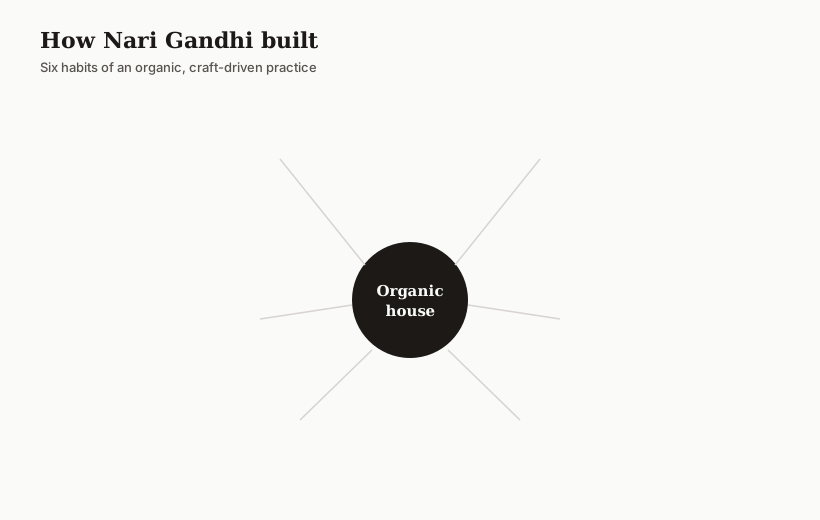
The houses around Lonavala and Alibaug, and his coastal Maharashtra work generally, read less like buildings than like landscapes that have been gently coaxed into shelter. Where a lesser architect would impose a box and call the leftover ground a garden, Gandhi let the ground keep its authority. A boulder becomes part of a living-room wall. A mature tree stands inside the plan, the roof opening around it. The result is a house you experience as a sequence of turns and discoveries, full of curved surfaces, shifting light, and the texture of hand-laid stone.
The choice of materials deserves emphasis, because it is where Gandhi's organic philosophy meets the specifics of India. Mangalore tiles — the terracotta roofing tile manufactured on the west coast since the nineteenth century — are about as ordinary a material as the region offers; you see them on godowns and bus shelters. Local basalt and laterite stone, country brick, and timber are the everyday substance of Maharashtra's older buildings. Gandhi did not reach for marble, glass curtain walls or imported finishes to signal sophistication. He reached for what the site and the region already had, and lifted it, through craft alone, into something poetic. A curved wall of rough local stone, laid with care so that the joints flow rather than march, carries more feeling than any polished imported surface — and it belongs.
Because every house was made this way — slowly, by hand, in dialogue with one site — no two are alike, and none could be mass-produced. That was the point. Gandhi was not designing a type to be repeated; he was making singular things.
The philosophy: organic architecture, lived
Gandhi is the most direct bridge between Frank Lloyd Wright's organic philosophy and Indian practice. Where many architects of the twentieth century treated "organic" as a style — a few curves, a sloping roof, some natural stone cladding — Gandhi treated it as a discipline that governed how a building should come into being.
The principle is simple to state and very hard to do: a building should be integral to its site, its materials and its making, the way a tree is integral to the soil it grows in. Form should follow from the land, the climate and the life inside, not from a preconceived geometry. Materials should be themselves — stone as stone, timber as timber — rather than disguised. And the maker's hand should remain visible, because a building is a made thing, not a manufactured one.
A building should be of its place, not merely on it — grown from the ground, the light and the hands that shape it.
This is the philosophy explored in our guide to organic architecture, and Gandhi is perhaps its purest practitioner anywhere. He sits in a direct line from his teacher Frank Lloyd Wright, and in close kinship with Laurie Baker — the British-born architect who, on the other side of India in Kerala, pursued a parallel ethic of local material, hand craft, low cost and deep respect for site. Baker and Gandhi never formed a movement together, but they are the twin consciences of Indian architecture: proof that there was always another way to build than the concrete frame.
India: the road not taken
To understand why Gandhi matters so much, you have to see the landscape he worked against. Independent India built itself, overwhelmingly, in reinforced concrete and the Corbusian modernist idiom — efficient, repeatable, industrial, and indifferent to site. It was a rational choice for a poor, hurrying nation that needed to build fast and at scale. But it had a cost: a sameness, a severing of building from craft and place, a forgetting of the deep Indian tradition of working stone, brick, timber and tile by hand.
Gandhi quietly refused all of it. He kept faith with the mason and the carpenter at exactly the moment the profession was learning to hand drawings to a contractor and look away. He insisted that an Indian house could be modern and organic and hand-made and rooted in its ground, all at once. In doing so he kept alive, almost single-handed, the organic and craft path of Indian architecture — the path that connects to the country's living vernacular traditions and to a biophilic instinct to build with nature rather than over it.
Because his work was private and undocumented, Gandhi became a near-legendary figure — a cult name passed between architects, a rumour of houses you had to know someone to visit. After his death in 1993, photographers and writers began to seek the surviving houses out, and his reputation grew precisely because it had never been manufactured. He is now widely regarded as one of India's great originals: the architect who proved the organic road was real, walkable, and beautiful.
Legacy and what we can learn
Gandhi left no school, no firm, no manifesto, almost no archive. What he left is harder to copy and more valuable: a standing proof.
He proves that architecture does not have to begin with a drawing — that a deep enough understanding of site, material and craft can carry a building into existence directly. He proves that ordinary local materials, in the right hands, are enough; you do not need imported finishes to make something extraordinary. He proves that respecting what is already on a site — the rock, the tree, the slope, the light — produces richer architecture than clearing it away. And he proves that the maker's hand is not a limitation but the very thing that gives a building soul.
For a designer today, working in a world of standardised products and copy-paste plans, Gandhi is a bracing corrective. You may not build without drawings as he did — almost no one can. But you can carry his questions to every project: What does this site already want to be? Which materials belong here? Where can the human hand still be felt? Build with those questions and you build in his lineage.
His instinct — that the best homes grow from their site, light and materials rather than being imposed on them — is exactly the instinct DesignAI is built to serve.
References
- Kaiwan Mehta, writings on Nari Gandhi and the organic tradition in Indian architecture.
- Frank Lloyd Wright, "The Natural House" and "An Organic Architecture" — the source philosophy Gandhi carried to India.
- William J. R. Curtis, "Modern Architecture Since 1900" — for the wider modern and Indian context against which Gandhi stood apart.
- Documentation and photographic essays on Gandhi's surviving Maharashtra houses published after 1993, in Indian architectural journals and the architecture press.
- Materials on the Taliesin Fellowship and Frank Lloyd Wright's apprenticeship system, for Gandhi's formation.
- Jon Lang, "A Concise History of Modern Architecture in India" — for the modernist mainstream Gandhi diverged from.
To follow Gandhi's lineage, read his teacher Frank Lloyd Wright and his Indian kindred spirit Laurie Baker, and explore the idea they all served in our guide to organic architecture.
Philosophies they championed