
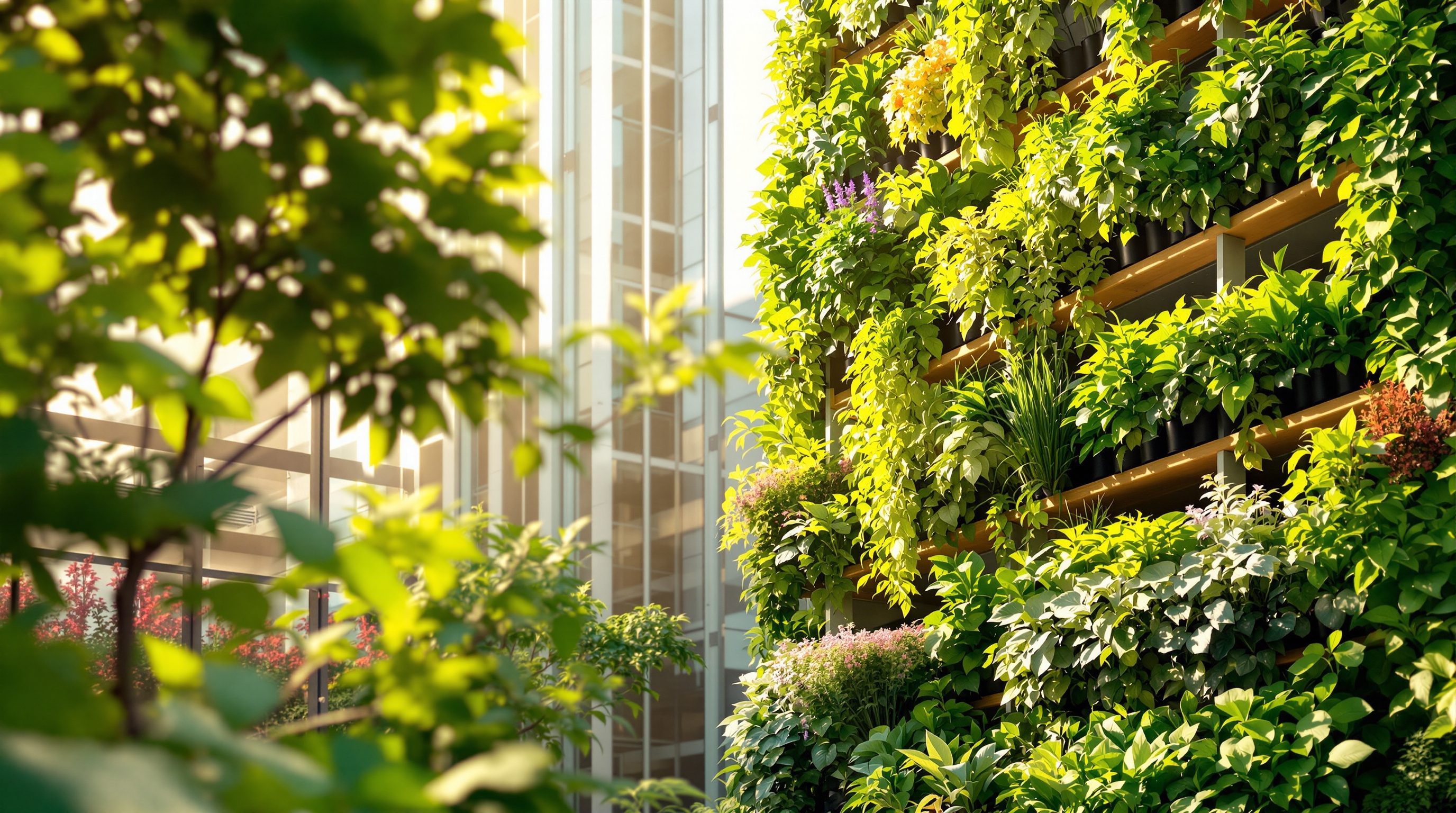
 Lesson 7.1
Lesson 7.1 · The Bigger Picture
Urban Food Systems
A rooftop farm is a hopeful thing, but a city is fed by a vast, layered food system stretching far beyond its walls - and knowing where building agriculture honestly fits in that picture, and how modest its realistic share is, is the difference between useful design and wishful thinking
A single glowing farm feels like the future of food. But how much of a city can a building actually feed?
It is easy, standing on a green rooftop full of lettuce, to feel that the food problem is being solved right here, that if every roof looked like this the city could feed itself. It is a lovely feeling, and it is almost entirely wrong at the scale of calories. A city is not fed by rooftops; it is fed by a vast, mostly invisible food system - millions of hectares of distant farmland, grain silos, cold chains, trucks, ports, wholesale markets and shops - that moves an enormous tonnage of grain, pulses, oil, vegetables, dairy and meat into the city every single day. The rooftop is real and it matters, but it is one small node in something immense.
This lesson asks you to zoom out from the single farm to the whole system, and to be honest about arithmetic. How much food can a city realistically grow on and in its buildings? The answer is a modest but genuine fraction - and, crucially, almost all of it is fresh produce (salad, herbs, vegetables, some fruit), not the staple grains and pulses that provide most of humanity's calories. Understanding that split, and understanding building agriculture's real place in a diverse, resilient urban food system rather than as a fantasy of self-sufficiency, is what separates a designer who helps from one who oversells.
Zoom out: city fed by a VAST distant food system. Building ag = one small node. Calories = rounding error; fresh produce = modest but real; biggest value = resilience through diversity. Not self-sufficiency.
What a food system actually is
Before we can place building agriculture, we have to see the thing it sits inside. A food system is the whole web of activities and actors that get food from where it grows to where it is eaten and beyond: production (farming, fishing, livestock), processing and storage (milling, packing, refrigeration, warehouses), distribution (transport, wholesale, logistics), retail (markets, shops, street vendors), consumption (households, canteens, restaurants), and the waste that leaks from every stage. It also includes the people, money, land, water, energy, policy and culture that hold it all together. It is one of the largest and most consequential systems humanity runs, and a modern city depends utterly on it.
The scale is worth feeling. A city of a few million people eats thousands of tonnes of food every day, most of it staples - rice, wheat, pulses, oil, sugar, potatoes - grown on farmland measured in thousands or millions of hectares, often hundreds of kilometres away, and moved in through supply chains that never stop. No amount of rooftop growing changes the order of magnitude of that flow. When you place a rooftop farm or an edible facade onto this picture, you are adding one small, local node to a colossal system - a node that can genuinely shorten the chain for *some* fresh produce and add local capacity, freshness and resilience, but that does not and cannot replace the system.
This is not a reason for gloom; it is a reason for clarity. Designers get into trouble when they confuse the node with the system - when a beautiful rooftop farm is sold, or believed, as 'the city growing its own food'. Seeing the whole food system first lets you make an honest, useful claim instead: that building agriculture strengthens a *part* of the system (local fresh produce, resilience, connection) without pretending to be the whole of it. Everything else in this lesson - how much a city can grow, where it fits, how to design for the system - follows from getting this scale right in your head first. Face the arithmetic, and the design gets better.
Food system = production -> processing -> distribution -> retail -> plate (+ waste at every step). Building ag = ONE small local node feeding in fresh produce. Node, not the whole system.
How much can a city actually grow?
Now the question everyone wants answered: if a city covered its roofs and facades with growing, how much of its food could it produce? The honest, well-studied answer is: a modest but real fraction - and overwhelmingly fresh produce, not staple calories. The reason splits neatly along the spectrum this course keeps returning to.
First, staples are ruled out almost entirely. Grains, pulses, roots and oil crops provide most of a city's calories, and they need vast areas of cheap sunlight and land to grow economically. You cannot grow a city's rice or wheat on its roofs; the area is nowhere near enough, and stacking staples under electric light is hopeless economics. So building agriculture's share of *staple calories* is close to zero, and honesty starts there.
Second, fresh produce is a genuinely different story. Vegetables, salad leaves, herbs and some fruit are light, fast, high-value and can be grown intensively in a small footprint - and here a city's roofs, terraces, facades and greenhouses can supply a meaningful share. Studies of cities with large flat roofs suggest that intensive rooftop and building growing could, in principle, cover a substantial part of a city's *vegetable* needs, though real-world figures are far lower once you subtract unsuitable roofs, structure limits, shading, cost and the fact that most roofs will never be farmed. Treat any headline percentage with care: it is illustrative, hugely context-dependent, and never a specification.
The honest summary is a two-part claim you can carry anywhere. On calories, building agriculture is a rounding error - it will not feed the city its staples, and anyone who says otherwise is selling something. On fresh produce, it is a modest but real and worthwhile contributor - capable of adding local, fresh vegetables, herbs and greens at a scale that genuinely matters for freshness, resilience and connection, even if it never dominates supply. Hold both halves at once. The mistake is to inflate the produce story into a calorie story, or to dismiss the whole thing because it cannot feed the city. It cannot feed the city - and it can still be well worth doing.
A place in a resilient food system
If building agriculture cannot feed the city, why bother framing it in food-system terms at all? Because a food system's health is not only about *quantity* - it is about resilience, and resilience comes from diversity of supply, exactly the thing building agriculture can add.
Modern urban food systems are extraordinarily efficient and extraordinarily concentrated: a handful of long supply chains, a few big distributors, produce grown far away in a few specialised regions. That efficiency is also fragility. A pandemic, a flood, a war, a fuel shock or a failed harvest in one distant region can empty shelves in a distant city within days, as the world saw repeatedly in recent years. A system with only one kind of supply has only one kind of failure.
Building agriculture, together with peri-urban farms, allotments, markets and home gardens, adds a local layer to the system - not to replace the distant farms but to sit alongside them, so that when one layer is disrupted others still function. A city that grows a real fraction of its fresh vegetables locally, that has a living culture of terrace and community growing, that has the skills and infrastructure to expand growing in a crisis, is more resilient than one wholly dependent on trucks arriving from far away. The value here is not the tonnage on a normal day; it is the buffering, the diversity and the latent capacity for a bad day.
There is also freshness and quality: local produce eaten hours after harvest is fresher and often more nutritious than produce that has travelled and been stored for a week, and shortening that particular chain genuinely helps for leafy, perishable crops. And there is flexibility: local growers can respond quickly to demand, grow unusual or culturally specific varieties, and cut waste from the long chain.
So the food-system case for building agriculture is honest and modest and real: it is a thin, useful layer that adds local fresh-produce capacity, freshness, diversity and resilience to a system that will always be dominated by distant staple farming. That is a genuinely worthwhile role - just not the role of feeding the city, which belongs, and will keep belonging, to the fields.
Resilience = diversity of supply. Layers: global staples / regional produce / city markets / building ag (thin local layer). Building ag buffers, adds freshness + latent capacity, does NOT replace distant farms.
Designing for the system, not the photo
What does all this mean for you at the drawing board? It means designing building agriculture to do the job it can honestly do, and measuring it by the right yardstick.
First, set honest goals. If the goal is fresh local vegetables, community connection, greening, cooling and resilience, building agriculture can deliver, and you should design and justify it on those terms. If the stated goal is 'making the building or the city self-sufficient in food', that goal is false and you should say so; it sets the project up to be judged a failure and feeds the hype that eventually discredits the whole field. Good design starts with a claim you can defend.
Second, prefer the layer that adds most for least. Across the whole system, the sun-powered forms - rooftop growing, terraces, greenhouses, edible planting - add local fresh-produce capacity, resilience and greening at low energy cost, which is exactly the food-system contribution that makes sense. Energy-hungry indoor farming adds the same fresh produce at a far higher energy and carbon price, so it earns a place in the system only in the narrow cases the course keeps flagging. When you think in food-system terms, the sun-powered bias gets even stronger, because the whole point is resilient, low-cost local capacity.
Third, connect the node to the system. A rooftop farm is more valuable when it plugs into local markets, kitchens, schools or community networks than when it is an isolated showpiece. Design for distribution, for who eats the food, for how it links to the surrounding city.
Finally, keep the boundary this course always keeps: the structural loads, waterproofing, water supply and drainage, and food-safety of any real growing system are binding engineering and regulatory questions that belong to qualified structural, services and food-safety engineers and horticultural specialists, verified data, and the governing codes and standards (the National Building Code of India, the relevant IS standards, and food-safety regulation). Any yield or share figure you cite is illustrative, not a specification. Your job is to place building agriculture honestly in the bigger food picture - a modest, real, resilient local layer - and to design it to deliver that, not a photo-op that promises to feed a city it never could.
The whole food system
What building agriculture sits inside
Production, processing, distribution, retail, consumption and waste - a vast, mostly distant system. Building agriculture is one small local node, never the whole. Frame every claim against the system. Module 7.1.
Calories vs fresh produce
The honest arithmetic of scale
Near-zero share of a city's staple calories; a modest but real share of fresh produce. Any headline percentage is illustrative and context-dependent, never a specification. Modules 7.1, 9.3.
Resilience through diversity
The real food-system value
A thin local layer that adds freshness, diversity and latent capacity, buffering a concentrated system that can fail in a crisis. Resilience, not self-sufficiency. Module 7.1.
Binding engineering deferred
Loads, water, food safety
Structural loads of wet growing systems, waterproofing, water supply, drainage and food safety belong to qualified structural, services and food-safety engineers and the codes (NBC India, IS, food-safety regulation). Modules 5, 6.4.
Workshop -- map a food onto the system
Building-agriculture literacy starts with seeing the whole system and being honest about scale. In this workshop you will trace where a real food comes from, then reason about how much of a city's food a building layer could honestly supply.
Just a meal, a city you know and a notebook. No calculation of real yields - that is context-dependent and belongs to verified data and specialists; this workshop builds the honest mental model of scale, and the binding engineering always stays with qualified engineers and food-safety specialists.
Goal: a felt grasp of the food system and building agriculture's honest share
Inputs: a city or neighbourhood you know + a recent meal + this lesson + a notebook
Time: ~40 minutes
- 1Trace one meal: pick a meal you ate and, for three or four items, note roughly where each was grown, how far it travelled, and how many stages (farm, processing, transport, market) it passed through.
- 2Sort by type: mark each item as a STAPLE (grain, pulse, root, oil) or FRESH PRODUCE (vegetable, salad, herb, fruit) - and notice that the staples dominate the calories and travel furthest.
- 3Ask what a building could grow: for the fresh-produce items only, judge which could plausibly be grown on a roof, terrace or greenhouse near you - and confirm the staples essentially could not.
- 4Estimate honestly: without pretending to precision, reason about whether building agriculture in your area could supply a rounding error, a modest share, or most of the city's fresh vegetables - and note it is essentially zero for staples.
- 5Write a one-paragraph reflection: what role building agriculture could honestly play in your city's food system (freshness, resilience, connection), what it cannot do (feed staple calories), and one thing you would want a specialist to confirm - flagged as reasoning.
You’ll walk away with
A one-page food-system read: one meal traced through the system, items split into staples vs fresh produce, an honest judgement of building agriculture's realistic share, and its true role framed as resilience and freshness rather than self-sufficiency.
Three altitudes on the same idea
Read the band that fits you — or all three.
Design building agriculture as a deliberate node in the urban food system, not a standalone spectacle - and be honest about its scale. On staple calories it is a rounding error; on fresh produce it can be a modest but real contributor; and its biggest system value is resilience through diversity of local supply. So set defensible goals (fresh produce, greening, cooling, resilience, connection - never 'self-sufficiency'), and prefer sun-powered rooftop, terrace and greenhouse growing, which add local capacity and freshness at low energy cost. Think about how the food actually reaches people - markets, kitchens, community - so the node connects to the system. And keep the binding work with the specialists: structural loads for wet, heavy growing systems, waterproofing, water supply and drainage, and food safety belong to qualified structural, services and food-safety engineers and horticultural specialists, verified data and the codes (NBC India, IS, food-safety regulation). Your contribution is a building that strengthens a real part of the city's food system, honestly claimed.
Even small interior and rooftop growing has a place in the food-system picture - as freshness, connection and resilience at a human scale, not as a food supply. A herb wall in a cafe, salad growing in a workplace, planters on a terrace: these shorten the chain for a few perishable, high-value crops and, more importantly, connect people to food and add a small local layer. Frame them honestly - a delightful, useful supplement, never 'growing our own food' - and design them to plug into real use (the kitchen that harvests the herbs, the staff who tend the beds). Understand that fresh, light, fast crops (herbs, salad, microgreens) are what interior growing does well, and that serious quantities need the energy-hungry, specialist territory the course is honest about. Coordinate water, drainage, weight, electrical and food-safety matters with the specialists and the codes; your domain is the fresh, living, connected interior that adds a genuine thread to the food system at the scale of a room.
Learn to zoom out from the single farm to the whole food system - it is the fastest way to sound competent instead of starry-eyed. A food system runs from production through processing, distribution, retail and consumption to waste, and a city depends on a vast, distant version of it. Building agriculture is one small local node in that system. The honest arithmetic: it cannot feed a city its staple calories (grains, pulses, roots need vast cheap sunlight), but it can supply a modest, real share of fresh produce (vegetables, herbs, salad) and, above all, add resilience through diversity of supply. So its role is a thin, useful local layer - freshness, resilience, connection - not self-sufficiency. Carry the two-part claim: rounding error on calories, real contributor on fresh produce. Prefer sun-powered forms because they add that local capacity cheaply. You are not expected to feed a city; you are expected to place building agriculture honestly in the bigger food picture and design it for the job it can really do.
“If we covered every roof and facade with farms, cities could grow their own food and become self-sufficient, breaking free of long supply chains and distant agriculture.”
Do it yourself
No tools needed -- reason it through.
- 1Name the main stages of a food system, from production to consumption and waste.
- 2Why can building agriculture supply a modest share of a city's fresh produce but essentially none of its staple calories?
- 3Explain why resilience in a food system comes from diversity of supply, and how building agriculture adds to it.
- 4What is wrong with framing a rooftop farm as 'the city growing its own food'?
- 5Why should any headline figure for how much a city could grow be treated as illustrative, not a specification?
The one line to carry out
Peer-reviewed journals & authoritative standards
- 01Food system — Wikipedia -- Food system, 2026.
- 02Food security — Wikipedia -- Food security, 2026.
- 03Urban agriculture — Wikipedia -- Urban agriculture, 2026.
- 04Staple food — Wikipedia -- Staple food, 2026.
- 05Local food — Wikipedia -- Local food, 2026.
Building agriculture's honest food-system role is modest on calories - so why do it at all? Often because its greatest value is not the food but the people: community, learning, wellbeing and connection. That is the next lesson.
The author
Amogh N P
Architect, interior designer, and creative polymath. Studio Matrx began in his notebooks — his vision of design made honest, useful, and open to everyone. Its Academy is written and taught in his memory, and free, forever.
More about Amogh →