
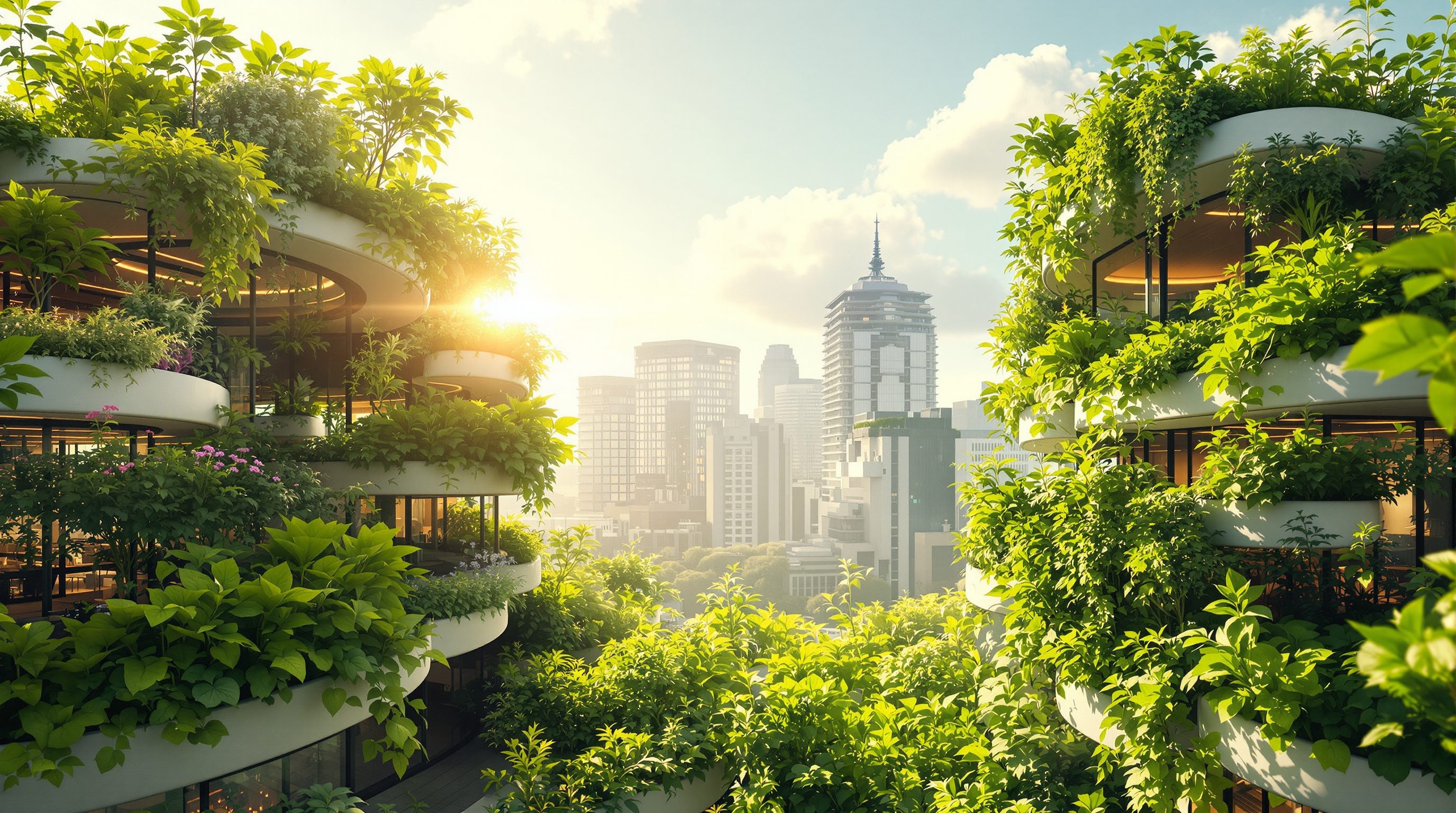
 Lesson 7.3
Lesson 7.3 · The Bigger Picture
Sustainability, Honestly
Growing food on buildings is wrapped in green claims, some true and some the opposite of true - and the only way to tell them apart is to drop the word 'sustainable' as a slogan, weigh the real benefits against the real costs across the whole life cycle, and accept that 'local' does not automatically mean 'green'
Is growing food on a building green? The honest answer is: it completely depends - and 'local' is not the answer you think it is.
Few phrases are used more loosely in this field than 'sustainable'. A glossy indoor vertical farm calls itself sustainable because the food is grown locally, uses little water and no pesticides and does not travel across the world. A rooftop garden calls itself sustainable because it is green and grows food. Both claims contain truth and both can be badly misleading, and the reason is that 'sustainable' has become a slogan that ends thought rather than a question that starts it.
This lesson refuses the slogan and does the honest weighing. Growing food in and on buildings has genuine sustainability benefits - greening and cooling the city, reusing water, greater biodiversity, wellbeing, and, for the right produce, a genuinely shorter chain. It also has genuine sustainability costs - above all the enormous energy of indoor lighting, but also the embodied carbon of the structures, pumps, plastics and systems a growing installation needs and must eventually replace. Whether any given project is net-good or net-bad depends entirely on which side is bigger, which depends on the design, the crop, the method and, decisively, on energy. And one myth has to go first: the idea that because food is grown locally it must be low-carbon. As you will see, 'local' is not automatically 'green' - sometimes it is the opposite - and learning to see past that single word is most of the skill.
Sustainability = weighing, not slogan. Kill food-miles myth: transport = small slice, so local != green; fossil-lit indoor salad can beat distant field for carbon. Benefits (greening/cooling/water/fresh) mostly sun-powered; costs (energy/embodied) mostly indoor. Life-cycle thinking. Sun-powered net-good; fossil indoor often net-bad.
Why 'local' is not automatically 'green'
The most seductive sustainability claim for building agriculture is that growing food where people eat it must be greener than shipping it across the world - it cuts the food miles, so it cuts the carbon. It sounds obviously true. It is often false, and understanding why is the foundation of thinking about this honestly.
The error is assuming transport dominates food's carbon footprint. For most foods it does not. When researchers break down the life-cycle emissions of a typical food item, the great majority usually comes from production - the farming itself: land use, fertiliser, machinery, livestock, energy on the farm - with processing and retail adding more, and transport often a surprisingly small slice, frequently well under a fifth and sometimes a tiny fraction. This means shortening the transport leg, which is what 'local' does, saves only a small part of the total, and can be completely swamped by differences in *how* the food was grown.
Now apply that to building agriculture. A tomato grown in a sun-powered rooftop greenhouse near the city may indeed be greener than one trucked from far away - the transport saving is real and it was grown with free sunlight. But a tomato or a bag of salad grown in an energy-hungry indoor vertical farm under electric grow-lights can easily carry *more* carbon than one grown in an open field far away and transported in, because the electricity used to replace the sun - especially if it comes from fossil fuels - produces far more emissions than the transport ever saved. The local, no-food-miles salad can be the higher-carbon salad. 'Local' told you nothing about that; only looking at *how it was grown* did.
This is why 'local' cannot be trusted as a proxy for 'green', and why the food-miles framing, though intuitive and popular, is misleading on its own. It is not that local is bad - for the right produce grown the right way it is genuinely better - it is that local is not *automatically* good, and the word hides the thing that actually matters, which is the production method and its energy. Drop the assumption, and you are ready to weigh building agriculture's sustainability properly: not by where it is grown, but by the real benefits and real costs of how it is grown, across the whole life cycle. That weighing is the rest of this lesson.
Food carbon: farming/land = big slice; processing/retail = some; TRANSPORT = often small. So cutting food miles saves little. Indoor grow-lights can add MORE carbon than transport saved. Local != automatically green.
The real benefits, named honestly
Building agriculture has genuine sustainability benefits, and an honest account names them clearly rather than dismissing them. The point of dropping the 'local equals green' myth is not to conclude that growing food on buildings is pointless, but to see the benefits that are actually real.
Greening and cooling is often the biggest and most reliable. A green roof or productive rooftop, an edible facade or living wall, adds vegetation to a hard city, and vegetation cools: it shades surfaces, and through transpiration it turns sunlight into water vapour rather than heat, easing the urban heat island that makes cities hotter than their surroundings. It insulates the roof below, cutting the building's cooling load, and it manages stormwater by soaking up rain. In a hot country like India, greening a bare, baking roof with productive planting is a real and valuable climate benefit quite apart from any food.
Water reuse is a second real benefit. Growing systems can be designed to use captured rainwater and treated greywater rather than mains supply, and closed hydroponic systems in particular can use far less water per crop than open-field irrigation because water is recirculated rather than lost to the ground. Used well, building agriculture can be part of a building's water-cycling strategy.
Shorter transport for the right produce is real too, once you remember it is a small slice: for perishable, local, sun-grown produce, cutting the chain genuinely saves some emissions and, as importantly, delivers fresher food with less spoilage and waste. Reduced food waste can follow from harvesting to order close to the eater. There are also biodiversity gains from green space in a hard city, and the wellbeing and biophilia benefits the previous lesson described, which are part of a broad, honest picture of sustainability that includes people, not only carbon.
Notice the pattern: almost all of these benefits - greening, cooling, stormwater, water reuse, fresher produce, biodiversity, wellbeing - are delivered most strongly by the sun-powered forms, which add vegetation and life to the building while the sun does the growing. They are real, they are worth designing for, and they are exactly why sun-powered building agriculture usually has a genuinely good sustainability case. The costs, which fall much more heavily on the indoor end, are the other half of the ledger - and the next section is honest about them.
The real costs, named honestly
An honest ledger names the costs as clearly as the benefits, and building agriculture has real ones - concentrated, as always in this course, at the energy-hungry indoor end.
The dominant cost is energy, the elephant this whole course keeps naming. A fully-indoor vertical farm replaces free sunlight with electric grow-lights and must also power cooling (lights make heat), dehumidification and pumps, which is enormously energy-intensive. That single fact governs indoor farming's whole sustainability picture: if the electricity is fossil-fuelled, the carbon from growing can dwarf everything the shorter transport saved, making the local indoor crop worse than the distant field crop; even with cleaner electricity, it is a heavy demand on a limited supply of low-carbon power that could displace fossil generation elsewhere. Energy is why indoor farming's green claims must be treated with the most scepticism, and why it is especially hard to justify in India, where electricity is often carbon-heavy and costly.
A second, less obvious cost is embodied carbon and materials. Any growing installation is built from stuff - structural strengthening to carry heavy wet growing systems, waterproofing, tanks, pumps, pipes, plastic troughs and trays, growing media, lighting and control gear - all of which carries embodied carbon in its manufacture and must be maintained and eventually replaced. A high-tech indoor farm is a factory's worth of equipment; even a rooftop garden has real material weight. These embodied and replacement costs are easy to forget when only operational energy is counted, but life-cycle honesty includes them.
There are further costs to weigh: the water and nutrients an intensive system consumes (real, though often lower per crop than field farming for closed systems); the plastics and waste many systems generate; and the opportunity cost of the money, energy and effort - which, spent on an energy-hungry indoor farm growing garnish, might have done far more good spent elsewhere.
The pattern mirrors the benefits, inverted: the costs, especially energy, fall most heavily on the fully-indoor forms, while the sun-powered forms carry mainly the modest, one-off embodied cost of their structures and systems. This is the same spectrum the course has drawn from the first page, now seen through a sustainability lens: sun-powered building agriculture tends to be net-good; fossil-lit indoor farming often net-bad. Which is why you cannot answer 'is it sustainable?' with a slogan - you have to weigh this ledger, for this project, across its whole life. That whole-life weighing is the final section.
Costs (heaviest indoor): ENERGY (lights + cooling + pumps; fossil = worse than distant field) + embodied carbon of structure/tanks/pumps/plastics + water/nutrients + plastic waste. Sun-powered = mostly modest embodied cost only.
Life-cycle thinking and the honest verdict
How do you actually decide whether a building-agriculture project is sustainable? By refusing the slogan and doing life-cycle thinking - weighing all the benefits against all the costs across the whole life of the system, from making it, through operating it, to replacing and disposing of it.
A proper life-cycle assessment (LCA) is a rigorous, specialist exercise: it draws a boundary around the whole system, counts the embodied impacts of materials and construction, the operational impacts of energy, water and nutrients, and the end-of-life impacts, and sets them against the yield and benefits delivered. You are not expected to perform one - it belongs to qualified specialists with verified data - but you are expected to *think* in its terms: to ask, for any project, what goes in over its whole life, what comes out, and whether the balance is genuinely good. Crucially, the boundary you draw changes the answer, which is exactly why single headline figures ('uses 95 percent less water', 'zero food miles') are so misleading - they report one favourable slice and hide the rest.
Thinking this way produces an honest, defensible verdict rather than a slogan, and it lands where the whole course has pointed. Sun-powered building agriculture - rooftop gardens and farms, edible facades, integrated greenhouses - generally has a genuinely good sustainability case: real greening, cooling, water and freshness benefits, modest one-off embodied costs, and little operational energy because the sun does the growing. It is usually net-positive and worth doing, and you can say so honestly. Fully-indoor vertical farming has a far harder case: real benefits on water, land and freshness, but a dominating energy cost that can make it net-negative, especially on fossil electricity and especially in India, so it is genuinely sustainable only in narrow conditions (clean cheap electricity, high-value crops, no alternative) and its green claims deserve real scrutiny.
The honest stance, then, is neither the marketing one ('growing food on buildings is obviously green') nor the cynical one ('it is all greenwash'), but the weighing one: name the real benefits, name the real costs, think across the whole life cycle, distrust 'local' and single-number claims, and reach a verdict for the specific project. Do that, and prefer sun-powered forms where they work, and building agriculture's sustainability sits on truth rather than slogan. As ever, the binding numbers - the actual LCA, the energy modelling, the structural and water engineering - belong to qualified specialists, verified data and the governing codes; your job is to think honestly and design toward the genuinely sustainable end of the spectrum.
Local is not automatically green
The food-miles myth
Transport is usually a small slice of food's carbon; production dominates. Cutting food miles saves little, and indoor grow-light energy can add more carbon than transport saved. How it was grown matters, not where. Module 7.3.
The real benefits
What building agriculture genuinely offers
Greening and cooling (urban heat island), roof insulation, stormwater, water reuse (rainwater, greywater), fresher produce and less waste, biodiversity, wellbeing - delivered mostly by sun-powered forms. Module 7.3.
The real costs
What must be counted against
Dominating operational energy for indoor lighting and cooling, embodied carbon of structures, tanks, pumps and plastics, water, nutrients, replacement and waste - falling mostly on the indoor end. Modules 7.3, 9.2.
Life-cycle assessment is specialist
Reaching an honest verdict
A proper LCA counts embodied, operational and end-of-life impacts across a defined boundary and belongs to qualified specialists with verified data; think in its terms, distrust single figures, and defer the binding numbers. Module 7.3.
Workshop -- weigh a project's honest sustainability ledger
Sustainability is a weighing, not a slogan. In this workshop you will take a building-agriculture idea and build its honest ledger - real benefits against real costs, across the whole life cycle - and reach a defensible verdict.
Just a project idea and a notebook. No real carbon figures to compute - a proper life-cycle assessment needs verified data and specialists; this workshop builds honest life-cycle reasoning, and the binding energy, LCA, structural and water numbers always stay with qualified specialists and the codes.
Goal: practise honest, life-cycle sustainability reasoning
Inputs: a building-agriculture idea (yours or from earlier modules) + this lesson + a notebook
Time: ~45 minutes
- 1State the green claim: write the sustainability claim the project would probably make ('local', 'no food miles', 'uses less water') - then set it aside as unproven.
- 2List the real benefits: greening and cooling, roof insulation, stormwater, water reuse, fresher produce and less waste, biodiversity, wellbeing - noting which apply to this project.
- 3List the real costs across the life cycle: operational energy (especially any grow-lights and cooling), embodied carbon of structure, tanks, pumps and plastics, water and nutrients, and replacement and waste.
- 4Test the food-miles myth: ask honestly whether this project's transport saving is large or small compared with its growing energy - and whether fossil electricity could make it worse than a distant field crop.
- 5Reach a verdict and reflect: judge whether the project is likely net-good or net-bad and why, note that a proper life-cycle assessment belongs to specialists, and write which binding figures (energy, LCA, structure, water) you would have confirmed - flagged as reasoning.
You’ll walk away with
A one-page honest sustainability ledger: the green claim set aside, real benefits and real life-cycle costs listed, the food-miles myth tested, a defensible net verdict, and the binding numbers flagged for specialists.
Three altitudes on the same idea
Read the band that fits you — or all three.
Refuse 'sustainable' as a slogan and weigh the real ledger across the whole life cycle. Drop the food-miles myth first: transport is usually a small slice of food's carbon, so 'local' is not automatically 'green' - an indoor salad under fossil-lit LEDs can carry more carbon than a distant field crop. Then weigh honestly. Real benefits (greening, cooling the urban heat island, roof insulation, stormwater and water reuse, fresher produce, biodiversity, wellbeing) fall mostly on the sun-powered forms. Real costs (dominating operational energy for indoor lighting and cooling, embodied carbon of structure, tanks, pumps and plastics, water, nutrients, replacement) fall mostly on the indoor end. Think in life-cycle terms - what goes in over the whole life, what comes out, and note the boundary you draw changes the answer, which is why single headline figures mislead. The verdict lands where the course points: sun-powered building agriculture is usually net-good; fossil-lit indoor farming often net-bad. Design toward the sustainable end, and leave the binding LCA, energy modelling and structural and water engineering to qualified specialists, verified data and the codes.
Bring green, edible planting into interiors for its genuine benefits - biophilia, freshness, wellbeing, connection - while being honest about the sustainability ledger. A herb wall or planted interior grows a little food and adds real wellbeing and greening value at low cost when it uses daylight or modest supplementary light. But be clear-eyed: a heavily lit indoor growing installation carries the same energy elephant at small scale, and the embodied materials (structure, tanks, pumps, plastics, lighting) all count over their life. So prefer daylit, low-energy, sun-assisted interior growing; treat energy-hungry lit systems as the specialist, harder-to-justify territory the course flags; and never let 'we grow our own herbs' become a green badge that hides an energy-hungry reality. Choose durable, repairable, low-embodied materials and design for water reuse where you can. Coordinate the binding water, drainage, electrical, weight and food-safety matters with the specialists and the codes; your domain is the living, healthy interior whose green claims are honest and modest.
Learn to weigh sustainability without illusion, starting by killing the myth that 'local' means 'green'. For most foods, transport is a small slice of the carbon footprint - farming dominates - so cutting food miles saves little, and an indoor salad grown under fossil-fuelled grow-lights can carry MORE carbon than one from a distant field. 'Local' hides the thing that matters: how it was grown, and its energy. Then weigh both sides honestly. Real benefits: greening and cooling (easing the urban heat island), roof insulation, stormwater management, water reuse via rainwater and greywater, fresher produce with less waste, biodiversity, wellbeing - mostly delivered by sun-powered forms. Real costs: the dominating energy of indoor lighting and cooling, plus the embodied carbon of structures, tanks, pumps and plastics that must be built, maintained and replaced - mostly at the indoor end. Use life-cycle thinking: judge the whole system, not one flattering number. The honest verdict: sun-powered building agriculture is usually net-good; fossil-lit indoor farming often net-bad. Distrust slogans and single figures; the binding LCA belongs to specialists.
“Food grown locally on buildings is obviously more sustainable than food shipped in from far away - it has almost no food miles, uses less water and no pesticides, so it must be greener and lower-carbon.”
Do it yourself
No tools needed -- reason it through.
- 1Explain why transport is usually a small part of a food's carbon footprint, and what follows for 'local' food.
- 2Give an example of how a local, zero-food-miles crop could be higher-carbon than a distant field crop.
- 3Name four genuine sustainability benefits of building agriculture and say which forms deliver them most.
- 4Name the main sustainability costs of building agriculture and say which end of the spectrum they fall on.
- 5What is life-cycle thinking, and why does the boundary you draw change the sustainability answer?
The one line to carry out
Peer-reviewed journals & authoritative standards
- 01Life-cycle assessment — Wikipedia -- Life-cycle assessment, 2026.
- 02Food miles — Wikipedia -- Food miles, 2026.
- 03Sustainable agriculture — Wikipedia -- Sustainable agriculture, 2026.
- 04Local food — Wikipedia -- Local food, 2026.
- 05Green roof — Wikipedia -- Green roof, 2026.
Even where building agriculture is genuinely sustainable, one hard question remains: who does it actually serve? Sustainability is not the same as justice, and the next lesson faces the equity and access dimension honestly.
The author
Amogh N P
Architect, interior designer, and creative polymath. Studio Matrx began in his notebooks — his vision of design made honest, useful, and open to everyone. Its Academy is written and taught in his memory, and free, forever.
More about Amogh →