
B.Arch CurriculumFree, forever
A tribute to Amogh N P
Industrial Architecture
India needs tens of millions of homes, and it cannot build them one brick at a time, on time. This elective is the answer the construction industry borrowed from the factory: the INDUSTRIALISED BUILDING SYSTEM — designing a building as a kit of standardised components that are manufactured under factory control, transported, and assembled on site like a product. Learn why the housing problem drives the whole subject; how a building system is judged and where it pays; the discipline of MODULAR COORDINATION that lets parts fit without cutting; the spectrum of PREFABRICATION from a single precast beam to a whole room-sized module; and the real procedures, joints, transport and trade-offs of building this way. This is architecture as manufacturing — its promise of speed, quality and scale, and its hard constraints of repetition, jointing and logistics. Conventional construction is a companion subject; here the building is a product.
Course byAmogh N P· Architect & interior designer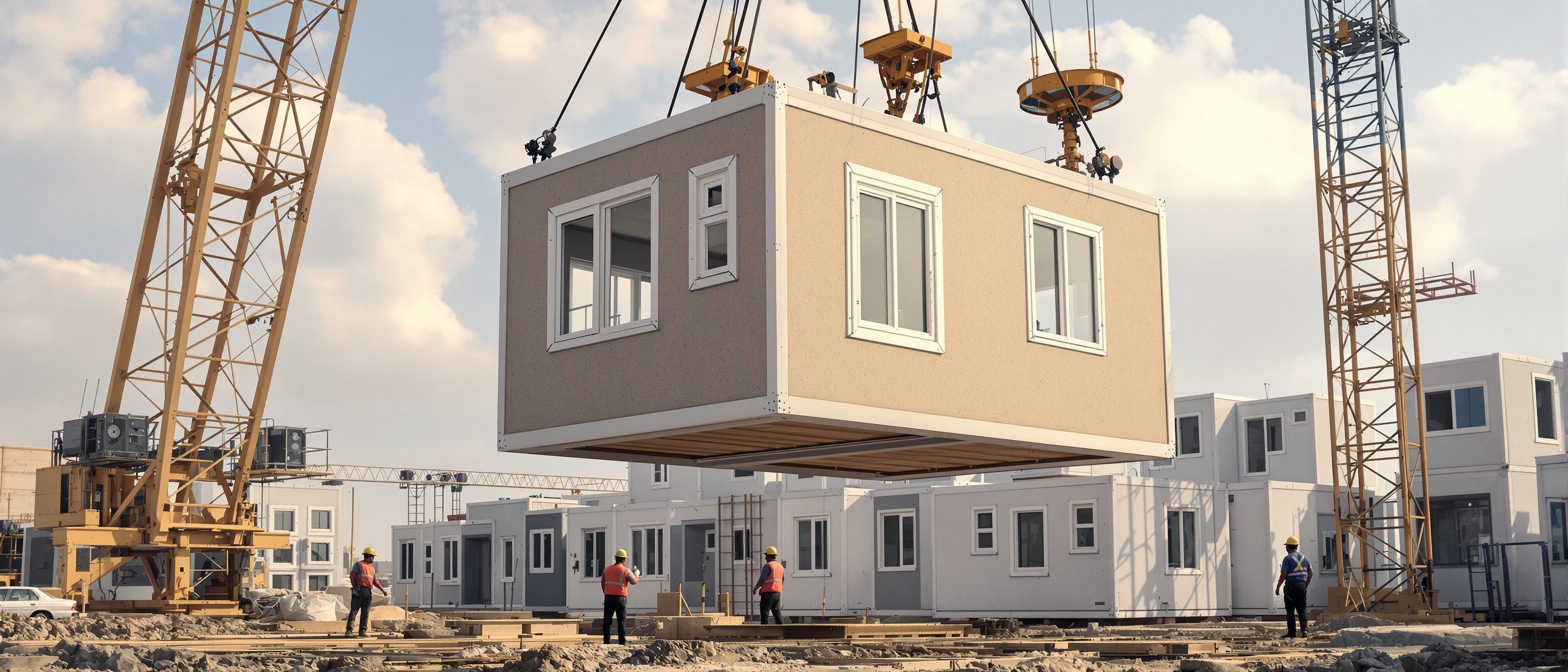
Five units — from the housing problem to the assembly line.
5 units · 5 liveTranscribed from the official B.Arch syllabus. All 5 units are live as full interactive lessons, each with original diagrams, a self-assessment quiz and a studio task.
Unit 1 — Introduction
LiveThe housing problem that drives the whole subject — the Five-Year-Plan thrust on housing and the issues of urban housing; the use of modern building materials and modern technology; and the meaning of an 'industrial building system' — building by manufacturing components rather than by hand on site.
Unit 2 — Application of the System
LiveWhere the industrialised building system actually fits — its feasibility in residential and non-residential buildings; the manufacturing of building components; the technology requirements an industrialised system demands; and its use as an option for rapid disaster mitigation and rehousing.
Unit 3 — Modular Coordination
LiveThe dimensional discipline that makes industrialisation possible — the concept of modular coordination and the basic module; the advantages and limitations of the modular principle; the components of residential buildings; and precast elements that fit a coordinated grid.
Unit 4 — Prefabrication System
LiveThe heart of the subject — the objective and necessity of prefabrication; the spectrum from off-site to on-site prefabrication; the prefabricated elements and the construction JOINTS that connect them; and the architectural and technical limitations that industrialisation imposes.
Unit 5 — Procedures & Organisation
LiveBuilding as a manufacturing process — the equipment used; the manufacturing processes for components; the transportation of components to site; on-site assembly and finishing; and the structural, social and economic issues that decide whether an industrialised building system succeeds.
Course outcomes
What you will be able to doExplain the industrialised building system and why housing demand drives it.
Judge the feasibility of an industrialised building system for a project.
Apply modular coordination and identify precast residential components.
Explain the prefabrication spectrum, off-site/on-site work and construction joints.
Describe the procedures — manufacture, transport, assembly — and the trade-offs.
Conceive a large-scale building using an industrialised building system.
The author
Amogh N P
Architect, interior designer, and creative polymath. Studio Matrx began in his notebooks — his vision of design made honest, useful, and open to everyone. Its Academy is written and taught in his memory, and free, forever.
More about Amogh →A building as a product.
The housing driver, feasibility, modular coordination, prefabrication and the supply chain. Read the five units, study the diagrams, then test yourself.
The curriculum is free, forever