
Procedures & Organisation
Manufacture, transport, assemble — building as a supply chain.
Industrialised building is a manufacturing and logistics operation as much as a design. Learn the procedures that turn a design into a building: the equipment and manufacturing processes; the transportation of large, heavy parts from factory to site (the constraint that often decides the system); on-site assembly and finishing; and the structural, social and economic issues that decide whether an industrialised system succeeds.
Learning objectives
By the end of this lesson, you will be able to — mapped to the course outcomes for Industrial Architecture:
Describe the equipment and manufacturing processes for components.
Explain the transportation and assembly of components.
Weigh the structural, social and economic issues of an IBS.
See industrialised building as a supply chain.
Manufacture, transport, assemble
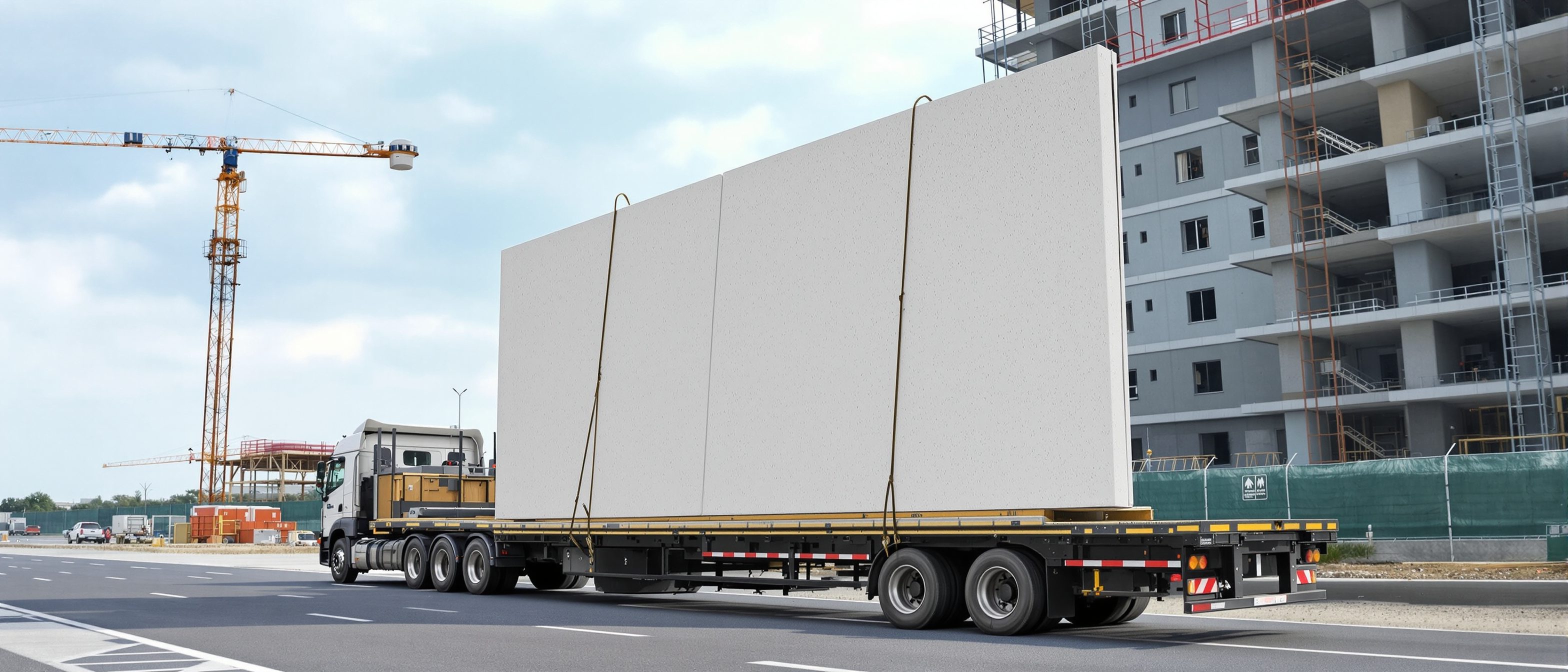
It starts in a factory — moulds, casting, curing, run in parallel for volume — then becomes a supply chain to site; transport and cranage limits often decide the whole system, not just design.[1, 2]
The factory side
Industrialised building starts in a FACTORY or casting yard. The EQUIPMENT: MOULDS (the most important tool — accuracy and repeatability come from them), batching and mixing plants, vibration and curing systems, and lifting GANTRIES. The MANUFACTURING process for a precast element runs: prepare the mould → place reinforcement (and stress it, if prestressed) → cast and compact concrete → CURE (often accelerated with steam) → demould → store and quality-check. Volume comes from running this cycle on many moulds in parallel. The factory's discipline is what gives prefab its quality edge over the weather-exposed site.[1, 2]
What decides success
Success turns on the engineering of connections and robustness (the Ronan Point lesson), the social shift of labour and livability, and the economics of volume; the goal is never maximum prefab but the right degree, often a hybrid.[2, 3]
What decides success
Whether an industrialised building system SUCCEEDS turns on three issues. STRUCTURAL: the engineering of CONNECTIONS, robustness, and resistance to progressive collapse (a lesson from the 1968 Ronan Point panel collapse, which reshaped precast jointing). SOCIAL: it shifts work from site labour to factory labour and skilled assembly — changing the workforce, sometimes resisted, and it must still produce homes people want to live in, not barracks. ECONOMIC: it pays only with VOLUME and REPETITION to amortise the high fixed cost; without them it is dearer than conventional building. MISCONCEPTION→correct: 'IBS is purely a technical choice' — its success is as much social and economic as structural.[2, 3]
At a glance
| Aspect | Detail | Note |
|---|---|---|
| Factory side | Moulds, casting, curing | Repeatable accuracy |
| The chain | Manufacture → transport → assemble | → finish |
| Often decisive | Transport & cranage | Not just design |
| Structural lesson | Connections & robustness | (Ronan Point, 1968) |
| Success needs | Volume + repetition + frozen design | Match system to need |
Key terms
The most important factory tool — accuracy and repeatability come from it.
Controlled (often steam-accelerated) hardening of cast concrete components.
Industrialised building as manufacture → transport → assembly → finish.
Road size/weight limits that often decide the system and component size.
The structural issue — joints and resistance to progressive collapse.
Matching prefab to the repetition and need — often a hybrid.
Studio task
Trace one precast wall panel from mould to finished wall — list each step from manufacture to finishing, and at each, note one thing that could go wrong. Then write three sentences on why an industrialised housing scheme can still fail for social or economic reasons even when the engineering is sound.
Self-assessment
1. The most important tool that gives prefabrication its accuracy and repeatability is the —
2. A factor that often decides the whole industrialised system is —
3. The 1968 Ronan Point collapse is remembered in this field because it —
Recap
References & further reading
- [1]Indian Concrete Institute, Industrialized Building Construction (Proceedings) — equipment and manufacturing processes.
- [2]Albert G. H. Dietz, Industrialized Building Systems for Housing (MIT) — procedures, logistics and the issues of success.
- [3]Studies of the Ronan Point collapse (1968) and progressive collapse — structural lessons for precast jointing.
Further reading
- Albert G. H. Dietz — Industrialized Building Systems for Housing (MIT).
- Indian Concrete Institute — Industrialized Building Construction.
- Henrik Nissen — Industrial Building and Modular Design.
Sources gathered and fact-checked June 2026. Published values vary by source, sample and method — treat as indicative and confirm against the cited standard before structural use.
The author
Amogh N P
Architect, interior designer, and creative polymath. Studio Matrx began in his notebooks — his vision of design made honest, useful, and open to everyone. Its Academy is written and taught in his memory, and free, forever.
More about Amogh →