
Application of the System
Where it fits, what it needs, and disaster relief.
An industrialised building system pays only where its logic fits. Learn the feasibility of using a system — the volume, repetition and speed that make a factory worthwhile; the manufacturing of components and the technology requirements a system demands; and one of its most valuable uses — rapid disaster mitigation, rehousing people in days, not years. Try the IBS-suitability checker.
Learning objectives
By the end of this lesson, you will be able to — mapped to the course outcomes for Industrial Architecture:
Judge the feasibility of an industrialised system for a project.
Explain the manufacturing of building components.
Identify the technology requirements an industrialised system demands.
Explain IBS as an option for disaster mitigation.
When it pays
An industrialised system has a high fixed cost, so it pays only with volume, repetition and a need for speed; a one-off bespoke building is the worst case, mass housing the best.[2]
Volume, repetition, speed
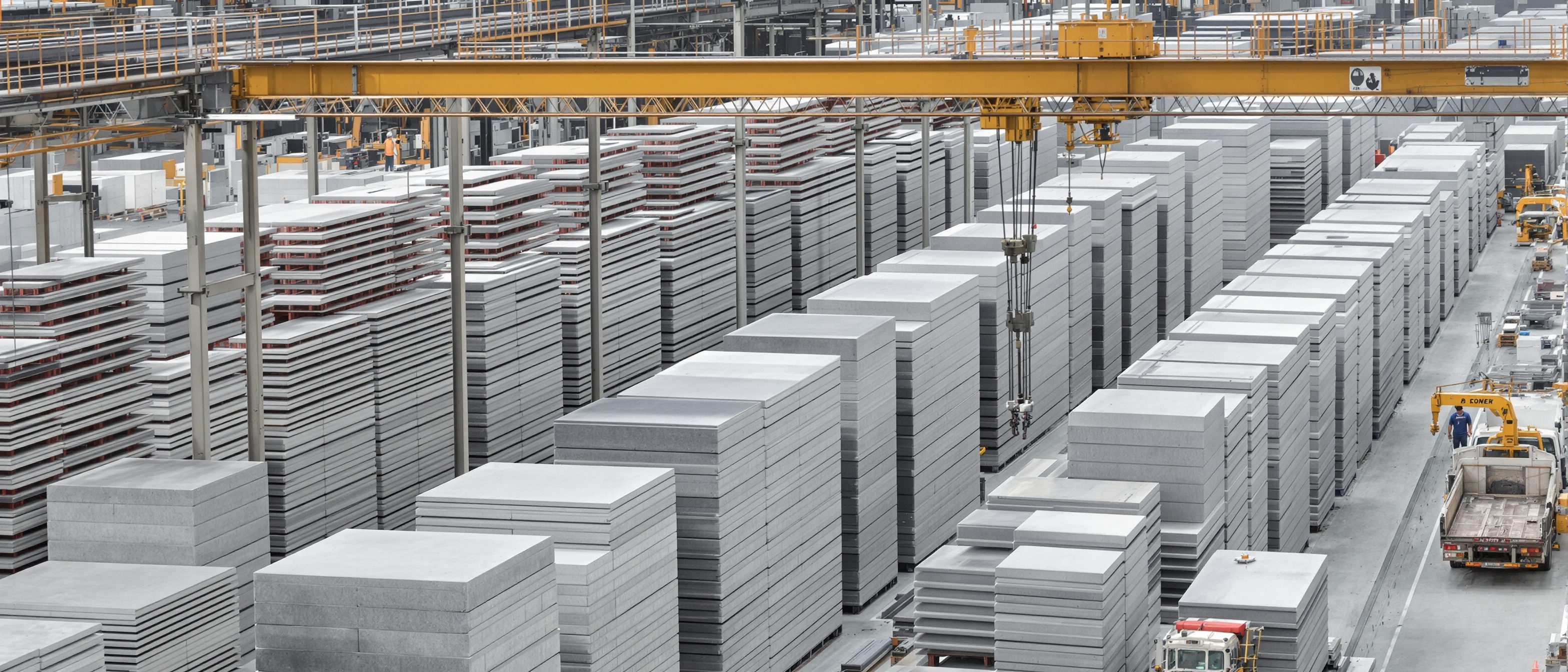
An industrialised building system carries a HIGH FIXED COST — the factory or casting yard, the moulds, the cranes, the logistics — so it pays only when that cost is spread over enough work. The three conditions that make it feasible: VOLUME (many units), REPETITION (the same component made again and again, so the mould earns its keep), and a need for SPEED. A one-off bespoke house is the WORST case for IBS; a thousand identical flats is the best. MISCONCEPTION→correct: 'prefab is always cheaper' — for a single, irregular building it is usually DEARER; IBS economics need scale and repetition. The checker below tests this logic.[2]
Check the suitability
Set the number of units, the repetition and the schedule pressure, and see whether an industrialised building system is favourable, marginal or unfavourable — and why a one-off building fails the test.
Does an industrialised system pay here?
Borderline — consider a hybrid: prefab the repeated parts, build the unique ones conventionally.
IBS has a high fixed cost — it needs volume, repetition and speed to pay. A one-off building is the worst case.
Technology & disaster relief
An industrialised system demands a whole ecosystem — factory, moulds, cranes, transport, skilled assembly and early frozen design; and it is a powerful disaster-mitigation tool, rehousing families in days.[1, 3]
What a system demands
An industrialised system is not just a design choice; it demands an ECOSYSTEM. You need a FACTORY or casting yard (with quality control), MOULDS for each repeated component, CRANES and handling equipment, TRANSPORT able to carry large components on real roads, a SKILLED ASSEMBLY crew, and — above all — DESIGN DISCIPLINE: the design must be frozen early and coordinated to the system, because you cannot easily change a component once the mould is cut. MISCONCEPTION→correct: 'we can decide the prefab later' — IBS forces decisions EARLY; late design changes that are cheap in site construction are very expensive once tooling exists.[2, 4]
At a glance
| Aspect | Detail | Note |
|---|---|---|
| IBS pays when | Volume + repetition + speed | Spreads the fixed cost |
| Worst case | A one-off bespoke building | Usually dearer than site-built |
| Best fit | Mass housing, hostels, hospitals | Repeated units |
| Demands | Factory, moulds, cranes, transport | + early frozen design |
| Special value | Disaster rehousing in days | Durable, not just tents |
Key terms
Whether volume, repetition and speed justify the system's high fixed cost.
Many units and a repeated component — what makes a mould and factory pay.
Programmes (housing, hostels, hospitals) with a unit repeated many times.
A prefab repetitive core with conventionally-built special elements.
Factory, moulds, cranes, transport, skilled assembly, early design discipline.
Prefab components to rehouse people in days after a disaster.
Studio task
Use the checker on two briefs: a 600-flat housing colony (high repetition, tight schedule) and a one-off art museum. Note each verdict and explain it. Then describe how you would use prefabrication to rehouse 200 families within two weeks after a flood — what is made, where, and how it reaches the site.
Self-assessment
1. An industrialised building system pays best when the project has —
2. Compared with conventional construction, IBS forces design decisions —
3. A valuable special application of prefabrication is —
Recap
References & further reading
- [1]BMTPC / NDMA — prefabrication and rapid construction for housing and disaster rehousing in India.
- [2]Albert G. H. Dietz, Industrialized Building Systems for Housing (MIT) — feasibility, economics and applications.
- [3]Global Housing Technology Challenge–India (GHTC-India) — proven industrialised technologies for mass housing.
- [4]Indian Concrete Institute, Industrialized Building Construction (Proceedings) — technology requirements.
Further reading
- Albert G. H. Dietz — Industrialized Building Systems for Housing (MIT).
- Indian Concrete Institute — Industrialized Building Construction.
- BMTPC — compendium of prefab / emerging construction technologies.
Sources gathered and fact-checked June 2026. Published values vary by source, sample and method — treat as indicative and confirm against the cited standard before structural use.
The author
Amogh N P
Architect, interior designer, and creative polymath. Studio Matrx began in his notebooks — his vision of design made honest, useful, and open to everyone. Its Academy is written and taught in his memory, and free, forever.
More about Amogh →