
Modular Coordination
The dimensional discipline that lets parts fit.
Prefabrication only works if the parts fit — and that needs a shared dimensional language. Learn modular coordination: designing to a basic module (internationally 100 mm, "M") and a grid of its multiples so components made separately fit without cutting; the advantages and limitations of the modular principle; the standardised components of a residential building; and the precast elements that populate a coordinated grid.
Learning objectives
By the end of this lesson, you will be able to — mapped to the course outcomes for Industrial Architecture:
Explain modular coordination and the basic module.
Weigh the advantages and limitations of the modular principle.
Identify the standardised components of a residential building.
Recognise the common precast elements.
The dimensional discipline
Modular coordination designs to a basic module (100 mm, "M") and a grid of its multiples, so separately-made parts coordinate without cutting; it brings standardisation, but risks rigidity and monotony.[1, 2]
A shared dimensional language
MODULAR COORDINATION is the dimensional discipline that lets prefabricated parts fit. It works from a BASIC MODULE — internationally the 100 mm module, written 'M' — and lays out the building on a GRID of its multiples (and sub-multiples for fine work). Every component is sized to the grid, so a slab, a panel and a column made separately all COORDINATE without cutting or packing. It is the same idea as a standard screw thread: agree the dimensions once, and parts become interchangeable. MISCONCEPTION→correct: 'the module is the size of a brick or a room' — the basic module (100 mm) is a small coordinating UNIT; rooms and components are multiples of it, not the module itself.[1, 2]
Components & precast elements
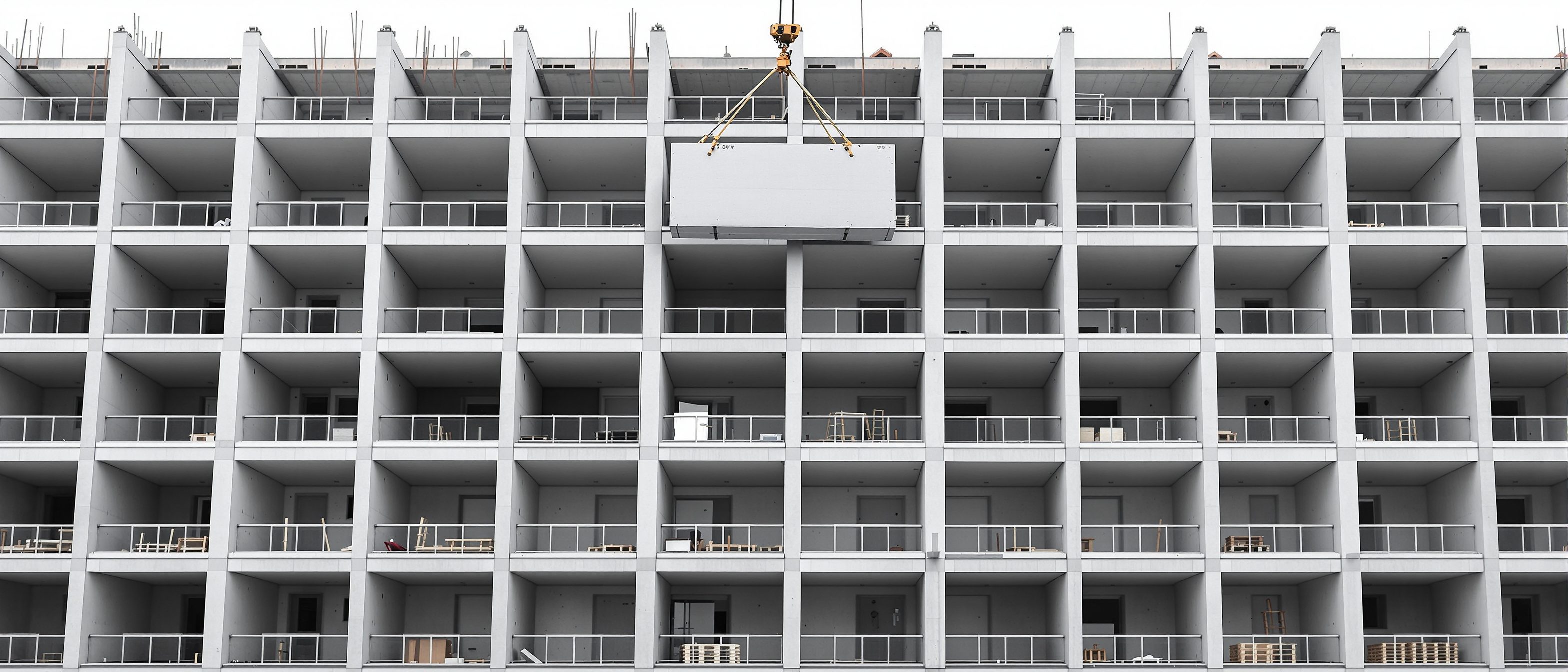
A residential building is a few repeated components — frame or wall panels, slabs, partitions, stairs, service pods; and the precast family (columns, beams, hollow-core slabs, panels), often prestressed, is the workhorse of industrialised concrete building.[2, 4]
The repeated parts
A residential building, seen as a system, is made of a few REPEATED COMPONENTS: the structural FRAME (columns and beams) or load-bearing WALL PANELS, FLOOR / roof slabs, internal PARTITIONS, STAIRCASES, and service cores (often a prefabricated bathroom/kitchen 'pod'). Because a housing block stacks the same flat many times, these few components are made over and over — which is exactly what makes the factory worthwhile. Identifying the repeated component is the first design move in an industrialised housing project.[2]
At a glance
| Aspect | Detail | Note |
|---|---|---|
| Basic module | 100 mm (M) | The coordinating unit |
| Design sits on | A grid of module multiples | Parts coordinate by design |
| Advantage | Standardisation, interchange | Fewer sizes, faster, fewer errors |
| Limitation | Rigidity, monotony risk | Vary within the grid to avoid it |
| Precast family | Columns, beams, slabs, panels | Designed to the grid |
Key terms
Designing to a shared dimensional grid so parts fit without cutting.
The coordinating unit — internationally 100 mm; components are multiples of it.
A grid of module multiples that the whole design and its parts sit on.
Standardised parts that fit anywhere on the grid — the modular payoff.
A component (column, beam, slab, panel) cast in a mould and lifted into place.
Tensioning steel before casting so a precast member spans further and slimmer.
Studio task
Lay out a one-room-wide flat on a planning grid in multiples of the 100 mm module — pick sensible modular dimensions for the room, the door and the window so they all coordinate. Then list the precast elements you would use to build it, and say one thing you would do to keep a hundred of these flats from looking monotonous.
Self-assessment
1. The internationally agreed basic module for modular coordination is —
2. The main payoff of modular coordination is —
3. 'Precast is only for grey utilitarian buildings' is —
Recap
References & further reading
- [1]ISO modular coordination standards — the basic module (M = 100 mm) and the planning grid.
- [2]Henrik Nissen, Industrial Building and Modular Design — modular coordination and its trade-offs.
- [3]National Building Code of India — modular coordination and standardisation (relevant parts).
- [4]PCI / precast-concrete handbooks — precast and prestressed elements and connections.
Further reading
- Henrik Nissen — Industrial Building and Modular Design.
- Albert G. H. Dietz — Industrialized Building Systems for Housing (MIT).
- Precast/Prestressed Concrete Institute (PCI) — Design Handbook.
Sources gathered and fact-checked June 2026. Published values vary by source, sample and method — treat as indicative and confirm against the cited standard before structural use.
The author
Amogh N P
Architect, interior designer, and creative polymath. Studio Matrx began in his notebooks — his vision of design made honest, useful, and open to everyone. Its Academy is written and taught in his memory, and free, forever.
More about Amogh →