
Introduction
The housing problem — and building as manufacturing.
This whole subject answers a number too big to build by hand — India's housing shortage. Learn how the national housing thrust (Five-Year Plans, PMAY) created a demand conventional, slow construction cannot meet; the issues of urban housing that push toward a factory answer; the role of modern materials and technology; and the core idea of an industrialised building system — designing a building as a kit of standardised parts made in a factory and assembled on site.
Learning objectives
By the end of this lesson, you will be able to — mapped to the course outcomes for Industrial Architecture:
Explain how the housing problem drives industrialised building.
Describe the issues of urban housing that push toward a factory answer.
Define an industrialised building system and its core idea.
Explain the role of modern materials and technology.
The housing problem
Industrialised building exists because demand outpaces hand-built supply; the issues of urban housing — cost, speed, quality, labour, waste — all push toward a factory answer.[1]
A number too big to build by hand
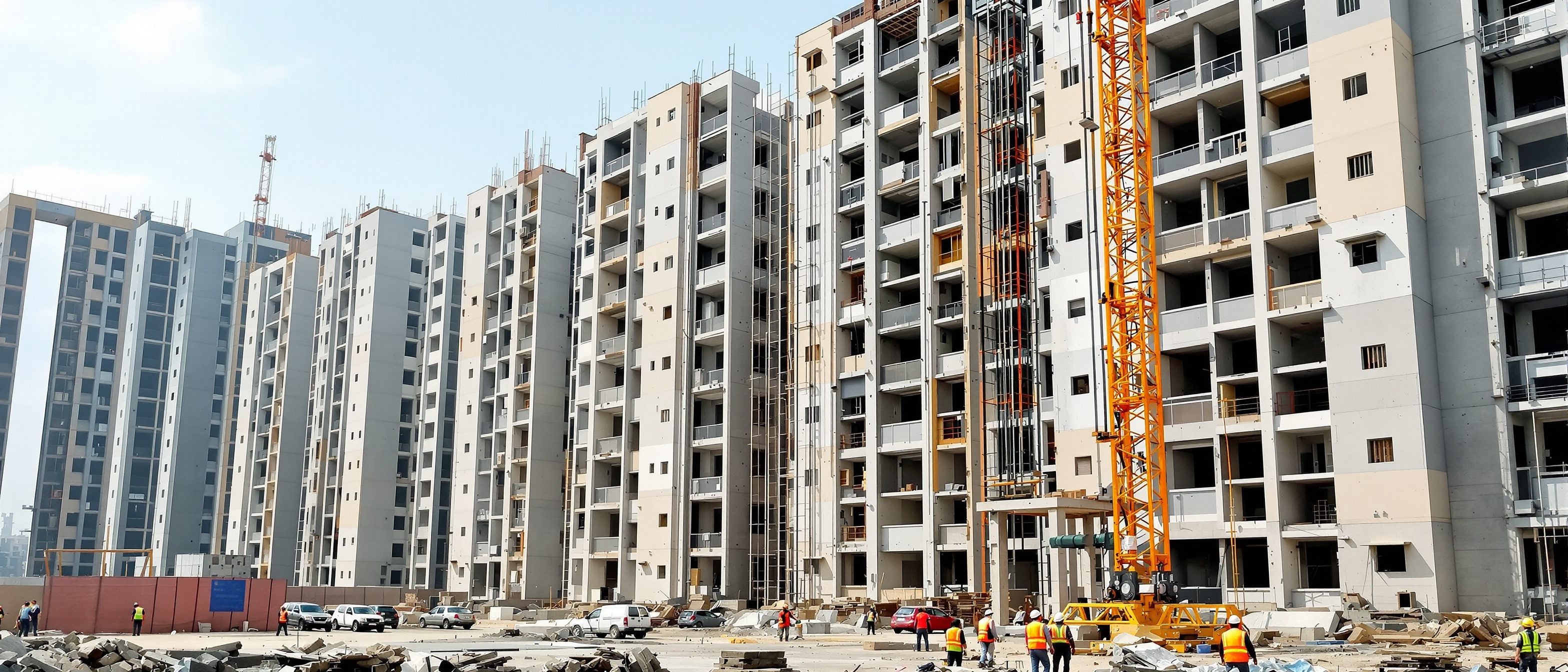
Industrialised building exists because of a NUMBER: India's urban housing shortage runs to many millions of units, and the national thrust on housing — across the FIVE-YEAR PLANS and missions like PRADHAN MANTRI AWAS YOJANA (PMAY) — demands homes at a speed and scale that conventional, hand-built, site-by-site construction simply cannot deliver on time. When you must build a million homes quickly, you stop building each one as a craft object and start MANUFACTURING them. MISCONCEPTION→correct: 'industrialised building is just a style choice' — it is a RESPONSE to a demand-and-speed problem that ordinary construction cannot solve.[1, 3]
A building as a kit of parts
An industrialised building system makes components in a factory, transports them, and assembles them on site — a building as a product; modern materials and technology are what make a kit of parts possible.[2, 4]
A building as a kit of parts
An INDUSTRIALISED BUILDING SYSTEM (IBS) is a way of building in which the components are MANUFACTURED (often in a factory, under controlled conditions), TRANSPORTED to site, and ASSEMBLED there — rather than being made by hand, wet, in place. The building is designed as a KIT of standardised, repeatable PARTS — columns, beams, slabs, wall panels, whole room modules — that fit together by design. It moves construction from a craft on site toward a PRODUCT off site. MISCONCEPTION→correct: 'prefab means low quality' — factory control usually yields HIGHER, more consistent quality than wet site work; the prejudice is a hangover from early, crude post-war prefab.[2]
At a glance
| Aspect | Detail | Note |
|---|---|---|
| Driver | The housing shortage | Speed + scale demand |
| Conventional building | Hand-built, wet, on site | Slow, variable quality |
| Industrialised (IBS) | Factory parts, assembled | Fast, consistent, scalable |
| Building is | A kit of standardised parts | A product, not a one-off |
| Made possible by | Modern materials + tech | Precast, steel, cranes, BIM |
Key terms
Building from factory-manufactured, transported, site-assembled components.
The national drive (Five-Year Plans, PMAY) for homes at speed and scale.
Cost, speed, quality, labour and waste — what pushes toward a factory answer.
A building designed as standardised, repeatable components that fit by design.
Moving construction from a hand-built site craft to a manufactured product.
Precast/prestressed concrete, steel, panels — what makes a kit possible.
Studio task
Find one real mass-housing project in India built with prefabrication or an industrialised system (a GHTC-India light-house project is a good start). In three sentences, explain what housing problem it answers, what makes it "industrialised" rather than conventional, and one modern material or technology it relies on.
Self-assessment
1. The fundamental reason industrialised building systems exist is —
2. An industrialised building system designs a building as —
3. 'Prefab means low quality' is —
Recap
References & further reading
- [1]BMTPC / Ministry of Housing — India's housing shortage, the housing missions (PMAY) and construction technology.
- [2]Albert G. H. Dietz, Industrialized Building Systems for Housing (MIT) — the concept and rationale of IBS.
- [3]Global Housing Technology Challenge–India (GHTC-India) — alternative/industrialised construction for mass housing.
- [4]Henrik Nissen, Industrial Building and Modular Design — modern materials and the industrialised approach.
Further reading
- Albert G. H. Dietz — Industrialized Building Systems for Housing (MIT).
- Henrik Nissen — Industrial Building and Modular Design.
- Indian Concrete Institute — Industrialized Building Construction (Proceedings).
Sources gathered and fact-checked June 2026. Published values vary by source, sample and method — treat as indicative and confirm against the cited standard before structural use.
The author
Amogh N P
Architect, interior designer, and creative polymath. Studio Matrx began in his notebooks — his vision of design made honest, useful, and open to everyone. Its Academy is written and taught in his memory, and free, forever.
More about Amogh →