
Prefabrication System
From a precast beam to a whole room — and the joints.
Prefabrication is the heart of the subject. Learn its objective — speed, quality, scale, less site labour; the spectrum from a single precast component, through flat panels, to whole 3D room modules and complete buildings; the divide between off-site and on-site work; the all-important construction joints — wet and dry — that decide a system's strength and watertightness; and the limitations industrialisation imposes. Try the prefabrication-spectrum explorer.
Learning objectives
By the end of this lesson, you will be able to — mapped to the course outcomes for Industrial Architecture:
Explain the objective and necessity of prefabrication.
Place a system on the prefabrication spectrum (component to module).
Distinguish off-site from on-site work and explain construction joints.
Weigh the architectural and technical limitations of prefabrication.
The prefabrication spectrum
Prefabrication runs along a spectrum — component, panelised, volumetric, complete — and moving up it means more factory work, faster erection, but less flexibility; off-site work runs in parallel with site work, so total time falls.[2]
Degrees of prefabrication
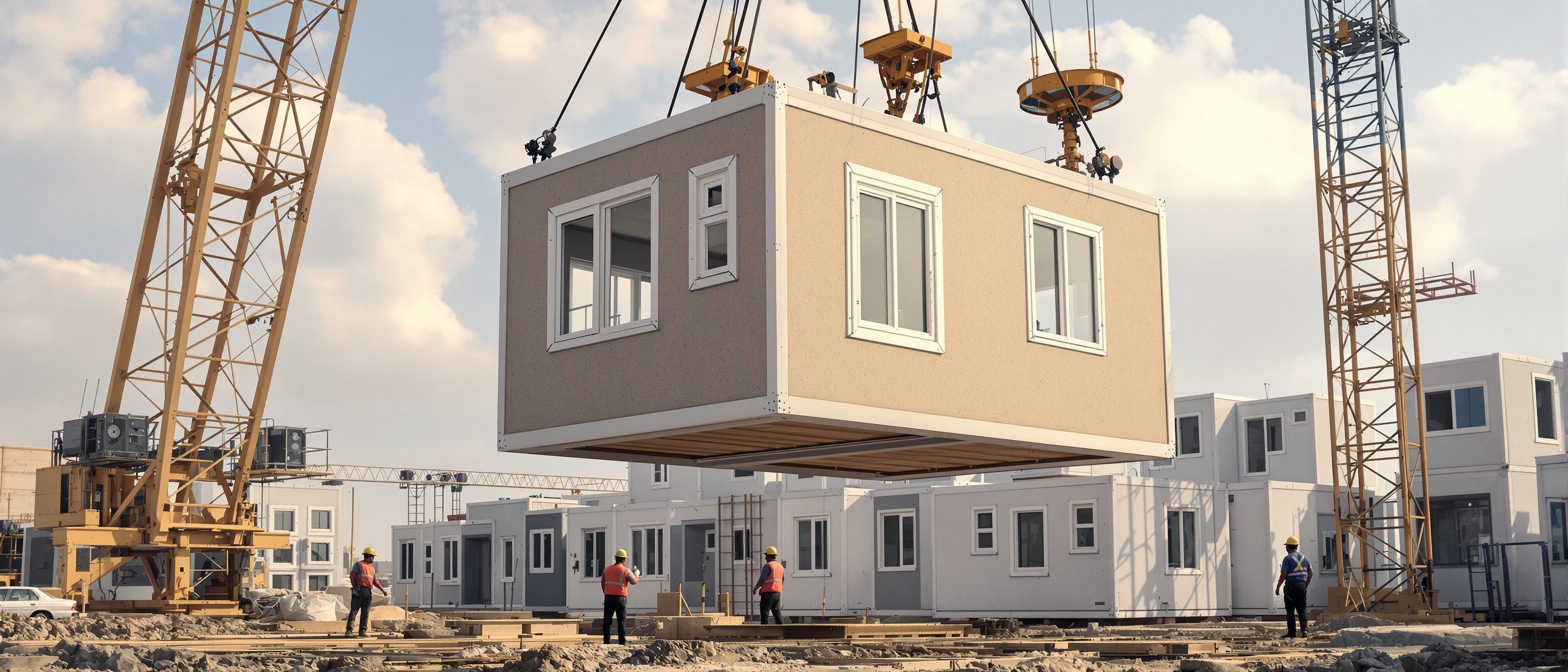
PREFABRICATION means making building parts away from their final position, then assembling them. Its OBJECTIVE: speed, factory QUALITY, scale and less on-site labour. It runs along a SPECTRUM of how much is done off site: COMPONENT prefab (single members — beams, slabs), PANELISED (2D wall/floor panels), VOLUMETRIC / MODULAR (3D room boxes finished in the factory), and COMPLETE buildings. As you move up the spectrum, SITE work falls and factory work rises — faster erection, but less design flexibility and harder transport. MISCONCEPTION→correct: 'prefab is one thing' — it is a spectrum; choosing WHERE to sit on it is the key design decision. The explorer sets out each level.[2]
Walk the spectrum
Pick a degree of prefabrication — component, panelised, volumetric, complete — and read what it is, how much is done off-site, and its trade-off.
The prefabrication spectrum · pick a level
Level 2. Panelised (2D)
off-site work: mediumFlat panels — load-bearing or cladding wall panels, floor panels — are made flat in the factory and stood up and connected on site.
Trade-off: Faster envelope and good quality, but joints between panels must be sealed and structurally tied.
Up the spectrum: more factory work, faster site erection — but less design flexibility and harder transport.
Joints & limitations
A prefabricated building is only as good as its joints — wet (cast in situ, strong, slow) or dry (bolted, fast, precise); and prefab imposes real limits — repetition, transport, cranage, frozen design — a discipline to design with.[2, 4]
Where systems succeed or fail
A prefabricated building is only as good as its JOINTS — the connections between components. They come in two families: WET joints (concrete poured in situ to tie elements together — strong and monolithic, but slow and weather-dependent) and DRY joints (bolted, welded or mechanical connections — fast and clean, but demanding precision). Joints must transfer STRUCTURAL forces, keep WATER out, allow MOVEMENT, and often resist fire and sound. MISCONCEPTION→correct: 'the components are the hard part' — in practice the JOINTS are where prefab systems leak, crack and fail; a system is judged by its connections, not its panels.[2, 4]
At a glance
| Aspect | Detail | Note |
|---|---|---|
| Up the spectrum | More factory work | Faster site, less flexibility |
| Off-site work | Controlled, parallel | Faster, drier, predictable |
| Wet joint | Cast in situ | Strong, monolithic, slow |
| Dry joint | Bolted / welded | Fast, clean, needs precision |
| Judged by | Its joints | Not its panels |
Key terms
Making building parts away from their final position, then assembling them.
Component → panelised → volumetric/modular → complete building.
Factory work (parallel, controlled) vs site assembly.
Concrete poured in situ to tie elements — strong but slow.
Bolted/welded/mechanical connection — fast but needs precision.
Whole 3D room boxes finished in the factory and stacked on site.
Studio task
For a 10-storey housing block, choose where to sit on the prefabrication spectrum and justify it against speed, cost and flexibility. Then sketch how two precast wall panels would meet at a corner — would you use a wet or a dry joint, and what must that joint do besides hold the panels together?
Self-assessment
1. Moving UP the prefabrication spectrum (component → panel → module) means —
2. In practice, prefabricated systems most often succeed or fail at their —
3. A wet joint differs from a dry joint in that it —
Recap
References & further reading
- [1]CIB / CIDB IBS classification — the spectrum of prefabrication systems.
- [2]Albert G. H. Dietz, Industrialized Building Systems for Housing (MIT) — prefabrication degrees, off-site work, limits.
- [3]Henrik Nissen, Industrial Building and Modular Design — prefabrication and joints.
- [4]PCI / precast handbooks — precast connections (wet and dry joints) and their performance.
Further reading
- Albert G. H. Dietz — Industrialized Building Systems for Housing (MIT).
- Henrik Nissen — Industrial Building and Modular Design.
- PCI — Design Handbook (connections).
Sources gathered and fact-checked June 2026. Published values vary by source, sample and method — treat as indicative and confirm against the cited standard before structural use.
The author
Amogh N P
Architect, interior designer, and creative polymath. Studio Matrx began in his notebooks — his vision of design made honest, useful, and open to everyone. Its Academy is written and taught in his memory, and free, forever.
More about Amogh →