
B.Arch CurriculumFree, forever
A tribute to Amogh N P
Contemporary Architecture
How architecture arrived at the present — and how India found its own modern voice. From the British-built Indo-Saracenic palaces of the princely states, through Le Corbusier's raw-concrete Chandigarh and Louis Kahn's brick at Ahmedabad, to the first generation of Indian masters — Doshi, Correa, Rewal, Kanvinde, Baker — and the worldwide currents of High-Tech and Post-Modernism that ran alongside them, ending with the sustainable, parametric and commercial practice shaping Indian cities now.
Course byAmogh N P· Architect & interior designer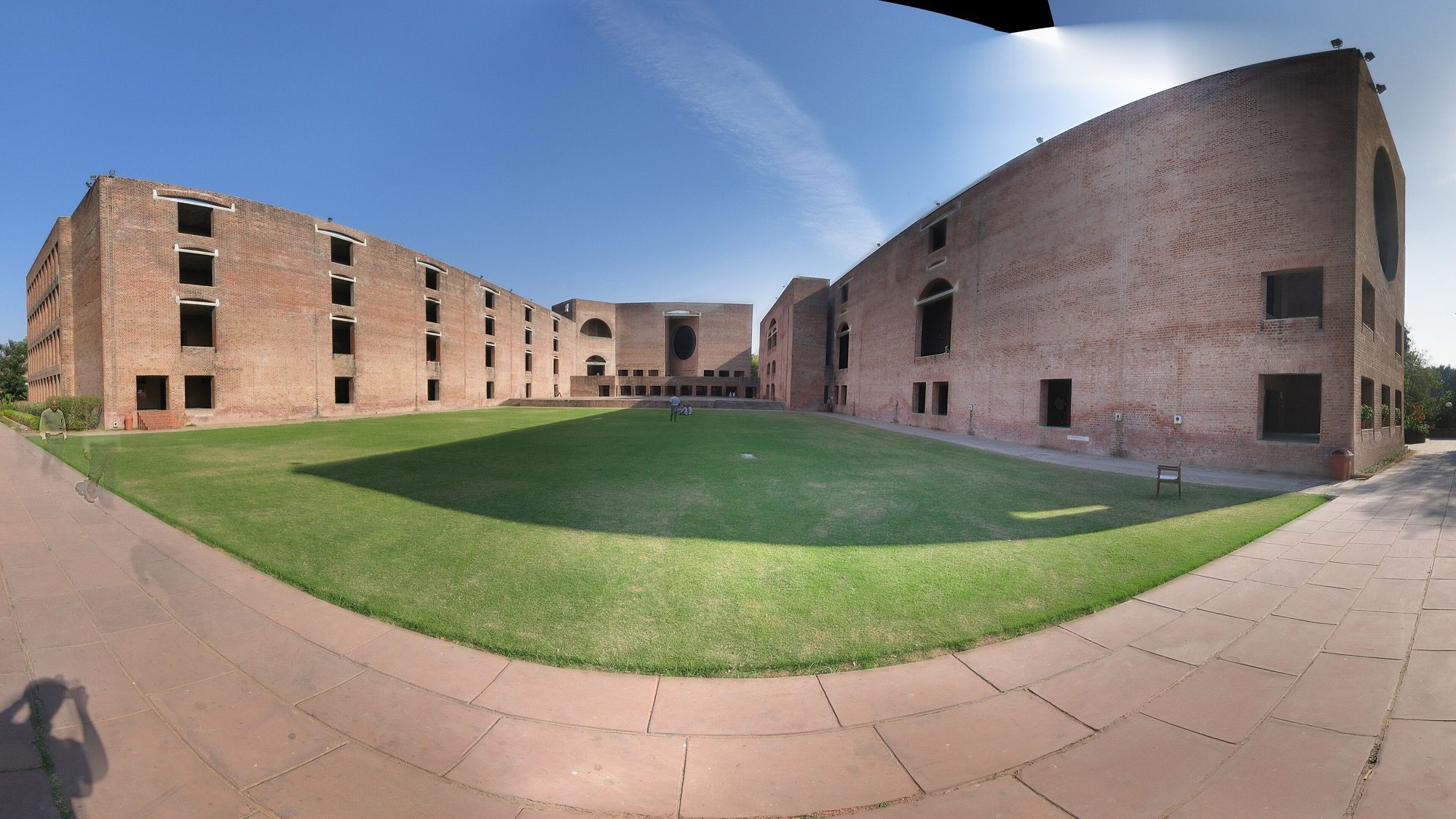
The syllabus
5 units · 5 liveTranscribed from the official B.Arch syllabus. All 5 units are live as full interactive lessons, each with original diagrams, a self-assessment quiz and a study task.
Unit 1 — Pre- & Post-Independence
LiveArchitecture of the princely states and the colonial period — the Indo-Saracenic of Jaipur, Calcutta, Chennai and Mysore — and the two manifestos of post-independence modern India: Le Corbusier's Chandigarh and the Ahmedabad of Corbusier, Louis Kahn and B.V. Doshi.
Unit 2 — Modern Architecture in India
LiveThe first generation of Indian modern masters — B.V. Doshi and Charles Correa; Raj Rewal, Achyut Kanvinde and Uttam Jain; Laurie Baker's cost-effective architecture and Anant Raje, Kahn's Indian disciple — and the climate-rooted, vernacular-modern language they forged.
Unit 3 — High-Tech Architecture
LiveThe last phase of modern architecture — Richard Meier, Charles Moore, Bernard Tschumi and Frank Gehry — and the British-born High-Tech (Structural Expressionism) of Norman Foster, Richard Rogers and Michael Hopkins, who made structure, services and technology the architecture itself.
Unit 4 — Post-Modern Architecture
LiveThe reaction against the International Style — modernism versus post-modernism, Jencks's 'double coding' and the 'death of modernism', Venturi's complexity and contradiction and the 'decorated shed' — through Robert Venturi, Michael Graves and James Stirling.
Unit 5 — Recent Trends in India
LiveCurrent Indian practice and recent trends — Sanjay Mohe, Christopher Benninger, Hafeez Contractor, Chitra Vishwanath and Sanjay Puri — read across sustainability and green rating, continued critical regionalism, parametric design, conservation, and the commercial high-rise.
Course outcomes
What you will be able to doUnderstand pre- and post-independence architecture in India — the colonial Indo-Saracenic of the princely states, and the post-independence modernism of Chandigarh and Ahmedabad.
Apply a familiarity with the contemporary forces and directions in architecture across the world and in India.
Understand the post-independence modern architecture of India — Doshi, Correa, Rewal, Kanvinde, Uttam Jain, Laurie Baker and Anant Raje — alongside developments elsewhere.
Understand the later directions of modern architecture worldwide — late modernism and deconstruction, the High-Tech movement, and Post-Modernism.
Apply an understanding of alternate and recent practice — sustainability, critical regionalism, parametric design and the commercial high-rise.
Gain knowledge of the recent trends in architecture and design and relate them to the work of contemporary Indian architects.
Image credits
Verified Commons / Public-DomainEvery photograph is a verified Creative-Commons or Public-Domain work from Wikimedia Commons, used with attribution. The hand-drawn diagrams are original Studio Matrx work.
- Mysore Palace Windows — Sumit Surai, CC BY-SA 4.0
- Victoria Memorial situated in Kolkata — Subhrajyoti07, CC BY-SA 4.0
- Hawa Mahal east facade (14-07-2022) — Chainwit., CC BY-SA 4.0
- Palace of Assembly Chandigarh — UnpetitproleX, CC BY-SA 4.0
- Indian Institute of Management Ahmedabad, panorama 2006 — Lauri Kymäläinen, Public domain
- Louis Kahn Plaza, IIM Ahmedabad — Perspectives - The Photography Club, IIM Ahmedabad, CC BY-SA 4.0
- 2022 July - JawaharKalaKendra Jaipur 02 — Chainwit., CC BY-SA 4.0
- Maveli Cafe Indian Coffee House Tvm — Ryan, CC BY 2.0
- Guggenheim Museum Bilbao 2 — kallerna, CC BY-SA 4.0
- London - St Andrew Undershaft and The Gherkin — Fred Romero from Paris, France, CC BY 2.0
- London - Lime Street - Lloyd's Building 1986 Richard Rogers - Willis Building 2008 Lord Norman Foster - The Gherkin - ICE Fisheye — Txllxt TxllxT, CC BY-SA 4.0
- Getty Center Los Angeles by Richard Meier — Michael Gäbler, CC BY 3.0
- Rotunde Neue Staatsgalerie Stuttgart — Walt.cleanhard, CC BY-SA 4.0
- Vanna Venturi House in Chestnut Hill, Philadelphia, Pennsylvania LCCN2011631388 — Carol M. Highsmith, Public domain
- Imperial Towers Mumbai — Satish Krishnamurthy, CC BY-SA 2.0
- Auroville Earth Institute — Kaspar Konrad, CC BY 3.0
The author
Amogh N P
Architect, interior designer, and creative polymath. Studio Matrx began in his notebooks — his vision of design made honest, useful, and open to everyone. Its Academy is written and taught in his memory, and free, forever.
More about Amogh →The concrete, the brick, the glass.
How architecture reached the present — and how India found its own modern voice. Read the five units top to bottom, study the diagrams, then test yourself.
The curriculum is free, forever