

Post-Modern Architecture
Less is a bore — ornament, history and irony return against the International Style.
By the 1960s the austere universalism of the International Style had exhausted its welcome. Post-Modernism answered with ornament, historical reference, symbolism and wit — what Charles Jencks called “double coding”. Robert Venturi fired the opening shot (“Less is a bore”) and taught architects to read the “decorated shed” of the everyday strip; Michael Graves brought colour to the skyscraper; James Stirling collaged history and the modern at Stuttgart.
Learning objectives
By the end of this lesson, you will be able to — mapped to the course outcomes for Contemporary Architecture:
Contrast modernism and post-modernism — function and 'less is more' versus ornament, reference and 'double coding'.
Explain Jencks's 'death of modernism' and Venturi's complexity, contradiction and the 'decorated shed'.
Describe the work of Robert Venturi, Michael Graves and James Stirling.
Recognise the correct authorship of the movement's famous slogans and its key controversies.
Modernism vs Post-Modernism
Modernism held to function, the machine aesthetic and no ornament — “less is more” (Mies), “form follows function” (Sullivan). Post-Modernism reintroduced ornament, quotation, colour and irony, deliberately contextual and “double coded”.[1, 2] Jencks even dated the “death of modernism” to the 1972 Pruitt-Igoe demolition — a rhetorical flourish, with a time he admitted inventing.
Two attitudes
Orthodox modernism / the International Style held to 'form follows function' (Sullivan), 'less is more' (Mies), a machine aesthetic and no ornament, in a universal placeless style. Post-Modernism, a 1960s–80s reaction, reintroduced ornament, historical quotation, colour, symbolism, wit and irony, and was deliberately contextual and pluralist. FLAG: get the slogans right — 'less is more' is Mies, 'less is a bore' is Venturi, 'form follows function' is Sullivan.[1, 2]
Venturi, Graves & Stirling
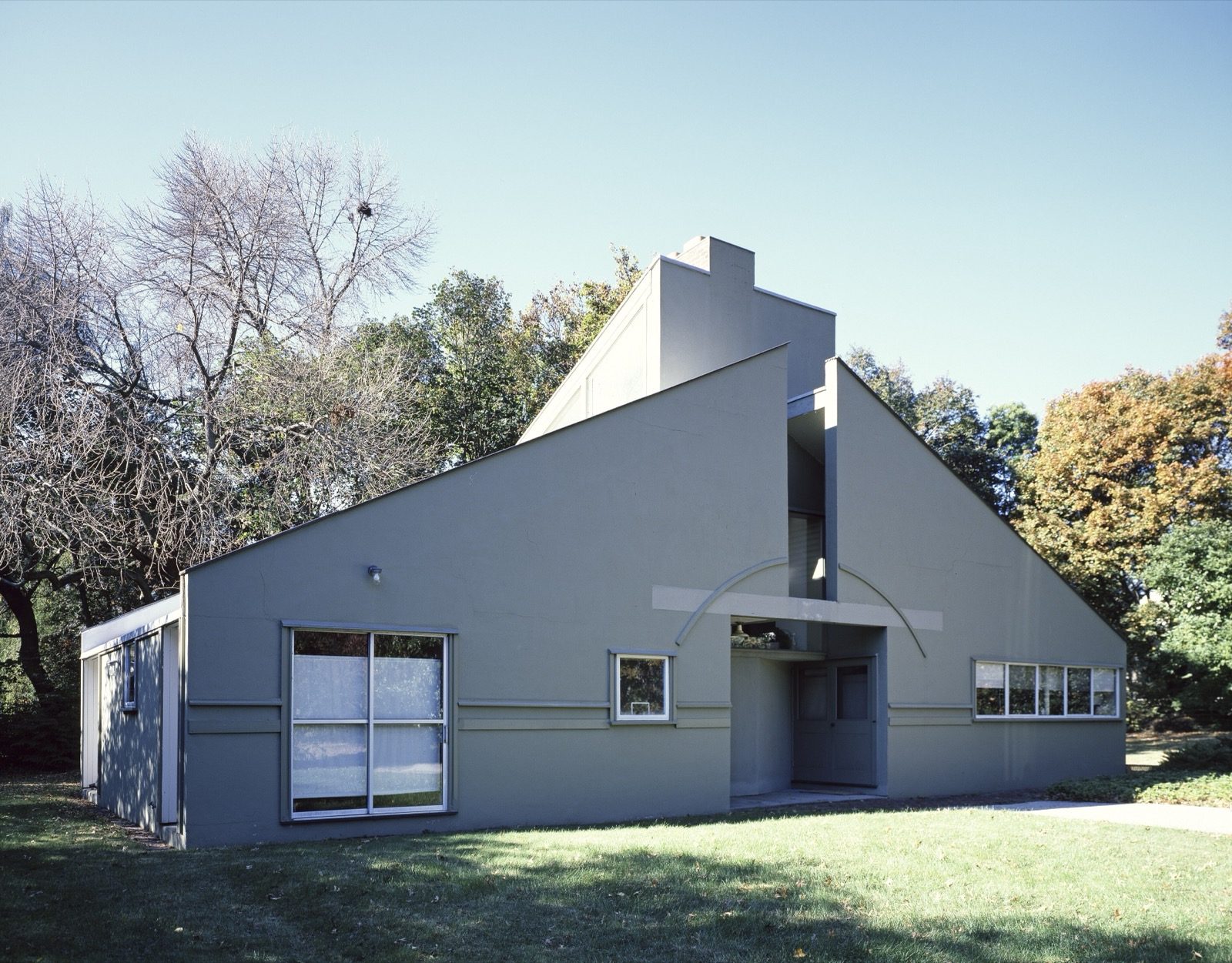
Venturi and Scott Brown were the intellectual founders — “complexity and contradiction” and the “duck vs decorated shed”. Graves brought colour and classical allusion to the Portland Building; Stirling collaged history and the modern at the Neue Staatsgalerie.[3, 4, 6] (Note: Denise Scott Brown was controversially excluded from Venturi's 1991 Pritzker.)
Complexity and contradiction
Robert Venturi (1925–2018), with Denise Scott Brown (b. 1931), were the intellectual founders of Post-Modernism. Complexity and Contradiction in Architecture (MoMA, 1966) — 'Less is a bore' — championed the 'messy vitality' of real buildings over modernist purity. The Vanna Venturi House (1964), with its split pediment, is the built manifesto; the Sainsbury Wing of the National Gallery, London (1991) is contextual PoMo. Venturi won the Pritzker in 1991 — but Scott Brown, his equal partner, was controversially excluded.[3, 4]
Modern vs Post-Modern
| Aspect | Modernism | Post-Modernism |
|---|---|---|
| Slogan | Modern: 'less is more' (Mies); 'form follows function' (Sullivan) | PoMo: 'less is a bore' (Venturi) |
| Ornament | Rejected — the machine aesthetic | Returned — historical quotation, colour, signage |
| Relation to place/history | Universal, placeless, ahistorical | Contextual, pluralist, ironic, 'double coded' |
| Symbolism | Form follows function | 'Duck' vs 'decorated shed' — communicate openly |
| Icon | Mies's glass boxes | Portland Building, Neue Staatsgalerie, Vanna Venturi House |
Key terms
Orthodox modernism — universal, functional, unornamented; the thing Post-Modernism reacted against.
Jencks's definition of PoMo — a building speaking to both the public and to architects at once.
Venturi's 1966 manifesto embracing 'messy vitality' over modernist purity ('Less is a bore').
A building whose form IS its sign (Venturi's term) — symbolism through shape.
An ordinary box carrying applied symbolic ornament and signage — Venturi's preferred model.
The 1972 St Louis housing demolition Jencks used to date the 'death of modernism' (rhetorically).
PoMo's embrace of many coexisting styles and references against modernism's single universal style.
Classical fragments (Venturi's split pediment) quoted ironically — a PoMo signature.
Study task
Take a plain modern box and “decorate the shed”: in one sketch, keep the structure but add the applied symbolism, colour or classical quotation that would make it Post-Modern. Then attribute the three slogans correctly — “less is more”, “form follows function”, “less is a bore”.
Self-assessment
1. 'Less is a bore' was the riposte of —
2. Venturi's 'decorated shed' is —
3. Jencks's claim that modernism 'died' at 3.32 pm on 15 July 1972 is —
Recap
References & further reading
- [1]Kenneth Frampton, Modern Architecture: A Critical History (5th ed.). London: Thames & Hudson, 2020.
- [2]Charles Jencks, The Language of Post-Modern Architecture. London: Academy Editions / Rizzoli, 1977.
- [3]Robert Venturi, Denise Scott Brown & Steven Izenour, Learning from Las Vegas. Cambridge, MA: MIT Press, 1972 (rev. 1977).
- [4]Robert Venturi, Complexity and Contradiction in Architecture. New York: Museum of Modern Art, 1966.
- [5]Diane Ghirardo, Architecture After Modernism. London: Thames & Hudson, 1996.
- [6]The Pritzker Architecture Prize — Laureate citations (Stirling 1981, Venturi 1991). https://www.pritzkerprize.com/laureates
Further reading
- Robert Venturi, Complexity and Contradiction in Architecture. MoMA, 1966.
- Venturi, Scott Brown & Izenour, Learning from Las Vegas. MIT Press.
- Charles Jencks, The Language of Post-Modern Architecture. Academy Editions.
Sources gathered and fact-checked June 2026. Published values vary by source, sample and method — treat as indicative and confirm against the cited standard before structural use.
The author
Amogh N P
Architect, interior designer, and creative polymath. Studio Matrx began in his notebooks — his vision of design made honest, useful, and open to everyone. Its Academy is written and taught in his memory, and free, forever.
More about Amogh →