
Water, plumbing & rainwater harvesting
The house has two water stories — the one that comes in, and the one the rules now make you keep.
Lesson byAmogh N P· Architect & interior designer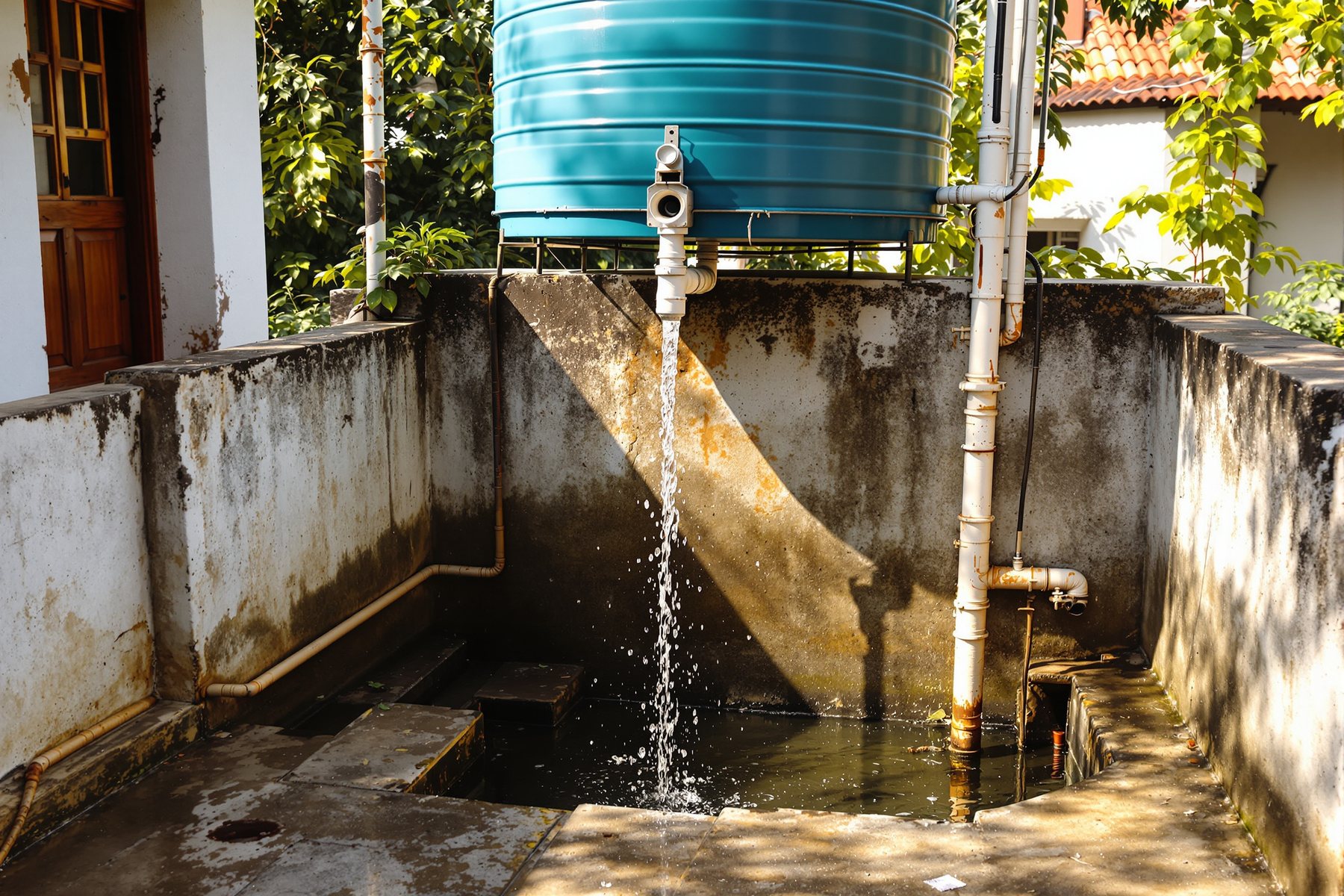
Your house drinks 600 litres a day — and the city now insists you save the rain.
Water seems simple until the borewell drops in May, the pump can't fill the tank by morning, or the occupancy certificate gets held up because there's no rainwater pit. A house quietly needs around 135 litres per person per day — roughly 600 for a family of four — coming in, stored, pressurised and heated, with waste and storm water leaving. And in most Indian cities the rain that falls on your roof is no longer yours to waste: harvesting it is the law. Plan all of it before the plumber lays a single pipe.
Water in, stored and heated — and the rain you're now required to keep
Three decisions size your whole water system: tanks, pump, hot water
A house needs water stored because the supply is rarely 24×7. The standard setup is two tanks with a pump between them.
- Underground sump (UGT) — the big reserve, filled when the municipal line or tanker comes. Size it for 1–2 days of use: a family of four wanting two days of buffer needs roughly 1,000–2,000 litres, often more where supply is erratic. - Overhead tank (OHT) — sits on the roof and feeds the house by gravity, giving pressure to taps and showers. Commonly 500–1,000 litres. - Pump — lifts water from sump to OHT. A small 0.5–1 HP monoblock suits most homes; size it to fill the OHT in well under an hour.
Then hot water: a per-bathroom electric geyser (instant, cheap to install, costs more to run), a solar water heater (₹15,000–35,000 installed, slashes the bill but needs sun and roof space), or a heat-pump for larger homes. Decide this now — it sets the plumbing runs and the roof layout.
Pipe is buried before the floor goes down. A leak found later is a floor broken open.
Rainwater harvesting isn't optional in most cities — and a recharge pit is simple
Across most Indian states and corporations, rainwater harvesting (RWH) is mandatory for new buildings above a plot-size threshold (often around 200–300 sq m), and the sanction or occupancy certificate (OC) can be withheld without it. Treat it as a permit requirement, not a green extra.
There are two paths, and many homes do both:
- Storage — roof runoff is filtered and stored in a tank for direct use (flushing, gardening, washing). - Recharge — runoff is led into a recharge pit that lets it soak back into the ground and lift your borewell and the local water table.
A basic recharge pit is genuinely simple: a pit roughly 1×1×2 m (sized to your roof catchment), layered bottom-up with boulders, gravel and coarse sand, fed by a pipe from the roof drains through a first-flush filter that discards the dirty initial wash. One good monsoon down a 1,500 sq ft roof is tens of thousands of litres you'd otherwise watch run into the storm drain.
Size your sump for at least a day or two of buffer — in a dry-summer city, the family that stored only a day's water is the one chasing tankers in May. Get the rainwater pit into the sanctioned plan from the start so it never threatens your OC, and ask for it to _recharge your own borewell_ where possible — you feel the benefit directly. On hot water, if you have south-facing roof and sun, a solar heater usually pays back in 3–5 years; otherwise per-bathroom geysers are the pragmatic default.
Produce a plumbing layout with separate lines (potable, flushing, hot, and ideally a recycled/RWH line), and size storage to local demand norms (~135 lpcd) plus the supply reliability of the area, not a generic figure. Check the specific state/corporation RWH rule — threshold plot area, required pit volume per unit of roof, and whether storage, recharge or both are mandated — and show it on the sanction drawings. Coordinate the OHT load with the structural engineer and the pump/solar runs with the electrical and roof plans.
Water is a closed loop you design twice: supply (source, storage, pressure, heating) and disposal (greywater, blackwater, storm). Learn the demand norm (~135 litres per capita per day) and how gravity gives pressure — the overhead tank exists because pumps are noisy and water towers are free. Rainwater harvesting is where building services meet hydrology and the building bye-laws; it's a clean example of regulation steering design toward sustainability.
“Rainwater harvesting is an optional eco add-on I can skip to save money.”
In most Indian cities it's a legal requirement for new houses above a plot-size threshold, and your plan sanction or occupancy certificate can be held up without it. A basic recharge pit is also cheap — a layered 1×1×2 m pit and some piping — and it lifts your own borewell and the local water table. Build it into the sanctioned plan from day one, not as an afterthought.
Plan your house's two water stories:
- 01Work out daily demand (~135 litres per person) and size your sump for 1–2 days of it — then check your area's actual supply reliability and add buffer where it's erratic.
- 02Look up your city/state rainwater harvesting rule (plot-area threshold and required pit/storage) and confirm the pit is on the sanctioned drawings, not added later.
- 03Decide hot water before plumbing rough-in — solar (3–5 year payback with good sun) versus per-bathroom geysers — because it fixes the pipe runs and the roof layout.
Plan water for the worst week, not the average one: a sump that carries you through a dry spell, a pump and overhead tank that hold pressure, a hot-water choice fixed before the pipes are laid, and a rainwater pit on the sanctioned plan from day one. Do it before the floor goes down, because a pipe found wrong later means a floor broken open.
Store water in a sump (1–2 days, ~1,000–2,000 L) lifted by a 0.5–1 HP pump to a gravity-fed overhead tank, pick hot water (solar pays back in 3–5 years with sun, else geysers), and build mandatory rainwater harvesting — a layered 1×1×2 m recharge pit — into the sanctioned plan or risk your OC.
Is rainwater harvesting mandatory for new houses in India?
In most states and municipal corporations, yes — rainwater harvesting is a legal requirement for new buildings above a plot-size threshold (commonly around 200–300 sq m), and plan sanction or the occupancy certificate can be withheld without it. Rules vary by state, so check your local corporation's bye-law for the exact threshold and required pit or storage size, and put it on the sanctioned drawings from the start.
What size water tank and sump do I need for a house in India?
Plan for roughly 135 litres per person per day — about 600 litres for a family of four. Size the underground sump for 1–2 days of that (often 1,000–2,000 litres, more where supply is erratic) and a rooftop overhead tank of 500–1,000 litres for gravity pressure, with a 0.5–1 HP pump lifting between them.
How do I build a rainwater recharge pit at home?
A basic recharge pit is roughly 1×1×2 m, sized to your roof catchment, layered bottom-up with boulders, gravel and coarse sand. Roof runoff is piped in through a first-flush filter (which discards the dirty initial wash) so clean water soaks into the ground and recharges your borewell and the local water table. Get the design and position onto your sanctioned plan early.
The author
Amogh N P
Architect, interior designer, and creative polymath. Studio Matrx began in his notebooks — his vision of design made honest, useful, and open to everyone. Its Academy is written and taught in his memory, and free, forever.
More about Amogh →Power in, water in and saved — the last service is the one that decides your running bills for decades: how the house makes and saves its own energy.