
Lighting & electrical plan
The wiring you'll live with for thirty years is decided in an afternoon nobody plans for.
Lesson byAmogh N P· Architect & interior designer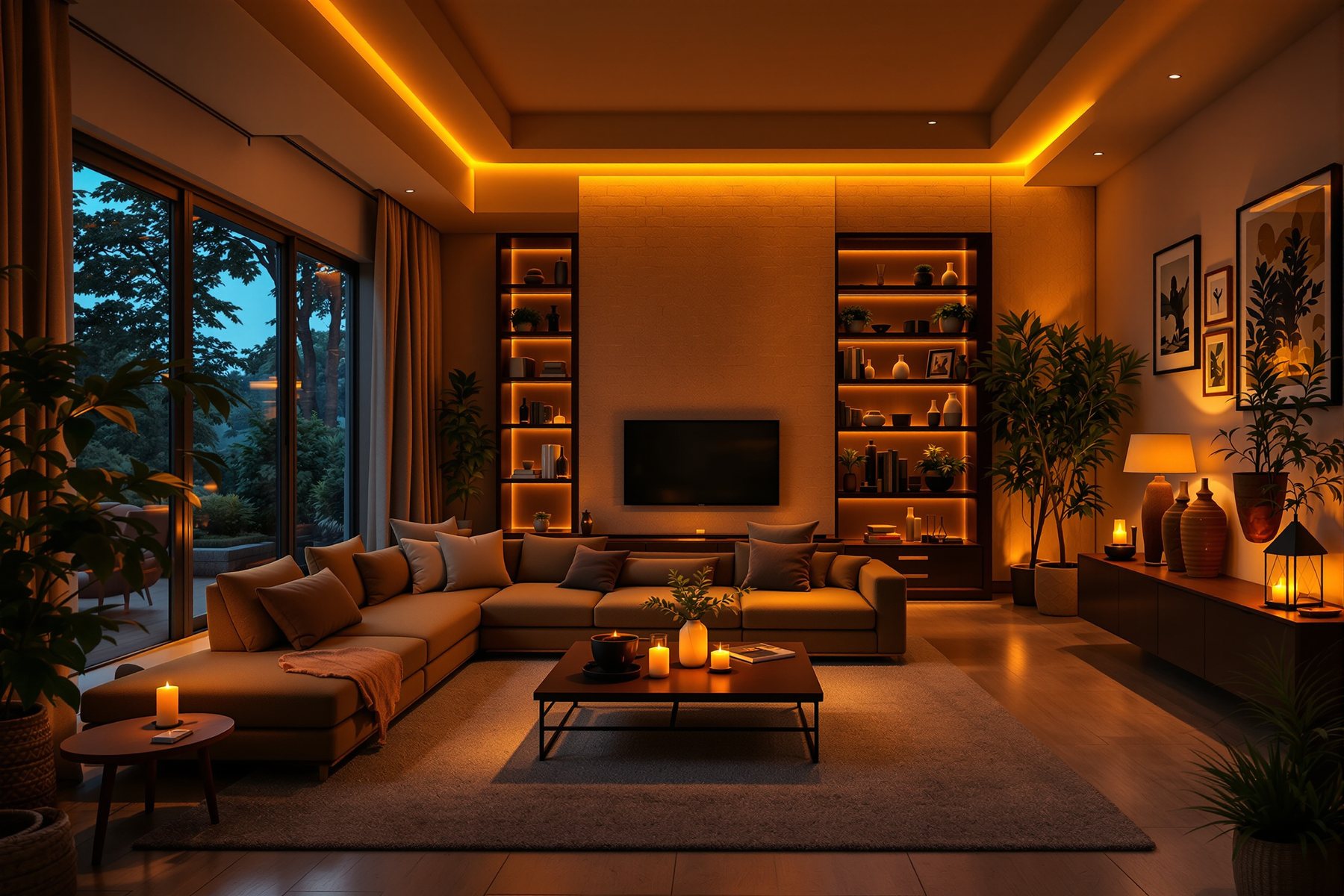
Two years later, every wall has the lamp you wanted — and a wire in the wrong place.
You can change your sofa, your paint, even your kitchen. What you can't easily change is the wire inside the wall. The day the electrician runs the conduits is the day your house decides, for thirty years, where a switch sits, whether the dining table has a hanging light, and how many gadgets a bedroom can charge at once. That afternoon usually happens with no plan at all. Let's give it one.
Two numbers and a layout: your load, your points, your light
Your house has a total appetite for power — get it on paper, then sanction it
Every house has a connected load — the sum of everything that can draw power at once, measured in kilowatts (kW). You add up the lights, fans, fridge, ACs, geysers, pump, kitchen appliances, then apply a diversity factor (you never run everything together) to get the sanctioned load you ask the electricity board (DISCOM) for.
Rough 2026 thumb-rules: a modest 2BHK lands around 3–5 kW, a typical 2,000 sq ft house with 2–3 ACs around 5–8 kW, and a large home with multiple ACs and a lift past 8–12 kW. Under-sanction and your mains trip every summer evening; over-sanction and you pay higher fixed charges for capacity you never use.
- Below ~5 kW you're usually on a single-phase connection. - Above it, the DISCOM moves you to three-phase — get this decided early, because it changes the meter, the mains cable and the main switch.
The switchboard is poured into the wall once. Plan it like furniture you can never move.
Walk every room twice: once for sockets, once for the light it should hold
First pass — points. Mark every switch, light, fan, socket and data point on the plan. A bedroom commonly needs 6–10 points, a kitchen 10–14 (it's the hungriest room — chimney, hob, microwave, mixer, fridge, water purifier), a living room 10–15. Generous now is cheap; a socket added after plaster means a chase, a re-plaster and a repaint.
Second pass — light, in three layers:
- Ambient — the general fill that lets you see the room (ceiling lights, cove lighting). - Task — bright, aimed light where you work: kitchen counter, study, mirror, reading. - Accent — the mood layer that makes a room feel designed: a wall-washer, a picture light, a strip under a niche.
A room with only one tube light has one layer and reads flat. Put the three layers on separate switches and you can shift one space between bright, working and soft.
Do the two walk-throughs yourself with the electrical drawing in hand, _before_ the conduit work starts — this is the cheapest hour you'll ever spend on the house. Be generous with sockets (you'll add gadgets for decades), insist on separate switches for each lighting layer, and add a few spare conduits to the TV wall and the ceiling for whatever automation or speakers you'll want in five years. Empty pipe is nearly free; a fresh wall chase is not.
Issue a coordinated electrical layout with a load schedule and a points legend, not just symbols on the architectural plan — and reconcile it against the false-ceiling and HVAC drawings so cove depths and AC points actually fit. Specify circuit separation (lighting, power, AC, kitchen on their own MCBs), ELCB/RCCB protection, and cable sizing per IS standards. State the assumed sanctioned load and the single-vs-three-phase decision in writing so the DISCOM application matches the design.
Lighting design is the part of architecture you feel before you notice. Learn the three-layer model and basic load calculation early — connected load, diversity factor, demand load — because services coordination (electrical against ceiling against HVAC against plumbing) is where real drawings either resolve or clash. The brief that says 'one light per room' is the brief that produces flat, institutional space.
“Wiring is the electrician's job — I'll just tell them what I want as the work happens.”
Deciding live, room by room, is exactly how houses end up with switches behind doors and no socket where the bed goes. The conduit is buried in the wall during rough-in and locked there at plaster. Plan every point on a drawing _before_ the chasing starts; changes after that mean breaking, re-plastering and repainting finished walls.
Turn your floor plan into a real electrical plan:
- 01Add up your connected load room by room (lights, fans, fridge, ACs, geysers, pump, kitchen) and check whether you cross the ~5 kW single-to-three-phase line.
- 02Walk each room on the plan twice — once marking every socket and switch, once deciding its ambient, task and accent light — and put each lighting layer on its own switch.
- 03Mark 2–3 spare empty conduits (TV wall, ceiling, study) for future automation, speakers or chargers — empty pipe laid now costs almost nothing.
A good electrical plan is two numbers and one drawing settled before the conduits go in: a sanctioned load that matches how you'll really live, and a points-and-lighting layout walked twice and signed off. Get that afternoon right and the house just works for thirty years; skip it and you'll be chasing extension cords and breaking walls for the rest of them.
Size your connected load (a typical house draws 5–8 kW; cross ~5 kW and you go three-phase), then walk every room twice — once for points (bedroom 6–10, kitchen 10–14), once for three lighting layers (ambient, task, accent) on separate switches. Lay spare empty conduit while you can.
How do I calculate the sanctioned load for a house in India?
Add up the wattage of everything that can run — lights, fans, fridge, ACs, geysers, pump, kitchen appliances — to get the connected load, then apply a diversity factor (you never run it all at once) to estimate the demand. A typical 2,000 sq ft home with 2–3 ACs lands around 5–8 kW; cross roughly 5 kW and the DISCOM usually moves you to a three-phase connection.
How many electrical points should each room have?
As a 2026 rule of thumb: a bedroom 6–10 points, a kitchen 10–14 (it's the hungriest room), a living room 10–15, and a bathroom 3–5. Be generous — a socket added after plaster needs a wall chase, re-plaster and repaint, while one extra point during rough-in costs very little.
What is layered lighting and why does it matter?
Layered lighting means three separate layers on separate switches: ambient (general fill so you can see), task (bright, aimed light for cooking, reading, grooming) and accent (mood light that highlights a wall, niche or artwork). A room lit by a single tube light has only one layer and reads flat; three layers let the same space shift between bright, working and soft.
The author
Amogh N P
Architect, interior designer, and creative polymath. Studio Matrx began in his notebooks — his vision of design made honest, useful, and open to everyone. Its Academy is written and taught in his memory, and free, forever.
More about Amogh →Power is one of the two utilities a house can't live without. The other runs the opposite way — water in, waste and rain out — and in many cities it now comes with a legal catch.