
Wind, rain & the monsoon vector
The wind that cools you in January is the wind that floods you in June. Design for both.
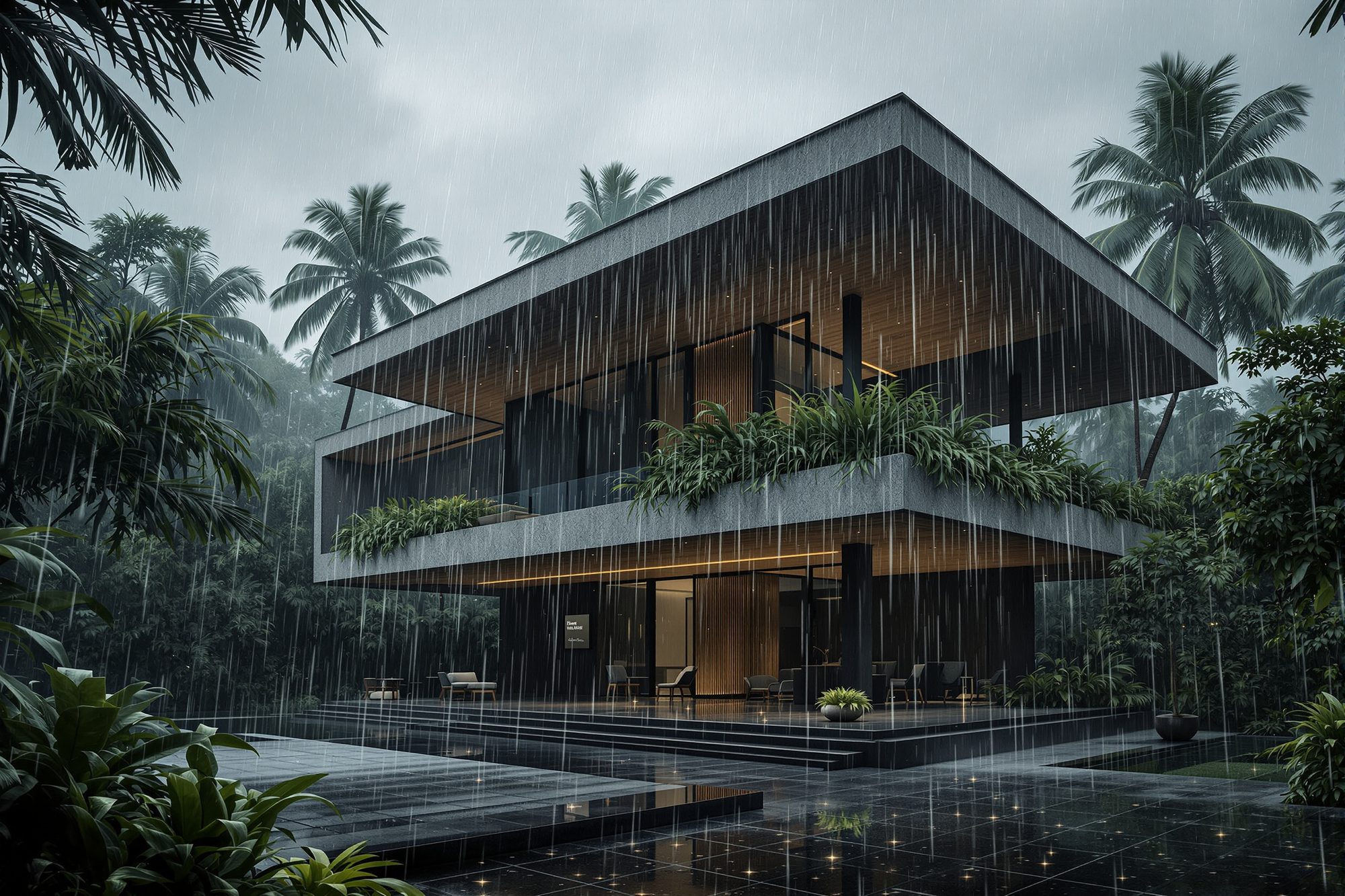
A coastal Karnataka house opens its big windows to the south-west sea breeze, and for eight months of the year it is perfect. Then the monsoon arrives — swinging in hard from the very same south-west quarter at 40 km/h, this time carrying horizontal rain — and those generous openings become a fire-hose inlet.
Nothing about the house changed. The wind did. The air that cools you in January is the air that floods you in June. That single reversal is the heart of designing for the Indian monsoon — and it is the subject of one of the Academy's most-read lessons, lifted here and condensed as this month's Masterclass.
Always split the wind rose
Architects love a wind rose — the little compass-star that shows which way the wind blows, and how often. For monsoon India there is a trap hidden in it. An annual-average wind rose smears two opposite winds into a meaningless smudge in the middle, hiding the very signal you need. The June south-westerly and the December north-easterly cancel each other out on the page, and you end up designing for a wind that never actually blows.
The discipline is simple: always split the rose. Draw one for the monsoon months and one for the dry months, and design for both — because they are two different climates wearing the same address.
Answer the breeze and shed the storm on one line
The instinct is to find the dominant wind and orient the house to it. On a monsoon coast that fails, because the dominant wind brings the rain too. So you do not choose between cooling and shelter — you design openings that answer the breeze and shed the storm on the same line.
Aim the main openings at the monsoon breeze, then protect them: deep overhangs, a wrapping verandah, louvres set to the local driving-rain angle. When that wind turns to water, the geometry sheds the rain while the air still slips through underneath. The verandah is not decoration; it is the device that lets a wall be open and protected at once.
Two numbers decide it
Two small calculations turn all of this from instinct into design — and they are why a magazine that teaches from a course can show you the working instead of just the slogan.
Wind pressure across an opening scales with the square of wind speed, so doubling the wind quadruples the push through your window — which is why aiming at the stronger seasonal wind beats simply enlarging the opening. And driving rain comes in at an angle, not straight down: a strong monsoon gust throws it in at roughly 45°. The mistake most overhangs make is to shadow the opening from the vertical, the way you would shade the sun. Rain protection has to be sized for that slant. Shade and shelter are not the same line.
Wind pressure on an opening (ρ ≈ 1.2 kg/m³). At 3 m/s ≈ 5.4 Pa; at 1.5 m/s only ≈ 1.35 Pa. Pressure grows with the square of speed — orientation beats enlargement.
The driving-rain angle. With a raindrop falling at ~6–9 m/s, a 9 m/s wind gives θ ≈ 45°. The overhang must shadow the opening from that slant — not from the vertical.
The question that comes before the plan
Strip the lesson to a single habit and it is this: before you place one opening, ask which wind, in which season, carrying what. A window is a decision about air and water at the same time. Get the season wrong, and the same opening that cooled the house all winter drowns the sill in June.
- 01Split the wind rose — design for the monsoon and the dry season as two separate climates.
- 02Aim openings at the seasonal breeze, then protect them with overhangs and verandahs at the driving-rain angle.
- 03Wind pressure scales with the square of speed — orientation beats a bigger window.
- 04Size rain protection for the ~45° driving-rain angle, not the vertical sun line.
This is one lesson from Climate-Responsive Design — an eight-module course that teaches you to read the Indian sky before you draw: sun, wind, rain and thermal mass, zone by zone, from the warm-humid coast to the cold mountains. It is free to take — and it is the reason this magazine can show you the physics, not just the opinion.