
Brickwork, plaster & waterproofing
Walls are the easy part to see and the easy part to skip the curing on.
Lesson byAmogh N P· Architect & interior designer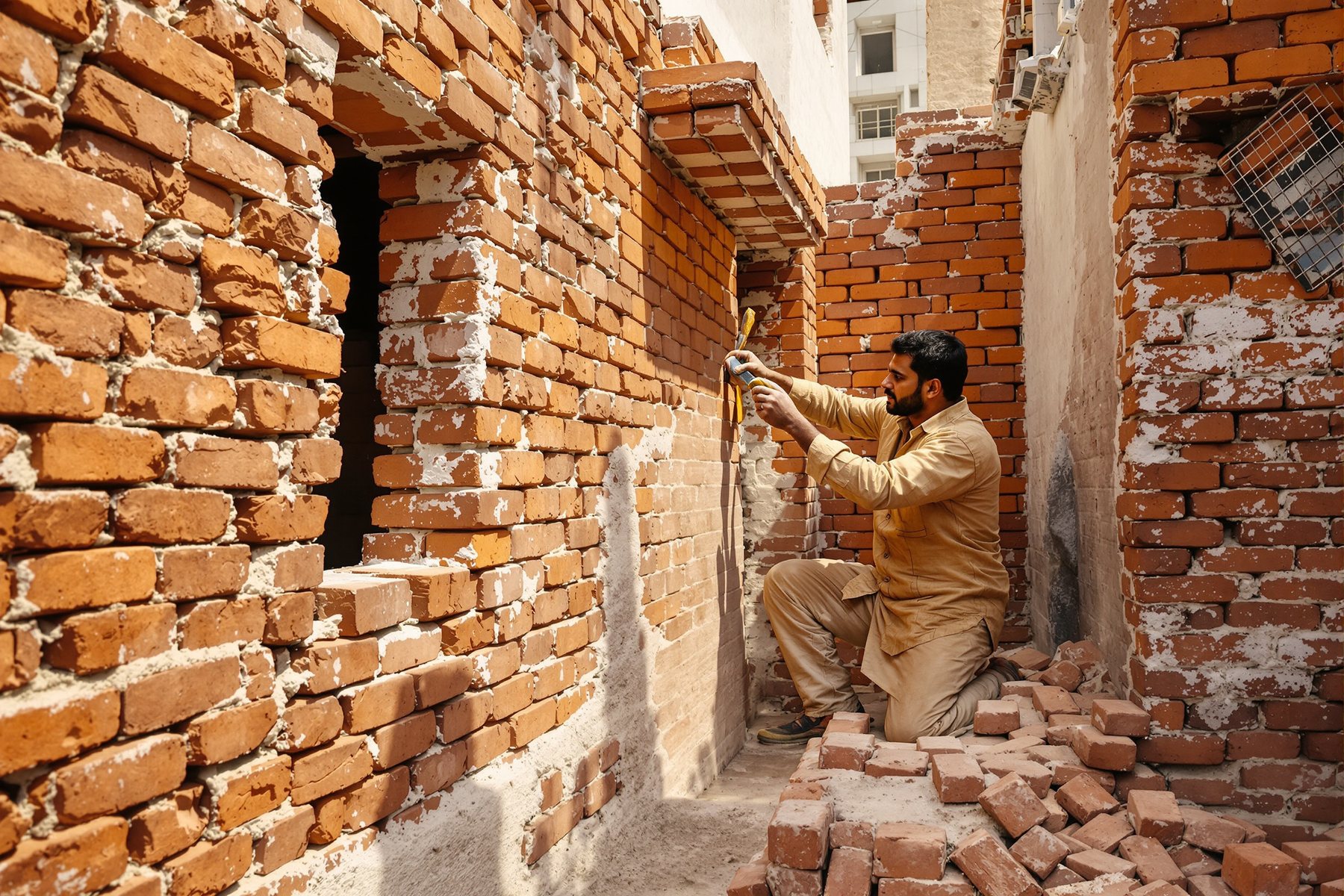
A leak found at handover is a snag. The same leak found after move-in is a renovation.
Waterproofing is the quietest line in the budget and the loudest regret in the house. Nobody admires a dry terrace — until the monsoon arrives and the bedroom ceiling below it blooms with damp. The walls, the plaster and the waterproofing are the stage where your house starts to look finished, which is exactly why the unglamorous, buried-again work gets rushed. Slow down where the water gets in.
Walls, skin, and seal: masonry, plaster, then waterproofing
Good walls are about wetting, mix and curing — not just laying bricks straight
Brickwork (masonry) fills the RCC frame. Two common choices in India:
- Red clay bricks — traditional, strong, locally available; quality varies, so check they ring solid and aren't under-burnt. - AAC blocks (aerated concrete) — lighter, larger, faster to lay, better insulation; increasingly popular in cities.
The quiet detail: bricks must be soaked before laying so they don't suck water out of the mortar and weaken the bond. Joints should be full and even (10-12mm), courses level, and the wall cured (kept wet) for several days like everything else.
Plaster is the cement-sand skin over the masonry, and the mix ratio matters:
- External plaster — richer, around 1:4 to 1:6 (cement:sand), often two coats, to resist rain. - Internal plaster — typically 1:6. - Ceiling — leaner, around 1:4.
Plaster also needs curing for ~7 days or it develops hairline cracks. Rushed, un-cured plaster is the commonest reason a new wall crazes within a year.
Dry bricks and un-cured plaster are free to lay and expensive to live with. Water is the cheap part.
Three places must never leak: the terrace, the bathrooms, the sunken slabs
Waterproofing isn't one product; it's detailing at every spot water sits or runs. Three zones decide whether your house stays dry:
The terrace / roof. The largest water-catcher. It needs a waterproofing system (membrane, or chemical coating under the screed) plus a slope (gradient) toward the outlets so water drains, not ponds. Test it before tiling: flood the terrace for 48-72 hours and check the ceiling below stays dry.
Bathrooms. Wet every day for decades. The floor and walls up to ~1.2m (or full height in the shower) get a waterproof coating, ideally a 'box-type' treatment that seals the whole wet area. Pond-test the bathroom floor for 24-48 hours before tiling.
Sunken slabs. Many Indian bathrooms have a sunken portion below the floor to hold plumbing; this cavity must be waterproofed and then filled with light material, or it becomes a hidden water tank that seeps into the rooms below.
The rule across all three: test with water before you cover the work with tile. A leak found under bare concrete is a morning's fix; the same leak found under finished tile and a false ceiling is a demolition.
Insist on one habit that prevents most water grief: the **flood test before tiling**. Flood the terrace for 2-3 days and each bathroom floor for a day or two, and only tile once the surface below stays bone dry. Also confirm the sunken slab was waterproofed before it was filled. These tests cost a few days and a few buckets of water, and save you the single most miserable post-move-in repair.
Specify waterproofing as a detailed system with a guarantee, not a line-item 'coating'. Insist on slope-to-drain on terraces (min ~1:100), coving at floor-wall junctions, and box-type treatment in wet areas. Sequence flood-testing into the program before screed/tiling, and document it. Match plaster mixes to exposure (richer externally) and enforce curing — most plaster cracking and external-wall seepage on small projects is a curing and mix-ratio failure, not a product one.
Waterproofing is a detailing discipline, not a material. Water finds the junction, the penetration, the cold joint — so the design intelligence is in slopes, drips, coving, sleeves around pipes, and continuity of the membrane around corners. Understand why a brick must be saturated-surface-dry before laying (capillary suction vs bond water), and why plaster mix richness trades cost against weather resistance. Leaks are almost always a detail, not a product.
“Waterproofing is a coating the contractor applies at the end — one good chemical and the house won't leak.”
Waterproofing is detailing, not a single product: slopes to drains, sealed pipe penetrations, coving at junctions, box-type wet areas, and a waterproofed-then-filled sunken slab — all tested with a flood test before any tile goes down. A leak found after the finishes are on means breaking them open to fix it, which is why testing before covering is non-negotiable.
Protect the house from water before it's sealed under tile:
- 01Schedule a flood test — terrace for 48-72 hours, each bathroom floor for 24-48 hours — and confirm the ceiling/floor below stays dry before any tiling starts.
- 02Confirm the sunken slabs were waterproofed before they were backfilled, and that terraces slope toward the drainage outlets.
- 03Check plaster mix ratios (richer ~1:4-1:6 externally, ~1:6 internally) and that walls and plaster were cured for several days — not laid and left dry.
Brickwork and plaster make the house look real, but the value of this stage is in the water you can't see being kept out. Soaked bricks, the right plaster mix, honest curing and — above all — a flood test before tiling on every terrace, bathroom and sunken slab. Do the boring water test now, and you'll never break open a finished bathroom to chase a leak you could have caught for the price of a few buckets.
Lay soaked bricks with full 10-12mm joints, plaster with the right mix (~1:4-1:6 external, ~1:6 internal), and cure both for several days. Then waterproof the three danger zones — terrace (sloped to drain), bathrooms (box-type), and sunken slabs — and flood-test before tiling (terrace 48-72h, bathroom 24-48h). A leak caught under bare concrete is a morning's fix; under finished tile it's a demolition.
What is the correct plaster mix ratio for walls in India?
External plaster is usually richer at about 1:4 to 1:6 (cement:sand) to resist rain, often in two coats, while internal plaster is typically 1:6 and ceilings around 1:4. Whatever the ratio, plaster must be cured (kept wet) for about 7 days, or it develops hairline cracks within a year.
How do I waterproof a terrace and bathroom properly?
Use a proper waterproofing system with a slope toward the drains on terraces and a box-type treatment in bathrooms (floor and walls up to about 1.2m). Critically, flood-test before tiling — terrace for 48-72 hours, bathroom floor for 24-48 hours — and only tile once the surface below stays dry. Don't forget to waterproof the sunken slab before filling it.
Are AAC blocks better than red bricks for building a house?
AAC blocks are lighter, larger, faster to lay and offer better thermal insulation, which suits multi-storey and urban builds. Red clay bricks are strong, locally available and traditional but vary in quality. Both work well when laid properly with soaked units, full mortar joints and curing — the workmanship matters more than the choice.
The author
Amogh N P
Architect, interior designer, and creative polymath. Studio Matrx began in his notebooks — his vision of design made honest, useful, and open to everyone. Its Academy is written and taught in his memory, and free, forever.
More about Amogh →Before the walls get plastered shut and the floors get tiled over, there's a point of no return to clear: the electrical and plumbing lines hidden inside them.