
Structure: columns, slabs, RCC
Concrete looks finished the day it's poured. It isn't strong for almost a month.
Lesson byAmogh N P· Architect & interior designer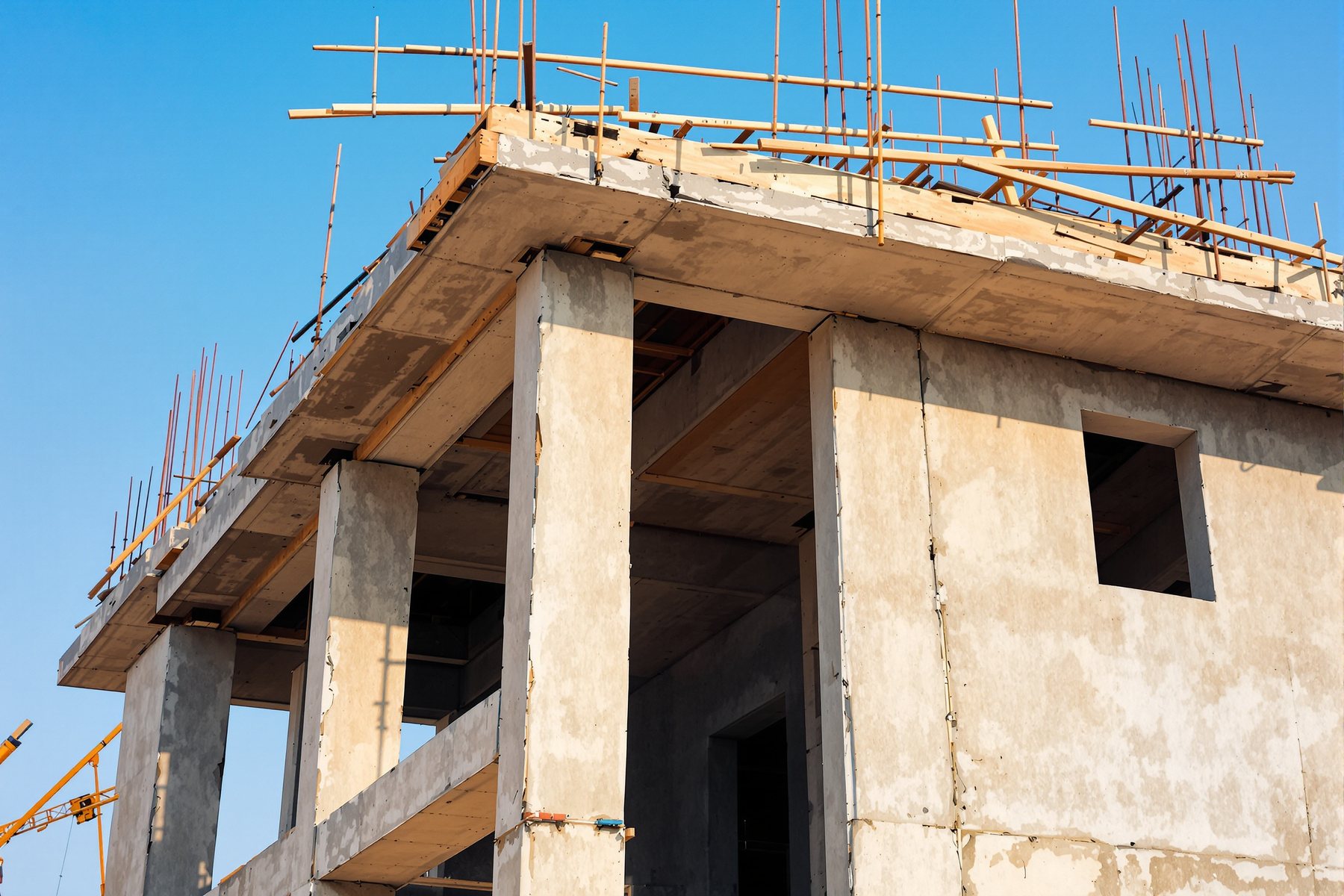
The slab was poured on Monday. The mistake to fear is removing the props on Friday.
Fresh concrete fools everyone. By the next morning it's hard enough to walk on and looks done. But it reaches barely a fraction of its strength in those first days — full strength takes about 28 days of patient curing. Rush the props off, skip the watering, and you've built a structure that's quietly weaker than the drawing assumed. The frame is where you cannot afford to be in a hurry.
RCC = the right concrete + the right steel + time to cure
Concrete is strong in compression, steel in tension — together they're the frame
RCC is reinforced cement concrete: concrete (strong when squeezed) with steel reinforcement bars inside (strong when stretched). The columns, beams and slabs of your house are RCC, and three things decide whether they match the engineer's drawing.
The concrete grade. Quoted as M20, M25, M30 — the number is the strength in N/mm-squared. Homes commonly use M20 or M25 for slabs and columns; the structural drawing specifies it. The grade comes from the mix ratio of cement, sand and aggregate (e.g. M20 is roughly 1:1.5:3) and the water-cement ratio — too much water on site to make it 'workable' quietly weakens it.
The steel. The right diameter bars, the right number, spaced and bent exactly as the bar bending schedule says. This is invisible once concrete covers it, so it must be checked before the pour.
Site-mix vs ready-mix (RMC). RMC from a batching plant gives more consistent grade; careful site-mixing works for small homes if measured by weight/box, not by guesswork shovels.
Concrete is honest about strength only at 28 days. Everything before that is a promise, not a result.
Formwork, cover, slump, vibration, curing — the things that make or break a slab
At each column and slab, five things separate a strong member from a weak one:
- Formwork (shuttering) — the mould holding wet concrete. It must be tight, level and properly propped, or the slab sags or leaks 'honeycombs' (gaps where the mix bled out). - Cover blocks — small spacers that hold the steel 25-50mm inside the concrete face. Too little cover and the steel rusts in a few years and the concrete spalls. Cheap, vital, often skipped. - Slump test — a quick cone test of how wet the mix is. It catches over-watered (weak) concrete before it's poured. For most slabs a slump of 75-125mm is typical. - Compaction (vibration) — a needle vibrator removes air pockets so the concrete is dense. Under-vibrated concrete is honeycombed; over-vibrated mix separates. - Curing — the big one. Concrete must be kept wet for at least 7 days, ideally 14, and gains most of its strength over 21-28 days. Ponding water on slabs, wet hessian on columns. Props/shuttering stay on per the engineer (slabs often 14-21 days before deshuttering). Take cube samples at the pour for lab testing — that's your proof the grade was actually delivered.
You don't need to test concrete yourself — you need to insist on three things and witness them: cover blocks under the steel before the pour, cubes taken at the pour for testing, and curing (visible wet slabs and props left on) for the full period the engineer states. The single most common shortcut on Indian sites is stopping curing after 2-3 days because the slab 'looks dry'. Don't allow it.
Specify grade, cover and curing regime in the BOQ and hold a pre-pour checklist: BBS-verified steel, cover blocks, formwork level, slump and cube moulds ready. Tie deshuttering and prop-removal to engineer sign-off, not a calendar guess. For small residential pours, weigh-batch or volume-box site mix rather than shovel counts, and reject mixes that get extra water added at the chute for 'workability'.
RCC is the union of two materials covering each other's weakness — concrete's poor tension handled by steel, steel's corrosion and fire-vulnerability handled by concrete cover. Understand why water-cement ratio governs strength (and why excess water lowers it), why curing is a hydration process not just 'drying', and why the 28-day cube test is the contractual definition of grade. Strength is time-dependent, and the design assumes you respected the time.
“Once the concrete is hard enough to walk on the next day, the slab is ready and we can remove the supports.”
Concrete reaching walkable hardness has only a small fraction of its design strength. It gains most strength over 21-28 days of curing, and slab props/shuttering typically stay 14-21 days until the engineer approves removal. Pulling supports early can crack or deflect the slab permanently. Curing isn't optional drying time — it's how concrete actually becomes strong.
Set the non-negotiables for every pour:
- 01Get the concrete grade (M20/M25) and curing/deshuttering period from your structural drawing in writing, and brief the contractor that cubes will be tested.
- 02Be present at one slab pour to witness cover blocks under the steel, the slump test, and cube samples being taken.
- 03Walk the site daily during curing for the first two weeks and confirm slabs are kept wet (ponded) and props stay until the engineer signs off.
Nearly every structural weakness in a small Indian build traces to one of three rushed steps: water added at the chute, cover blocks left out, or curing stopped after a couple of days. None costs money to do right — they cost only patience and attention. Witness the steel and the cubes, insist on the full curing period, and let concrete become as strong as the drawing assumed it would.
RCC = the specified grade (commonly M20/M25) plus steel placed per the bar-bending schedule, made strong by time. At each pour, check formwork, cover blocks (25-50mm), slump (75-125mm), compaction and curing. Cure wet for 21-28 days, keep props/shuttering on 14-21 days until the engineer signs off, and take cubes as proof of grade.
What concrete grade is used for a house in India — M20 or M25?
Most independent houses use M20 or M25 for columns and slabs, with the exact grade set by the structural engineer on the drawing. The 'M' number is the concrete's strength in N/mm-squared, so M25 is stronger than M20. Higher grades may be specified for heavily loaded columns or larger spans.
How long does concrete take to cure and gain strength?
Concrete should be kept wet for at least 7 days, ideally 14, and gains most of its strength over 21-28 days. The 28-day cube strength is the standard benchmark. Stopping curing early because the surface looks dry is a common mistake that leaves the concrete weaker than designed.
When can slab shuttering and props be removed?
Slab formwork and props usually stay on for about 14-21 days, and the exact period is set by the structural engineer based on the span and grade. Removing supports too early — sometimes done within days to reuse shuttering — can cause permanent cracking or deflection. Always tie deshuttering to engineer sign-off, not a calendar guess.
The author
Amogh N P
Architect, interior designer, and creative polymath. Studio Matrx began in his notebooks — his vision of design made honest, useful, and open to everyone. Its Academy is written and taught in his memory, and free, forever.
More about Amogh →The skeleton is up and cured. Now it gets clothed — brick walls fill the frame, plaster smooths it, and waterproofing keeps the weather out.