
B.Arch CurriculumFree, forever
A tribute to Amogh N P
Architectural Design VII
This is the studio where the building becomes a piece of the city. Architectural Design VII takes on advanced, complex problems at the URBAN LEVEL — groups of multi-storey buildings and their infrastructure, large developments shaped by climate, orientation, services and circulation, and the campuses, urban centres and senior-citizens' housing that hold thousands of people. It is also the studio that takes universal design seriously: a barrier-free route for every user, not as an afterthought but as the spine of the plan. Following Design VI's single complex building, Design VII scales up to the group, the campus and the quarter — and asks you to research, analyse and deliver an urban design proposal. It is the studio companion to the Urban Design theory course.
Course byAmogh N P· Architect & interior designer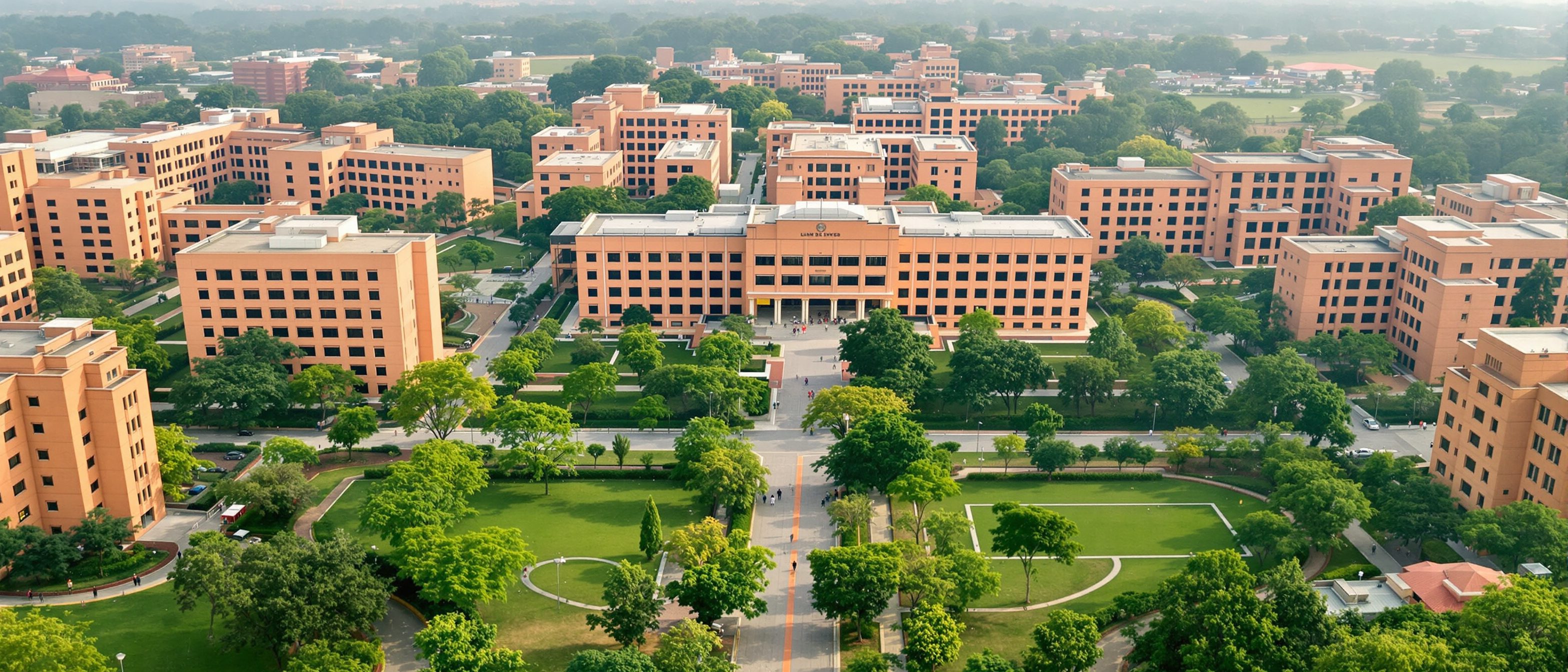
The syllabus
5 units · 5 liveThe published syllabus gives a single content block; we organise it into 5 teaching units faithful to the content and outcomes, each with original diagrams, a self-assessment and studio work.
Unit 1 — The Urban-Scale Design Problem
LiveThe jump from one building to a group; reading a complex, multi-part programme at the urban level; building-type basics for large developments; the organisational patterns — spine, court, cluster, mat and grid — that order groups of multi-storey structures and a campus; precedent study at the urban scale.
Unit 2 — Site, Climate & Context
LiveReading and responding to the large site — climatic conditions, orientation and microclimate; massing and open space for sun, wind and shade; the infrastructure of a large development (water, sewerage, power, stormwater, solid waste); and sensitising the design to its environment and its urban context.
Unit 3 — Circulation & Movement
LiveThe circulation problems of large developments — separating and integrating pedestrian, vehicular and service movement; the movement systems that organise a campus or urban centre; parking and access; and weaving services through a group of multi-storey buildings.
Unit 4 — Universal Design & the Campus
LiveDesign and detailing for movement and use by persons with disabilities within and around buildings and campuses; the seven principles of universal design and the Harmonised Guidelines 2021; barrier-free routes, ramps, lifts and wayfinding at campus scale; and designing for older people — senior-citizens' housing.
Unit 5 — Process, Communication & Delivery
LiveThe design process from research and analysis to a tangible design; the diagram as a design and communication tool; delivering an urban design proposal; communicating ideas across drawings, diagrams, models and multiple media; and the jury — assessed against a weighted rubric.
Course outcomes
What you will be able to doUnderstand the functional aspects of designing a complex building type and its spatial organization.
Reciprocate and sensitise the design to its environment, with design skill across the project.
Transform theoretical ideas into the tangible output of an architectural design.
Apply space-organization and space-volume thinking to large-scale projects.
Research, analyse and deliver an urban design proposal.
Communicate design ideas effectively across drawings, diagrams and models.
The author
Amogh N P
Architect, interior designer, and creative polymath. Studio Matrx began in his notebooks — his vision of design made honest, useful, and open to everyone. Its Academy is written and taught in his memory, and free, forever.
More about Amogh →When the building becomes a piece of the city.
Groups of buildings and campuses, climate and infrastructure, movement, universal design and the urban design proposal. Work through the five units, study the diagrams, then self-assess.
The curriculum is free, forever