
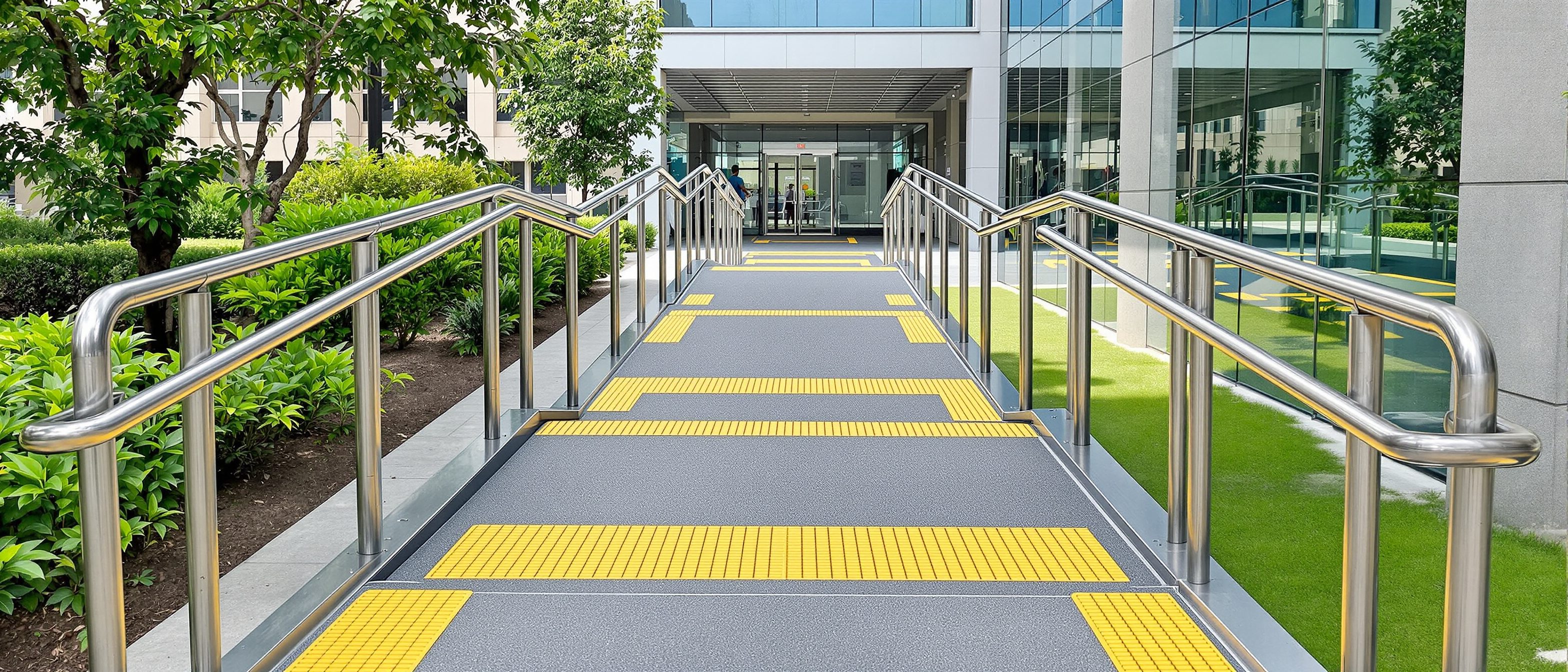
Universal Design & the Campus
A barrier-free route for every user — and designing for older people.
The syllabus singles out one agenda for this studio: design and detailing for movement and use by persons with disabilities, within and around buildings AND across campuses. This unit treats universal design not as a checklist bolted on at the end but as the spine of the plan — a continuous barrier-free route that connects every part for every user, including wheelchair users, the visually impaired and older people. It covers the seven principles, the Harmonised Guidelines 2021, campus-scale accessibility, and senior-citizens' housing.
Learning objectives
By the end of this unit, you will be able to — mapped to the course outcomes for Architectural Design VII:
Explain the seven principles of universal design and the Harmonised Guidelines 2021.
Design a continuous barrier-free route across a campus for every user.
Detail accessible ramps, lifts, toilets and wayfinding to the current standard.
Design housing for senior citizens with their specific needs in mind.
Design for all
Universal design — the seven principles, the legal standard, the continuous accessible route that fails at its weakest link — is the spine of the plan, not a bolt-on.[10, 11]
Design for all
UNIVERSAL DESIGN goes beyond 'barrier-free' (removing obstacles for disabled people) to designing environments USABLE BY ALL, of every age and ability, without special adaptation. Its SEVEN PRINCIPLES — equitable use, flexibility in use, simple and intuitive use, perceptible information, tolerance for error, low physical effort, and size and space for approach and use — are the design test. The aim is a campus no one has to enter 'the other way'.[10]
Designing for older people
Older people are a named user group; senior housing should be home-and-community, accessible and dignified — and the studio must be held to the right numbers.[12, 11]
Senior citizens' needs
Older people are a named user group in this studio. Designing for age means: step-free, low-effort movement; good light and clear sight-lines; non-slip, even surfaces; rest points and seating along routes; clear, legible wayfinding; safe, supervised yet dignified outdoor space; and proximity of services and healthcare. Universal design serves seniors as a matter of course — they are the clearest case for designing-for-all.[12]
At a glance
| Aspect | One | The other |
|---|---|---|
| Approach | Barrier-free: remove obstacles for some | Universal: usable by all from the start |
| Current standard | Myth: Harmonised 2016 | Reality: Harmonised Guidelines 2021 |
| The route | Isolated ramps here and there | A continuous accessible network |
| Accessibility fails | Only if many things are wrong | At the single weakest link |
| Senior housing | Institutional ward | Home & community, accessible and dignified |
Key terms
Designing environments usable by all, of every age and ability, without special adaptation.
Equitable use, flexibility, simple/intuitive, perceptible information, tolerance for error, low effort, size/space.
The statute making accessibility a legal duty in India.
Current Indian universal-accessibility standard (superseded the 2016 barrier-free guidelines).
A continuous step-free, graded, firm, lit path connecting everything for every user.
Accessibility fails at the worst point — one kerb or step breaks the whole chain.
Maximum accessible ramp gradient; gentler preferred, with landings and dual handrails.
Housing designed for older people — step-free, legible, supported, community-rich.
Studio task
Trace the continuous accessible route through your scheme — from parking and drop-off to every building entrance and key space — as a single highlighted line, and prove there is no break (no kerb, step or missing ramp). Detail one accessible ramp, lift and toilet to the Harmonised Guidelines 2021, and sketch a senior-citizens' housing cluster that is step-free, legible and community-rich.
Self-assessment
1. Universal design differs from 'barrier-free' design in that it aims to —
2. The current authoritative accessibility standard for India is the —
3. On a campus, an accessible route fails when —
Recap
References & further reading
- [10]Centre for Universal Design, NC State — The Seven Principles of Universal Design (Ron Mace et al., 1997).
- [11]CPWD / MoHUA — Harmonised Guidelines and Standards for Universal Accessibility in India, 2021; Rights of Persons with Disabilities Act 2016.
- [12]Building Type Basics for Senior Living (Wiley); design guidance for ageing and senior-citizens' housing.
Further reading
- CPWD / MoHUA — Harmonised Guidelines for Universal Accessibility 2021 (free PDF).
- Ron Mace et al. — The Seven Principles of Universal Design (1997).
- Building Type Basics for Senior Living (Wiley).
Sources gathered and fact-checked June 2026. Published values vary by source, sample and method — treat as indicative and confirm against the cited standard before structural use.
The author
Amogh N P
Architect, interior designer, and creative polymath. Studio Matrx began in his notebooks — his vision of design made honest, useful, and open to everyone. Its Academy is written and taught in his memory, and free, forever.
More about Amogh →