
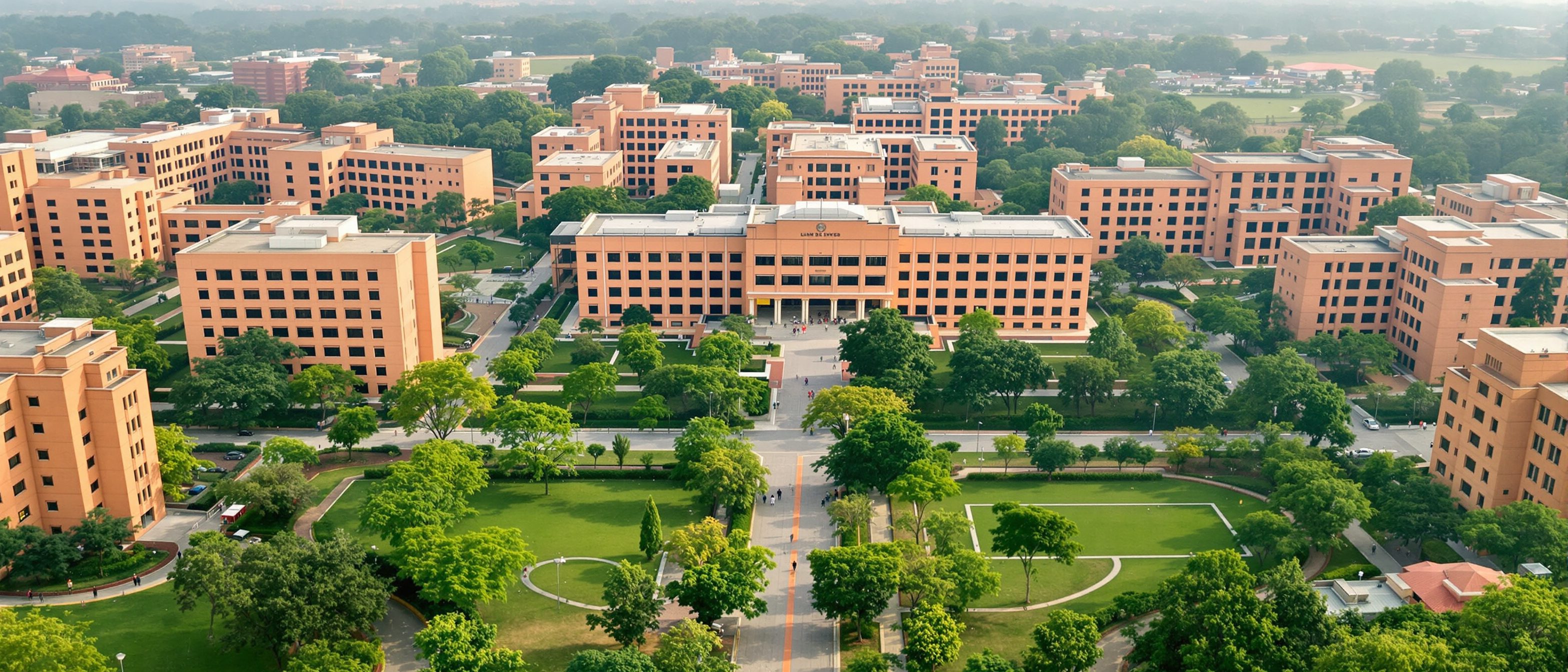
The Urban-Scale Design Problem
From one building to a group, a campus, a quarter.
Design VII begins with a jump in scale: from a single building to a group of multi-storey structures, a campus, an urban centre. The complex programme can no longer be held in one object — it must be ORGANISED across many, and the organising idea (a spine, a court, a cluster, a mat, a grid) becomes the design. This first unit teaches you to read a complex urban-scale brief, to use building-type basics for large developments, and to choose an organisational pattern that orders the group and lets it grow.
Learning objectives
By the end of this unit, you will be able to — mapped to the course outcomes for Architectural Design VII:
Read and structure a complex, multi-part programme at the urban scale.
Explain the organisational patterns — spine, court, cluster, mat, grid — for groups of buildings.
Choose and test an organising idea for a campus or urban-centre project.
Use building-type basics and precedent to inform a large-development design.
From one building to a group
A single building resolves its programme inside one envelope; an urban-level project cannot. The programme is distributed across a group, and the spaces between buildings become the real design.[1, 6]
A group, not an object
Design VII is defined by SCALE. A single complex building (Design VI) resolves its programme inside one envelope; an urban-level project — a campus, an urban centre, a large mixed development — cannot. The programme is distributed across a GROUP of buildings, and the relationships BETWEEN them (the streets, courts and routes that link them) become the real design. The architect now works partly as an urban designer, ordering the spaces between buildings, not just the buildings.[1, 6]
Patterns that order the group
Five organisational patterns order a group of buildings — and for hot Indian climates the court and mat are climate devices, while the grid gives the legibility of the city.[1, 8]
Order along an axis
A SPINE organises buildings along a dominant pedestrian street or axis that carries movement and structures growth — extend the spine and the campus grows. It gives a clear address and a strong public route, and suits projects that must grow over time. The risk is monotony and long walks if the spine is not punctuated by nodes and courts.[1]
Test the organising idea
Pick an organisational pattern and see how it orders a group of buildings — and what it is best for. The pattern is the design.
Organising the group · pick a pattern
Courtyard / quad
Buildings wrapped around shared outdoor rooms (quads, courts); the void organises the solids and gives sheltered, climate-friendly social space.
Best for: Hot-climate campuses, institutions, senior housing — shade and community.
The organising pattern is the design — it orders the group and decides how it grows.
At a glance
| Aspect | One | The other |
|---|---|---|
| Organised by | Spine: a linear axis | Court: a central void |
| Growth | Spine/grid: extend easily | Cluster: grow unevenly, incrementally |
| Density model | Mat: low-rise high-density | Tower: high-rise |
| Climate fit (hot) | Court & mat: shade, ventilation | Open slab blocks: exposed |
| Design VI vs VII | VI: one complex building | VII: a group / campus / quarter |
Key terms
A design of a group of buildings and the spaces between them — a campus, urban centre or quarter.
The idea that orders a group of buildings — spine, court, cluster, mat or grid.
A dominant pedestrian axis along which buildings are arranged and growth extends.
Buildings wrapped around a shared outdoor room — the void as organiser and social heart.
A dense low-rise woven fabric of building and court, high density without towers.
The central organising idea or diagram of a scheme.
Reference dimensional/functional standards for known building types (Kliment, Neufert).
A studied built example used to build design judgement at a scale you cannot prototype.
Studio task
For your urban-scale brief (a campus, urban centre or large development), draw a programme-as-system diagram — the zones, what is near what, who moves between. Then test two organisational patterns with the explorer and pick one, arguing why it suits your programme, climate and growth. Sketch the parti as a single diagram.
Self-assessment
1. What most distinguishes an Architectural Design VII project from a Design VI one?
2. In a courtyard (quad) organisation, the element that organises the buildings is the —
3. A 'mat' or carpet organisation achieves high density by —
Recap
References & further reading
- [1]Garcia, Mark (ed.) — The Diagrams of Architecture (Wiley, 2010) — organisational diagrams and parti.
- [3]Burte, Himanshu — Space for Engagement: The Indian Artplace and a Habitational Approach to Architecture (Seagull Books, 2008).
- [4]Kliment, Stephen A. (ed.) — Building Type Basics series (Wiley).
- [5]Mitchell, William J. — Imagining MIT: Designing a Campus for the 21st Century (MIT Press, 2007).
- [6]Nesbitt, Kate (ed.) — Theorizing a New Agenda for Architecture (Princeton Architectural Press, 1996).
- [7]Peña, W. & Parshall, S. — Problem Seeking: An Architectural Programming Primer (Wiley).
- [8]Curtis, William J.R. — Balkrishna Doshi: An Architecture for India; studies of IIM Ahmedabad (Kahn) and campus design.
Further reading
- Mark Garcia (ed.) — The Diagrams of Architecture (2010).
- Stephen A. Kliment (ed.) — Building Type Basics series.
- William J. Mitchell — Imagining MIT (2007).
Sources gathered and fact-checked June 2026. Published values vary by source, sample and method — treat as indicative and confirm against the cited standard before structural use.
The author
Amogh N P
Architect, interior designer, and creative polymath. Studio Matrx began in his notebooks — his vision of design made honest, useful, and open to everyone. Its Academy is written and taught in his memory, and free, forever.
More about Amogh →