
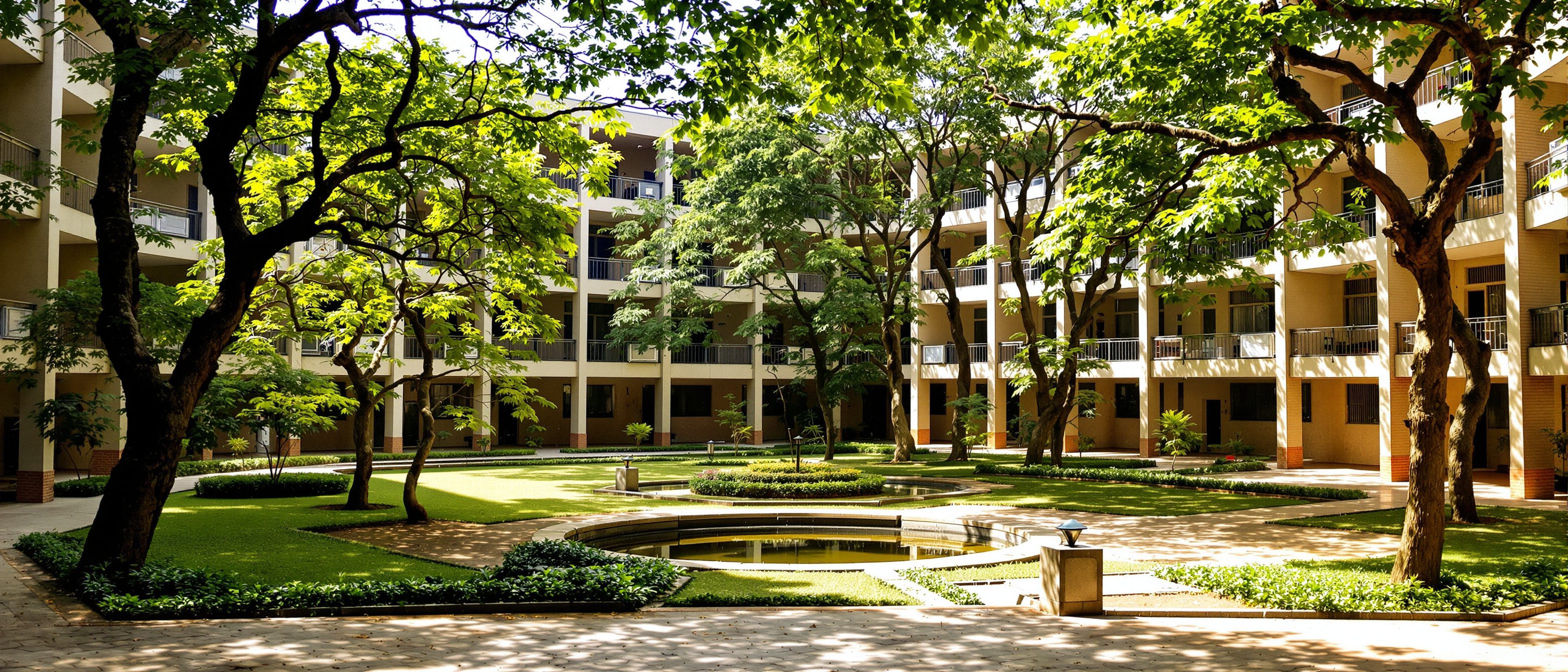
Site, Climate & Context
Massing for sun and wind, and the infrastructure of a large development.
At the urban scale, the site stops being a backdrop and becomes the design's main partner. This unit is about sensitising the project to its environment: reading the large site's climate, orientation and microclimate and massing the group of buildings for sun, shade and wind; and providing the infrastructure a large development needs — water, sewerage, stormwater, power, waste — which at this scale is a structuring system, not a service afterthought.
Learning objectives
By the end of this unit, you will be able to — mapped to the course outcomes for Architectural Design VII:
Read a large site's climate, orientation and microclimate and respond in the massing.
Mass a group of buildings for sun, shade, wind and the public open spaces.
Plan the infrastructure of a large development as a structuring system.
Sensitise the design to its urban and environmental context.
Massing for climate
Climate at the group scale is controlled by massing and the designed spaces between buildings — and a large project must strengthen its urban context.[9, 2]
Sun, wind, rain
Begin with the site's CLIMATE — the sun path and the harsh and benign orientations, the prevailing wind, the monsoon and stormwater, and the microclimate the existing trees, water and ground already create. In most of India the design problem is shade and ventilation; orientation and self-shading massing matter more than any single building's facade. (Cross-link the Climatology course for the physics.)[9]
The infrastructure armature
A large development carries its own infrastructure city — water, sewerage, stormwater, power and waste — that structures the plan. Design the armature first; buildings then find their place.[4]
The hidden city
A large development carries its own infrastructure city: water supply (sourcing, storage, distribution, pressure zones), and sewerage and treatment (often an on-site STP, with treated water reused for landscape and flushing). At this scale these systems shape the plan — where the plant goes, how the gradients fall, where the trunk mains run — so they must be designed WITH the layout, not after it.[4]
At a glance
| Aspect | One | The other |
|---|---|---|
| Climate control at scale | By single-building facades | By massing & the spaces between |
| Open space | Myth: left-over land | Designed for shade, breeze, public life |
| Infrastructure | Myth: a hidden afterthought | A structuring system, designed with the layout |
| Stormwater | Ignored: floods the development | Designed: part of the public landscape |
| Order of design | Buildings first, services patched | Armature first, buildings find place |
Key terms
The local climate created by a site's trees, water, ground and built form.
Shaping and orienting a group of buildings so they shade each other and the public realm and channel breeze.
Sewage Treatment Plant — an on-site system treating wastewater, often for landscape/flushing reuse.
Sustainable urban drainage and rain capture — stormwater as designed landscape.
The main water, sewer, power and data lines that structure a development's layout.
The structuring framework of roads, services and open space on which buildings sit.
Collection, segregation and processing of waste across a development.
Designing a large project to strengthen its natural and urban surroundings.
Studio task
For your site, draw a climate-and-context analysis (sun path, prevailing wind, harsh orientations, neighbours, edges) and then a massing diagram showing how the group self-shades and opens to the breeze. Separately, draw the infrastructure armature — roads, trunk services, open-space network, where the STP and plant sit — and show how the buildings sit on it.
Self-assessment
1. At the urban scale, climate is most powerfully controlled by —
2. In a large development, infrastructure (water, sewerage, stormwater, power) is best treated as —
3. Getting stormwater design wrong in monsoon India most directly causes —
Recap
References & further reading
- [2]Leach, Neil (ed.) — Rethinking Architecture: A Reader in Cultural Theory (Routledge, 2000).
- [4]Kliment, Stephen A. (ed.) — Building Type Basics series; CPHEEO Manuals (water, sewerage, SWM) for Indian infrastructure norms.
- [6]Nesbitt, Kate (ed.) — Theorizing a New Agenda for Architecture (Princeton Architectural Press, 1996).
- [9]Koenigsberger, O.H. et al. — Manual of Tropical Housing and Building; SP 41 (BIS) — climate-responsive design.
Further reading
- Koenigsberger et al. — Manual of Tropical Housing and Building.
- Stephen A. Kliment (ed.) — Building Type Basics series.
- CPHEEO Manuals — Water Supply, Sewerage and Solid Waste (Govt. of India).
Sources gathered and fact-checked June 2026. Published values vary by source, sample and method — treat as indicative and confirm against the cited standard before structural use.
The author
Amogh N P
Architect, interior designer, and creative polymath. Studio Matrx began in his notebooks — his vision of design made honest, useful, and open to everyone. Its Academy is written and taught in his memory, and free, forever.
More about Amogh →