
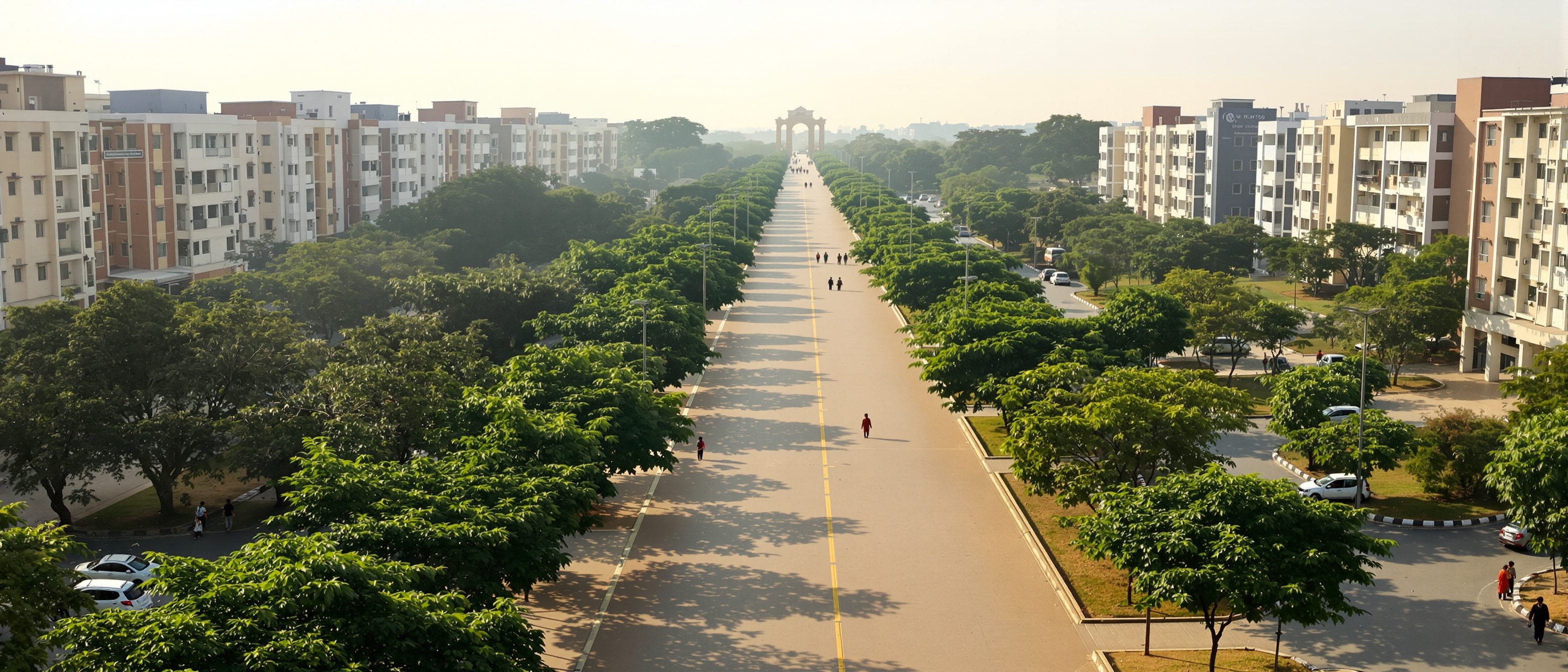
Circulation & Movement
Separating people, vehicles and services across a large development.
Move thousands of people, hundreds of vehicles and a constant flow of services through a campus, and circulation becomes the hardest problem in the studio. This unit is about MOVEMENT at the large scale: separating and integrating pedestrian, vehicular and service flows so they support rather than fight each other; the movement systems that organise the whole; parking and access; and weaving services through a group of multi-storey buildings. As Edmund Bacon argued, movement is what organises urban form.
Learning objectives
By the end of this unit, you will be able to — mapped to the course outcomes for Architectural Design VII:
Separate and integrate pedestrian, vehicular and service movement at the large scale.
Design a movement system — hierarchy, spine, loop — for a campus or urban centre.
Resolve parking and access for a large development.
Weave services through a group of multi-storey buildings.
Three flows, one design
Three movements must be separated yet integrated; movement systems organise urban form, and the pedestrian comes first.[1]
People, vehicles, services
A large development carries three different movements that must be SEPARATED yet INTEGRATED: pedestrians (who want a safe, shaded, continuous walking realm), vehicles (who need access and parking but should not dominate), and services (deliveries, waste, emergency, maintenance — which must reach every building unseen). Conflict between them — a service truck crossing a pedestrian spine, cars flooding a square — is the commonest failure at this scale.[1]
Services through the group
Services need their own routes and yards, run horizontally between buildings and vertically within them, and share routes with the hard constraint of emergency access.[4]
The unseen flows
Services — deliveries, kitchens, laundry, waste, plant maintenance — need their own routes and yards that reach every building without crossing the public realm. A service spine or rear-access lane, screened service courts, and dedicated cores keep the messy necessary flows working and invisible. Forgetting service access is a classic studio error that only shows up when the building is 'finished'.[4]
At a glance
| Aspect | One | The other |
|---|---|---|
| Three flows | Conflicting: trucks cross the spine | Integrated: layered by route and level |
| Who comes first | Car-led: parking dominates | Pedestrian-first: shaded walking realm |
| Services | Forgotten until 'finished' | Own routes and yards, designed early |
| Movement framework | Left to chance: a maze | Designed hierarchy: legible |
| Emergency access | An afterthought | A hard constraint to every building |
Key terms
Pedestrian, vehicular and service movement — separated yet integrated across a development.
The framework of spines, loops and hierarchies that organises movement and urban form (Bacon).
Designing a continuous, shaded, barrier-free walking realm as the first move; cars as guests.
A dedicated route and yards reaching every building without crossing the public realm.
Arterial → loop → access, with parking peripheral or structured.
A defined point for vehicles to set down and pick up without entering the pedestrian core.
Required emergency-vehicle access and turning to within a set distance of every building (NBC).
Layering the three flows by route, level and time so each works without spoiling the others.
Studio task
Draw a movement diagram for your scheme on three layers — pedestrian, vehicle, service — then overlay them to find conflicts and resolve them by route, level or time. Mark the drop-offs, the parking, the service yards, and prove that a fire tender can reach within the required distance of every building.
Self-assessment
1. Edmund Bacon argued that the primary organiser of urban form is —
2. On a well-designed campus, the three flows — pedestrian, vehicle, service — should be —
3. A classic studio error at the urban scale is to forget —
Recap
References & further reading
- [1]Bacon, Edmund N. — Design of Cities (Viking Press, 1967) — movement systems as the organiser of urban form.
- [4]BIS — NBC 2016, Part 4 (fire-tender access) & Part 3 (parking, circulation); Kliment Building Type Basics.
Further reading
- Edmund N. Bacon — Design of Cities (1967).
- BIS — NBC 2016, Parts 3 & 4 (circulation, parking, fire access).
- Joseph De Chiara & Lee Koppelman — Time-Saver Standards for Site Planning.
Sources gathered and fact-checked June 2026. Published values vary by source, sample and method — treat as indicative and confirm against the cited standard before structural use.
The author
Amogh N P
Architect, interior designer, and creative polymath. Studio Matrx began in his notebooks — his vision of design made honest, useful, and open to everyone. Its Academy is written and taught in his memory, and free, forever.
More about Amogh →