
Process, Communication & Delivery
From research to an urban design proposal — and the jury.
An urban-scale idea is worth nothing until it is delivered as a tangible, communicated design. This final unit is about PROCESS and DELIVERY: moving from research and analysis through a design methodology to a resolved scheme; using the diagram as both a design and a communication tool; delivering an urban design proposal (the course's analyse-level outcome); communicating across drawings, diagrams, models and multiple media; and facing the jury. Self-assess with the Design VII rubric before the crit.
Learning objectives
By the end of this unit, you will be able to — mapped to the course outcomes for Architectural Design VII:
Run a design process from research and analysis to a tangible, resolved scheme.
Use the diagram as a tool for both designing and communicating an urban-scale idea.
Research, analyse and deliver an urban design proposal.
Communicate across drawings, diagrams, models and multiple media, and present at a jury.
An iterative methodology
A design methodology keeps a complex project in control — research earns the design, and the diagram both thinks and shows.[6, 1, 13]
Method, not magic
At this scale a design METHODOLOGY keeps you in control: research and site analysis → programme and concept → an organising parti → development of the group, the public realm and the section → detailing and resolution → delivery. It is iterative, not linear — you loop back as analysis reveals problems — but having a framework (CO: 'a frame work of Design methodology') stops a complex project drifting.[6, 7]
Communicate and deliver
Communicate the scheme across multiple media, deliver a whole urban design proposal, and defend it at the jury — the design's final design tool.[1, 6]
Draw, model, render, narrate
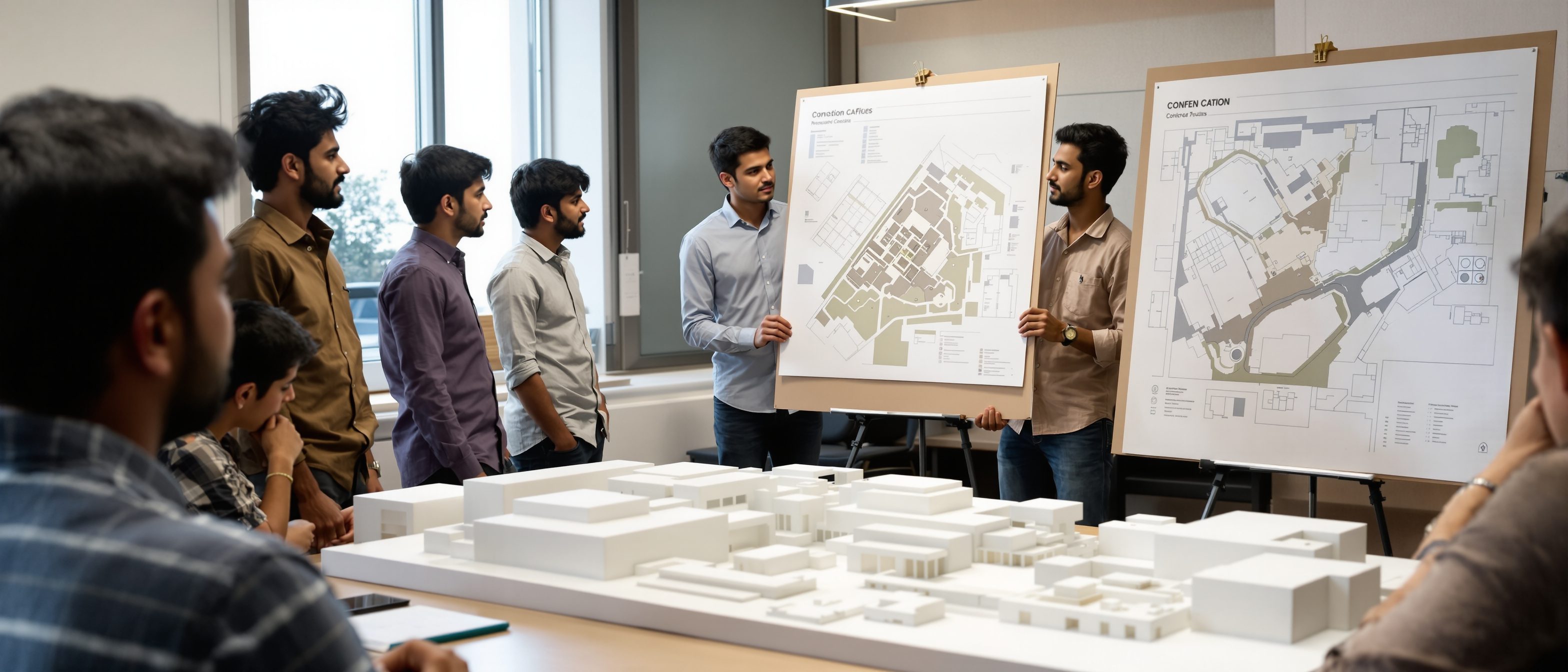
Communicate the scheme across MULTIPLE MEDIA: orthographic drawings (site plan, plans, sections, elevations), analytical and concept diagrams, physical and digital models, perspectives and walkthroughs, and a clear written/spoken narrative. Different media carry different truths — the model shows massing and shadow, the section shows the public realm, the diagram shows the idea. Use each for what it does best.[1]
Self-assess before the jury
Score your scheme on the six weighted dimensions the studio is judged on, and read the weighted total and verdict — so you fix the weakest dimension before the critics find it.
Self-assess your scheme · before the jury
Partly resolved — pushing from the low toward the high.
Partly resolved — pushing from the low toward the high.
Partly resolved — pushing from the low toward the high.
Partly resolved — pushing from the low toward the high.
Partly resolved — pushing from the low toward the high.
Partly resolved — pushing from the low toward the high.
60
/ 100
Developing — the idea is there; resolve the weak dimensions.
Weighted across the six dimensions the studio is judged on — fix the weakest before the critics find it.
At a glance
| Aspect | One | The other |
|---|---|---|
| Process | Linear: rush analysis, jump to form | Iterative: analysis earns the design |
| The diagram | A decorative graphic at the end | A tool to both think and show |
| Concept test | Looks good in one render | Survives drawing at every scale |
| Deliverable | A set of buildings | A whole urban design proposal |
| The jury | A verdict to fear | The design's final design tool |
Key terms
A framework guiding a complex project from research through concept to delivery — iterative, not linear.
The study of site, climate, context, users and precedent where the design's real moves are found.
The urban designer's key tool for both thinking through and communicating an idea.
The resolved drawings, models and details into which a theoretical idea is transformed (CO3).
The course's headline deliverable — a structured argument for a piece of city or campus.
Drawings, diagrams, models, renders and narrative — each used for what it shows best.
The presentation and defence of a scheme to critics — the design's final design tool.
A weighted set of criteria for self-assessing and judging an urban-scale scheme.
Studio task — the capstone
Deliver your urban design proposal: the analysis that justifies it, the parti diagram, the public realm and movement, the environmental and universal-design strategies, and the staged delivery — across site plan, sections, diagrams and a physical model. Self-assess with the rubric, fix the weakest dimension, then present and defend it as if at the jury. Draw on the Urban Design theory course throughout.
Self-assessment
1. In the urban-scale studio, the DIAGRAM is best understood as —
2. Course outcome CO5 asks the student specifically to —
3. The best use of a physical model versus a section drawing is that the model best shows —
Recap
References & further reading
- [1]Garcia, Mark (ed.) — The Diagrams of Architecture (Wiley, 2010).
- [3]Burte, Himanshu — Space for Engagement (Seagull Books, 2008).
- [6]Nesbitt, Kate (ed.) — Theorizing a New Agenda for Architecture (Princeton Architectural Press, 1996).
- [7]Peña, W. & Parshall, S. — Problem Seeking: An Architectural Programming Primer (Wiley).
- [13]Ingels, Bjarke — Yes is More: An Archicomic on Architectural Evolution (Taschen, 2009).
Further reading
- Mark Garcia (ed.) — The Diagrams of Architecture (2010).
- Bjarke Ingels — Yes is More (2009).
- Kate Nesbitt (ed.) — Theorizing a New Agenda for Architecture (1996).
Sources gathered and fact-checked June 2026. Published values vary by source, sample and method — treat as indicative and confirm against the cited standard before structural use.
The author
Amogh N P
Architect, interior designer, and creative polymath. Studio Matrx began in his notebooks — his vision of design made honest, useful, and open to everyone. Its Academy is written and taught in his memory, and free, forever.
More about Amogh →