
B.Arch CurriculumFree, forever
A tribute to Amogh N P
Architectural Design V
The mid-scale studio. After the single building comes the small complex — a shopping centre, a group of apartments, a nursing home, a home for the aged, or a mixed-use block — where the design problem is no longer one room but the stacking of uses, the analysis of circulation and massing, the planning of a site, and the integration of building services. Above all it is the studio that designs for everyone: barrier-free, universal movement of the physically handicapped and the elderly, approached stage by stage through architectural programming.
Course byAmogh N P· Architect & interior designer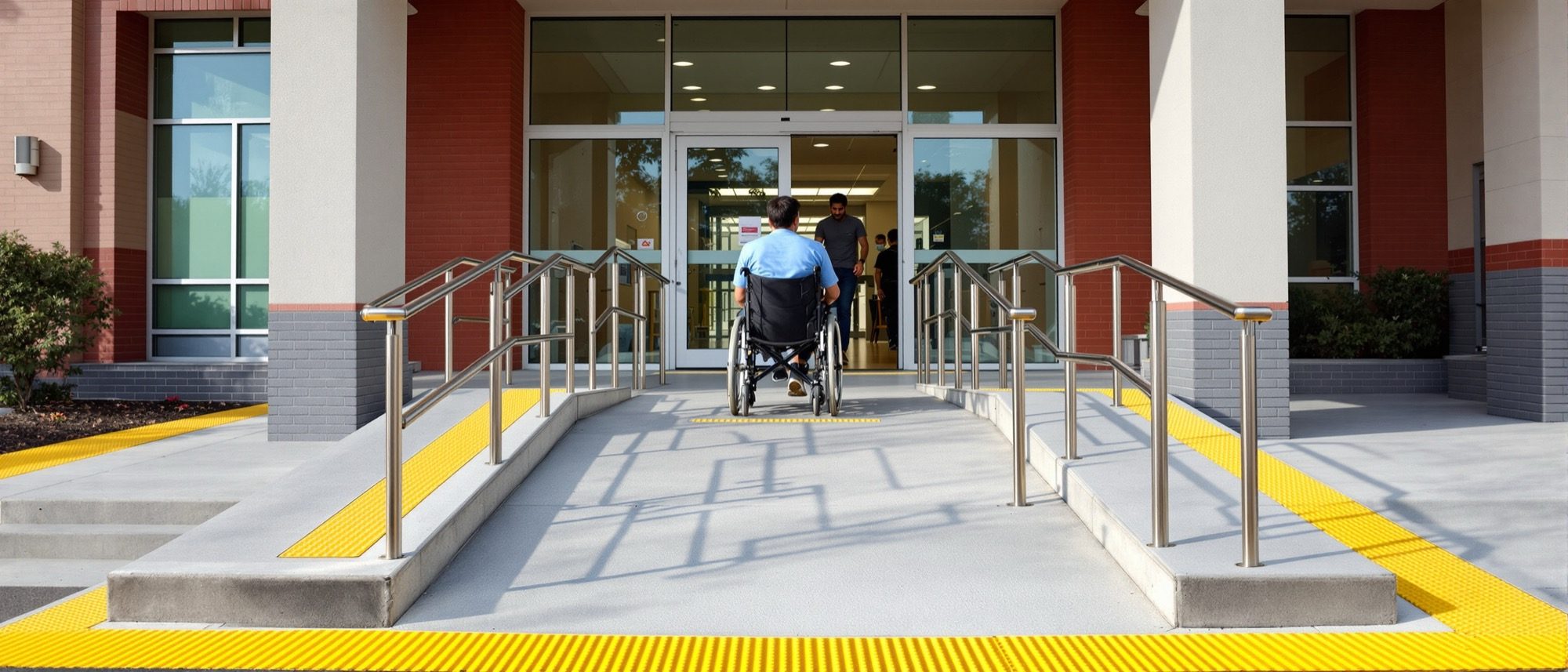
The syllabus
5 units · 5 liveTranscribed from the official B.Arch syllabus. All 5 units are live as full interactive lessons, each with original diagrams, a self-assessment quiz and a studio task.
Unit 1 — Mid-Scale Complexes & Programming
LiveThe small complex as a design problem; architectural programming (Peña's problem-seeking — goals, facts, concepts, needs, problem) and the stage-wise design process from programming through schematic design and development to documentation.
Unit 2 — Universal Design
LiveDesign and detailing for the movement of physically handicapped and elderly persons within and around buildings — barrier-free versus universal design, the seven principles, and the India-correct accessibility dimensions (ramps, doors, turning space, accessible toilets, parking, lifts, tactile paving) under the RPwD Act 2016 and the Harmonised Guidelines.
Unit 3 — Building Types
LiveProgramming and space standards for the studio's building types — the shopping centre (commercial), apartments (residential), the nursing home and the home for the aged (institutional) — and how a mixed-use complex stacks and separates its uses.
Unit 4 — Site, Massing & Services
LiveSite-planning fundamentals for mid-scale projects (site analysis, zoning, vehicular and pedestrian circulation, parking, landscape); massing and circulation analysis; core placement and the served-and-servant idea; and the integration of building services into the design.
Unit 5 — Presentation & Models
LiveCommunicating the design — three-dimensional building databases and rendered images, presentation techniques, and the making of scaled physical models in different materials for the studio jury.
Course outcomes
What you will be able to doUnderstand the functional aspect of designing a complex building type and its spatial organisation.
Reciprocate and sensitise the design to its environment, site and context.
Transform theoretical ideas — and an architectural programme — into the tangible output of a design.
Understand space organisation and the space-volume design approach in larger-scale, multi-use projects.
Research, analyse and deliver a barrier-free, mixed-use architectural design.
Communicate the design effectively through drawings, scaled models and presentation.
The author
Amogh N P
Architect, interior designer, and creative polymath. Studio Matrx began in his notebooks — his vision of design made honest, useful, and open to everyone. Its Academy is written and taught in his memory, and free, forever.
More about Amogh →A building for everyone.
The mid-scale, mixed-use studio — programming, universal design, building types, site planning and presentation. Read the five units, study the diagrams, then test yourself.
The curriculum is free, forever