
Building Types
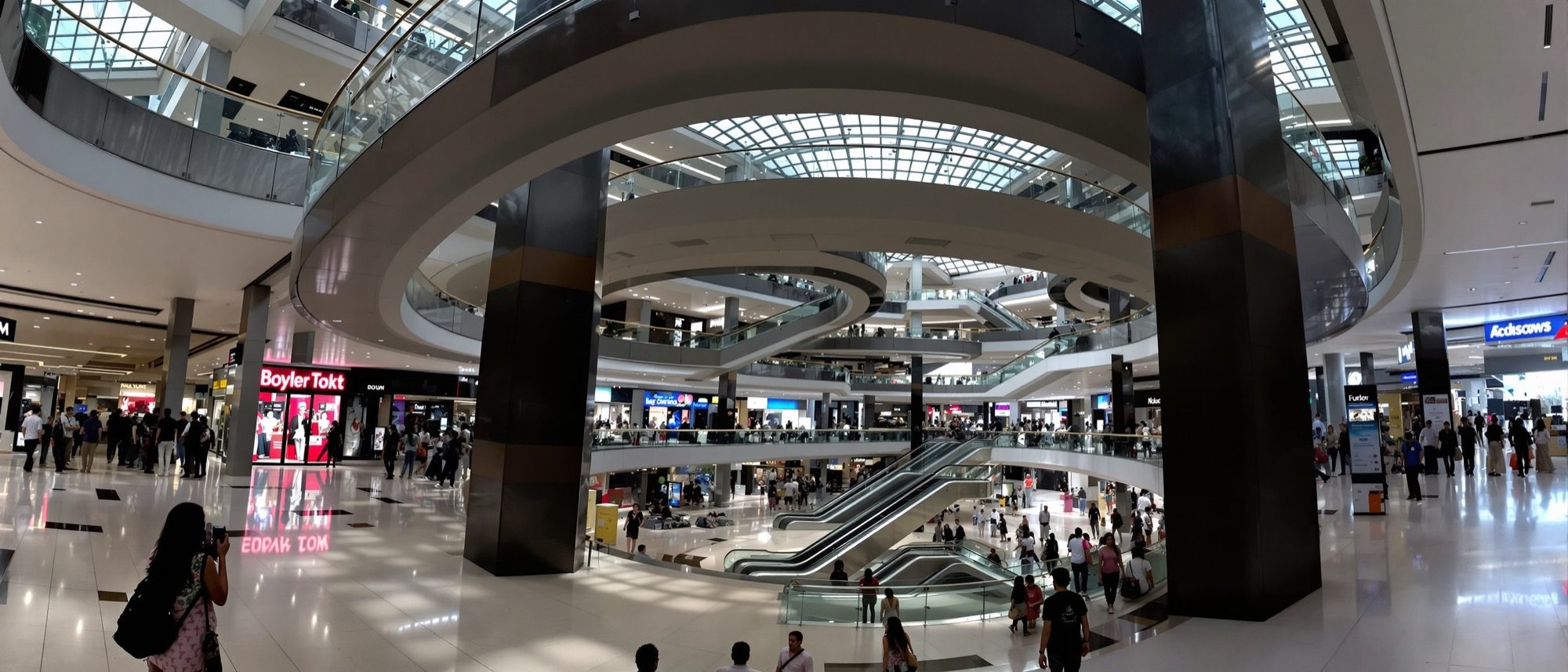
The shopping centre, the apartments, the nursing home and the home for the aged — and the mixed-use stack.
Each building type carries its own programme and standards. The shopping centre runs on anchors and inline shops; apartments cluster dwellings around cores; the nursing home zones clean from dirty; the home for the aged is built around the ageing body. And the mixed-use complex stacks them all — separating each use's cores, entries and parking.
Learning objectives
By the end of this lesson, you will be able to — mapped to the course outcomes for Architectural Design V:
Describe the programme and key spaces of the shopping centre, apartments, nursing home and home for the aged.
Apply the critical space standards and fire/parking norms for each type.
Explain how a mixed-use complex stacks and separates its uses.
Zone clean-from-dirty and public-from-service circulation for institutional types.
Commercial & residential
The mall runs on the magnet-and-generator logic of the dumb-bell plan, separating the public mall from a service corridor; apartments cluster dwellings around cores under NBC's room and high-rise fire rules.[6, 5]
Magnets and generators
A mall runs on the MAGNET-AND-GENERATOR principle — ANCHOR stores pull footfall, inline tenants between them capture impulse spend. The classic DUMB-BELL plan puts two anchors at the ends of a linear concourse so shoppers pass every shop. Inline units are ~12–18 m deep on a ~9 m grid; the concourse doubles as the fire spine. Strictly separate the public mall circuit from a back-of-house service corridor so loading and garbage never cross customer paths. Mercantile fire: ≥ 2 staircases above 15 m, refuge above 24 m, sprinklers.[6, 5]
Institutional & mixed-use
The nursing home zones clean from dirty and moves beds on a stretcher lift; the home for the aged is engineered around the ageing body; the mixed-use complex stacks uses by publicness with separate cores.[5, 4]
Clean from dirty
A nursing home / small hospital zones to control cross-infection and move beds. Allow ~80–85 m² per bed (total, with services); bed centres ≥ 2.5 m apart, 1.2 m clear at the foot; ward corridors ≥ 3 m; a nursing station per ~40–45 beds. The OT suite grades Protective → Clean → Sterile → Disposal. FLAG THE PRINCIPLE: plan clean and dirty flows as separate, non-crossing circuits. A stretcher/bed lift (1.1 × 2.4 m) is mandatory; non-ambulant patients evacuate horizontally to an adjacent fire compartment.[5, 7]
Mixed-use stack · tap a level
Semi-public
Hotel
Guest rooms in the upper tower; separate lobby, lifts and back-of-house from the residences.
Read the stack top to bottom: uses layer by publicness — public retail at the base, private residences on top — each with its own core, entry and parking.
At a glance
| Aspect | One | The other |
|---|---|---|
| Organising logic | Mall: magnets & generators (dumb-bell) | Apartments: dwellings clustered around cores |
| Key standard | Hospital: ~80–85 m²/bed, beds ≥ 2.5 m apart | Apartment: NBC room 9.5 m², ceiling 2.75 m |
| Critical zoning | Hospital: clean from dirty (non-crossing) | Mall: public circuit from service corridor |
| Elderly home | Engineered around the ageing body & slow egress | Small household clusters + secure garden (dementia) |
| Mixed-use | Stack by publicness (podium → tower) | Separate cores, entries & parking per use |
Key terms
A large magnet tenant that pulls footfall to a mall; inline shops sit between two anchors.
A mall plan with anchors at the ends of a linear concourse so shoppers pass every shop.
Floor Space Index — total floor area ÷ plot area; a local bye-law control on density.
A protected floor (above 24 m) where occupants wait safely in a fire — 0.3 m²/occupant.
The ward control point, one per ~40–45 beds, with sightlines to patients.
Separating sterile from contaminated flows in a hospital — the key institutional principle.
A mixed-use form — a public retail base (podium) with private towers set back above it.
A floor of deep beams reconciling the wide retail grid below with the tight residential grid above.
Studio task
For your chosen building type, draw a zoning diagram showing the public, semi-public, private and service zones — and, for a mixed-use scheme, a stacking section with a separate core marked for each use.
Self-assessment
1. The 'dumb-bell' plan of a shopping mall places —
2. The single most important zoning principle in a nursing home is to —
3. In a mixed-use complex, the uses are typically stacked so that —
Recap
References & further reading
- [4]Harmonised Guidelines and Space Standards for Universal Accessibility in India, 2021. CPWD / MoHUA.
- [5]National Building Code of India 2016 — Part 3 (general requirements) and Part 4 (fire & life safety). BIS.
- [6]Joseph De Chiara & Michael J. Crosbie, Time-Saver Standards for Building Types (4th ed.). McGraw-Hill.
- [7]Indian Public Health Standards (IPHS) — Guidelines for District Hospitals. NHM / MoHFW. https://nhm.gov.in/
Further reading
- De Chiara & Crosbie, Time-Saver Standards for Building Types. McGraw-Hill.
- Ernst & Peter Neufert, Architects' Data. Wiley-Blackwell.
- Stephen A. Kliment (ed.), Building Type Basics series. Wiley.
Sources gathered and fact-checked June 2026. Published values vary by source, sample and method — treat as indicative and confirm against the cited standard before structural use.
The author
Amogh N P
Architect, interior designer, and creative polymath. Studio Matrx began in his notebooks — his vision of design made honest, useful, and open to everyone. Its Academy is written and taught in his memory, and free, forever.
More about Amogh →