
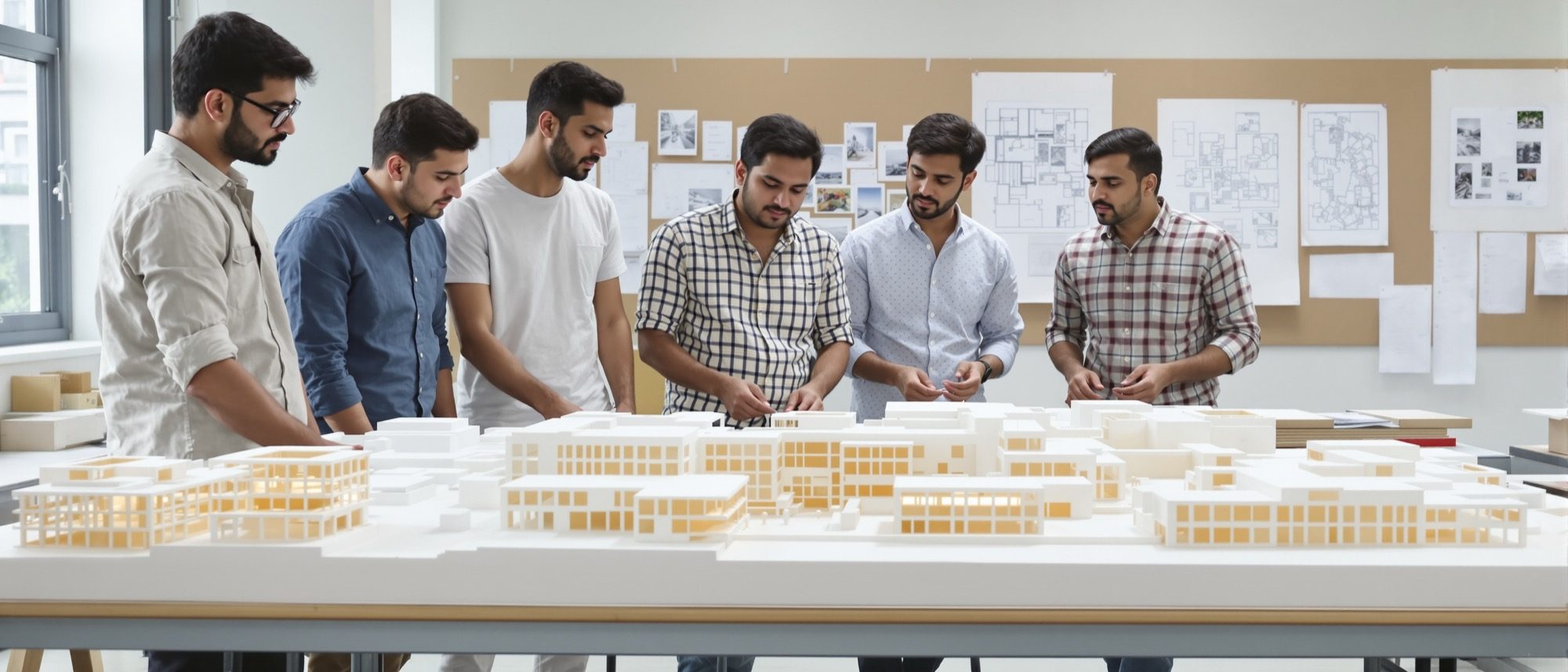
Mid-Scale Complexes & Programming
When the problem is no longer one room — and why you define it before you design.
Design V steps up in scale — from a single building (the work of Architectural Design IV) to a small complex of several uses. At this scale the most important work happens before any line is drawn: architectural programming, which Peña's Problem Seeking calls the act of defining the problem so design can solve it.
Learning objectives
By the end of this lesson, you will be able to — mapped to the course outcomes for Architectural Design V:
Explain why a mid-scale complex is a different design problem from a single building.
Describe architectural programming as problem definition (Peña's five steps and four considerations).
Outline the stage-wise design process — programming, schematic, development, documentation.
Turn a brief into a zoned, sized programme for a small complex.
Programming — define the problem
Programming is problem definition; design is problem solving — two distinct, sequential acts.[1] Five steps (goals, facts, concepts, needs, problem) are weighed across four considerations (function, form, economy, time).
Define before you solve
Peña's Problem Seeking makes one central distinction: PROGRAMMING is problem definition; DESIGN is problem solving — two distinct, sequential acts. 'Stating the problem is the last step of programming and the first step of design.' FLAG THE MYTH: do not design while programming. At mid scale, where a wrong brief wastes a whole complex, defining the problem fully first is what separates a resolved scheme from a confused one.[1]
The complex as a problem
A complex has several uses, so the design problem becomes their organisation — zoned by publicness, tested by adjacency, written into a brief before form is fixed.[3, 1]
Many uses, one organism
A single building has one occupancy and one circulation idea; a complex has several. The design problem becomes the ORGANISATION of parts — which uses go where, how they connect and separate, where the cores and services sit, and how the whole reads as one building on its site. Spatial organisation, not room design, is the skill the studio builds.[3]
At a glance
| Aspect | One | The other |
|---|---|---|
| The act | Programming: problem definition (analytic) | Design: problem solving (creative) |
| Scale of problem | Single building: one occupancy, one circulation idea | Complex: many uses — the problem is their organisation |
| First move | Zone the programme by publicness and noise | Test adjacencies before fixing form |
| Deliverable | Programming → the brief (goals, needs, problem) | Design → schematic → development → documentation |
| Peña's four | Function & form | Economy & time (incl. growth/change) |
Key terms
Architectural problem definition — the analytic front-end that precedes design (Peña).
The fifth and final step of programming — the distilled essential conditions that the design must answer.
Function, form, economy and time — weighed across every step of programming.
The written statement of goals, facts, quantified needs and the problem — programming's deliverable.
The first design stage — concept, massing and zoning options generated from the programme.
The arrangement and connection of a complex's many parts — the core skill at mid scale.
A bubble diagram testing which spaces must be near or far before plan form is fixed.
A complex combining several occupancies (retail, office, residential, hotel) in one project.
Studio task
For your studio project, write a one-page programme: the goals, the key facts (site, budget, codes), a list of spaces with areas, and a single problem statement. Then zone the spaces by publicness in a quick section.
Self-assessment
1. In Peña's Problem Seeking, programming is —
2. Which is NOT one of Peña's four considerations?
3. The first organising move for a mixed-use complex is to —
Recap
References & further reading
- [1]William M. Peña & Steven A. Parshall, Problem Seeking: An Architectural Programming Primer (5th ed.). Hoboken: Wiley, 2012.
- [2]Edith Cherry, Programming for Design: From Theory to Practice. Wiley, 1999.
- [3]Francis D.K. Ching, Architecture: Form, Space, and Order (4th ed.). Wiley, 2015.
Further reading
- Peña & Parshall, Problem Seeking. Wiley.
- Edith Cherry, Programming for Design. Wiley.
- Ching, Architecture: Form, Space, and Order. Wiley.
Sources gathered and fact-checked June 2026. Published values vary by source, sample and method — treat as indicative and confirm against the cited standard before structural use.
The author
Amogh N P
Architect, interior designer, and creative polymath. Studio Matrx began in his notebooks — his vision of design made honest, useful, and open to everyone. Its Academy is written and taught in his memory, and free, forever.
More about Amogh →