
Universal Design
Designing for everyone — the movement of the physically handicapped and the elderly.
The heart of this studio is a building that works for everyone. Learn the difference between barrier-free (removing obstacles, often a special add-on) and universal design (designing from the outset for all), the seven principles, and the law — the RPwD Act 2016, which makes the Harmonised Guidelines mandatory — then the India dimensions that matter.
Learning objectives
By the end of this lesson, you will be able to — mapped to the course outcomes for Architectural Design V:
Distinguish barrier-free design from universal design and state the seven principles.
Apply the India-correct accessibility dimensions — ramps, doors, turning space, toilets, parking, lifts.
Explain the legal basis — the RPwD Act 2016 and the Harmonised Guidelines.
Detail the specific provisions for the elderly within and around a building.
Barrier-free, universal & the law
Universal design works for all from the outset; the seven principles (Mace) frame it; and the RPwD Act 2016 makes the Harmonised Guidelines mandatory for plan approval.[4, 6, 3]
Add-on or designed-in
FLAG THE DISTINCTION: 'BARRIER-FREE' means removing obstacles — often a special, retrofitted add-on for disabled users. UNIVERSAL DESIGN is broader — designing from the outset so one environment works for ALL people, of all ages and abilities, without segregation or special adaptation. Universal design subsumes barrier-free; India's 2021 guidelines deliberately shifted the title to 'Universal Accessibility' to signal this move.[4, 6]
The India dimensions
A few numbers recur through every accessible plan — the 1:12 ramp, the 900 mm door, the 1500 mm turning circle, the 2200 × 2300 mm accessible toilet, accessible parking, lifts and tactile paving.[4]
1:12 max, 1:20 preferred
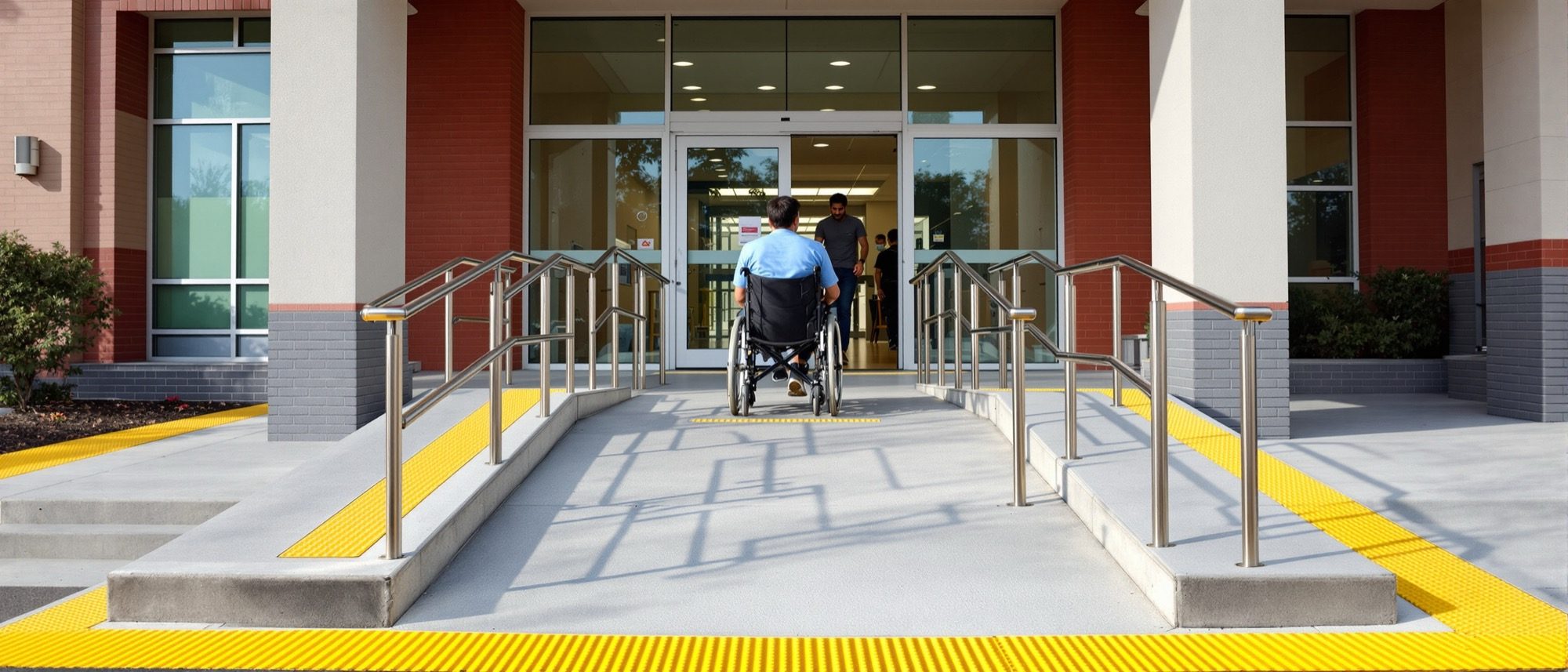
A ramp's MAXIMUM gradient is 1:12; 1:20 is PREFERRED where space allows (FLAG: 1:12 is the steepest permitted, not the target). Maximum run before a landing is 9 m; clear width ≥ 1200 mm; landings 1500 × 1500 mm; a kerb ramp is 1:10. HANDRAILS on both sides, continuous, at TWO heights — an upper rail ~850–950 mm and a lower rail ~650–750 mm — extending ≥ 300 mm beyond each end.[4]
At a glance
| Aspect | One | The other |
|---|---|---|
| Approach | Barrier-free: remove obstacles (often a retrofit) | Universal design: design for all from the outset |
| Ramp gradient | 1:12 — the maximum permitted | 1:20 — the preferred, gentler slope |
| Accessible toilet | Type A 2200 × 2300 mm (preferred) | Type B 1700 × 2200 mm (compact) |
| Lift size | 1100 × 1400 mm — minimum (admits a wheelchair) | 1500 × 1500 mm — preferred (allows turning) |
| Tactile paving | Warning (dots) at hazards | Directional (bars) along the path |
Key terms
Designing from the outset for all ages and abilities — broader than barrier-free, no special adaptation.
Removing obstacles, often a retrofit add-on for disabled users — subsumed by universal design.
The Rights of Persons with Disabilities Act — the law (replaced the 1995 Act) making the Harmonised Guidelines mandatory.
India's space standards for universal accessibility (CPWD/MoHUA) — the source of the dimensions.
1:12 is the maximum gradient; 1:20 is the preferred, gentler slope.
Type A 2200 × 2300 mm (preferred), Type B 1700 × 2200 mm (compact) — not the smaller foreign figure.
1500 × 1500 mm — the space a wheelchair needs to turn.
Ground indicators — warning (dots) at hazards, directional (bars) along paths.
Studio task
Trace the accessible route through your project — from the accessible parking bay, along a level tactile-guided path, up a 1:12 ramp, through a 900 mm door, to an accessible toilet — and dimension each element to the Harmonised Guidelines.
Self-assessment
1. The India-correct minimum gradient relationship for a ramp is —
2. Under the Harmonised Guidelines, the preferred accessible toilet (Type A) is —
3. Universal design differs from barrier-free design because it —
Recap
References & further reading
- [3]The Rights of Persons with Disabilities Act, 2016 (India) — in force 15 June 2017. https://www.indiacode.nic.in/bitstream/123456789/15939/1/the_rights_of_persons_with_disabilities_act,_2016.pdf
- [4]Harmonised Guidelines and Space Standards for Universal Accessibility in India, 2021. CPWD / MoHUA. https://niua.org/harmonised-guide/chapter-1
- [5]National Building Code of India 2016, Part 3 — General Building Requirements (accessibility). BIS.
- [6]The 7 Principles of Universal Design — NC State Center for Universal Design (Ronald Mace et al., 1997); Universal Design India Principles (NID, 2011). https://projects.ncsu.edu/ncsu/design/cud/about_ud/udprinciplestext.htm
Further reading
- Harmonised Guidelines and Space Standards for Universal Accessibility in India, 2021. CPWD/MoHUA.
- Selwyn Goldsmith, Designing for the Disabled: The New Paradigm. Architectural Press.
- Neufert, Architects' Data — accessibility and the elderly.
Sources gathered and fact-checked June 2026. Published values vary by source, sample and method — treat as indicative and confirm against the cited standard before structural use.
The author
Amogh N P
Architect, interior designer, and creative polymath. Studio Matrx began in his notebooks — his vision of design made honest, useful, and open to everyone. Its Academy is written and taught in his memory, and free, forever.
More about Amogh →