

Lancelot "Capability" Brown
The master of the English landscape garden, who made art look like nature.
Portrait: public domain, via Wikimedia Commons
Movements
Signature works
- Blenheim Palace
- Stowe
- Petworth
- Croome Court
- Bowood
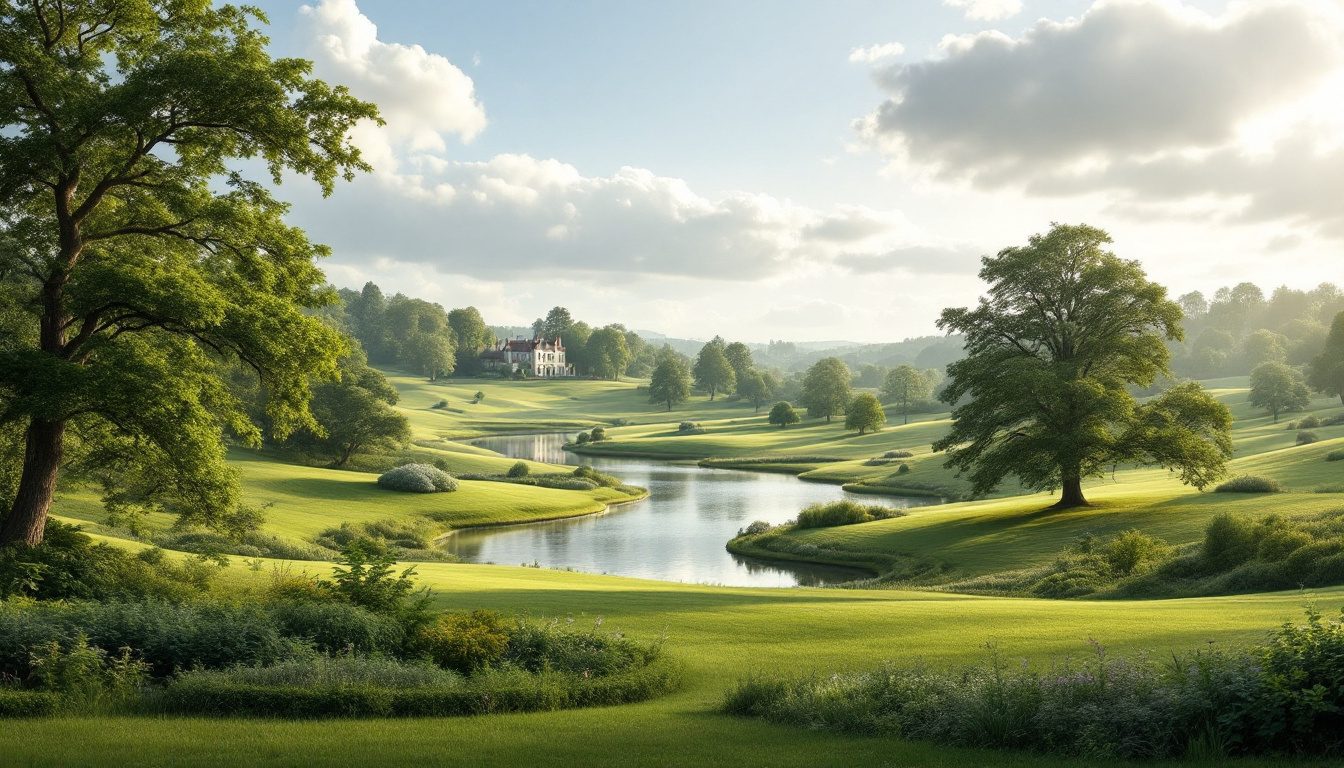
Stand on the gravel terrace at Blenheim Palace and look out, and what you see seems so effortlessly, eternally English that it is hard to believe it was made. A great silver lake curves away below, its two arms reconciled under a bridge that suddenly looks the right size at last. Cattle graze on grass that rolls in unbroken green right up to the foot of the palace. Clumps of oak and beech stand in lazy groupings on the slopes; a dark belt of woodland frames the whole composition and hides the world beyond. There is not a straight line, not a clipped hedge, not a flowerbed in sight. It looks like nature in a particularly good mood.
It is, in fact, one of the most deliberate works of art in Europe. Every contour was reshaped, every tree positioned, the lake itself dug and flooded across a dammed valley. The man responsible was Lancelot Brown, born in a Northumberland village in 1716 and known to all of England, then and since, as "Capability" Brown — because he had a habit of telling landowners that their estate had great "capabilities" for improvement. Over a working life of some four decades he reshaped more than 250 estates and, in doing so, rewrote what a garden was supposed to be.
Brown's revolutionary idea was that the most beautiful garden of all should not look like a garden — it should look like an idealised, peaceful English countryside, with the formal geometry of the past swept away in favour of serpentine water, grouped trees and rolling lawn flowing right up to the walls of the house. He did not decorate the land; he composed it, the way a painter composes a canvas, and in the process he invented the English landscape garden and exported a way of seeing nature to the whole world.
The idea: nature, improved
To understand what Brown did, you have to picture what he undid. The grand European garden of the seventeenth century — the world of Versailles and its many English imitators — was geometry imposed on the land. Avenues ran dead straight to the horizon, parterres laid out box hedges in symmetrical embroidery, water was forced into rectangular canals, topiary clipped trees into cones and balls. The whole point was to show that the man who owned the estate had mastered raw nature into rational, visible control.
Brown found this artificial, and increasingly so did the taste of his age. Drawing on a new sensibility — the love of "natural" scenery promoted by poets and by the idealised Italian landscape paintings of Claude Lorrain and Nicolas Poussin — Brown reached for the opposite of geometry. He wanted the estate to look like a perfected version of the English landscape itself: gentle, pastoral, apparently untouched.
To achieve that "natural" look took enormous artifice. His method had a recognisable grammar, repeated and refined across hundreds of commissions. Straight canals were enlarged and bent into broad, serpentine lakes whose far ends curved out of sight, so you could never tell where the water stopped and imagined more of it was concealed. Avenues were felled and replaced with clumps — informal groups of trees scattered across the slopes to lead the eye and model the ground. The estate was wrapped in a belt of perimeter woodland that screened the boundary and the working world beyond, turning the whole property into a single, framed, private scene. And the lawn was brought right up to the house, sweeping grass replacing the old terraces and parterres so that the building seemed to sit directly in its idealised countryside.

One device made all of this possible, and it is Brown's most quietly brilliant invention to inherit and perfect: the ha-ha. If you bring the grazing lawn right up to the house, how do you stop the cattle and deer from walking in the front door? A wall or fence would break the seamless view of countryside. The answer is a hidden ditch — a sunken trench with a retaining wall on the inner face — set where it cannot be seen from the house. Livestock cannot cross it, but the eye passes straight over, so the lawn appears to merge unbroken with the grazed parkland beyond. The boundary is invisible; the view is endless. Its odd name supposedly comes from the surprised "ha-ha!" of a walker who comes upon the unexpected drop. With it, Brown could erase the visible edge of the garden altogether and let the whole horizon become part of the composition.

Life and path
Lancelot Brown was born in 1716 in the hamlet of Kirkharle, Northumberland, the son of a land agent and a chambermaid — emphatically not the gentry whose estates he would transform. He left the local school at about sixteen and went to work as a gardener's apprentice on the nearby Kirkharle estate, learning the practical crafts of his trade: drainage, earth-moving, planting, the reading of ground and water.
In his mid-twenties he moved south, and in 1741 took a post at Stowe in Buckinghamshire, the most celebrated garden in England, then under the architect William Kent — often called the father of the English landscape garden, the first to "leap the fence and see that all nature was a garden," in Horace Walpole's phrase. Working as head gardener and clerk of works, executing Kent's designs and increasingly making his own, Brown served the perfect apprenticeship: handling great quantities of earth and water, managing gangs of labourers, and thinking at the scale of a whole landscape rather than a single bed.
By 1751 he had set up as an independent "place-maker," and demand was extraordinary. Brown combined the eye of an artist with the head of a contractor: he would ride over an estate, pronounce on its "capabilities," and take on the entire transformation — surveying, damming valleys, moving hills, planting tens of thousands of trees — often on a fixed price with his own teams. Shrewd, genial and trusted, he was passed from one great house to the next. In 1764 he was appointed Master Gardener at Hampton Court, the royal seal on his career. He worked relentlessly, criss-crossing the country on horseback, until his death in London in 1783.

The signature works
Brown's output was vast — by his own count he improved over 170 estates, and modern scholarship attributes more than 250 to him. A handful carry the argument and can still be walked today.
| Work | Place & dates | Why it matters |
|---|---|---|
| Stowe | Buckinghamshire, from 1741 | His training ground under William Kent; where the English landscape garden and Brown himself came of age. |
| Croome Court | Worcestershire, from 1751 | His first great independent commission — he drained a marsh, made the lake and river, and even designed the house and church; the complete "place-maker." |
| Blenheim Palace | Oxfordshire, 1760s | His masterpiece: he dammed the River Glyme to create the great lake that finally made sense of Vanbrugh's vast bridge. |
| Petworth | West Sussex, 1750s–60s | A sublime rolling deer park of lawn, water and clumped trees, later immortalised in the paintings of J. M. W. Turner. |
| Bowood | Wiltshire, 1760s | A celebrated serpentine lake and rolling pleasure grounds, a textbook of the Brownian devices. |
| Chatsworth | Derbyshire, 1760s | He naturalised the older formal grounds, sweeping away parterres to bring lawn and a reshaped river to the house. |
Blenheim is the work that silences doubters. The palace, a gift from the nation to the Duke of Marlborough, had been given an enormous, almost absurdly grand bridge by the architect Vanbrugh — stranded over a feeble little stream that made it look ridiculous. Brown dammed the River Glyme and flooded the valley to create a great two-armed lake, deliberately drowning the lower arches of the bridge so that it now rises from the water at exactly the right scale. It was an act of landscape engineering and aesthetic judgement so complete that Brown is said to have remarked the Thames would never forgive him for it. The result is, by common consent, one of the most beautiful made landscapes on earth.
Croome shows the full range of his role. Arriving at a damp Worcestershire estate, Brown drained the waterlogged ground, dug a serpentine artificial river and lake, modelled the parkland, and went so far as to design the remodelled house and a new church on the hill — proof that the "place-maker" was not merely a gardener but the author of an entire designed world.
Petworth and Bowood distil the Brownian formula at its serene best: immense sweeps of grazed lawn, sheets of curving water, trees deployed in clumps and belts, the boundary dissolved by the ha-ha. That Turner returned again and again to paint Petworth's park is the clearest evidence that Brown had achieved exactly what he set out to — a real landscape that looked like an idealised painting.
The philosophy
Brown rarely wrote anything down; his philosophy has to be read from the ground itself. But its principles are remarkably clear, and they reach far beyond eighteenth-century England.
The first is that a designed landscape should conceal its own design. Where the formal garden flaunted human control, Brown hid it. The labour of moving a hill or damming a river was meant to vanish into a result that looked God-given. This is the deep source of why his parks feel so calming: nothing in them announces effort or assertion. That same quiet — the sense of a scene composed to soothe rather than impress — is exactly what Studio Matrx explores in why some gardens feel peaceful. Brown understood, two centuries before the psychologists, that we relax in landscapes that read as gentle, open, savannah-like and safely enclosed.
The second is composition by framing and concealment. The belt of woodland, the lake curving out of sight, the ha-ha that hides the boundary — all control what the eye sees and, crucially, what it does not. Brown also made constant use of the borrowed view, opening sight lines to a distant church spire or hill so that scenery he did not own joined his composition. This picturesque way of editing a view — what to reveal, what to screen, where the eye should travel — is a transferable lesson for any garden, however small.
The third is working with the given land and water rather than against it, shaping contours and drainage to a unified, restful whole. That instinct connects directly to climate-responsive landscape design and to the character-led use of trees that runs through Studio Matrx's guide to the best trees for Indian homes. For Brown, trees were not ornament but the structure of the whole scene: they modelled the ground, led the eye and gave the park its bones.
Brown is said to have told clients that their land had "great capabilities" — the conviction that almost any ground could be composed into beauty was the engine of his whole career.
The debate: beauty or erasure?
Brown was never without critics, and the argument they began is worth carrying into any garden today. To his admirers he was a genius who gave England a landscape of sublime, serene beauty and freed gardens from rigid, foreign geometry. To his detractors — most loudly the proponents of the wilder, rougher Picturesque, such as Uvedale Price and Richard Payne Knight — Brown's parks were too smooth, too tame, too repetitive: a single bland formula of lawn-clump-belt-lake stamped on every estate regardless of its character.
There was a harder charge, too. To make his seamless pastoral views, Brown sometimes swept away centuries of history — old formal gardens, avenues, even entire villages were demolished or moved to clear the composition. Did he reveal the true beauty of a place, or did he erase its past to impose a fashionable ideal? It is a question every designer who reshapes land must face, and it has no comfortable answer. What is undeniable is that he saw the whole estate as one composition, and pursued that vision with a completeness no one had attempted before.
India: the garden the Empire carried
Brown himself never came near India, and his work belongs to the cool, damp English countryside. Yet his idea travelled, because the British did not only bring laws and railways to India — they brought their taste in landscape. The naturalistic English park, with its rolling lawn, scattered trees and curving water, became the template for the colonial estate, the cantonment and above all the hill station.
Walk through Lutyens' Delhi, the lawns of a Bangalore cantonment, or the public gardens of a hill station like Shimla, Ooty or Darjeeling, and you are walking through Brown's descendants: open sweeps of mown grass, trees in informal groups, a studied pastoral "naturalness" set against the formal Mughal char-bagh the British found here. The contrast is instructive — the Mughal garden was geometric, walled, water-channelled and paradisal, everything Brown rejected; the English landscape garden was open, soft and apparently boundless. India inherited both traditions, and they still sit side by side in our cities.
For an Indian gardener today the lesson is not to copy Brown — his thirsty English lawns are often exactly wrong for a hot, water-scarce climate. The lesson is in his thinking. The serene feeling of a Brownian park comes from composition, framing and concealment, not from the particular plants. You can borrow the principles — flowing rather than rigid lines, trees grouped to lead the eye, a boundary screened rather than fenced, a distant view "borrowed" into your plot — while choosing native, drought-tolerant species suited to the subcontinent. The question Brown really poses to an Indian home is the deepest one in this whole field: should this garden be formal and ordered, or naturalistic and flowing — and which will actually bring you peace?
Legacy and what we can learn
Capability Brown changed the look of an entire country and, through it, much of the world. The "natural" English park that millions take for the timeless face of the countryside is largely his invention, and the public park, the campus, the garden suburb and the golf course all descend in part from his serene, grassy vision. Humphry Repton took up his mantle and refined the style, and across the Atlantic it fed directly into the great democratic parks of Frederick Law Olmsted, whose Central Park is a Brownian pastoral opened to the whole city rather than reserved for a duke.
For the home gardener, Brown's first practical lesson is about feeling: a landscape calms us when it is composed, when the eye is gently led and the harsh edges hidden, far more than when it is merely planted. His second lesson is one of restraint — that grass, water, ground-shape and trees, used with judgement, can do more than any quantity of flowers and ornament. And his third, the one most alive in India today, is the choice he forces between the formal and the natural, a choice that the modern Indian landscape tradition — in the hands of designers like Prabhakar Bhagwat — has answered in its own climate-rooted way.
These are the principles we encode in DesignAI — composing a landscape so that its lines, its planting and its framed views work together to create a place that genuinely feels peaceful, whatever its size.
References
- Jane Brown, The Omnipotent Magician: Lancelot "Capability" Brown, 1716–1783 (Chatto & Windus).
- Dorothy Stroud, Capability Brown (Faber & Faber) — the foundational modern study.
- John Phibbs, Capability Brown: Designing the English Landscape and Place-Making: The Art of Capability Brown.
- Tom Williamson, Polite Landscapes: Gardens and Society in Eighteenth-Century England.
- Horace Walpole, The History of the Modern Taste in Gardening.
- National Trust and Blenheim Palace estate histories of Brown's surviving landscapes.
Explore the ideas Brown championed — why some gardens feel peaceful, climate-responsive landscape design and the best trees for Indian homes — alongside fellow landscape masters Frederick Law Olmsted and Prabhakar Bhagwat.
Philosophies they championed